people
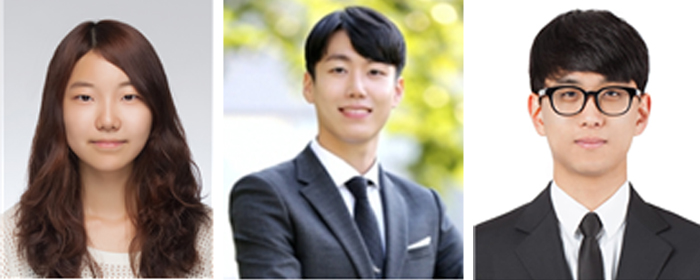
< Soo Ye Kim, Sanghyun Woo and Hae Beom Lee (from left) >
PhD candidates Soo Ye Kim and Sanghyun Woo from the KAIST School of Electrical Engineering and Hae Beom Lee from the Kim Jaechul Graduate School of AI were selected as the 2021 Google PhD Fellows. The Google PhD Fellowship is a scholarship program that supports graduate school students from around the world that have produced excellent achievements from promising computer science-related fields. The 75 selected fellows will receive ten thousand dollars of funding with the opportunity to discuss research and receive one-on-one feedback from experts in related fields at Google.
Kim and Woo were named fellows in the field of "Machine Perception, Speech Technology and Computer Vision" with research of deep learning based super-resolution and computer vision respectively. Lee was named a fellow in the field of "Machine Learning" for his research in meta-learning.
Kim's research includes the formulation of novel methods for super-resolution and HDR video restoration and deep joint frame interpolation and super-resolution methods. Many of her works have been presented in leading conferences in computer vision and AI such as CVPR, ICCV, and AAAI. In addition, she has been collaborating as a research intern with the Vision Group Team at Adobe Research to study depth map refinement techniques.
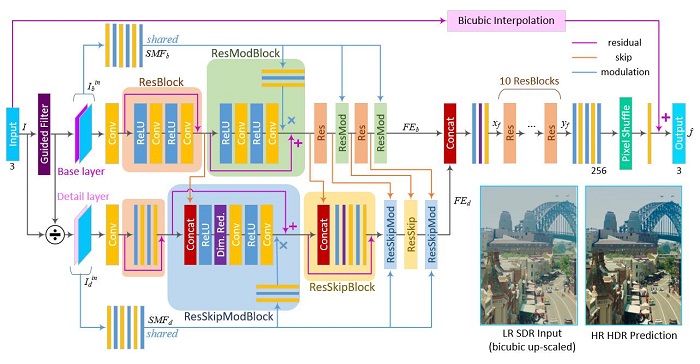
(Kim's research on deep learning based joint super-resolution and inverse tone-mapping framework for HDR videos)
Woo’s research includes an effective deep learning model design based on the attention mechanism and learning methods based on self-learning and simulators. His works have been also presented in leading conferences such as CVPR, ECCV, and NeurIPS. In particular, his work on the Convolutional Block Attention Module (CBAM) which was presented at ECCV in 2018 has surpassed over 2700 citations on Google Scholar after being referenced in many computer vision applications. He was also a recipient of Microsoft Research PhD Fellowship in 2020.
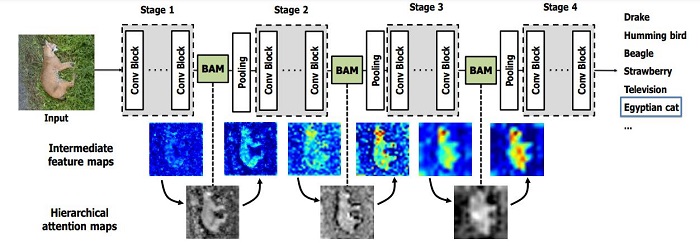
(Woo's research on attention mechanism based deep learning models)
Lee’s research focuses effectively overcoming various limitations of the existing meta-learning framework. Specifically, he proposed to deal with a realistic task distribution with imbalances, improved the practicality of meta-knowledge, and made meta-learning possible even in large-scale task scenarios. These various studies have been accepted to numerous top-tier machine learning conferences such as NeurIPS, ICML, and ICLR. In particular, one of his papers has been selected as an oral presentation at ICLR 2020 and another as a spotlight presentation at NeurIPS 2020.
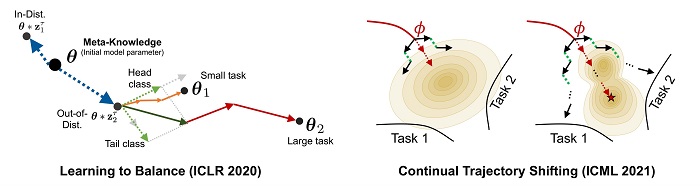
(Lee's research on learning to balance and continual trajectory shifting)
Due to the COVID-19 pandemic, the award ceremony was held virtually at the Google PhD Fellowship Summit from August 31st to September 1st. The list of fellowship recipients is displayed on the Google webpage.
-
people Professor Juho Kim’s Team Wins Best Paper Award at ACM CHI 2022
The research team led by Professor Juho Kim from the KAIST School of Computing won a Best Paper Award and an Honorable Mention Award at the Association for Computing Machinery Conference on Human Factors in Computing Systems (ACM CHI) held between April 30 and May 6. ACM CHI is the world’s most recognized conference in the field of human computer interactions (HCI), and is ranked number one out of all HCI-related journals and conferences based on Google Scholar’s h-5 index. Best pap
2022-06-13 -
people Prof. Sang Wan Lee Selected for 2021 IBM Academic Award
Professor Sang Wan Lee from the Department of Bio and Brain Engineering was selected as the recipient of the 2021 IBM Global University Program Academic Award. The award recognizes individual faculty members whose emerging science and technology contains significant interest for universities and IBM. Professor Lee, whose research focuses on artificial intelligence and computational neuroscience, won the award for his research proposal titled A Neuroscience-Inspired Approach for Metacognitive
2021-06-25 -
policy KAIST and Google Partner to Develop AI Curriculum
Two KAIST professors, Hyun Wook Ka from the School of Transdisciplinary Studies and Young Jae Jang from the Department of Industrial and Systems Engineering, were recipients of Google Education Grants that will support the development of new AI courses integrating the latest industrial technology. This collaboration is part of the KAIST-Google Partnership, which was established in July 2019 with the goal of nurturing AI talent at KAIST. The two proposals -- Professor Ka’s ‘Cloud A
2020-12-11 -
people Taesik Gong Named Google PhD Fellow
PhD candidate Taesik Gong from the School of Computing was named a 2020 Google PhD Fellow in the field of machine learning. The Google PhD Fellowship Program has recognized and supported outstanding graduate students in computer science and related fields since 2009. Gong is one of two Korean students chosen as the recipients of Google Fellowships this year. A total of 53 students across the world in 12 fields were awarded this fellowship. Gong’s research on condition-independent mobil
2020-10-15 -
policy KAIST and Google Jointly Develop AI Curricula
KAIST selected the two professors who will develop AI curriculum under the auspices of the KAIST-Google Partnership for AI Education and Research. The Graduate School of AI announced the two authors among the 20 applicants who will develop the curriculum next year. They will be provided 7,500 USD per subject. Professor Changho Suh from the School of Electrical Engineering and Professor Yong-Jin Yoon from the Department of Mechanical Engineering will use Google technology such as TensorFlo
2019-12-04