event
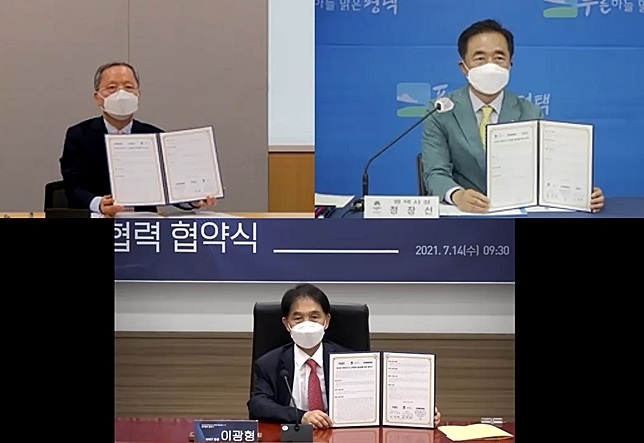
< Samsung Electronics President Park, Pyeongtaek City Mayor Jung, and KAIST President Lee (clockwise) >
KAIST President Kwang Hyung Lee agreed to establish the ‘Department of Samsung Semiconductors’ in collaboration with Samsung Electronics Co Ltd and the City of Pyeongtaek in Kyonggi-do. The three parties, including Pyeongtaek City Mayor Jang-Seon Jung and President of Samsung Electronics Hark-Kyu Park, signed the MOU on July 13 during an online ceremony.
President Lee said that the collaboration will help spur Korea’ semiconductor industry forward. “We will spare no effort to foster seasoned semiconductor personnel who will carve out our competitive edge in the global market,” he explained.
While Samsung will sponsor the Department of Semiconductors on the Daejeon campus, Pyeongtaek City will provide 460,000 m2 of land for establishing the KAIST Semiconductor R&D Center. Samsung Electronics has run two massive semiconductor complexes in the city. The triangle of collaboration is expected to bring about synergy by generating field-based education and R&D.
KAIST also announced plans to work closely with the local government of Pyeongtaek City to create startup towns and quality jobs in the region by providing software education and technology as well as cultural spaces for local citizens.
Vice Minister of the Ministry of Science and ICT Hong-Taek Yong and National Assemblymen Jaeill Byun and Eui-dong Yu, who represent the ruling and opposition parties on the Semiconductor Special Committee, joined the online ceremony and praised the collaboration.
-
research KAIST Turns an Unprecedented Idea into Reality: Quantum Computing with Magnets
What started as an idea under KAIST’s Global Singularity Research Project—"Can we build a quantum computer using magnets?"—has now become a scientific reality. A KAIST-led international research team has successfully demonstrated a core quantum computing technology using magnetic materials (ferromagnets) for the first time in the world. KAIST (represented by President Kwang-Hyung Lee) announced on the 6th of May that a team led by Professor Kab-Jin Kim from the Department of P
2025-06-12 -
event KAIST to Develop a Korean-style ChatGPT Platform Specifically Geared Toward Medical Diagnosis and Drug Discovery
On May 23rd, KAIST (President Kwang-Hyung Lee) announced that its Digital Bio-Health AI Research Center (Director: Professor JongChul Ye of KAIST Kim Jaechul Graduate School of AI) has been selected for the Ministry of Science and ICT's 'AI Top-Tier Young Researcher Support Program (AI Star Fellowship Project).' With a total investment of ₩11.5 billion from May 2025 to December 2030, the center will embark on the full-scale development of AI technology and a platform capable of independently inf
2025-05-26 -
research KAIST Develops Neuromorphic Semiconductor Chip that Learns and Corrects Itself
< Photo. The research team of the School of Electrical Engineering posed by the newly deveoped processor. (From center to the right) Professor Young-Gyu Yoon, Integrated Master's and Doctoral Program Students Seungjae Han and Hakcheon Jeong and Professor Shinhyun Choi > - Professor Shinhyun Choi and Professor Young-Gyu Yoon’s Joint Research Team from the School of Electrical Engineering developed a computing chip that can learn, correct errors, and process AI tasks - Equipping
2025-01-17 -
research The World’s First Hacking-preventing Cryptographic Semiconductor Chip
With the dramatic increase in the amount of information exchanged between components or devices in the 5G/6G era, such as for the Internet of Things (IoT) and autonomous driving, hacking attacks are becoming more sophisticated. Consequently, enhancing security functions is essential for safely transmitting data between and among devices. On February 29th, a KAIST research team led by Professors Yang-gyu Choi and Seung-tak Ryu from the School of Electrical Engineering announced the successful
2024-03-07 -
research A KAIST research team develops a high-performance modular SSD system semiconductor
In recent years, there has been a rise in demand for large amounts of data to train AI models and, thus, data size has become increasingly important over time. Accordingly, solid state drives (SSDs, storage devices that use a semiconductor memory unit), which are core storage devices for data centers and cloud services, have also seen an increase in demand. However, the internal components of higher performing SSDs have become more tightly coupled, and this tightly-coupled structure limits SSD f
2023-06-23