event
- Presidents of KAIST, MIT, Tokyo Tech, and Northwestern to define new roles and responsibilities of universities for the post-COVID and 4IR eras during an online summit in celebration of KAIST’s 50th anniversary. -
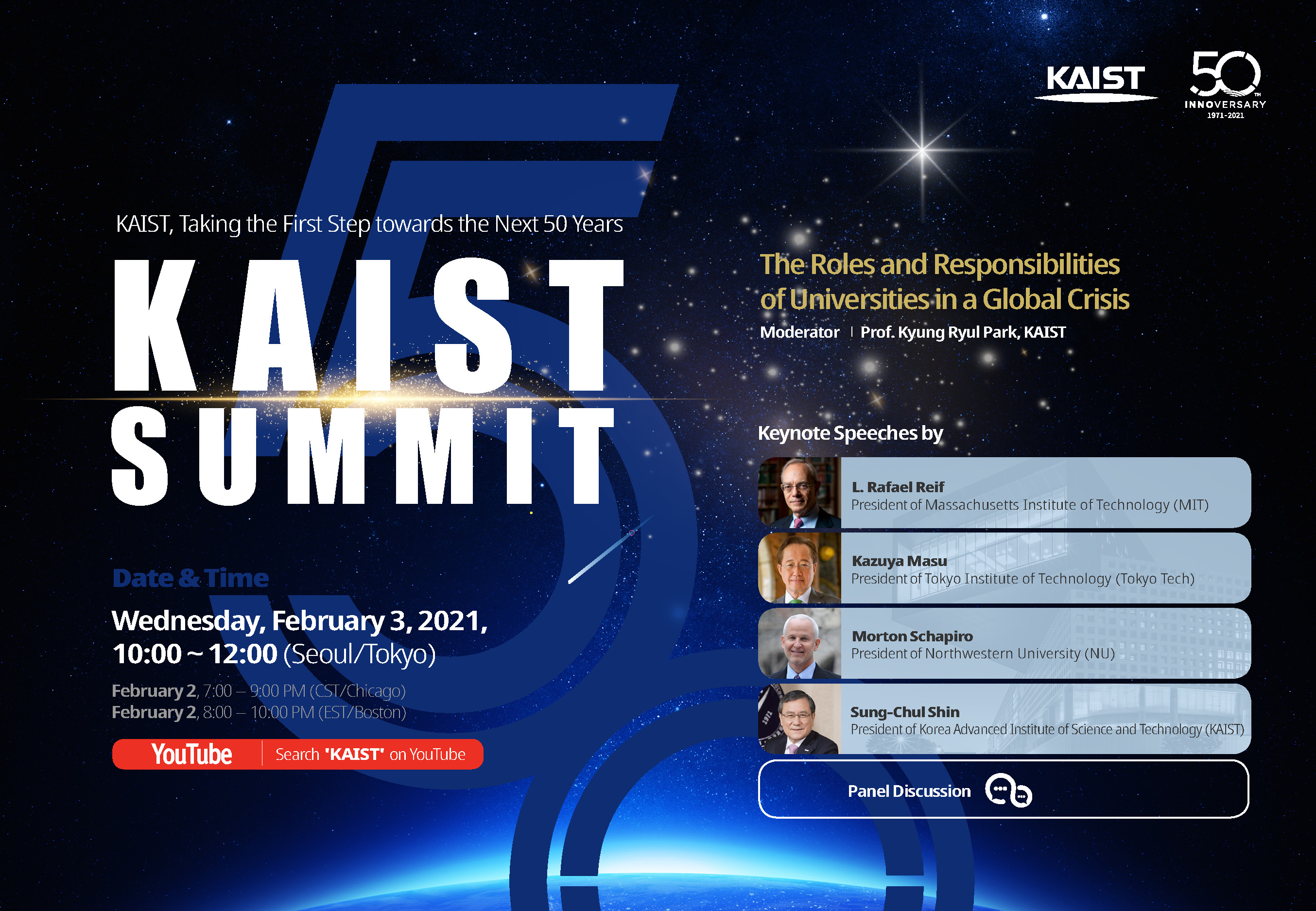
Universities are facing ever-mounting pressure to address impacts brought on by COVID-19 and the emerging technologies of the Fourth Industrial Revolution (4IR).
Presidents from MIT, Tokyo Tech, and Northwestern University will join the KAIST Summit to explore new directions for higher education during the post-COVID era intertwined with the 4IR. They agree that addressing these dual challenges requires pushing for innovations to rebuild the competitive edges of universities.
This summit is one of KAIST’s series of events to envision the future of KAIST and higher education in celebration of its 50th anniversary. The online summit will be live streamed on KAIST’s official YouTube channel (https://www.youtube.com/c/KAISTofficial) on February 3, 2021, from 10 a.m. to 12:00 p.m. Korean time (February 2, 7:00-9:00 p.m. CST and 8:00-10:00 p.m. EST, respectively).
The KAIST Summit titled “The Roles and Responsibilities of Universities in a Global Crisis” will discuss a range of issues affecting many aspects of universities in the coming decades.
“This summit will allow us to measure the level of risk that universities face today and will face in the future. Although there will be varying views on what a post-COVID world might look like, one thing for sure is that universities cannot go back to the way they used to exist and operate. Moreover, the 4IR continues to infiltrate and shake up our daily lives. Changes are inevitable, and universities must pursue bold and innovative responses to remain sustainable and relevant to society,” said KAIST President Sung-Chul Shin on the background of hosting the event.
The keynote speakers include KAIST President Shin, MIT President L. Rafael Reif, Tokyo Tech President Kazuya Masu, and Northwestern University President Morton Schapiro. After the keynote speech session, the speakers will take part in a panel discussion on three topics: “The Digital Divide,” “Emerging Challenges in AI,” and “Social Entrepreneurship and University-Industry Collaboration.” A Q&A session with an online audience consisting of KAIST faculty, staff, and students as well as high school students across the nation will follow shortly afterwards.
President Reif of MIT will congratulate KAIST on its successful 50-year journey from meager beginnings to achieving its current status as one of the finest global universities in science and technology. Then he will give a talk titled “Universities as Engines of Change” to present how universities have played a critical role in advancing solutions to humanity’s most urgent problems.
President Masu of Tokyo Tech will stress the importance of universities’ continuous dialogue with society as drivers of innovation. In his speech titled “Designing Our Future—Tokyo Tech DLab’s Approach,” he will introduce the activities of Tokyo Tech’s Laboratory for Design of Social Innovation in Global Networks (DLab) and explain how DLab collaborates for the future with members of society.
President Schapiro of Northwestern University will speak about how universities might incorporate the lessons they learned in dealing with COVID-19 to improve their research, teaching, and public service in the post-pandemic era. He will also look into issues arising from changing labor market needs associated with the 4IR and the aftermath of COVID-19 in his talk titled “The University in the ‘New Normal.’”
Finally, President Shin of KAIST will deliver a presentation on the “Visions & Innovations for the Next Dream of KAIST.” He will reflect on the remarkable track record from KAIST’s first 50 years and how it has contributed significantly to the rapid growth of Korea as a hi-tech powerhouse. Furthermore, he will elaborate on a new vision for the development of KAIST over the next 50 years and roll out a set of strategic innovation plans in the five areas of education, research, technology commercialization, globalization, and future strategy.
In the panel discussion, the four presidents will dive into a more intense conversation on such topics as universities’ role in bridging the increasing digital divide through their research, education, and international cooperation; the socioeconomic implications and ethical challenges of the fast deployment of AI and robotics; 4IR disruptions that will transform higher education; ways to foster social innovation and youth entrepreneurship; and how to build university-industry cooperation.
More information on KAIST’s 50th anniversary celebrations can be found on its special celebratory website at https://50.kaist.ac.kr/eng/. The official anniversary ceremony is scheduled for February 16, 2021, from 10 a.m. Korean time, and live-streaming will also be made available on KAIST’s official YouTube channel at https://www.youtube.com/c/KAISTofficial.
(END)
-
event Center for Global Strategies and Planning Hosts Successful Virtual KAIST U.S. Alumni Connection Event
< Screen capture of the KAIST U.S. Alumni meeting held online on December 8 > On December 8th, the Center for Global Strategies and Planning at KAIST, led by Vice President Man-Sung Yim of the International Office, conducted a virtual event to bring together KAIST alumni in the United States. The purpose of this event was to showcase KAIST's current initiatives in the U.S., facilitate information exchanges among U.S. alumni, and foster networking opportunities. Over 130 KAIST alumni b
2023-12-08 -
event NYU-KAIST Global AI & Digital Governance Conference Held
< Photo 1. Opening of NYU-KAIST Global AI & Digital Governance Conference > In attendance of the Minister of Science and ICT Jong-ho Lee, NYU President Linda G. Mills, and KAIST President Kwang Hyung Lee, KAIST co-hosted the NYU-KAIST Global AI & Digital Governance Conference at the Paulson Center of New York University (NYU) in New York City, USA on September 21st, 9:30 pm. At the conference, KAIST and NYU discussed the direction and policies for ‘global AI and digit
2023-09-22 -
event KAIST holds its first ‘KAIST Tech Fair’ in New York, USA
< Photo 1. 2023 KAIST Tech Fair in New York > KAIST (President Kwang-Hyung Lee) announced on the 11th that it will hold the ‘2023 KAIST Tech Fair in New York’ at the Kimmel Center at New York University in Manhattan, USA, on the 22nd of this month. It is an event designed to be the starting point for KAIST to expand its startup ecosystem into the global stage, and it is to attract investments and secure global customers in New York by demonstrating the technological value
2023-09-11 -
event MVITRO Co., Ltd. Signs to Donate KRW 1 Billion as Development Fund toward KAIST-NYU Joint Campus
KAIST (President Kwang Hyung Lee) announced on the 29th that it has solicited a development fund of KRW 1 billion from MVITRO (CEO Young Woo Lee) for joint research at the KAIST-NYU Joint Campus, which is being pursued to be KAIST's first campus on the United States. KAIST plans to use this development fund for research and development of various solutions in the field of 'Healthcare at Home' among several joint researches being conducted with New York University (hereinafter referred to as N
2023-05-30 -
event KAIST Holds 2023 Commencement Ceremony
< Photo 1. On the 17th, KAIST held the 2023 Commencement Ceremony for a total of 2,870 students, including 691 doctors. > KAIST held its 2023 commencement ceremony at the Sports Complex of its main campus in Daejeon at 2 p.m. on February 27. It was the first commencement ceremony to invite all its graduates since the start of COVID-19 quarantine measures. KAIST awarded a total of 2,870 degrees including 691 PhD degrees, 1,464 master’s degrees, and 715 bachelor’s degrees
2023-02-20