event
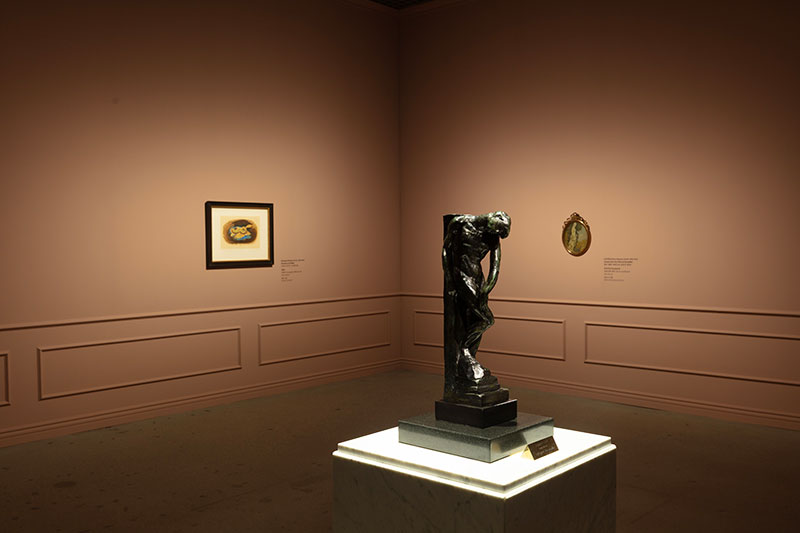
< Rodin de Paris, Exhibition Hall 3 (Photographer: Professor Hojun Ji, Department of Industrial Design) >
KAIST, which has been presenting high-quality exhibitions since the opening of its art museum in December 2024, has organized a special exhibition that illuminates how Parisian art around 1900 connected to Korean modern art.
On the 22nd, KAIST announced that it has been concurrently hosting the Parisian art collection exhibition ‘Rodin de Paris’ and the special exhibition for the late artist Ryu Kyung-chai, ‘The Poetics of Emotion,’ at the KAIST Museum of Art since April 14.
Around 1900, Paris was the center of the art world, where artists from all over the globe gathered, and various art movements clashed and were experimented with. Transcending their nationalities, they formed an international artistic community often collectively referred to as the 'School of Paris' (École de Paris).
Exhibition Hall 3 of the KAIST Museum of Art showcases the dynamism of the Parisian art scene at the time, where different formative languages coexisted during this turbulent period. A total of 10 works are on display, including pieces donated to and owned by the KAIST Museum of Art, such as Auguste Rodin’s sculpture ‘Étude pour Adam au pilier’ (Study for Adam at the Pillar), Pablo Picasso’s ceramic ‘Colombe Mate’ (Matte Dove), and Marc Chagall’s print ‘Le Cirque à Clown Jaune’ (The Circus with a Yellow Clown).
Meanwhile, the artistic world of Kyung-chai Ryu, introduced in Exhibition Hall 2, illustrates the process through which these modern Parisian art movements reached Korea via Japan. At the time, Japan was already actively accepting the latest art from Paris, and Korean painters during the Japanese colonial period encountered Western art through Japan. However, there were historical limitations, as they had to seek gradual change within an institutional framework rather than radical experimentation. Despite these constraints, Kyung-chai Ryu formed a stream of Korean lyrical abstraction through new explorations of color and form.
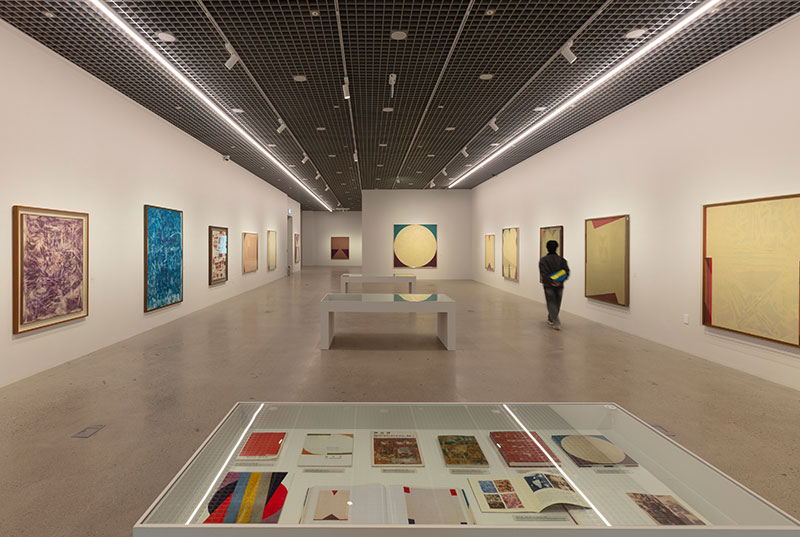
< Kyung-chai Ryu's The Poetics of Emotion, Exhibition Hall 2 (Photographer: Professor Ho Jun Ji, Department of Industrial Design) >
Following liberation and the Korean War, Ryu also played a pioneering role as an art educator by authoring middle and high school art textbooks tailored to the realities of Korea. In Exhibition Hall 2, 28 works by Kyung-chai Ryu, donated to and owned by the KAIST Museum of Art, are on display alongside historical materials that show the flow of Korean modern art history—such as art textbooks from that era and the original Presidential Award certificate he received at the 1st National Art Exhibition (Gukjeon) in 1949—courtesy of the bereaved family.
Beyond a simple simultaneous hosting, the two exhibitions raise the question: “How does artistic innovation originating at the center spread and transform at the periphery?” It demonstrates how the avant-garde art of Paris around 1900 was moderated and reconstructed within the context of colonial Joseon, prompting viewers to view modern art not as a single stream, but as a multilayered interaction.
Hyeon Jeong Suk, Director of the Museum of Art (and Head of the Department of Industrial Design), stated:
“I hope visitors can experience the global and Korean artistic worldviews together in this exhibition space, which the KAIST Museum of Art organized using donated works by domestic and international masters.”
Kwang Hyung Lee, President of KAIST, remarked:
“I would like to express my deepest gratitude once again to the late Chairman Moon-soul Chung for generously donating a large number of artist Kyung-chai Ryu's works. I look forward to the KAIST Museum of Art establishing itself as a cultural space for both the KAIST community and the public.”
Exhibition Information
-
Admission: Free to the public
-
Exhibition Periods:
-
Parisian Art Collection Exhibition: Until October 16, 2026
-
Kyung-chai Ryu Special Exhibition: Until February 26, 2027
-
-
Viewing Hours: Weekdays, 10:00 AM to 5:00 PM
-
event KAIST Hosts 2026 DCM, Expanding Connections Between Tech Entrepreneurship and Investment
On May 21, KAIST held a meeting with representatives from venture capital (VC) firms at the KI Building to strengthen the entrepreneurship and technology commercialization capabilities of its faculty members. The event, hosted by the Institute for Technology Value Creation, was part of the "Department Capital Meeting (DCM)" initiative. DCM serves as a platform to build networks through regular exchanges between faculty members and VCs. Launched in November 2021, the program operates to encour
2026-05-22 -
event Welcome to South Korea's Hosting of the 'Global AI Hub'
KAIST announced on May 22nd that the entire faculty of the Graduate School of AI welcomes South Korea's hosting of the 'Global AI Hub.' The faculty determined that hosting this will serve as a crucial momentum builder for South Korea to earnestly contribute to international cooperation and the responsible use of technology in the artificial intelligence (AI) era. In a joint statement, the faculty of the KAIST Graduate School of AI expressed, "Hosting the Global AI Hub goes beyond simply attr
2026-05-22 -
event Call for Participants: 'GRAVITY 2026', the Integrated Deep-Tech Student Startup League of the 4 Major Science and Technology Institutes
< Promotional Poster for the Startup League > KAIST announced on May 21st that "GRAVITY 2026," an integrated student startup league co-hosted with GIST, DGIST , and UNIST , is officially opening recruitment for participants. The program name "GRAVITY" is inspired by the concept of gravity, and it was named to signify a platform that pulls together students who take on challenges in innovation and entrepreneurship. This program is the largest united startup league among science and t
2026-05-21 -
event KAIST Holds the 2026 President's Advisory Council
< 2026 KAIST President's Advisory Council > On the morning of May 21st, KAIST held the '2026 KAIST President's Advisory Council' at ORBIT 50 in the FKI Tower in Yeouido, Seoul. A total of 22 attendees participated in the meeting, including members of the President's Advisory Council, Chairwoman Myung-Ja Kim, President Kwang Hyung Lee, and key university officials. President Kwang Hyung Lee personally presented the achievements and current status across all sectors of the university&mda
2026-05-21 -
research “Why Only Copper?”… KAIST Reveals Key Limitation of Catalysts That Convert Carbon into Fuel
<(From left) Professor Jihun Oh, Ph.D candidate Suneon Wang, (Starting from the left circle) Dr. Beomil Kim, Ph.D candidate Seungchang Han, Professor Stefan Ringe> Technology that converts carbon dioxide (CO₂) into fuels and plastic feedstocks using electricity is gaining attention as a core technology in the era of carbon neutrality. In particular, ethylene and ethanol are high-value materials widely used in the production of plastics, fuels, and chemical products, but until now, the o
2026-05-21