research

<(From Left) Prof. Jungwon Kim, Dr. Changmin Ahn>
Researchers at KAIST have demonstrated a chip-scale photonic approach for generating ultralow-noise and highly stable microwave and millimeter-wave signals based on optical frequency combs (microcombs), offering a potential pathway toward compact, high-performance frequency sources for next-generation technologies.
High-frequency signals in the tens to hundreds of gigahertz range are essential for emerging applications such as 6G communications, radar, and precision sensing. However, achieving both low noise and high stability at these frequencies remains a fundamental challenge for conventional electronic signal sources.
In the first study, the researchers addressed the long-standing challenge of transferring the stability of an optical reference to a microcomb. Direct stabilization is difficult due to the lack of carrier-envelope offset detection in high-repetition-rate microcombs. To overcome this, they used a mode-locked laser as a transfer oscillator and synchronized it to the microcomb using electro-optic sampling. This approach enabled direct and robust transfer of optical-reference stability to the microcomb repetition rate, achieving fractional frequency stability at the 10-18 level and a phase noise of -125 dBc/Hz at 100 Hz offset from a 22 GHz carrier, representing state-of-the-art performance and more than 80 dB improvement over the free-running microcomb in the low-offset-frequency regime.
In the second study, the team addressed the degradation of noise performance typically observed when scaling microcombs to higher repetition rates. While microcombs with lower repetition rates (large resonators) exhibit better noise characteristics, increasing the repetition rate generally leads to performance degradation. The researchers showed that this limitation can be overcome using perfect soliton crystal (PSC) states, which enable repetition-rate multiplication while preserving the low-noise characteristics of the original comb. As a result, they generated millimeter-wave signals at 44 GHz and 66 GHz with timing jitter on the order of 3 femtoseconds, demonstrating that the low-noise performance of a microwave-rate microcomb can be preserved during scaling to millimeter-wave frequencies.
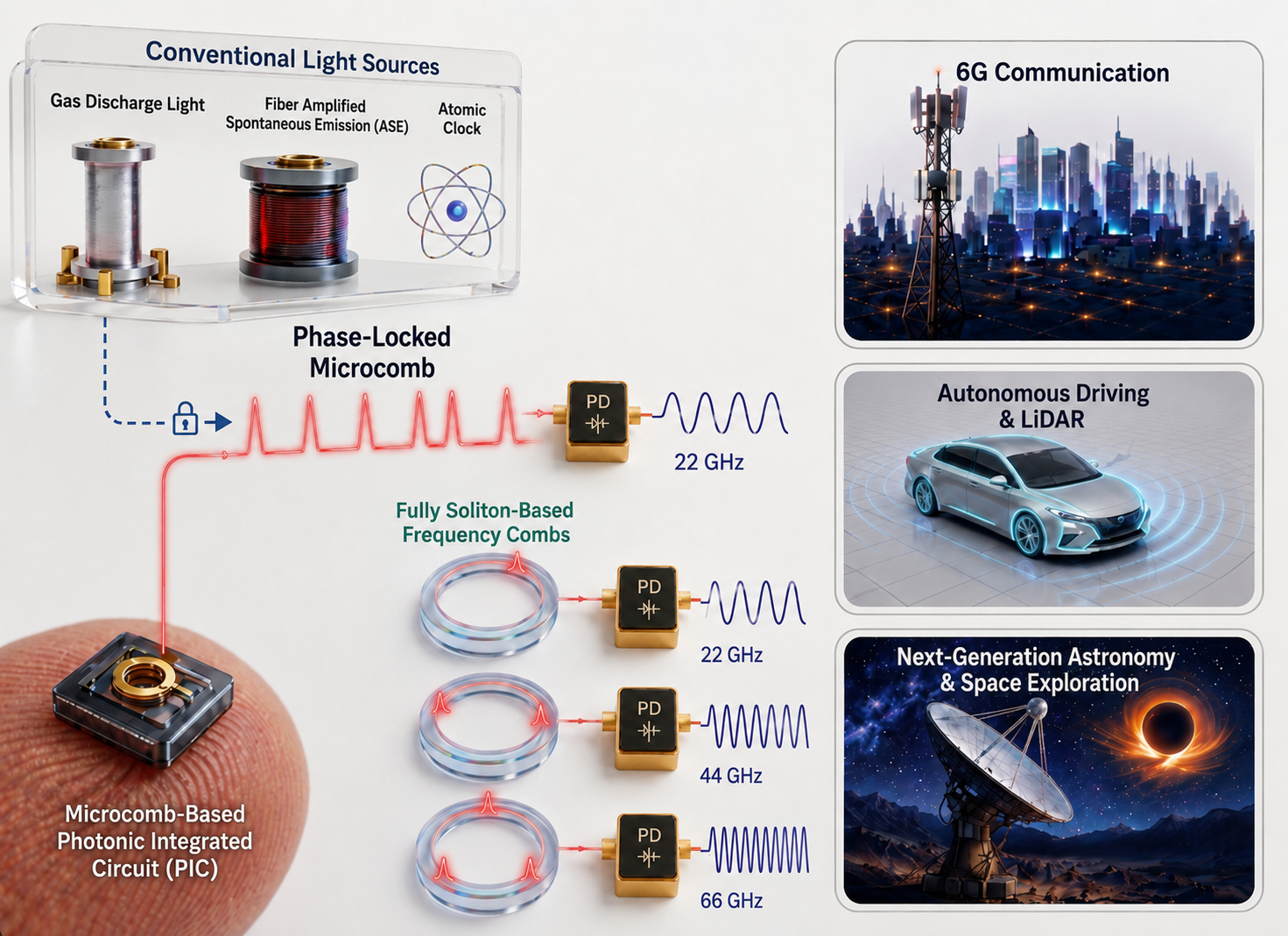
<Ultra-compact optical resonator chip with noise suppression based on an optical reference signal and increased frequency via fully solitonic waves (AI-generated image)>
Together, these results establish two key capabilities: (1) high-fidelity transfer of optical-reference stability to chip-scale microcombs, and (2) preservation of low-noise performance during frequency scaling to millimeter-wave regimes. This combined capability provides a practical route toward compact photonic signal sources that integrate optical-level stability with high-frequency operation.
The research was led by Dr. Changmin Ahn and Prof. Jungwon Kim at KAIST, in collaboration with Prof. Hansuek Lee. The results were published in Laser & Photonics Reviews and Optica.
· Optical-to-microcomb stability transfer for ultrastable timing and microwave/millimeter-wave generation (DOI: 10.1002/lpor.71135)
· Preserving ultralow timing jitter in microcombs with repetition-rate multiplication via perfect soliton crystal formation (DOI: 10.1364/OPTICA.581054)
-
research KAIST Develops Real-Time Diagnostic Smart Dressing Patch to End the Fear of Diabetic Foot Amputation
<(From Left) Professor Inkyu Park, Dr. Seokjoo Cho, (Upper Right, From Left) Professor Ji-Hwan Ha, Researcher Junho Jeong , Professor Wei Gao> “Diabetic ulcers,” which occur in patients with diabetes, are dangerous complications that can lead to amputation if the treatment window is missed. A joint research team has developed a “smart dressing patch” that can monitor wound conditions in real time. KAIST (President Kwang Hyung Lee) announced on the 14th of May th
2026-05-14 -
event “Entrepreneurial Mutual Growth Fair 2026” to be Held... KAIST Super Star Companies Gather for AI Solopreneurship, Tech Commercialization, Investment, and Youth Job Fair
KAIST announced that it will host the ‘AI Agent-Based Solopreneurship Program Information Session’ and the ‘Entrepreneurial Mutual Growth Fair 2026’ for two days from May 18th to 19th. In this event, KAIST’s new AI-based solopreneurship model, which utilizes AI not merely as an operational tool but as a ‘Co-founder,’ will be introduced in depth. The university will hold an information session for the ‘AI Solopreneur Support Project,’ whic
2026-05-13 -
event Launch of Center for Science Diplomacy... Building a Science Diplomacy Hub for the AI Era
< Science Diplomacy Forum Poster > KAIST announced that it has officially launched the ‘KAIST Center for Science Diplomacy (KCSD),’ connecting science and technology with diplomacy, and is holding a global forum on May 13th to commemorate the occasion. Through the Center for Science Diplomacy, our university plans to promote the securing of technological sovereignty and the strengthening of global cooperation, contributing to the resolution of common human challenges such
2026-05-13 -
research “Even Recognizing Puddles at Night”... KAIST Surpasses the Limits of Autonomous Driving
< (From left) Ph.D. student Hanbin Cho, Postdoctoral Researcher Wenxuan Zhu, Professor Joonki Suh, and MS-PhD integrated student Changhwan Kim > A technology that surpasses the limitations of existing sensors, which failed to distinguish between water and asphalt on dark roads, has emerged to enhance the accuracy of autonomous driving and medical diagnostics. Our university's research team has developed a next-generation polarization sensor that can read the "direction" of light and ch
2026-05-12 -
research First Observation of the Moment Lithium Batteries Breakdown... Key Clue to Extending EV Range
< (From left) Professor Seungbum Hong, Ph.D candidate Seonghyun Kim, Dr. Youngwoo Choi, and Dr. Yoonhan Cho > A crucial clue to simultaneously increasing electric vehicle (EV) driving range and battery lifespan has been discovered. A research team at our university has observed the exact moment of degradation in lithium metal batteries at the nanoscale (approximately 1/100,000th the thickness of a human hair) and identified the fundamental cause of performance decline. This is evaluated
2026-05-11