research
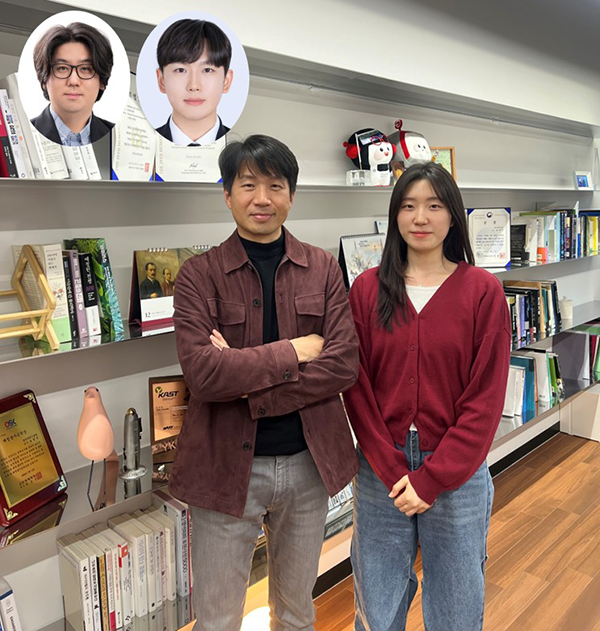
<(From Left) Professor Young Min Song, Ph.D candidate Hyo Eun Jeong, (Upper Left) Professor Hyeon-Ho Jeong, Dr. Joo Hwan Ko>
A new display technology has emerged that significantly increases resolution while consuming almost no power. A Korean research team has developed a “monopixel” structure in which a single pixel can independently change colors while consuming minimal energy to maintain them. This breakthrough opens the possibility of creating sharper AR/VR displays without heavy battery demands.
KAIST (President Kwang Hyung Lee) announced on the 29th of March that a research team led by Professor Young Min Song of the School of Electrical Engineering, in collaboration with Professor Hyeon-Ho Jeong’s team at Gwangju Institute of Science and Technology (GIST, President Ki-Cheol Lim), has developed a new low-power monopixel technology called a “reconfigurable Gires–Tournois resonator (r-GT).” This system uses electrochromic materials—substances that change color when electricity is applied—to produce colors with very low power consumption.
Displays have been making pixels increasingly smaller to achieve higher resolution. However, as pixels shrink, power consumption rises and brightness decreases. This is especially challenging for AR/VR devices, which must achieve both extremely small pixels and low power consumption due to their proximity to the human eye.
The r-GT pixel developed by the research team changes color when voltage is applied, and once changed, the color is maintained for a certain period even after the power is turned off. In other words, power is only required when changing colors, while maintaining color requires almost no energy.
The core of this technology lies in two elements. First is a conductive polymer, polyaniline (PANI), whose properties change when voltage is applied. This material responds even at voltages below 1 volt (V), altering its refractive index and thereby changing color. The refractive index refers to how much light bends when passing through a material, and changes in this value lead to changes in perceived color.
Second, the system incorporates a resonator structure that reflects light multiple times to amplify specific colors. This structure enhances even small changes, enabling vivid color expression with minimal power.
As a result, the system achieved a wide color variation exceeding 220° using ultra-low power (90 μW cm⁻²). In simple terms, it can express more than half of the full color wheel (360°) using only about 0.00009 watts per square centimeter.
Another key feature is the “monopixel” structure. Unlike conventional displays that divide a single pixel into red (R), green (G), and blue (B) subpixels, the monopixel approach allows one pixel to independently produce various colors. This enables more pixels within the same area, resulting in higher resolution and reduced light loss, leading to clearer images.
Additionally, PANI retains its color state even after the applied voltage is removed. This confirms the feasibility of a “memory-in-pixel” display, where energy is used only when changing colors, not when maintaining them.
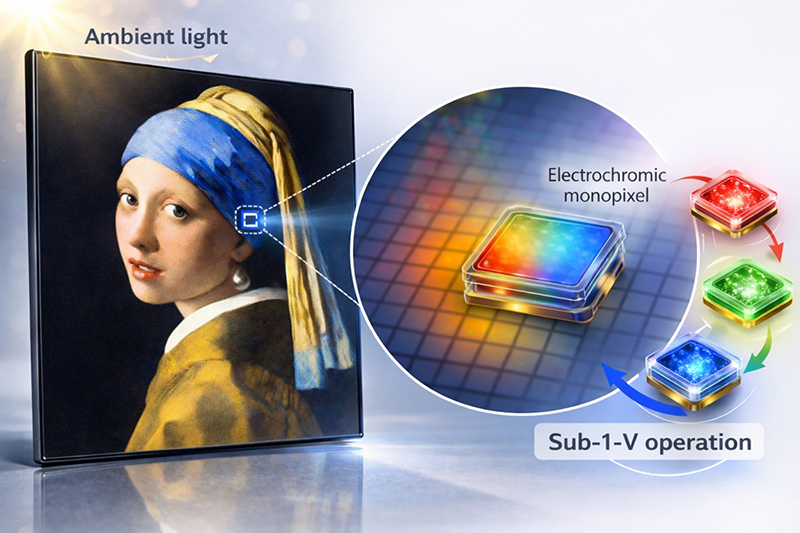
<Reflective display AI image>
The research team demonstrated that this technology can achieve a wide color range (220.6°) and reduce pixel size to as small as 1.5 micrometers (μm), corresponding to an ultra-high resolution of up to approximately 16,900 PPI—beyond the level where individual pixels can be distinguished by the human eye.
Moreover, even with a single-pixel structure, the system can represent about 48.1% of the standard sRGB color gamut, and up to 69.9% with varied material combinations, enabling richer color expression.
The team fabricated a 5×5 monopixel array to verify performance. The energy required to change colors was extremely low (2.31 mJ), demonstrating up to 5.8 times lower power consumption compared to conventional LEDs. As a reflective display, it also becomes more visible under brighter ambient lighting, since it uses external light rather than emitting its own.
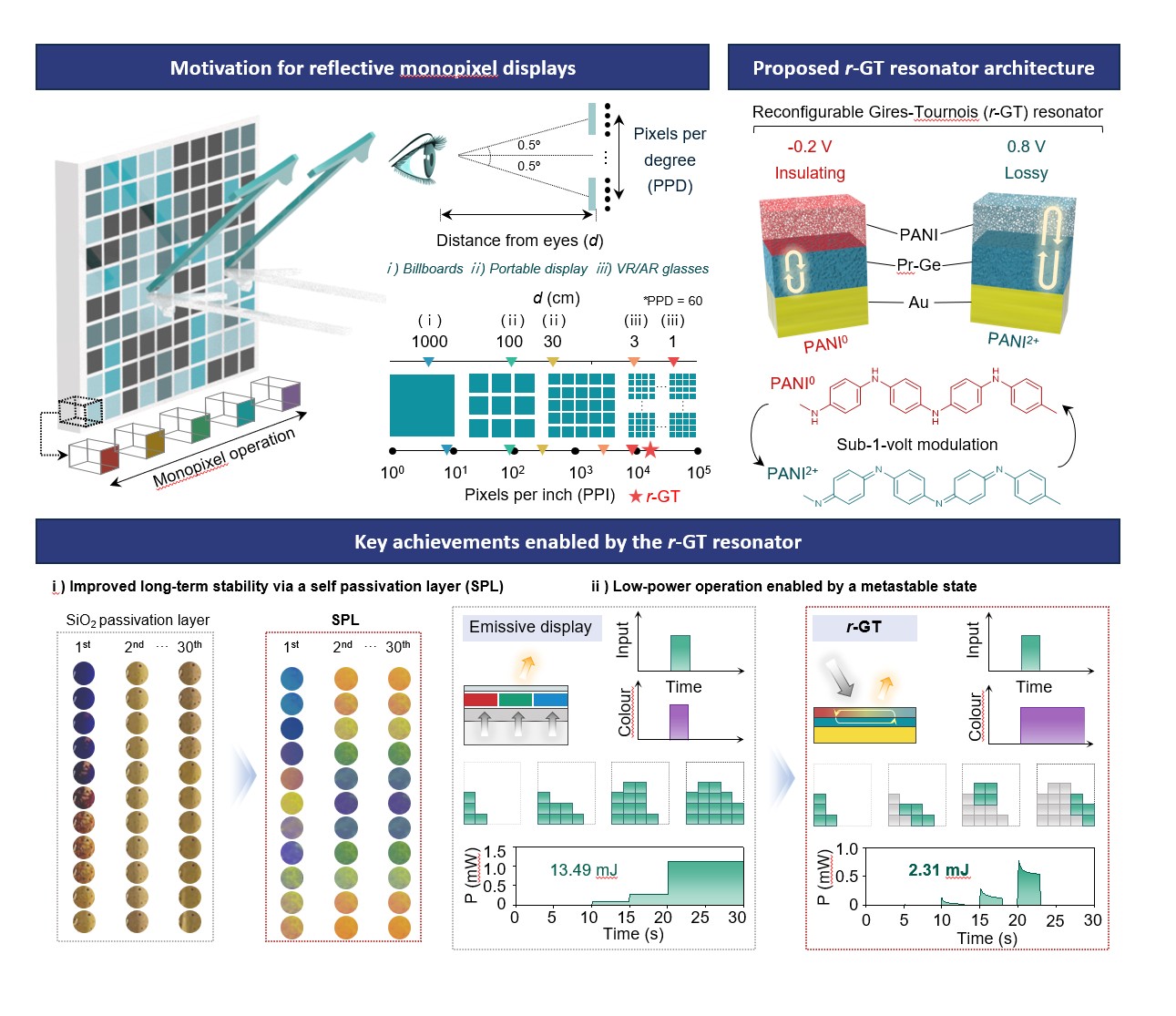
<Structure and Representative Results of an Electrically Tunable Single Reflective Resonant Device Using Conductive Polymers>
This study demonstrates that combining electrochemical materials with optical resonator structures enables full-color implementation at ultra-low power. It is expected to be applied in various fields requiring energy efficiency, including ultra-high-resolution near-eye displays for AR/VR, wearable devices, outdoor displays, and electronic paper. It also suggests the potential for sustainable and energy-efficient display technologies by minimizing power consumption during color retention.
Professor Young Min Song stated, “This technology allows a wide range of color changes using very little electricity,” adding, “When combined with future display driving methods, it could enable not only clearer and more energy-efficient ultra-high-resolution displays but also a variety of optical applications.”
This research was conducted with Hyo Eun Jeong, an integrated M.S./Ph.D. student at KAIST, as co-first author, and Professor Young Min Song as the corresponding author. The results were published online on February 28 in Light: Science & Applications, a leading international journal in optics.
※ Paper title: “Sub-1-volt, reconfigurable Gires-Tournois resonators for full-coloured monopixel array,” DOI: https://www.nature.com/articles/s41377-026-02228-2
This research was supported by multiple programs funded by the Ministry of Science and ICT, the National Research Foundation of Korea (NRF), the InnoCORE-GIST program, nanomaterials and technology development initiatives, future medical innovation programs, international collaboration hubs, and the Ministry of Trade, Industry and Energy (MOTIE).
-
event KAIST Hosts 2026 DCM, Expanding Connections Between Tech Entrepreneurship and Investment
On May 21, KAIST held a meeting with representatives from venture capital (VC) firms at the KI Building to strengthen the entrepreneurship and technology commercialization capabilities of its faculty members. The event, hosted by the Institute for Technology Value Creation, was part of the "Department Capital Meeting (DCM)" initiative. DCM serves as a platform to build networks through regular exchanges between faculty members and VCs. Launched in November 2021, the program operates to encour
2026-05-22 -
event From Paris to Gyeongseong' Illuminating the Flow of Modern Art
< Rodin de Paris, Exhibition Hall 3 (Photographer: Professor Hojun Ji, Department of Industrial Design) > KAIST, which has been presenting high-quality exhibitions since the opening of its art museum in December 2024, has organized a special exhibition that illuminates how Parisian art around 1900 connected to Korean modern art. On the 22nd, KAIST announced that it has been concurrently hosting the Parisian art collection exhibition ‘Rodin de Paris’ and the special exhibi
2026-05-22 -
event Welcome to South Korea's Hosting of the 'Global AI Hub'
KAIST announced on May 22nd that the entire faculty of the Graduate School of AI welcomes South Korea's hosting of the 'Global AI Hub.' The faculty determined that hosting this will serve as a crucial momentum builder for South Korea to earnestly contribute to international cooperation and the responsible use of technology in the artificial intelligence (AI) era. In a joint statement, the faculty of the KAIST Graduate School of AI expressed, "Hosting the Global AI Hub goes beyond simply attr
2026-05-22 -
event Call for Participants: 'GRAVITY 2026', the Integrated Deep-Tech Student Startup League of the 4 Major Science and Technology Institutes
< Promotional Poster for the Startup League > KAIST announced on May 21st that "GRAVITY 2026," an integrated student startup league co-hosted with GIST, DGIST , and UNIST , is officially opening recruitment for participants. The program name "GRAVITY" is inspired by the concept of gravity, and it was named to signify a platform that pulls together students who take on challenges in innovation and entrepreneurship. This program is the largest united startup league among science and t
2026-05-21 -
event KAIST Holds the 2026 President's Advisory Council
< 2026 KAIST President's Advisory Council > On the morning of May 21st, KAIST held the '2026 KAIST President's Advisory Council' at ORBIT 50 in the FKI Tower in Yeouido, Seoul. A total of 22 attendees participated in the meeting, including members of the President's Advisory Council, Chairwoman Myung-Ja Kim, President Kwang Hyung Lee, and key university officials. President Kwang Hyung Lee personally presented the achievements and current status across all sectors of the university&mda
2026-05-21