research

< (From left) Ph.D candidate Changhwan Kim, Ph.D candidate Seunghwan Kim , Ph.D candidate Namwook Hur, Professor Joonki Suh, Ph. D candidate Youngseok Cho>
As artificial intelligence advances, computers demand faster and more efficient memory. The key to ultra-high-speed, low-power semiconductors lies in the "switching" principle—the mechanism by which memory materials turn electricity on and off. A South Korean research team has successfully captured the elusive moment of switching and its internal operational principles by momentarily melting and freezing materials within a nanoscale electronic device. This study provides a foundational blueprint for designing next-generation memory materials that are faster and consume less power based on fundamental principles.
On February 8th, the research team led by Professor Joonki Suh from our department (Chemical and Biomolecular Engineering), in collaboration with Professor Tae-Hoon Lee’s team from Kyungpook National University, announced the development of an experimental technique capable of real-time monitoring of electrical switching processes and phase changes within nano-devices—phenomena that were previously difficult to observe.
To verify the electrical switching, the team applied a method of instantaneous melting followed by rapid cooling (quenching). Through this, they succeeded in stably implementing amorphous tellurium (a-Te)—a state where tellurium is disordered like glass—within a nano-device much smaller than a human hair. Tellurium is typically sensitive to heat and changes properties easily when current is applied; however, in its amorphous state, it is garnering significant attention as a core material for next-generation memory due to its speed and energy efficiency. *Tellurium (Te): A metalloid element possessing properties of both metals and non-metals.

< Illustration of the experiment involving instantaneous melting and freezing in a memory electronic device (AI-generated image) >
Through this study, the team specifically identified the threshold voltage and thermal conditions at which switching begins, as well as the segments where energy loss occurs. Based on these findings, they observed stable and high-speed switching even while reducing heat generation. This enables "principle-based" memory material design, allowing researchers to understand exactly why and when electricity starts to flow.
The results confirmed that microscopic defects within amorphous tellurium play a crucial role in electrical conduction. When the voltage exceeds a certain threshold, the corresponding current does not rise all at once; instead, it follows a two-step switching process: initially, a rapid current increase along the defects occurs primarily during the abrupt electrical switching, followed by heat accumulation that causes the material to melt.
Furthermore, the team successfully implemented a "self-oscillation" phenomenon—where voltage spontaneously increases and decreases—by conducting experiments that maintained the amorphous state without excessive current flow. This demonstrates that stable electrical switching is possible using only the single element of tellurium, without the need for complex material combinations.
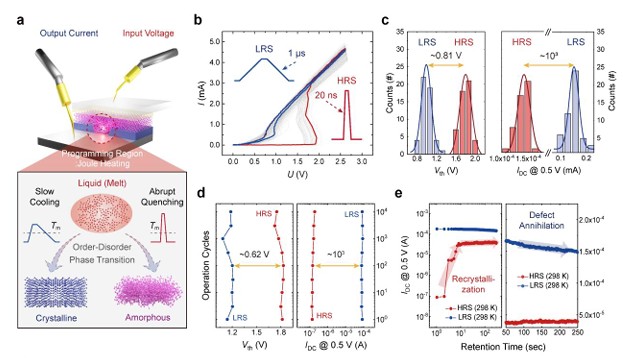
< Electrical characteristics of amorphous tellurium created through rapid cooling from a liquid state within an electronic device >
This research is a significant achievement as it implements amorphous tellurium—a next-generation memory material—within an actual electronic device and systematically elucidates the fundamental principles of electrical switching. These findings are expected to serve as essential guidelines for designing semiconductor materials to realize faster and more energy-efficient memory in the future.
"This is the first study to implement amorphous tellurium in a real-world device environment and clarify the switching mechanism," said Professor Joonki Suh. "It sets a new standard for research into next-generation memory and switching materials."
The study, with Namwook Hur as the first author and Seunghwan Kim as the second author, and Professor Joonki Suh (KAIST) as the corresponding author, was published online on January 13th in the international academic journal Nature Communications.
- Paper Title: On-device cryogenic quenching enables robust amorphous tellurium for threshold switching
- DOI: 10.1038/s41467-025-68223-0
Meanwhile, this research was supported by the National Research Foundation of Korea (NRF) through the PIM (Processor-in-Memory) AI Semiconductor Core Technology Development Project, the Excellent Young Researcher Program funded by the Ministry of Science and ICT, and Samsung Electronics.
-
event “Entrepreneurial Mutual Growth Fair 2026” to be Held... KAIST Super Star Companies Gather for AI Solopreneurship, Tech Commercialization, Investment, and Youth Job Fair
KAIST announced that it will host the ‘AI Agent-Based Solopreneurship Program Information Session’ and the ‘Entrepreneurial Mutual Growth Fair 2026’ for two days from May 18th to 19th. In this event, KAIST’s new AI-based solopreneurship model, which utilizes AI not merely as an operational tool but as a ‘Co-founder,’ will be introduced in depth. The university will hold an information session for the ‘AI Solopreneur Support Project,’ whic
2026-05-13 -
event Professor Yiyun Kang Selected as TED 2026 Main Stage Speaker
< Professor Yiyun Kang (Photo Credit: Ryan Lash / TED) > KAIST announced on April 17th that Professor Yiyun Kang of the Department of Industrial Design has been selected as a speaker for the Main Stage at TED 2026, the world-renowned knowledge conference. Founded in 1984 under the motto "Ideas Worth Spreading," TED is an American non-profit knowledge platform where scholars, innovators, and artists from around the globe gather annually to lead global discourse. Previous Korean speakers
2026-04-18 -
research Breakthrough in Data Processing via Light Control... Enhancing AI Accelerators and Quantum Communication
< (From left) Undergraduate researcher Taewon Kim and Professor Sangsik Kim > A new technology has been developed that allows light to be "designed" into desired forms, potentially making Artificial Intelligence (AI) and communication technologies faster and more accurate. A KAIST research team has developed an "integrated photonic resonator"—a core component of next-generation optical integrated circuits that process data using light. The research is particularly significant as i
2026-04-16 -
event AI, Humanoid Robots, and Space Rovers to Gather: Experience Future Technologies at the Science Festival
<(From left) Photos of the KAIST Science Festival exhibition hall and booths from the previous year> KAIST announced on April 10th that KAIST will participate in the ‘2026 Korea Science and Technology Festival,’ the largest science festival in the country, to mark Science Month in April. KAIST will operate ‘KAIST Play World,’ an interactive exhibition hall showcasing the pinnacle of AI and robotics. This year’s festival will be held in two parts: ‘20
2026-04-13 -
research InnoCORE Research Group Successfully Achieves AI Protein Design with Nobel Laureate David Baker
< (From left) Professor Gyu Rie Lee, Professor David Baker > Under the foundation of research cooperation established through the Ministry of Science and ICT's InnoCORE (InnoCORE) project, KAIST InnoCORE researchers have derived meaningful research results. Following a visit by Professor David Baker (University of Washington, USA), the 2024 Nobel Laureate in Chemistry, KAIST has revealed research findings on designing proteins that accurately recognize desired compounds using AI through
2026-04-09