event

< (From left) Dr. Yuqian Sun, Professor Chang-Hee Lee of the Department of Industrial Design, and Ali Asadipour, Director of CSRC at the Royal College of Art >
'Nüshu (女書)' is the world's only women's script, a unique writing system created autonomously by women in Hunan Province, China, starting around the 19th century. These women, excluded from Hanzi education, used it to record their lives and communicate with each other. A research team from KAIST participated in the 'AI Nüshu (女书)' project, which combines the script's significance (creation amidst oppression, female solidarity, linguistic experimentation) with modern technology, winning a prestigious international award often called the 'Academy Award of the media art world.'
KAIST announced on the 10th that the 'AI Nüshu' project, jointly conducted by Professor Chang-Hee Lee's research team from the Department of Industrial Design and Ali Asadipour, Director of the Computer Science Research Center at the Royal College of Art (RCA), was selected for the Honorary Mention in the Digital Humanity category at the 'Prix Ars Electronica 2025,' the world's highest-level media art festival.
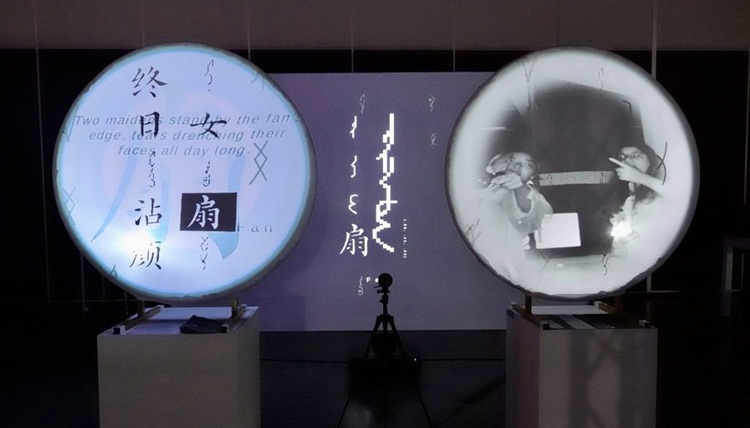
< Installation image of 'AI Nüshu' >
The 'Prix Ars Electronica,' known as the 'Academy Award of the media art world,' is the premier international media art competition held annually in Linz, Austria. This competition, which discovers innovative works spanning the boundaries of art and science, saw 3,987 submissions from 98 countries this year, with only two works receiving the honor in the Digital Humanity category.
The award-winning work, 'AI Nüshu (女书),' is based on 'Nüshu,' the world's only women's script created by Chinese women who were excluded from literacy education to record and communicate their lives.
The KAIST research team and collaborators combined this script with Computational Linguistics to create an installation that visitors can directly experience.
The artificial intelligence within the artwork learns the communication methods of pre-modern Chinese women and generates its own new language. This is regarded as a symbol of resistance against the patriarchal order and a feminist endeavor that moves beyond Western-centric views on language.

< Example of the same sentence expressed in English, Chinese, Nüshu, and AI Nüshu >
It also received high praise for artistically presenting the possibility of machines creating new languages, going beyond the preconception that 'only humans create language.'
Dr. Yuqian Sun of the Royal College of Art expressed her feelings, saying, "Although there were many difficulties in my life and research process, I feel great reward and emotion through this award."
Professor Chang-Hee Lee of the KAIST Department of Industrial Design stated, "It is very meaningful that this contemplative art, born from the intersection of history, humanities, art, and technology, has led to such a globally prestigious award."
Detailed information about the project can be found on the official Prix Ars Electronica website (
-
event Professor Yiyun Kang Selected as TED 2026 Main Stage Speaker
< Professor Yiyun Kang (Photo Credit: Ryan Lash / TED) > KAIST announced on April 17th that Professor Yiyun Kang of the Department of Industrial Design has been selected as a speaker for the Main Stage at TED 2026, the world-renowned knowledge conference. Founded in 1984 under the motto "Ideas Worth Spreading," TED is an American non-profit knowledge platform where scholars, innovators, and artists from around the globe gather annually to lead global discourse. Previous Korean speakers
2026-04-18 -
research Breakthrough in Data Processing via Light Control... Enhancing AI Accelerators and Quantum Communication
< (From left) Undergraduate researcher Taewon Kim and Professor Sangsik Kim > A new technology has been developed that allows light to be "designed" into desired forms, potentially making Artificial Intelligence (AI) and communication technologies faster and more accurate. A KAIST research team has developed an "integrated photonic resonator"—a core component of next-generation optical integrated circuits that process data using light. The research is particularly significant as i
2026-04-16 -
event AI, Humanoid Robots, and Space Rovers to Gather: Experience Future Technologies at the Science Festival
<(From left) Photos of the KAIST Science Festival exhibition hall and booths from the previous year> KAIST announced on April 10th that KAIST will participate in the ‘2026 Korea Science and Technology Festival,’ the largest science festival in the country, to mark Science Month in April. KAIST will operate ‘KAIST Play World,’ an interactive exhibition hall showcasing the pinnacle of AI and robotics. This year’s festival will be held in two parts: ‘20
2026-04-13 -
research InnoCORE Research Group Successfully Achieves AI Protein Design with Nobel Laureate David Baker
< (From left) Professor Gyu Rie Lee, Professor David Baker > Under the foundation of research cooperation established through the Ministry of Science and ICT's InnoCORE (InnoCORE) project, KAIST InnoCORE researchers have derived meaningful research results. Following a visit by Professor David Baker (University of Washington, USA), the 2024 Nobel Laureate in Chemistry, KAIST has revealed research findings on designing proteins that accurately recognize desired compounds using AI through
2026-04-09 -
research KAIST, Developing National Positioning Infrastructure with Wi-Fi-Based Precision Technology… A Step Toward “Location Sovereignty”
<(From Left) Prof. Dong-Soo Han, Dr. Kyuho Son, Dr. Byeongcheol Moon, Dr. Sumin Ahn, Ph.D candidate Seungwoo Chae> A Korean research team has developed a technology that enables precise indoor positioning using only a smartphone. Developed over eight years by KAIST researchers, this technology is expected to help secure critical time in missing-person searches and is being recognized as a “location sovereignty” solution that could reshape the current location service ecosyst
2026-04-03