research

<(From Left) Professor Kijung Shin, Ph.D candidate Kyuhan Lee, and Ph.D candidate Geon Lee>
Just like when multiple people gather simultaneously in a meeting room, higher-order interactions—where many entities interact at once—occur across various fields and reflect the complexity of real-world relationships. However, due to technical limitations, in many fields, only low-order pairwise interactions between entities can be observed and collected, which results in the loss of full context and restricts practical use. KAIST researchers have developed the AI model “MARIOH,” which can accurately reconstruct* higher-order interactions from such low-order information, opening up innovative analytical possibilities in fields like social network analysis, neuroscience, and life sciences.
*Reconstruction: Estimating/reconstructing the original structure that has disappeared or was not observed.
KAIST (President Kwang Hyung Lee) announced on the 5th that Professor Kijung Shin’s research team at the Kim Jaechul Graduate School of AI has developed an AI technology called “MARIOH” (Multiplicity-Aware Hypergraph Reconstruction), which can reconstruct higher-order interaction structures with high accuracy using only low-order interaction data.
Reconstructing higher-order interactions is challenging because a vast number of higher-order interactions can arise from the same low-order structure.
The key idea behind MARIOH, developed by the research team, is to utilize multiplicity information of low-order interactions to drastically reduce the number of candidate higher-order interactions that could stem from a given structure.
In addition, by employing efficient search techniques, MARIOH quickly identifies promising interaction candidates and uses multiplicity-based deep learning to accurately predict the likelihood that each candidate represents an actual higher-order interaction.

<Figure 1. An example of recovering high-dimensional relationships (right) from low-dimensional paper co-authorship relationships (left) with 100% accuracy, using MARIOH technology.>
Through experiments on ten diverse real-world datasets, the research team showed that MARIOH reconstructed higher-order interactions with up to 74% greater accuracy compared to existing methods.
For instance, in a dataset on co-authorship relations (source: DBLP), MARIOH achieved a reconstruction accuracy of over 98%, significantly outperforming existing methods, which reached only about 86%. Furthermore, leveraging the reconstructed higher-order structures led to improved performance in downstream tasks, including prediction and classification.
According to Kijung, “MARIOH moves beyond existing approaches that rely solely on simplified connection information, enabling precise analysis of the complex interconnections found in the real world.” Furthermore, “it has broad potential applications in fields such as social network analysis for group chats or collaborative networks, life sciences for studying protein complexes or gene interactions, and neuroscience for tracking simultaneous activity across multiple brain regions.”

The research was conducted by Kyuhan Lee (Integrated M.S.–Ph.D. program at the Kim Jaechul Graduate School of AI at KAIST; currently a software engineer at GraphAI), Geon Lee (Integrated M.S.–Ph.D. program at KAIST), and Professor Kijung Shin. It was presented at the 41st IEEE International Conference on Data Engineering (IEEE ICDE), held in Hong Kong this past May.
※ Paper title: MARIOH: Multiplicity-Aware Hypergraph Reconstruction
※ DOI: https://doi.ieeecomputersociety.org/10.1109/ICDE65448.2025.00233
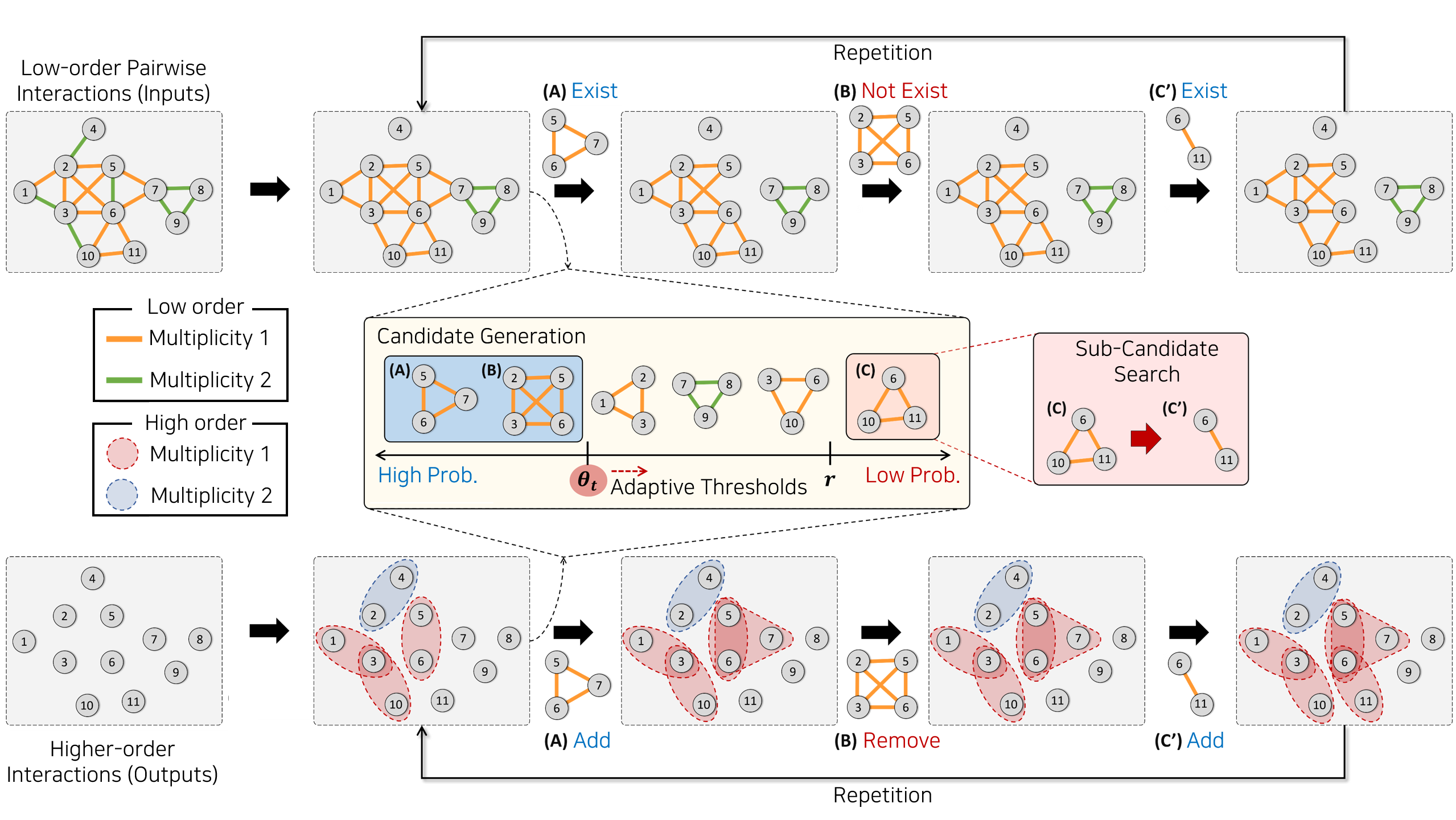
<Figure 2. An example of the process of recovering high-dimensional relationships using MARIOH technology>
This research was supported by the Institute of Information & Communications Technology Planning & Evaluation (IITP) through the project “EntireDB2AI: Foundational technologies and software for deep representation learning and prediction using complete relational databases,” as well as by the National Research Foundation of Korea through the project “Graph Foundation Model: Graph-based machine learning applicable across various modalities and domains.”
-
research KAIST Develops Self-Regenerating Catalyst That Restores Its Own Performance, Opening a Breakthrough for CO₂ Conversion Technology
<(From Left) Professor Dong Young Chung, Ph.D Candidate Hongmin An, Hanjoo Kim> Technologies that convert carbon dioxide (CO₂) emitted from factories and power plants into useful chemical feedstocks are considered key to achieving carbon neutrality. However, rapid degradation of catalyst performance has long hindered commercialization. KAIST researchers have now developed a “self-regenerating” catalyst that restores its activity during operation, offering a potential solutio
2026-03-11 -
research 3D Worlds from Just a Few Phone Photos
<(From Left) Ph.D candidate Jumin Lee, Ph.D candidate Woo Jae Kim, Ph.D candidate Youngju Na, Ph.D candidate Kyu Beom Han, Professor Sung-eui Yoon> Existing 3D scene reconstructions require a cumbersome process of precisely measuring physical spaces with LiDAR or 3D scanners, or correcting thousands of photos along with camera pose information. The research team at KAIST has overcome these limitations and introduced a technology enabling the reconstruction of 3D —from tabletop obj
2025-11-10 -
research KAIST Develops Foundational Technology to Revert Cancer Cells to Normal Cells
Despite the development of numerous cancer treatment technologies, the common goal of current cancer therapies is to eliminate cancer cells. This approach, however, faces fundamental limitations, including cancer cells developing resistance and returning, as well as severe side effects from the destruction of healthy cells. < (From top left) Bio and Brain Engineering PhD candidates Juhee Kim, Jeong-Ryeol Gong, Chun-Kyung Lee, and Hoon-Min Kim posed for a group photo with Professor Kwang-
2024-12-23