people
Team KAIST finishes 4th at the inaugural CES Autonomous Racing Competition
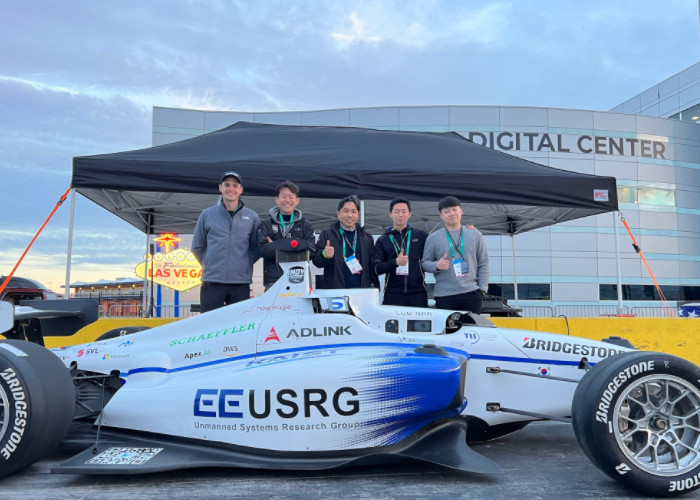
< A self-driving race car with an algorithm designed by Team KAIST speeds up on the track of the Las Vegas Motor Speedway on Jan. 7, 2022. The team finished 4th in the inaugural CES Autonomous Racing Competition >
Team KAIST led by Professor Hyunchul Shim and Unmanned Systems Research Group (USRG) placed fourth in an autonomous race car competition in Las Vegas last week, making its presence felt in the self-driving automotive tech industry.
Team KAIST, beat its first competitor, Auburn University, with speeds of up to 131 mph at the Autonomous Challenge at CES held at the Las Vegas Motor Speedway. However, the team failed to advance to the final round when it lost to PoliMOVE, comprised of the Polytechnic University of Milan and the University of Alabama, the final winner of the $150,000 USD race.
A total of eight teams competed in the self-driving race. The race was conducted as a single elimination tournament consisting of multiple rounds of matches. Two cars took turns playing the role of defender and attacker, and each car attempted to outpace the other until one of them was unable to complete the mission.
Each team designed the algorithm to control its racecar, the Dallara-built AV-21, which can reach a speed of up to 173 mph, and make it safely drive around the track at high speeds without crashing into the other.
The event is the CES version of the Indy Autonomous Challenge, a competition that took place for the first time in October last year to encourage university students from around the world to develop complicated software for autonomous driving and advance relevant technologies. Team KAIST placed 4th at the Indy Autonomous Challenge, which qualified it to participate in this race.
“The technical level of the CES race is much higher than last October’s and we had a very tough race. We advanced to the semifinals for two consecutive races. I think our autonomous vehicle technology is proving itself to the world,” said Professor Shim.
Professor Shim’s research group has been working on the development of autonomous aerial and ground vehicles for the past 12 years. A self-driving car developed by the lab was certified by the South Korean government to run on public roads.
The vehicle the team used cost more than 1 million USD to build. Many of the other teams had to repair their vehicle more than once due to accidents and had to spend a lot on repairs. “We are the only one who did not have any accidents, and this is a testament to our technological prowess,” said Professor Shim.
He said the financial funding to purchase pricy parts and equipment for the racecar is always a challenge given the very tight research budget and absence of corporate sponsorships.
However, Professor Shim and his research group plan to participate in the next race in September and in the 2023 CES race.
“I think we need more systemic and proactive research and support systems to earn better results but there is nothing better than the group of passionate students who are taking part in this project with us,” Shim added.
-
research Longevity mediated by suppressing age-associated circRNA
< (Back row from left) Prof. Yoon Ki Kim, Prof. Seung-Jae V. Lee, and Gwangrog Lee; (Front row from left) Dr. Sung Ho Boo, Sieun S. Kim, Seokjin Ham, and (top) Donghun Lee > Cells in our bodies produce RNA based on genetic information stored in DNA, and RNA serves as a blueprint for making proteins. Researchers at our university have discovered a new phenomenon: removing 'circular RNA' that accumulates in cells as we age can slow down aging and extend lifespan. This study provides cru
2026-03-18 -
research KAIST Develops Brain-Like AI… Thinks One More Time Even When Predictions Are Wrong
<(From left) Professor Sang Wan Lee, Myoung Hoon Ha, and Dr. Yoondo Sung> Artificial intelligence now plays Go, paints pictures, and even converses like a human. However, there remains a decisive difference: AI requires far more electricity than the human brain to operate. Scientists have long asked the question, “How can the brain learn so intelligently using so little energy?” KAIST researchers have moved one step closer to the answer. KAIST (President Kwang Hyung Lee) an
2026-03-06 -
people KAIST Extends Its Deepest Condolences on the Passing of the Late Chairman Chang Sun Jung, Founder of Jungheung Group
KAIST extends its deepest condolences on the passing of the late Chairman Chang Sun Jung, founder of Jungheung Group. Chairman Jung made significant contributions to the development of Korea’s construction industry and regional economy, and was a visionary leader who deeply recognized and actively supported the importance of nurturing science and technology talent. In particular, through his generous contribution to the KAIST Development Fund, he left a meaningful legacy in fostering fu
2026-02-03 -
research Discovery of a Switch to Halt Adipocyte Generation
< (From left) Dr. Ju-Gyeong Kang, Ph.D candidate TaeJun Seol, Professor Dae-Sik Lim > Metabolic diseases such as obesity, fatty liver, and insulin resistance are rapidly increasing worldwide, but fundamental methods to regulate the process of fat formation remain limited. In particular, once adipocytes (fat cells) are formed, they are difficult to reduce, making treatment challenging. Amidst this, a research team from our university has discovered the existence of a ‘switch&rsquo
2026-01-26 -
event KAIST to Showcase K-Tech Competitiveness at KAIST Pavilion during CES 2026
< Figure 1. Bird's-eye view of the KAIST Pavilion at CES 2026 > KAIST announced on January 2nd that it will participate in the Consumer Electronics Show (CES 2026), held from January 6 to 9, 2026, at Eureka Park in the Venetian Expo, Las Vegas. KAIST will operate a dedicated 111㎡ "KAIST Pavilion" to showcase its innovative technologies to global corporations and investors. A total of 12 startups will participate in the KAIST Pavilion at CES 2026. Notably, eight of these companies are b
2026-01-02