policy
The benchmark for the responsible usage of AI technology in the healthcare sector will promote clarity and high standards for technological applications
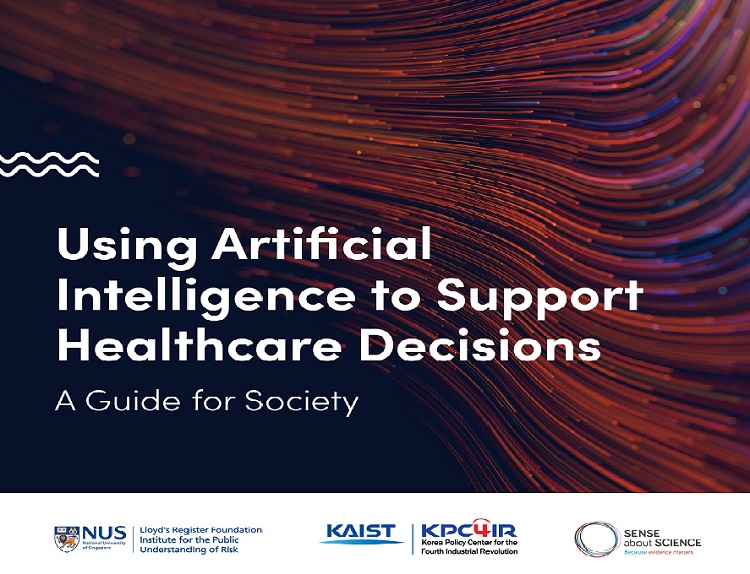
< AI Guide for healthcare sector published by KAIST, NUS, and Sense about Science. >
The KAIST Korea Policy Center for the Fourth Industrial Revolution (KPC4IR) published 'Using AI to Support Healthcare Decisions: A Guide for Society.' This global guide is designed to serve as a benchmark for the responsible usage of AI technologies, and will promote clarity and high standards for technological applications in the healthcare sector. The guide details what should be considered when making clinical decisions to help reduce the chances of the AI giving false or misleading results.
The KPC4IR presented the guide in collaboration with the Lloyd’s Register Foundation Institute for the Public Understanding of Risk at the National University of Singapore (NUS IPUR) and Sense about Science, a non-profit organization in the UK specialized in science communication, during the 2021 SIG-KDD (Special Interest Group on Knowledge Discovery and Data Mining) Conference on August 15.
AI technology is being widely used in the healthcare sector and has already proved its accuracy and efficiency in diagnosing and predicting diseases. Despite its huge impact on our daily lives in every sector of society, AI technology has some drawbacks and comes with risks, especially due to biased algorithms.
“We focused on the ‘reliability’ of AI applications in the healthcare sector to make all data well represented, in good quality. The technology will eventually innovate to better serve the people’s new demand, especially critical demands for safety and precision in healthcare services. This global guide will help both developers and people’s understanding of the appropriate technology applications,” says Director So Young Kim at the KPC4IR.
The guide, for instance, says that to scrutinize quality and reliability, the source of the data must be clearly known; the data must have been collected or selected for the purpose it’s being used for; the limitations and assumptions for that purpose have been clearly stated; the biases have been addressed; and it has been properly tested in the real world. It also reflects the importance of the representativeness of data that will affect the accuracy of the AI applications.
“By being transparent and demonstrating the steps taken to check that the AI is reliable, researchers and developers can help give people confidence about providing their data,” the guide states.
For this guide, the KPC4IR and its collaborators collected data after working with numerous experts from the Graduate School of AI at KAIST, the Science and Technology Policy Institute in Korea, Asan Medical Center in Seoul, Seoul National University Bundang Hospital, and AI solution companies.
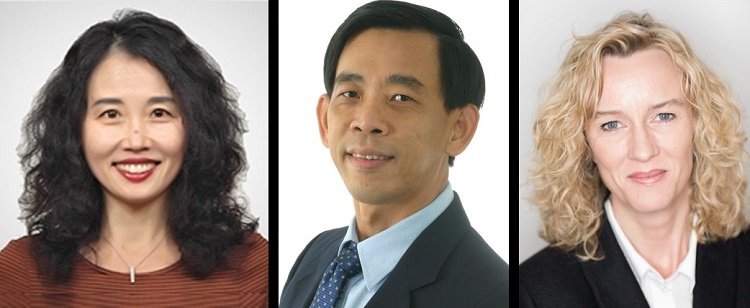
< From left: Director So Young Kim at KAIST KPC4IR, Director Chan Ghee Koh at NUS IPUR, and Director Tracey Brown OBE at Sense about Science. >
-
event “Entrepreneurial Mutual Growth Fair 2026” to be Held... KAIST Super Star Companies Gather for AI Solopreneurship, Tech Commercialization, Investment, and Youth Job Fair
KAIST announced that it will host the ‘AI Agent-Based Solopreneurship Program Information Session’ and the ‘Entrepreneurial Mutual Growth Fair 2026’ for two days from May 18th to 19th. In this event, KAIST’s new AI-based solopreneurship model, which utilizes AI not merely as an operational tool but as a ‘Co-founder,’ will be introduced in depth. The university will hold an information session for the ‘AI Solopreneur Support Project,’ whic
2026-05-13 -
event Professor Yiyun Kang Selected as TED 2026 Main Stage Speaker
< Professor Yiyun Kang (Photo Credit: Ryan Lash / TED) > KAIST announced on April 17th that Professor Yiyun Kang of the Department of Industrial Design has been selected as a speaker for the Main Stage at TED 2026, the world-renowned knowledge conference. Founded in 1984 under the motto "Ideas Worth Spreading," TED is an American non-profit knowledge platform where scholars, innovators, and artists from around the globe gather annually to lead global discourse. Previous Korean speakers
2026-04-18 -
research Breakthrough in Data Processing via Light Control... Enhancing AI Accelerators and Quantum Communication
< (From left) Undergraduate researcher Taewon Kim and Professor Sangsik Kim > A new technology has been developed that allows light to be "designed" into desired forms, potentially making Artificial Intelligence (AI) and communication technologies faster and more accurate. A KAIST research team has developed an "integrated photonic resonator"—a core component of next-generation optical integrated circuits that process data using light. The research is particularly significant as i
2026-04-16 -
event AI, Humanoid Robots, and Space Rovers to Gather: Experience Future Technologies at the Science Festival
<(From left) Photos of the KAIST Science Festival exhibition hall and booths from the previous year> KAIST announced on April 10th that KAIST will participate in the ‘2026 Korea Science and Technology Festival,’ the largest science festival in the country, to mark Science Month in April. KAIST will operate ‘KAIST Play World,’ an interactive exhibition hall showcasing the pinnacle of AI and robotics. This year’s festival will be held in two parts: ‘20
2026-04-13 -
research InnoCORE Research Group Successfully Achieves AI Protein Design with Nobel Laureate David Baker
< (From left) Professor Gyu Rie Lee, Professor David Baker > Under the foundation of research cooperation established through the Ministry of Science and ICT's InnoCORE (InnoCORE) project, KAIST InnoCORE researchers have derived meaningful research results. Following a visit by Professor David Baker (University of Washington, USA), the 2024 Nobel Laureate in Chemistry, KAIST has revealed research findings on designing proteins that accurately recognize desired compounds using AI through
2026-04-09