security
-
 KAIST studnets win 2014 Creative Vitamin Project Competition
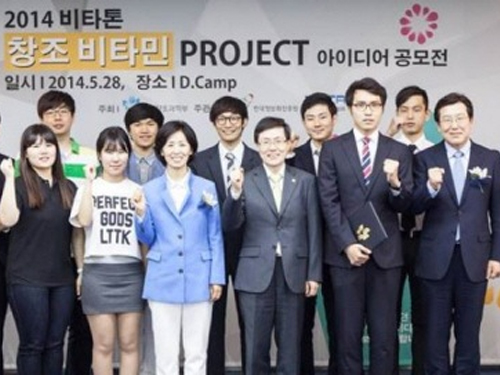
A team of KAIST students have won the grand prize for the “2014 Creative Vitamin Project Competition” held on May 28, 2014 in Seoul. The event was co-hosted by the Ministry of Science, ICT and Future Planning, National Information Society Agency, and Korea IT Convergence Technology Association. The Creative Vitamin Project is the Korean government’s initiative to grow the Korean economy and generate job creation by applying science and technology, information and communications technology in particular, to the existing industry and social issues.
The winners were Hyeong-Min Son, a student in the master’s program in the Department of Civil and Environmental Engineering, KAIST and Su-Yeon Yoo, a Ph.D. student from the Graduate School of Information Security, KAIST.
Son and Yoo proposed a sustainable crop protection system using directional speakers. This technique not only efficiently protects crops from harmful animals, but also effectively guides the animals outside the farmland.
Kwang-Soo Jang, the Director of the National Information Society Agency, said, “This competition provides an opportunity to develop public consensus and interest in the Creative Vitamin Project. We hope that through the participation of all citizens, the project can become an instrument to realizing the creative economy.”
2014.06.18 View 8363
KAIST studnets win 2014 Creative Vitamin Project Competition
A team of KAIST students have won the grand prize for the “2014 Creative Vitamin Project Competition” held on May 28, 2014 in Seoul. The event was co-hosted by the Ministry of Science, ICT and Future Planning, National Information Society Agency, and Korea IT Convergence Technology Association. The Creative Vitamin Project is the Korean government’s initiative to grow the Korean economy and generate job creation by applying science and technology, information and communications technology in particular, to the existing industry and social issues.
The winners were Hyeong-Min Son, a student in the master’s program in the Department of Civil and Environmental Engineering, KAIST and Su-Yeon Yoo, a Ph.D. student from the Graduate School of Information Security, KAIST.
Son and Yoo proposed a sustainable crop protection system using directional speakers. This technique not only efficiently protects crops from harmful animals, but also effectively guides the animals outside the farmland.
Kwang-Soo Jang, the Director of the National Information Society Agency, said, “This competition provides an opportunity to develop public consensus and interest in the Creative Vitamin Project. We hope that through the participation of all citizens, the project can become an instrument to realizing the creative economy.”
2014.06.18 View 8363 -
 Cyber Security MOU between KAIST and Yeungnam University College (YNC)
The KAIST Cyber Security Research Center and the Department of Cyber Security at Yeungnam University College (YNC) signed a memorandum of understating (MOU) on May 12, 2014 at the YNC campus to cooperate in cyber security education and technological development.
In the MOU, KAIST and YNC agreed to collaborate for the training of professional personnel and the development of new technology for the strengthening of national cyber security, as well as the common use of mutual research environments and group participation of core tasks.
As a result of the MOU interaction, the KAIST Cyber Security Research Center and the Department of Cyber Security at YNC will pursue mutual development through the joint management of the latest educational training programs for cyber security and information protection and the development of up-to-date security technology suited for nuclear energy infrastructures and regional electronic industry complexes. They will also hold joint research seminars and forums.
The Director of the Cyber Security Research Center, Professor Dae-Joon Joo (KAIST Graduate School of Information Security) commented, “With a great deal of experience in the field of cyber security, KAIST, and its excellence in education and research areas, will contribute in many ways, such as increasing the supply of expert cyber-security personnel in the Daegu-Kyungbuk region and actively participate toward greater national cyber security through this collaboration agreement.”
[Picture]
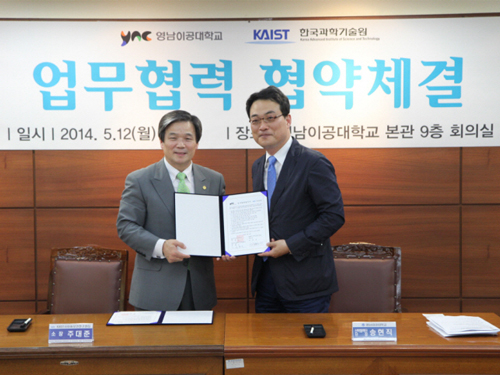
Dae-Jun Joo, KAIST Cyber Security Research Center Director (Left) and Hyun-Jig Song (Right), Chief of Industry-Academic Cooperation Foundation at Yeungnam University College, pose after signing the cooperation agreement on cyber security.
2014.05.17 View 7953
Cyber Security MOU between KAIST and Yeungnam University College (YNC)
The KAIST Cyber Security Research Center and the Department of Cyber Security at Yeungnam University College (YNC) signed a memorandum of understating (MOU) on May 12, 2014 at the YNC campus to cooperate in cyber security education and technological development.
In the MOU, KAIST and YNC agreed to collaborate for the training of professional personnel and the development of new technology for the strengthening of national cyber security, as well as the common use of mutual research environments and group participation of core tasks.
As a result of the MOU interaction, the KAIST Cyber Security Research Center and the Department of Cyber Security at YNC will pursue mutual development through the joint management of the latest educational training programs for cyber security and information protection and the development of up-to-date security technology suited for nuclear energy infrastructures and regional electronic industry complexes. They will also hold joint research seminars and forums.
The Director of the Cyber Security Research Center, Professor Dae-Joon Joo (KAIST Graduate School of Information Security) commented, “With a great deal of experience in the field of cyber security, KAIST, and its excellence in education and research areas, will contribute in many ways, such as increasing the supply of expert cyber-security personnel in the Daegu-Kyungbuk region and actively participate toward greater national cyber security through this collaboration agreement.”
[Picture]
Dae-Jun Joo, KAIST Cyber Security Research Center Director (Left) and Hyun-Jig Song (Right), Chief of Industry-Academic Cooperation Foundation at Yeungnam University College, pose after signing the cooperation agreement on cyber security.
2014.05.17 View 7953 -
 Partnership Agreement between KAIST and SK Telecom for Cyber Security
KAIST
and SK Telecom, one of the largest wireless telecommunications operators in
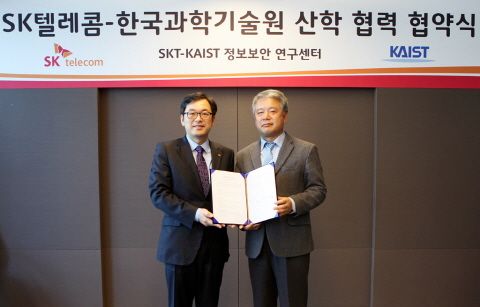
Korea, signed a memorandum of understanding on the industry and university cooperation
to establish a research center for cyber security on March 18, 2014.
The
center will conduct research projects to improve privacy protection, develop core
technologies needed for cyber security, train engineers and researchers, and
host seminars and conferences.
The
two organizations will implement the first joint research project on the
development of software-defined network-based solutions and universal subscriber
identity module-based personal identification solutions.
2014.03.26 View 6101
Partnership Agreement between KAIST and SK Telecom for Cyber Security
KAIST
and SK Telecom, one of the largest wireless telecommunications operators in
Korea, signed a memorandum of understanding on the industry and university cooperation
to establish a research center for cyber security on March 18, 2014.
The
center will conduct research projects to improve privacy protection, develop core
technologies needed for cyber security, train engineers and researchers, and
host seminars and conferences.
The
two organizations will implement the first joint research project on the
development of software-defined network-based solutions and universal subscriber
identity module-based personal identification solutions.
2014.03.26 View 6101 -
 MOU: KAIST-Korea Internet & Security Agency
KAIST signed a MOU with the Korea Internet & Security Agency for the development of IT and International Security.
As a result of the MOU interaction in ▲Exchange of personnel and materials for cooperative research for information protection ▲Information protection policy and technology ▲Education and training for developing information protection personnel, will be increased.
Director of Cyber Security Research Center Joo Dae Joon commented, “Cyber-attack on national infrastructure like DDOS attacks can threaten the nation’s system” and that “the two institutes will establish a response system against cyber-attacks and train experts in information protection”.
2012.01.31 View 6425
MOU: KAIST-Korea Internet & Security Agency
KAIST signed a MOU with the Korea Internet & Security Agency for the development of IT and International Security.
As a result of the MOU interaction in ▲Exchange of personnel and materials for cooperative research for information protection ▲Information protection policy and technology ▲Education and training for developing information protection personnel, will be increased.
Director of Cyber Security Research Center Joo Dae Joon commented, “Cyber-attack on national infrastructure like DDOS attacks can threaten the nation’s system” and that “the two institutes will establish a response system against cyber-attacks and train experts in information protection”.
2012.01.31 View 6425 -
 Bicycle Sharing System "Ta-Shu" Arrives at KAIST.
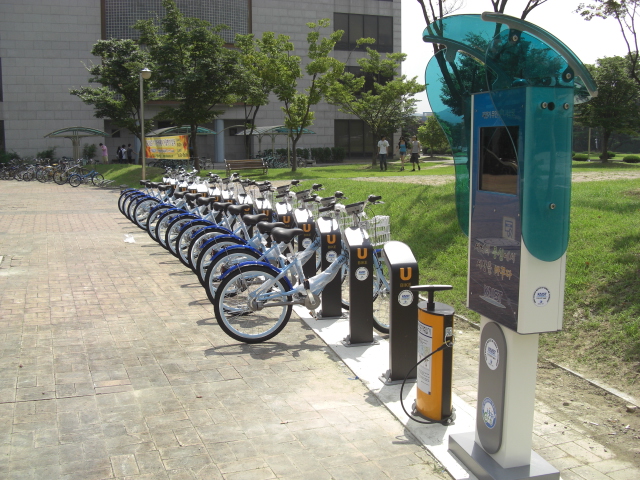
KAIST has begun providing a bike rental service, called “Ta-Shu,” to its students. This bicycle sharing system, implemented in tandem with the local city government, has been in service since the 7th of September and will allow KAIST students to rent bicycles for travel within campus and even to other parts of the city, Daejeon.
The ‘University Pubic-Bicycle Rental System’ is a program in which numbers of bicycles are made available for shared use by students. Initiated by the Ministry of Public Administration and Security, the university expects that more students will use bicycles as part of their daily mobility means through this system.
2011.09.22 View 7442
Bicycle Sharing System "Ta-Shu" Arrives at KAIST.
KAIST has begun providing a bike rental service, called “Ta-Shu,” to its students. This bicycle sharing system, implemented in tandem with the local city government, has been in service since the 7th of September and will allow KAIST students to rent bicycles for travel within campus and even to other parts of the city, Daejeon.
The ‘University Pubic-Bicycle Rental System’ is a program in which numbers of bicycles are made available for shared use by students. Initiated by the Ministry of Public Administration and Security, the university expects that more students will use bicycles as part of their daily mobility means through this system.
2011.09.22 View 7442 -
'S+ Convergence CEO Program' Completion Ceremony
KAIST will be holding the first Completion Ceremony for the ‘S+ Convergence CEO Program’ which is a differentiated course with a new paradigm. The program offers a different syllabus from the existing CEO training programs and focuses on the fusion of industries and IT, fusion of management and security, and fusing together other future technologies. The course should provide the future CEO’s with the ability to plot a suitable creative management strategy in this day of rapid change and growth.
The program invited a guest speaker every month, apart from the planed lectures. The guest speakers were the top of their respective fields. In addition, various activities like riding the OLEV or domestic workshops or educational trips abroad imparted the ability to take on a global perspective.
The use of Social Network Services like twitter or facebook was educated in the free study period before the lecture began. As a result most of the graduates can now use these SNS freely, better preparing them for the technology oriented direction the world is striving in.
The program will have a total of 54 graduates who come from companies from various industries, are politicians, and/or are government officials.
The program name “S+ Convergence CEO Program” is imbedded with the program goal of training the best CEO’s by fusing together Smart Technology, Security, and Strategy.
2011.03.18 View 7849
-
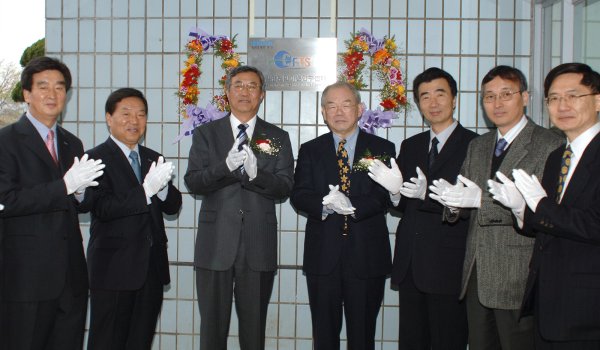 KAIST Opens CFTS
- To research the prevention of the illegal production of security technologies
- Total 1.5 billion won of research expenses and 102 researchers to be invested for the next three years- Opening ceremony at the computer science building, KAIST on April 13 at 10 am
KAIST (President Nam-Pyo Suh) will open ‘the Center of Fusion Technology for Security (CFTS)’ under the auspices of the Korea Minting & Security Printing Corporation (KOMSCO, President Hae-Sung Lee) to undertake researches over the prevention of illegal reproduction of security technologies. The opening ceremony was held at the computer science building, KAIST on Friday, April 13.
Total .1.5 billion won of research expenses and 102 researchers will be invested in the center for the next three years.
Main research fields are ▲ advanced IT-based information concealment methods ▲ utilization of energy transfer luminescence in host guest nano-substances ▲ the utilization of quantum-dot, non-crystal carbon and piezoelectric elements ▲ development of radio frequency identification (RFID), optical, biological security element-applied technologies, etc.
“We’ll develop fusion technologies for security that can easily detect forgeries and alterations of security products by introducing advanced IT, optical, chemical engineering, and biological elements. The development of core technologies applied to security products will activate domestic security markets and enable the export of relevant technologies,” said General Research Director Heung-Kyu Lee, a professor of Computer Sciences.
2007.04.19 View 11732
KAIST Opens CFTS
- To research the prevention of the illegal production of security technologies
- Total 1.5 billion won of research expenses and 102 researchers to be invested for the next three years- Opening ceremony at the computer science building, KAIST on April 13 at 10 am
KAIST (President Nam-Pyo Suh) will open ‘the Center of Fusion Technology for Security (CFTS)’ under the auspices of the Korea Minting & Security Printing Corporation (KOMSCO, President Hae-Sung Lee) to undertake researches over the prevention of illegal reproduction of security technologies. The opening ceremony was held at the computer science building, KAIST on Friday, April 13.
Total .1.5 billion won of research expenses and 102 researchers will be invested in the center for the next three years.
Main research fields are ▲ advanced IT-based information concealment methods ▲ utilization of energy transfer luminescence in host guest nano-substances ▲ the utilization of quantum-dot, non-crystal carbon and piezoelectric elements ▲ development of radio frequency identification (RFID), optical, biological security element-applied technologies, etc.
“We’ll develop fusion technologies for security that can easily detect forgeries and alterations of security products by introducing advanced IT, optical, chemical engineering, and biological elements. The development of core technologies applied to security products will activate domestic security markets and enable the export of relevant technologies,” said General Research Director Heung-Kyu Lee, a professor of Computer Sciences.
2007.04.19 View 11732