publication
-
 The Korea Herald: Synthetic Biology Holds Key to Future
The Korea Herald
, a leading English newspaper in Korea, published an article on the production of gasoline by a metabolically engineered microorganism. For the article, please go to the link below:
The Korea Herald
March 14, 2014
"Synthetic biology holds key to future"
KAIST professor makes breakthrough in biorefining using E. coli’s metabolic process
http://www.koreaherald.com/view.php?ud=20140314001343
2014.03.17 View 6018
The Korea Herald: Synthetic Biology Holds Key to Future
The Korea Herald
, a leading English newspaper in Korea, published an article on the production of gasoline by a metabolically engineered microorganism. For the article, please go to the link below:
The Korea Herald
March 14, 2014
"Synthetic biology holds key to future"
KAIST professor makes breakthrough in biorefining using E. coli’s metabolic process
http://www.koreaherald.com/view.php?ud=20140314001343
2014.03.17 View 6018 -
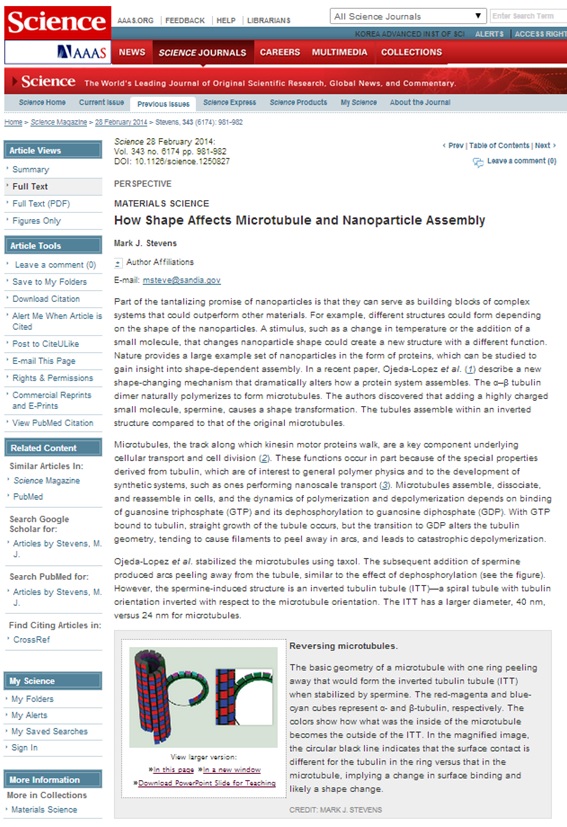 A research paper by Professor Myung-Chul Choi reviewed in Science (February 28, 2014)
A research paper entitled “Transformation of taxol-stabilized microtubules into inverted tubulin tubules triggered by a tubulin conformation switch” was published in
Nature Materials
this year, dated January 19, 2014.
Professor Myung-Chul Choi and Dr. Chae-Yeon Song from the Department of Bio and Brain Engineering at KAIST co-authored the paper together with researchers from the University of California in Santa Barbara and the Hebrew University of Jerusalem.
Science,
dated February 28, 2014, has recently reviewed the paper in its section called "Perspectives."
2014.03.13 View 7456
A research paper by Professor Myung-Chul Choi reviewed in Science (February 28, 2014)
A research paper entitled “Transformation of taxol-stabilized microtubules into inverted tubulin tubules triggered by a tubulin conformation switch” was published in
Nature Materials
this year, dated January 19, 2014.
Professor Myung-Chul Choi and Dr. Chae-Yeon Song from the Department of Bio and Brain Engineering at KAIST co-authored the paper together with researchers from the University of California in Santa Barbara and the Hebrew University of Jerusalem.
Science,
dated February 28, 2014, has recently reviewed the paper in its section called "Perspectives."
2014.03.13 View 7456 -
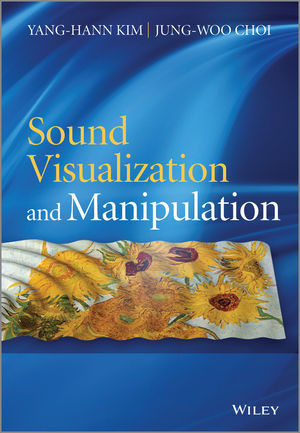 Book Announcement: Sound Visualization and Manipulation
The movie
Gravity
won seven Oscar awards this year, one of which was for its outstanding 3D sound mixing, immersing viewers in the full experience of the troubled space expedition.
3D audio effects are generated by manipulating the sound produced by speakers, speaker-arrays, or headphones to place a virtual sound source at a desired location in 3D space such as behind, above, or below the listener's head.
Two professors from the Department of Mechanical Engineering at KAIST have recently published a book that explains two important technologies related to 3D sound effects: sound visualization and manipulation.
Professor Yang-Hann Kim, an eminent scholar in sound engineering, and Professor Jung-Woo Choi collaborated to write Sound Visualization and Manipulation (Wily 2013), which uniquely addresses the two most important problems in the field in a unified way.
The book introduces general concepts and theories and describes a number of techniques in sound visualization and manipulation, offering an interrelated approach to two very different topics: sound field visualization techniques based on microphone arrays and controlled sound field generation techniques using loudspeaker arrays.
The authors also display a solid understanding of the associated physical and mathematical concepts applied to solve the visualization and manipulation problems and provide extensive examples demonstrating the benefits and drawbacks of various applications, including beamforming and acoustic holography technology.
The book will be an excellent reference for graduate students, researchers, and professionals in acoustic engineering, as well as in audio and noise control system development.
For detailed descriptions of the book:
http://as.wiley.com/WileyCDA/WileyTitle/productCd-1118368479.html
2014.03.10 View 9628
Book Announcement: Sound Visualization and Manipulation
The movie
Gravity
won seven Oscar awards this year, one of which was for its outstanding 3D sound mixing, immersing viewers in the full experience of the troubled space expedition.
3D audio effects are generated by manipulating the sound produced by speakers, speaker-arrays, or headphones to place a virtual sound source at a desired location in 3D space such as behind, above, or below the listener's head.
Two professors from the Department of Mechanical Engineering at KAIST have recently published a book that explains two important technologies related to 3D sound effects: sound visualization and manipulation.
Professor Yang-Hann Kim, an eminent scholar in sound engineering, and Professor Jung-Woo Choi collaborated to write Sound Visualization and Manipulation (Wily 2013), which uniquely addresses the two most important problems in the field in a unified way.
The book introduces general concepts and theories and describes a number of techniques in sound visualization and manipulation, offering an interrelated approach to two very different topics: sound field visualization techniques based on microphone arrays and controlled sound field generation techniques using loudspeaker arrays.
The authors also display a solid understanding of the associated physical and mathematical concepts applied to solve the visualization and manipulation problems and provide extensive examples demonstrating the benefits and drawbacks of various applications, including beamforming and acoustic holography technology.
The book will be an excellent reference for graduate students, researchers, and professionals in acoustic engineering, as well as in audio and noise control system development.
For detailed descriptions of the book:
http://as.wiley.com/WileyCDA/WileyTitle/productCd-1118368479.html
2014.03.10 View 9628 -
 K-Glass: Korea's Answer to Google Glass
Wall Street Journal (blog) published an
article on the K-Glass developed by Professor Hoi-Jun Yoo of Electrical
Engineering at KAIST. For the article, please go to the link below:
K-Glass: Korea’s Answer to Google Glass, March 5, 2014
http://blogs.wsj.com/digits/2014/03/05/meet-k-glass-koreas-answer-to-google-glass/
2014.03.07 View 6272
K-Glass: Korea's Answer to Google Glass
Wall Street Journal (blog) published an
article on the K-Glass developed by Professor Hoi-Jun Yoo of Electrical
Engineering at KAIST. For the article, please go to the link below:
K-Glass: Korea’s Answer to Google Glass, March 5, 2014
http://blogs.wsj.com/digits/2014/03/05/meet-k-glass-koreas-answer-to-google-glass/
2014.03.07 View 6272 -
 Times Higher Education 2014 World Reputation Rankings
Times Higher Education released the 2014 World Reputation Rankings on March 6, 2014. KAIST moved from the 61-70 band in 2013 to the 51-60 place this year. For details, please visit the link below:
http://www.scoop.co.nz/stories/WO1403/S00091/times-higher-education-2014-world-reputation-rankings.htm
2014.03.07 View 6261
Times Higher Education 2014 World Reputation Rankings
Times Higher Education released the 2014 World Reputation Rankings on March 6, 2014. KAIST moved from the 61-70 band in 2013 to the 51-60 place this year. For details, please visit the link below:
http://www.scoop.co.nz/stories/WO1403/S00091/times-higher-education-2014-world-reputation-rankings.htm
2014.03.07 View 6261 -
 Quacquarelli Symonds (QS) World University Rankings by Subject 2014
The QS
World University Rankings are annual university rankings published by
Quacquarelli Symonds (QS) which provides the overall rankings of top global
universities as well as the rankings for individual subjects. The 2014 QS World
University Rankings by Subject is a comprehensive guide to the world’s best universities
in 30 popular subjects of 5 academic disciplines: arts & humanities,
engineering & technology, life sciences & medicine, natural sciences,
and social sciences.
According
to the 2014 subject rankings, released on February 26, KAIST made the list of top
50 universities in 9 subjects: physics & astronomy; materials sciences;
chemistry; chemical engineering; mechanical, aeronautical & manufacturing
engineering; electrical & electronic engineering; civil & structural engineering;
computer science & information systems; and biological sciences.
Among
them, KAIST was ranked number one in Korea for 5 subjects: materials sciences
(16th); mechanical, aeronautical & manufacturing engineering (21st);
civil & structural engineering (32nd); computer science &
information systems (36th), and biological sciences (43rd).
For basic sciences, KAIST has made good progress as well. For example, in
mathematics, KAIST took first place in Korea and was ranked in the 51st-100th
of the world’s top universities. Another notable result was that its business college
in Seoul campus, a relatively new addition to KAIST, made the rankings list of
51st-100th in accounting & finance.
The 2014
QS subject rankings used the following criteria for its evaluation of
university performance: a survey of academic and employer reputation, citations
per paper, inclusion of specialists, and the h-index, known as the Hirsch index or Hirsch number, which was
suggested by Jorge E. Hirsch, a physicist at the University of California in
San Diego, as a tool for determining theoretical physicists’ relative quality.
Today, the h-index is used to measure
both the productivity and impact of the published work of a scientist or
scholar.
2014.02.28 View 9362
Quacquarelli Symonds (QS) World University Rankings by Subject 2014
The QS
World University Rankings are annual university rankings published by
Quacquarelli Symonds (QS) which provides the overall rankings of top global
universities as well as the rankings for individual subjects. The 2014 QS World
University Rankings by Subject is a comprehensive guide to the world’s best universities
in 30 popular subjects of 5 academic disciplines: arts & humanities,
engineering & technology, life sciences & medicine, natural sciences,
and social sciences.
According
to the 2014 subject rankings, released on February 26, KAIST made the list of top
50 universities in 9 subjects: physics & astronomy; materials sciences;
chemistry; chemical engineering; mechanical, aeronautical & manufacturing
engineering; electrical & electronic engineering; civil & structural engineering;
computer science & information systems; and biological sciences.
Among
them, KAIST was ranked number one in Korea for 5 subjects: materials sciences
(16th); mechanical, aeronautical & manufacturing engineering (21st);
civil & structural engineering (32nd); computer science &
information systems (36th), and biological sciences (43rd).
For basic sciences, KAIST has made good progress as well. For example, in
mathematics, KAIST took first place in Korea and was ranked in the 51st-100th
of the world’s top universities. Another notable result was that its business college
in Seoul campus, a relatively new addition to KAIST, made the rankings list of
51st-100th in accounting & finance.
The 2014
QS subject rankings used the following criteria for its evaluation of
university performance: a survey of academic and employer reputation, citations
per paper, inclusion of specialists, and the h-index, known as the Hirsch index or Hirsch number, which was
suggested by Jorge E. Hirsch, a physicist at the University of California in
San Diego, as a tool for determining theoretical physicists’ relative quality.
Today, the h-index is used to measure
both the productivity and impact of the published work of a scientist or
scholar.
2014.02.28 View 9362 -
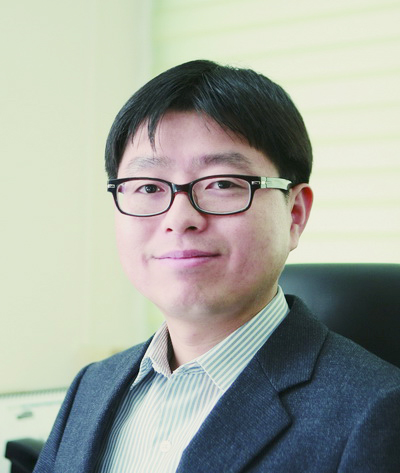 Phys.org: Researchers develop non-iridescent, structural, full-spectrum pigments for reflective displays
The latest research work by Professor Shin-Hyun Kim of Chemical and Biomolecular Engineering at KAIST on the “microcapsulation og photonic crystals using osmotic pressure” has been published by Phys.org, a leading web-based science, research and technology news. For the articles, please click the link below:February 20, 2014Researchers develop non-iridescent, structural, full-spectrum pigments for reflective displayshttp://phys.org/news/2014-02-non-iridescent-full-spectrum-pigments.html
2014.02.21 View 6689
Phys.org: Researchers develop non-iridescent, structural, full-spectrum pigments for reflective displays
The latest research work by Professor Shin-Hyun Kim of Chemical and Biomolecular Engineering at KAIST on the “microcapsulation og photonic crystals using osmotic pressure” has been published by Phys.org, a leading web-based science, research and technology news. For the articles, please click the link below:February 20, 2014Researchers develop non-iridescent, structural, full-spectrum pigments for reflective displayshttp://phys.org/news/2014-02-non-iridescent-full-spectrum-pigments.html
2014.02.21 View 6689 -
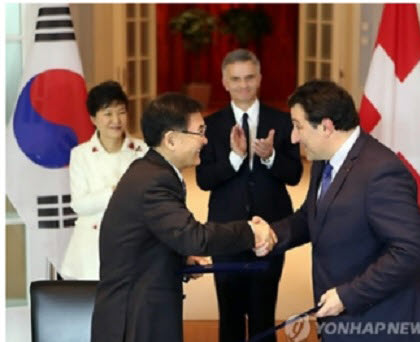 2014 Davos Forum: KAIST-EPFL Connection
The Korean-American Science and Technology News (KASTN), a biweekly global electronic newsletter carrying news and analyses in science and technology, as well as social, economic, and cultural issues related to the general interest of the Korean-American professional community, published an article on the partnership agreement made by KAIST and the Ecole Polytechnique Federale Lausanne (EPFL) during the 2014 World Economic Forum held at Davos, Switzerland, from January 22nd to 25th.
For the article, please click the link below: KASTN Issue 14-05, February 26, 2014
http://www.phy.duke.edu/~myhan/b_14-05.pdf
2014.02.04 View 7086
2014 Davos Forum: KAIST-EPFL Connection
The Korean-American Science and Technology News (KASTN), a biweekly global electronic newsletter carrying news and analyses in science and technology, as well as social, economic, and cultural issues related to the general interest of the Korean-American professional community, published an article on the partnership agreement made by KAIST and the Ecole Polytechnique Federale Lausanne (EPFL) during the 2014 World Economic Forum held at Davos, Switzerland, from January 22nd to 25th.
For the article, please click the link below: KASTN Issue 14-05, February 26, 2014
http://www.phy.duke.edu/~myhan/b_14-05.pdf
2014.02.04 View 7086 -
 The Huffington Post, January 30th, 2014: The Top Young Universities in the World, According to QS Rankings
KAIST was ranked third among the “QS Top 50 Under 50,” a ranking of the world’s top 50 universities established within the last 50 years, which was based on the highest performing young universities in the 2013/14 QS World University Rankings. For details, please read the news article below:
The Huffington Post, January 30th, 2014: The Top Young Universities in the World, According to QS Rankings: http://www.huffingtonpost.co.uk/2014/01/30/top-young-universities-in-world-qs-rankings_n_4693918.html
2014.02.03 View 5406
The Huffington Post, January 30th, 2014: The Top Young Universities in the World, According to QS Rankings
KAIST was ranked third among the “QS Top 50 Under 50,” a ranking of the world’s top 50 universities established within the last 50 years, which was based on the highest performing young universities in the 2013/14 QS World University Rankings. For details, please read the news article below:
The Huffington Post, January 30th, 2014: The Top Young Universities in the World, According to QS Rankings: http://www.huffingtonpost.co.uk/2014/01/30/top-young-universities-in-world-qs-rankings_n_4693918.html
2014.02.03 View 5406 -
 Nanoparticle based Super Lens selected as 2013 Science and Technology News
Professor Yong-keun Park
"Nanoparticle-based Super Lens", an article by KAIST Physics Department’s Professor Yong-keun Park and Professor Yong-hoon Cho’s joint research team, has been selected as one of the ten representative 2013 Science and Technology News, by the Korea Federation of Science and Technology Societies.
This new concept super lens uses the scattering of light, which can yield over three times more superior resolution of previous optical lenses.
Unlike the conventional optical lens that utilizes refraction of the light, the super lens can give the image of viruses and structure within the cell at 100㎚. This lens is also applicable to state-of-the-art optical and semiconductor processes.
In addition, this year's research achievements also include the successful launch of Naro, a new technology to remove the brain cell membrane which gives a more transparent view of the brain, a new drug to inhibit cancer metastasis, as well as the development of ultra-wide-angle insect eye camera technology.
Articles for 2013 Science and Technology News are chosen in three trial reviews by committee and online voting by 5,437 people over the course of [two weeks]14 days, from November 21st to December 4th.
2013.12.14 View 8006
Nanoparticle based Super Lens selected as 2013 Science and Technology News
Professor Yong-keun Park
"Nanoparticle-based Super Lens", an article by KAIST Physics Department’s Professor Yong-keun Park and Professor Yong-hoon Cho’s joint research team, has been selected as one of the ten representative 2013 Science and Technology News, by the Korea Federation of Science and Technology Societies.
This new concept super lens uses the scattering of light, which can yield over three times more superior resolution of previous optical lenses.
Unlike the conventional optical lens that utilizes refraction of the light, the super lens can give the image of viruses and structure within the cell at 100㎚. This lens is also applicable to state-of-the-art optical and semiconductor processes.
In addition, this year's research achievements also include the successful launch of Naro, a new technology to remove the brain cell membrane which gives a more transparent view of the brain, a new drug to inhibit cancer metastasis, as well as the development of ultra-wide-angle insect eye camera technology.
Articles for 2013 Science and Technology News are chosen in three trial reviews by committee and online voting by 5,437 people over the course of [two weeks]14 days, from November 21st to December 4th.
2013.12.14 View 8006 -
 Rechargeable Lithium Sulfur Battery for Greater Battery Capacity
Professor Do Kyung Kim from the Department of Material Science and Engineering and Professor Jang Wook Choi from the Graduate School of EEWS have been featured in the lead story of the renowned nanoscience journal Advanced Materials for their research on the lithium sulfur battery. This new type of battery developed by Professor Kim is expected to have a longer life battery life and [higher] energy density than currently commercial batteries.
With ample energy density up to 2100Wh/kg—almost 5.4 times that of lithium ion batteries—lithium sulfur batteries can withstand the sharp decrease in energy capacity resulting from charging and discharging—which has been considered the inherent limitation of the conventional batteries.
Professor Kim and his research team used one-dimensional, vertical alignment of 75nm tick, 15μm long sulfur nanowires to maximize electric conductivity. Then, to prevent loss of battery life, they carbon-coated each nanowire and prohibited direct contact between the sulfur and electrolyte.
The result was one of the most powerful batteries in terms of both energy performance and density. Compared to conventional batteries which suffer from continuous decrease in energy capacity after being discharged, the lithium sulfur battery maintained 99.2% of its initial capacity after being charged and discharged 300 times and up to 70% even after 1000 times.
Professor Kim claims that his new battery is an important step forward towards a high-performance rechargeable battery which is a vital technology for unmanned vehicles, electric automobiles and energy storage. He hopes that his research can solve the problems of battery-capacity loss and contribute to South Korea’s leading position in battery technology. Professor Kim’s research team has filed applications for one domestic and international patent for their research.
2013.12.11 View 9365
Rechargeable Lithium Sulfur Battery for Greater Battery Capacity
Professor Do Kyung Kim from the Department of Material Science and Engineering and Professor Jang Wook Choi from the Graduate School of EEWS have been featured in the lead story of the renowned nanoscience journal Advanced Materials for their research on the lithium sulfur battery. This new type of battery developed by Professor Kim is expected to have a longer life battery life and [higher] energy density than currently commercial batteries.
With ample energy density up to 2100Wh/kg—almost 5.4 times that of lithium ion batteries—lithium sulfur batteries can withstand the sharp decrease in energy capacity resulting from charging and discharging—which has been considered the inherent limitation of the conventional batteries.
Professor Kim and his research team used one-dimensional, vertical alignment of 75nm tick, 15μm long sulfur nanowires to maximize electric conductivity. Then, to prevent loss of battery life, they carbon-coated each nanowire and prohibited direct contact between the sulfur and electrolyte.
The result was one of the most powerful batteries in terms of both energy performance and density. Compared to conventional batteries which suffer from continuous decrease in energy capacity after being discharged, the lithium sulfur battery maintained 99.2% of its initial capacity after being charged and discharged 300 times and up to 70% even after 1000 times.
Professor Kim claims that his new battery is an important step forward towards a high-performance rechargeable battery which is a vital technology for unmanned vehicles, electric automobiles and energy storage. He hopes that his research can solve the problems of battery-capacity loss and contribute to South Korea’s leading position in battery technology. Professor Kim’s research team has filed applications for one domestic and international patent for their research.
2013.12.11 View 9365 -
 KAIST Placed 3rd in the World's Best 100 Emerging Universities
The Times Higher Education (THE) published its world university rankings on June 20, 2013. It is a list of the best 100 universities whose histories are 50 years old or younger. KAIST was ranked 3rd in the list, two places up from the 5th last year. Forbes and Reuters carried a story on the top ten emerging universities out of the listed 100 institutions, highlighting strong showings in the Asian region. For the articles, please see the attached file (Forbes) or click the link (Reuters) below:
http://www.reuters.com/article/2013/06/19/education-university-rankings-idUSL2N0EU1HZ20130619
2013.06.22 View 6192
KAIST Placed 3rd in the World's Best 100 Emerging Universities
The Times Higher Education (THE) published its world university rankings on June 20, 2013. It is a list of the best 100 universities whose histories are 50 years old or younger. KAIST was ranked 3rd in the list, two places up from the 5th last year. Forbes and Reuters carried a story on the top ten emerging universities out of the listed 100 institutions, highlighting strong showings in the Asian region. For the articles, please see the attached file (Forbes) or click the link (Reuters) below:
http://www.reuters.com/article/2013/06/19/education-university-rankings-idUSL2N0EU1HZ20130619
2013.06.22 View 6192