conference
-
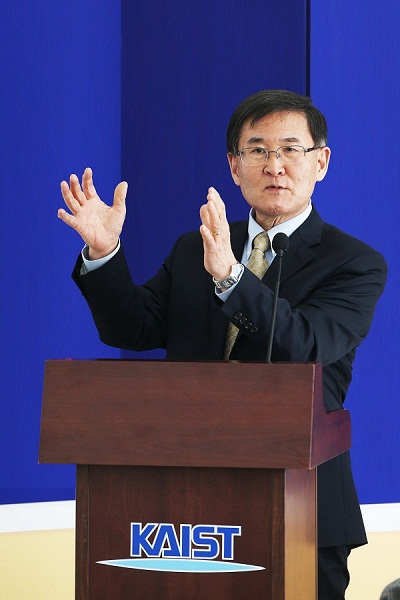 KAIST President Held One-year Anniversary Press Conference
President Steve Kang had a press conference
on February 25, 2014 at the Faculty Club on campus, commemorating the first
year of his presidency. About 30 different media representatives nationwide
attended the meeting.
At his first press conference on the anniversary of his tenure, President Kang
described what he has achieved in the past year, which were: 1) rebuilding the
campus culture to start a campaign for mutual respect, trust, and open
communication by holding meetings with the members of the KAIST community more
than 60 times, 2) establishing core values, creativity and challenge, to
enhance the fabric of the community, 3) restructuring of the university
administration, and 4) the announcement of the mid- and long-term development
plan.
He also mentioned that “2014 will be another exciting year for KAIST to make
more progress” and laid out a few major projects to be implemented this year:
launching of the “Committee for Engineering Education Innovation,” “Startup
KAIST” (an entrepreneurship program), “Greater Collaboration in Technology
Translation and Management with Seoul National University,” and “KAIST End Run”
(a global business incubation program).Explanation of 2014 Major Endeavors by President KangFor
the past decade, domestic engineering schools weighed SCI dissertation
publication more heavily in university evaluations, yielding a world-class
research level. However, such an approach resulted in placing less importance
on entrepreneurship, commercialization, or creating economic values.As a
result, engineering Professors have been evaluated as being too focused on theoretical
SCI dissertation research rather than practical research that could yield
economic benefits through commercialization of developed technology. In
addition, some have criticized that engineering universities have not educated
creative researchers demanded by the industry.KAIST
has begun responding to these criticisms and has made a few suggestions to strengthen
engineering education, promote entrepreneurship in engineers, and globalize Korean
venture companies.As
part of such efforts, KAIST established the KAIST Education and Research
Innovation Committee, composed of various individuals from the industry,
research institutes, alumni, faculty members, and others, to discuss ways to reinforce
engineering education.
A
course to encourage entrepreneurship will be implemented.Startup
KAIST will develop and commercialize innovative ideas from members of KAIST, and
the End Run project will enable students and faculty to establish a global,
venture company. KAIST hopes that a new entrepreneurial culture will be created
on campus, thereby the research success of KAIST members will lead to commercialization
and startups.KAIST
plans on releasing free internet lectures as part of its knowledge contribution
and sponsoring programs which will level the playing field in eduation.KAIST
will establish the KAIST Open Online Course (KOOC). An entrepreneurship
curriculum will be developed for KOOC. KAIST will start trials for KOOC from
2015, gradually expanding to include more courses.
2014.02.27 View 7431
KAIST President Held One-year Anniversary Press Conference
President Steve Kang had a press conference
on February 25, 2014 at the Faculty Club on campus, commemorating the first
year of his presidency. About 30 different media representatives nationwide
attended the meeting.
At his first press conference on the anniversary of his tenure, President Kang
described what he has achieved in the past year, which were: 1) rebuilding the
campus culture to start a campaign for mutual respect, trust, and open
communication by holding meetings with the members of the KAIST community more
than 60 times, 2) establishing core values, creativity and challenge, to
enhance the fabric of the community, 3) restructuring of the university
administration, and 4) the announcement of the mid- and long-term development
plan.
He also mentioned that “2014 will be another exciting year for KAIST to make
more progress” and laid out a few major projects to be implemented this year:
launching of the “Committee for Engineering Education Innovation,” “Startup
KAIST” (an entrepreneurship program), “Greater Collaboration in Technology
Translation and Management with Seoul National University,” and “KAIST End Run”
(a global business incubation program).Explanation of 2014 Major Endeavors by President KangFor
the past decade, domestic engineering schools weighed SCI dissertation
publication more heavily in university evaluations, yielding a world-class
research level. However, such an approach resulted in placing less importance
on entrepreneurship, commercialization, or creating economic values.As a
result, engineering Professors have been evaluated as being too focused on theoretical
SCI dissertation research rather than practical research that could yield
economic benefits through commercialization of developed technology. In
addition, some have criticized that engineering universities have not educated
creative researchers demanded by the industry.KAIST
has begun responding to these criticisms and has made a few suggestions to strengthen
engineering education, promote entrepreneurship in engineers, and globalize Korean
venture companies.As
part of such efforts, KAIST established the KAIST Education and Research
Innovation Committee, composed of various individuals from the industry,
research institutes, alumni, faculty members, and others, to discuss ways to reinforce
engineering education.
A
course to encourage entrepreneurship will be implemented.Startup
KAIST will develop and commercialize innovative ideas from members of KAIST, and
the End Run project will enable students and faculty to establish a global,
venture company. KAIST hopes that a new entrepreneurial culture will be created
on campus, thereby the research success of KAIST members will lead to commercialization
and startups.KAIST
plans on releasing free internet lectures as part of its knowledge contribution
and sponsoring programs which will level the playing field in eduation.KAIST
will establish the KAIST Open Online Course (KOOC). An entrepreneurship
curriculum will be developed for KOOC. KAIST will start trials for KOOC from
2015, gradually expanding to include more courses.
2014.02.27 View 7431 -
 KAIST developed an extremely low-powered, high-performance head-mounted display embedding an augmented reality chip
Walking around the streets searching for a place to eat will be no hassle when a head-mounted display (HMD) becomes affordable and ubiquitous. Researchers at the Korea Advanced Institute of Science and Technology (KAIST) developed K-Glass, a wearable, hands-free HMD that enables users to find restaurants while checking out their menus. If the user of K-Glass walks up to a restaurant and looks at the name of the restaurant, today’s menu and a 3D image of food pop up. The Glass can even show the number of tables available inside the restaurant. K-Glass makes this possible because of its built-in augmented reality (AR) processor. Unlike virtual reality which replaces the real world with a computer-simulated environment, AR incorporates digital data generated by the computer into the reality of a user. With the computer-made sensory inputs such as sound, video, graphics or GPS data, the user’s real and physical world becomes live and interactive. Augmentation takes place in real-time and in semantic context with surrounding environments, such as a menu list overlain on the signboard of a restaurant when the user passes by it, not an airplane flight schedule, which is irrelevant information, displayed. Most commonly, location-based or computer-vision services are used in order to generate AR effects. Location-based services activate motion sensors to identify the user’s surroundings, whereas computer-vision uses algorithms such as facial, pattern, and optical character recognition, or object and motion tracking to distinguish images and objects. Many of the current HMDs deliver augmented reality experiences employing location-based services by scanning the markers or barcodes printed on the back of objects. The AR system tracks the codes or markers to identify objects and then align them with virtual reality. However, this AR algorithm is difficult to use for the objects or spaces which do not have barcodes, QR codes, or markers, particularly those in outdoor environments and thus cannot be recognized. To solve this problem, Hoi-Jun Yoo, Professor of Electrical Engineering at KAIST and his team developed, for the first time in the world, an AR chip that works just like human vision. This processor is based on the Visual Attention Model (VAM) that duplicates the ability of human brain to process visual data. VAM, almost unconsciously or automatically, disentangles the most salient and relevant information about the environment in which human vision operates, thereby eliminating unnecessary data unless they must be processed. In return, the processor can dramatically speed up the computation of complex AR algorithms. The AR processor has a data processing network similar to that of a human brain’s central nervous system. When the human brain perceives visual data, different sets of neurons, all connected, work concurrently on each fragment of a decision-making process; one group’s work is relayed to other group of neurons for the next round of the process, which continues until a set of decider neurons determines the character of the data. Likewise, the artificial neural network allows parallel data processing, alleviating data congestion and reducing power consumption significantly. KAIST’s AR processor, which is produced using the 65 nm (nanometers) manufacturing process with the area of 32 mm2, delivers 1.22 TOPS (tera-operations per second) peak performance when running at 250 MHz and consumes 778 miliWatts on a 1.2V power supply. The ultra-low power processor shows 1.57 TOPS/W high efficiency rate of energy consumption under the real-time operation of 30fps/720p video camera, a 76% improvement in power conservation over other devices. The HMDs, available on the market including the Project Glass whose battery lasts only for two hours, have revealed so far poor performance. Professor Yoo said, “Our processor can work for long hours without sacrificing K-Glass’s high performance, an ideal mobile gadget or wearable computer, which users can wear for almost the whole day.” He further commented:“HMDs will become the next mobile device, eventually taking over smartphones. Their markets have been growing fast, and it’s really a matter of time before mobile users will eventually embrace an optical see-through HMD as part of their daily use. Through augmented reality, we will have richer, deeper, and more powerful reality in all aspects of our life from education, business, and entertainment to art and culture.” The KAIST team presented a research paper at the International Solid-State Circuits Conference (ISSCC) held on February 9-13, 2014 in San Francisco, CA, which is entitled “1.22TOPS and 1.52mW/MHz Augmented Reality Multi-Core Processor with Neural Network NoC for HMD Applications.”Youtube Link: http://www.youtube.com/watch?v=wSqY30FOu2s&feature=c4-overview&list=UUirZA3OFhxP4YFreIJkTtXw
2014.02.20 View 13904
KAIST developed an extremely low-powered, high-performance head-mounted display embedding an augmented reality chip
Walking around the streets searching for a place to eat will be no hassle when a head-mounted display (HMD) becomes affordable and ubiquitous. Researchers at the Korea Advanced Institute of Science and Technology (KAIST) developed K-Glass, a wearable, hands-free HMD that enables users to find restaurants while checking out their menus. If the user of K-Glass walks up to a restaurant and looks at the name of the restaurant, today’s menu and a 3D image of food pop up. The Glass can even show the number of tables available inside the restaurant. K-Glass makes this possible because of its built-in augmented reality (AR) processor. Unlike virtual reality which replaces the real world with a computer-simulated environment, AR incorporates digital data generated by the computer into the reality of a user. With the computer-made sensory inputs such as sound, video, graphics or GPS data, the user’s real and physical world becomes live and interactive. Augmentation takes place in real-time and in semantic context with surrounding environments, such as a menu list overlain on the signboard of a restaurant when the user passes by it, not an airplane flight schedule, which is irrelevant information, displayed. Most commonly, location-based or computer-vision services are used in order to generate AR effects. Location-based services activate motion sensors to identify the user’s surroundings, whereas computer-vision uses algorithms such as facial, pattern, and optical character recognition, or object and motion tracking to distinguish images and objects. Many of the current HMDs deliver augmented reality experiences employing location-based services by scanning the markers or barcodes printed on the back of objects. The AR system tracks the codes or markers to identify objects and then align them with virtual reality. However, this AR algorithm is difficult to use for the objects or spaces which do not have barcodes, QR codes, or markers, particularly those in outdoor environments and thus cannot be recognized. To solve this problem, Hoi-Jun Yoo, Professor of Electrical Engineering at KAIST and his team developed, for the first time in the world, an AR chip that works just like human vision. This processor is based on the Visual Attention Model (VAM) that duplicates the ability of human brain to process visual data. VAM, almost unconsciously or automatically, disentangles the most salient and relevant information about the environment in which human vision operates, thereby eliminating unnecessary data unless they must be processed. In return, the processor can dramatically speed up the computation of complex AR algorithms. The AR processor has a data processing network similar to that of a human brain’s central nervous system. When the human brain perceives visual data, different sets of neurons, all connected, work concurrently on each fragment of a decision-making process; one group’s work is relayed to other group of neurons for the next round of the process, which continues until a set of decider neurons determines the character of the data. Likewise, the artificial neural network allows parallel data processing, alleviating data congestion and reducing power consumption significantly. KAIST’s AR processor, which is produced using the 65 nm (nanometers) manufacturing process with the area of 32 mm2, delivers 1.22 TOPS (tera-operations per second) peak performance when running at 250 MHz and consumes 778 miliWatts on a 1.2V power supply. The ultra-low power processor shows 1.57 TOPS/W high efficiency rate of energy consumption under the real-time operation of 30fps/720p video camera, a 76% improvement in power conservation over other devices. The HMDs, available on the market including the Project Glass whose battery lasts only for two hours, have revealed so far poor performance. Professor Yoo said, “Our processor can work for long hours without sacrificing K-Glass’s high performance, an ideal mobile gadget or wearable computer, which users can wear for almost the whole day.” He further commented:“HMDs will become the next mobile device, eventually taking over smartphones. Their markets have been growing fast, and it’s really a matter of time before mobile users will eventually embrace an optical see-through HMD as part of their daily use. Through augmented reality, we will have richer, deeper, and more powerful reality in all aspects of our life from education, business, and entertainment to art and culture.” The KAIST team presented a research paper at the International Solid-State Circuits Conference (ISSCC) held on February 9-13, 2014 in San Francisco, CA, which is entitled “1.22TOPS and 1.52mW/MHz Augmented Reality Multi-Core Processor with Neural Network NoC for HMD Applications.”Youtube Link: http://www.youtube.com/watch?v=wSqY30FOu2s&feature=c4-overview&list=UUirZA3OFhxP4YFreIJkTtXw
2014.02.20 View 13904 -
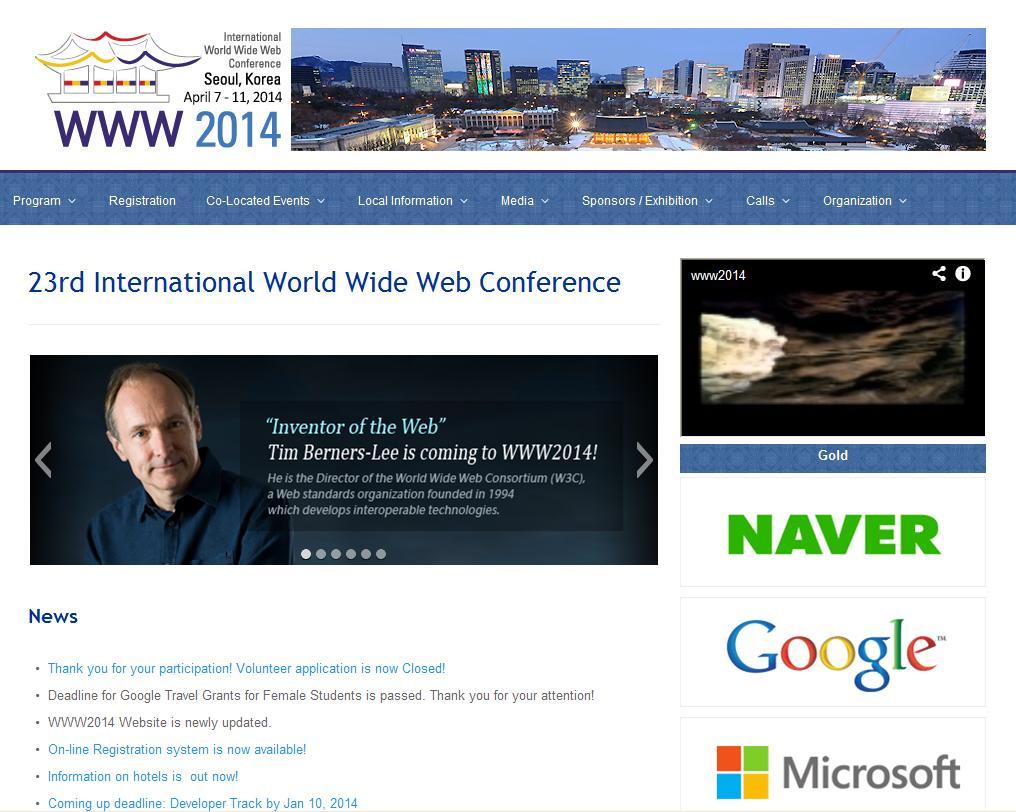 World's Largest Web Conference To Be Held in Korea
The 2014 International World Wide Web Conference (WWW 2014), the world’s most prestigious academic conference in the field of web, will be held for the first time in Korea. The conference is to be last for five days at Seoul COEX, from 7th to 11th April. International World Wide Web Conference covers a wide range of web-related areas, including technologies, research papers, services and more. Since the first conference in 1994 in Switzerland, it has been held in various parts of North America, Europe, South America and Asia, attracting more than 1000 experts in the field. The 23rd International World Wide Web Conference is managed by the International World Wide Web Conferences Steering Committee (IW3C2) and co-hosted by KAIST and National Agency for Technology and Standards, as well as sponsored by Korea Information Science Society and the World Wide Web Consortium (W3C). Keynote speakers for this year’s conference include inventor of the World Wide Web, Sir Tim Berners-Lee, senior vice president of Microsoft, Dr. Qi Lu, and Carnegie Mellon University’s Prof. Christos Faloutsos, as well as Samsung Electronic’s vice president Jong-Deok Choi. In addition to WWW 2014, BigData Innovators Gathering (BIG 2014) and Web for Access (W4A 2014) is also to be held in joint. KAIST Computer Sciences Department’s Prof. Jinwan Jeong, in charge of directing this year’s conference, said “From one-sided 1st generation web to two-way 2nd generation web, such as blogs, and then recently to the 3rd generation web, which include social networks and semantic webs, the web technologies has grown vastly over the past 25 years. WWW 2014 will be the opportunity for Korea to discuss with the world about the informatization and future of the web.” Pre-registration for WWW 2014 can be applied at the official webpage for WWW 2014 (http://www2014.kr) before 17th February.
2014.02.14 View 8058
World's Largest Web Conference To Be Held in Korea
The 2014 International World Wide Web Conference (WWW 2014), the world’s most prestigious academic conference in the field of web, will be held for the first time in Korea. The conference is to be last for five days at Seoul COEX, from 7th to 11th April. International World Wide Web Conference covers a wide range of web-related areas, including technologies, research papers, services and more. Since the first conference in 1994 in Switzerland, it has been held in various parts of North America, Europe, South America and Asia, attracting more than 1000 experts in the field. The 23rd International World Wide Web Conference is managed by the International World Wide Web Conferences Steering Committee (IW3C2) and co-hosted by KAIST and National Agency for Technology and Standards, as well as sponsored by Korea Information Science Society and the World Wide Web Consortium (W3C). Keynote speakers for this year’s conference include inventor of the World Wide Web, Sir Tim Berners-Lee, senior vice president of Microsoft, Dr. Qi Lu, and Carnegie Mellon University’s Prof. Christos Faloutsos, as well as Samsung Electronic’s vice president Jong-Deok Choi. In addition to WWW 2014, BigData Innovators Gathering (BIG 2014) and Web for Access (W4A 2014) is also to be held in joint. KAIST Computer Sciences Department’s Prof. Jinwan Jeong, in charge of directing this year’s conference, said “From one-sided 1st generation web to two-way 2nd generation web, such as blogs, and then recently to the 3rd generation web, which include social networks and semantic webs, the web technologies has grown vastly over the past 25 years. WWW 2014 will be the opportunity for Korea to discuss with the world about the informatization and future of the web.” Pre-registration for WWW 2014 can be applied at the official webpage for WWW 2014 (http://www2014.kr) before 17th February.
2014.02.14 View 8058 -
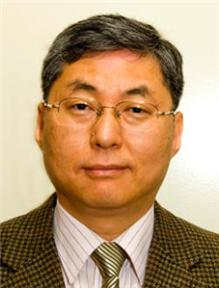 Professor Hoi-Jun Yoo Appointed as the First Asian University Chairman of the ISSCC
Hoi-Jun Yoo, a professor of Electrical Engineering Department at KAIST, was chosen to be the first Asian University Chairman of the ISSCC (International Solid-State Circuits Conference) held in San Francisco, USA, from February 10 to 13, 2014. His term will last one year from April, 2014. Professor Yoo ranked tenth globally in thesis achievement over the 60-year history of the ISSCC. He ranked fourth globally over the last ten years and was the highest-ranked member from Asia over that time. He received an award for this remarkable achievement in 2012. ISSC is a world-renowned conference in the semiconductor field, where only 200 strictly selected papers are presented by semiconductor-related enterprises, research centers, and university representatives. Nicknamed the “The Olympics of the Semiconductor”, ISSCC runs for 4 days and hosts more than 3000 semiconductor engineers from around the world. It is most famous for the first CPU presentation by Intel and the first memory technology release of Samsung. Professor Yoo stated, “The Korean Semiconductor Engineering is leading the world’s technology instead of imitating it.” He aspires to devote himself to upgrading semiconductor engineering around the world.
2014.02.14 View 7773
Professor Hoi-Jun Yoo Appointed as the First Asian University Chairman of the ISSCC
Hoi-Jun Yoo, a professor of Electrical Engineering Department at KAIST, was chosen to be the first Asian University Chairman of the ISSCC (International Solid-State Circuits Conference) held in San Francisco, USA, from February 10 to 13, 2014. His term will last one year from April, 2014. Professor Yoo ranked tenth globally in thesis achievement over the 60-year history of the ISSCC. He ranked fourth globally over the last ten years and was the highest-ranked member from Asia over that time. He received an award for this remarkable achievement in 2012. ISSC is a world-renowned conference in the semiconductor field, where only 200 strictly selected papers are presented by semiconductor-related enterprises, research centers, and university representatives. Nicknamed the “The Olympics of the Semiconductor”, ISSCC runs for 4 days and hosts more than 3000 semiconductor engineers from around the world. It is most famous for the first CPU presentation by Intel and the first memory technology release of Samsung. Professor Yoo stated, “The Korean Semiconductor Engineering is leading the world’s technology instead of imitating it.” He aspires to devote himself to upgrading semiconductor engineering around the world.
2014.02.14 View 7773 -
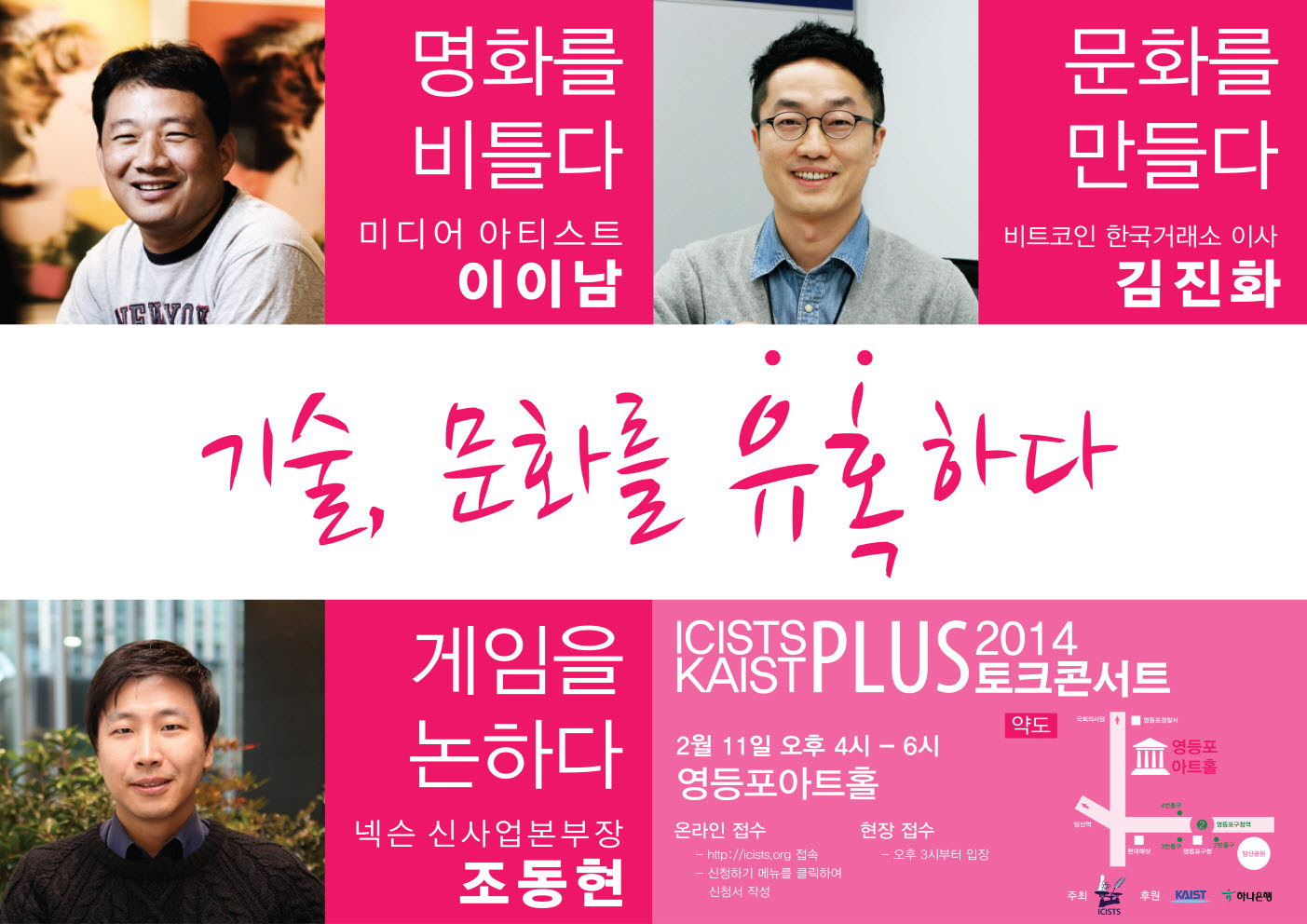 ICISTS-KAIST Talk Concert 2014
The International Conference for the Integration of Science, Technology and Society at KAIST (ICISTS-KAIST) will hold a talk entitled “Scientific Technology and Culture” at Youngdungpo Art Hall in Seoul on Tuesday, February 11, 2014.The three main presenters will be: Jin-Hwa Kim, Director of Korbit, Dong-Hyeon Jo, Chief of New Business at Nexon, and media artist Yi-Nam Lee. They will address the meeting of culture and scientific technology in the fields of art, games, and other genres.Jin-Hwa Kim is the director of Korbit, the first Korean bitcoin exchange, and wrote The Next Money: Bitcoin, the world’s first bitcoin textbook. He will elaborate on how science and technology are constantly changing and have affected popular culture, and how public demand gave birth to bitcoin.Dong-Hyeon Jo from Nexon will explain how the appearance of new media and platforms such as smartphones has changed our lives.Media artist Yi-Nam Lee has been described as “the second Nam-June Paik,” an internationally-acclaimed video artist, for his integration of oriental and western masterpieces with modern media. During the event, samples of his artwork will be displayed.ICISTS-KAIST is a student organization which has held a conference every year since 2005 with hundreds of students attending from many parts of the world, Asia in particular.
2014.02.07 View 9044
ICISTS-KAIST Talk Concert 2014
The International Conference for the Integration of Science, Technology and Society at KAIST (ICISTS-KAIST) will hold a talk entitled “Scientific Technology and Culture” at Youngdungpo Art Hall in Seoul on Tuesday, February 11, 2014.The three main presenters will be: Jin-Hwa Kim, Director of Korbit, Dong-Hyeon Jo, Chief of New Business at Nexon, and media artist Yi-Nam Lee. They will address the meeting of culture and scientific technology in the fields of art, games, and other genres.Jin-Hwa Kim is the director of Korbit, the first Korean bitcoin exchange, and wrote The Next Money: Bitcoin, the world’s first bitcoin textbook. He will elaborate on how science and technology are constantly changing and have affected popular culture, and how public demand gave birth to bitcoin.Dong-Hyeon Jo from Nexon will explain how the appearance of new media and platforms such as smartphones has changed our lives.Media artist Yi-Nam Lee has been described as “the second Nam-June Paik,” an internationally-acclaimed video artist, for his integration of oriental and western masterpieces with modern media. During the event, samples of his artwork will be displayed.ICISTS-KAIST is a student organization which has held a conference every year since 2005 with hundreds of students attending from many parts of the world, Asia in particular.
2014.02.07 View 9044 -
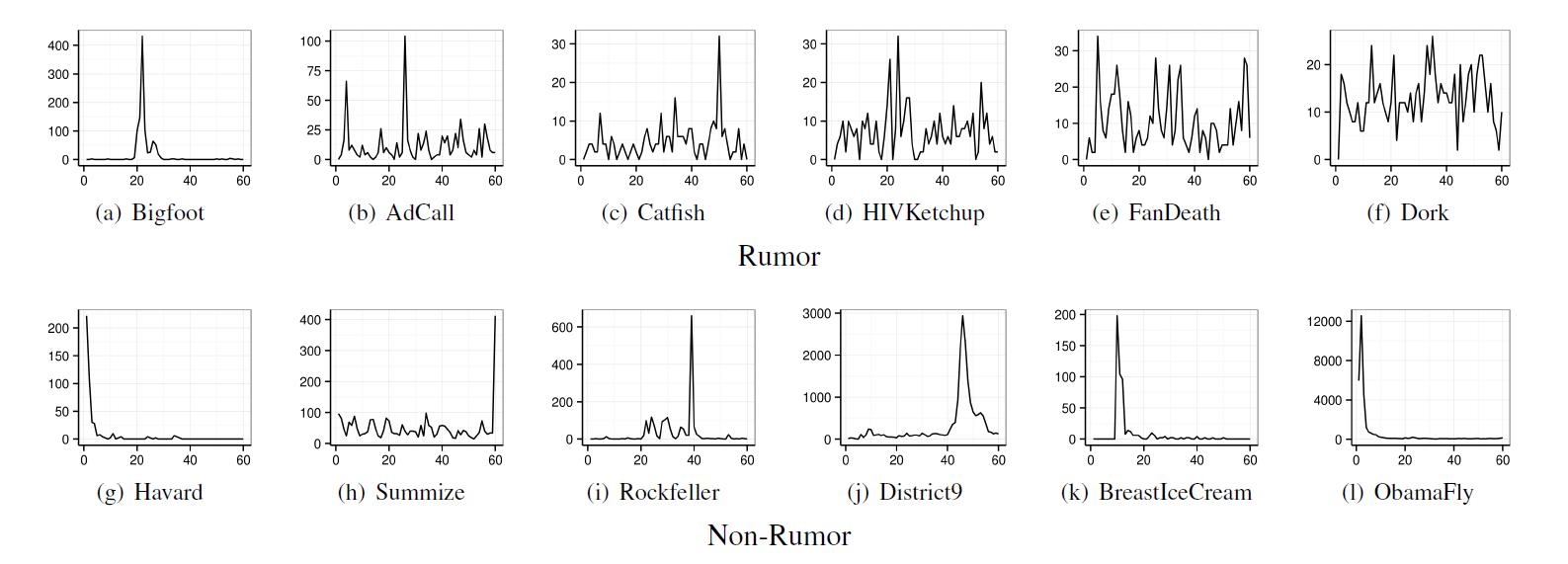 Is it possible to identify rumors on SNS?
Rumors
sporadically spread with people with fewer followers in the centerResearched
over 100 rumors in the US from 2006 to 2009 Is it
possible to filter information on SNS such as Twitter and Facebook? A research
team led by Professor Mee-Young Cha from the Department of Cultural Technology
Graduate School at KAIST, Professor Kyo-Min Jung of Seoul National University,
Doctor Wei Chen and Yajun Wang of Microsoft Asia, has developed a technology
that can accurately filter out information on Twitter to 90% accuracy. The
research not only deduced a new mathematical model, network structure, and
linguistic characteristics on rumors from SNS data, but is also expected to
enhance the effort to make secure technology to regulate Internet rumors. The team
analysed the characteristics of rumors in over 100 widespread cases in the US
from 2006 to 2009 on Twitter. The team gathered data, which included a range of
areas such as politics, IT, health and celebrity gossips, and their analysis
could identify rumors to 90% accuracy. The filtering was more accurate in
rumors that included slanders or insults. The
research team identified three characteristics of the spread of rumors. Firstly,
rumors spread continuously. Normal news spreads widely once and is mentioned
rarely again on media, but rumors tend to continue for years. Secondly,
rumors spread through sporadic participation of random users with no
connections. Rumors start from people with fewer followers and spread to the
more popular. This phenomenon is often observed in rumors concerning
celebrities or politicians. Lastly,
rumors have unique linguistic characteristics. Rumors frequently include words
(such as “it may be true,” “although not certain, I think,” “although I cannot
fully remember”) related to psychological processes that question, deny, or
infer the reliability of the information. Professor
Cha said, “This research deduced not only a statistical and mathematical model
but also is an integrated research on social psychological theory on the
characteristics of rumors that attract great attention from the society based
on ample data.” The results
were made public in IEEE International Conference on Data Mining last December
in Texas, USA.
2014.02.03 View 8252
Is it possible to identify rumors on SNS?
Rumors
sporadically spread with people with fewer followers in the centerResearched
over 100 rumors in the US from 2006 to 2009 Is it
possible to filter information on SNS such as Twitter and Facebook? A research
team led by Professor Mee-Young Cha from the Department of Cultural Technology
Graduate School at KAIST, Professor Kyo-Min Jung of Seoul National University,
Doctor Wei Chen and Yajun Wang of Microsoft Asia, has developed a technology
that can accurately filter out information on Twitter to 90% accuracy. The
research not only deduced a new mathematical model, network structure, and
linguistic characteristics on rumors from SNS data, but is also expected to
enhance the effort to make secure technology to regulate Internet rumors. The team
analysed the characteristics of rumors in over 100 widespread cases in the US
from 2006 to 2009 on Twitter. The team gathered data, which included a range of
areas such as politics, IT, health and celebrity gossips, and their analysis
could identify rumors to 90% accuracy. The filtering was more accurate in
rumors that included slanders or insults. The
research team identified three characteristics of the spread of rumors. Firstly,
rumors spread continuously. Normal news spreads widely once and is mentioned
rarely again on media, but rumors tend to continue for years. Secondly,
rumors spread through sporadic participation of random users with no
connections. Rumors start from people with fewer followers and spread to the
more popular. This phenomenon is often observed in rumors concerning
celebrities or politicians. Lastly,
rumors have unique linguistic characteristics. Rumors frequently include words
(such as “it may be true,” “although not certain, I think,” “although I cannot
fully remember”) related to psychological processes that question, deny, or
infer the reliability of the information. Professor
Cha said, “This research deduced not only a statistical and mathematical model
but also is an integrated research on social psychological theory on the
characteristics of rumors that attract great attention from the society based
on ample data.” The results
were made public in IEEE International Conference on Data Mining last December
in Texas, USA.
2014.02.03 View 8252 -
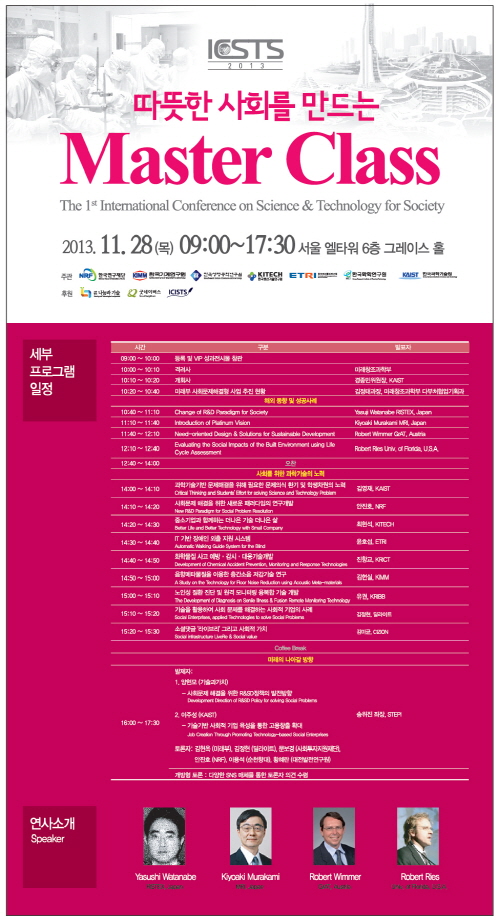 First International Conference on Science and Technology for Society
KAIST co-organized the 2013 International Conference on Science and Technology for Society which was held on November 28 at the Grace Hall in Seoul EL-Tower. More than 300 people, including members of the Global Social Technology Advisory Board, domestic social technology experts, private companies, government officials, private citizens, and students joined the conference to discuss the roles and responsibilities of science and technology for society.
R&D policies and technologies for solving social issues were introduced, and discussions were held on desirable directions for technological development.
The first speaker, Yasushi Watanabe, Director of RISTEX (Research Institute of Science and Technology for Society) in Japan, introduced the importance of science and technology for society under the title “Change of R&D Paradigm for Society.”
Robert Wimmer, GrAT (Center for Appropriate Technology), Vienna University of Technology in Austria, presented “Need-oriented Design & Solutions for Development.” Kiyoaki Murakami, MRI, Japan, presented “Introduction of Platinum Vision” and Robert Ries, University of Florida, U.S.A., presented “Evaluating the Social Impacts of the Built Environment Using Life Cycle Assessment.”
Case studies on social enterprises and presentations on R&D for solving social problems were introduced by ICISTS (International Conference for the Integration of Science, Technology and Society), which is a student group at KAIST, National Research Foundation of Korea (NRF), Korea Institute of Machinery and Materials (KIMM), Korea Research Institute of Bioscience and Biotechnology (KRIBB), Korea Institute of Industrial Technology (KITECH), Electronics and Telecommunication Research Institute (ETRI), and Korea Research Institute of Chemical Technology (KRICT).The conference was hosted by the Ministry of Science, ICT, and Future Planning and co-organized by NRF, KIMM, KRIBB, KITECH, ETRI and KRICT.
2013.12.11 View 8425
First International Conference on Science and Technology for Society
KAIST co-organized the 2013 International Conference on Science and Technology for Society which was held on November 28 at the Grace Hall in Seoul EL-Tower. More than 300 people, including members of the Global Social Technology Advisory Board, domestic social technology experts, private companies, government officials, private citizens, and students joined the conference to discuss the roles and responsibilities of science and technology for society.
R&D policies and technologies for solving social issues were introduced, and discussions were held on desirable directions for technological development.
The first speaker, Yasushi Watanabe, Director of RISTEX (Research Institute of Science and Technology for Society) in Japan, introduced the importance of science and technology for society under the title “Change of R&D Paradigm for Society.”
Robert Wimmer, GrAT (Center for Appropriate Technology), Vienna University of Technology in Austria, presented “Need-oriented Design & Solutions for Development.” Kiyoaki Murakami, MRI, Japan, presented “Introduction of Platinum Vision” and Robert Ries, University of Florida, U.S.A., presented “Evaluating the Social Impacts of the Built Environment Using Life Cycle Assessment.”
Case studies on social enterprises and presentations on R&D for solving social problems were introduced by ICISTS (International Conference for the Integration of Science, Technology and Society), which is a student group at KAIST, National Research Foundation of Korea (NRF), Korea Institute of Machinery and Materials (KIMM), Korea Research Institute of Bioscience and Biotechnology (KRIBB), Korea Institute of Industrial Technology (KITECH), Electronics and Telecommunication Research Institute (ETRI), and Korea Research Institute of Chemical Technology (KRICT).The conference was hosted by the Ministry of Science, ICT, and Future Planning and co-organized by NRF, KIMM, KRIBB, KITECH, ETRI and KRICT.
2013.12.11 View 8425 -
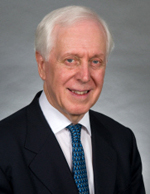 UN biological weapons expert gives lecture at KAIST
KAIST’s student organization, the ICISTS Organizing Committee, invited United Nations Security Council expert Terence Taylor to deliver a speech under the topic of ‘Terrorists and Scientists: Biological Weapons and its impact on Global Society’. The lecture took place on November 19 on the Daejeon campus.
Taylor shared his experiences as a biochemical weapons expert at Iraq and discussed the fast-approaching future of the world with biochemical weapons.
Terence Taylor is a former British military officer, who served various governmental and non-governmental organizations around the world, including UK and U.S. agencies, as well as the UN. His current work involves the non-proliferation and disarmament of nuclear or biological weapons, toxic substances and other weapons of mass destruction.
ICISTS Organizing Committee is a student organization run by of KAIST students. Since 2005, it has actively held one of the largest student conferences in Asia, ICISTS-KAIST, at KAIST every year. "ICISTS" stands for “International Conference for the Integration of Science, Technology, and Society”, which conveys its vision in achieving a harmony between science and society.
UN Security Council expert Terence Taylor
2013.11.28 View 6948
UN biological weapons expert gives lecture at KAIST
KAIST’s student organization, the ICISTS Organizing Committee, invited United Nations Security Council expert Terence Taylor to deliver a speech under the topic of ‘Terrorists and Scientists: Biological Weapons and its impact on Global Society’. The lecture took place on November 19 on the Daejeon campus.
Taylor shared his experiences as a biochemical weapons expert at Iraq and discussed the fast-approaching future of the world with biochemical weapons.
Terence Taylor is a former British military officer, who served various governmental and non-governmental organizations around the world, including UK and U.S. agencies, as well as the UN. His current work involves the non-proliferation and disarmament of nuclear or biological weapons, toxic substances and other weapons of mass destruction.
ICISTS Organizing Committee is a student organization run by of KAIST students. Since 2005, it has actively held one of the largest student conferences in Asia, ICISTS-KAIST, at KAIST every year. "ICISTS" stands for “International Conference for the Integration of Science, Technology, and Society”, which conveys its vision in achieving a harmony between science and society.
UN Security Council expert Terence Taylor
2013.11.28 View 6948 -
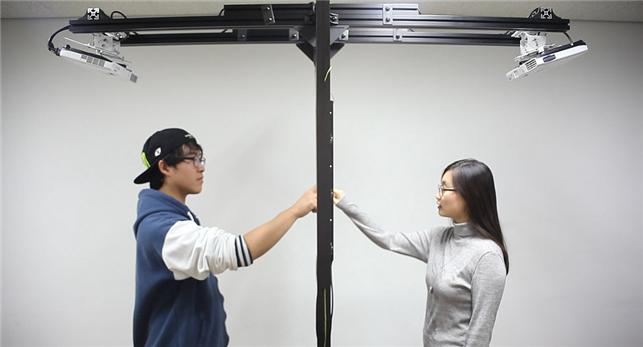 Transparent Glass Wall as a Touch Game Media
Professor Woo-hoon Lee
- Selected as the “Highlight” at SIGGRAPH emerging technology conference
- “An excellent example of the transparent display panel in everyday life”
A joint research team led by KAIST Industrial Design Department’s Prof. Woo-hoon Lee and Computer Sciences Prof. Ki-hyuk Lee has developed a brand new concept game media “TransWall”, which utilizes both sides of the glass wall as the touch medium.
TransWall has been chosen as the “highlight” of 2013 SIGGRAPH emerging technology conference. SIGGRAPH is a world-renowned conference in the area of computer graphics and interaction technique, last held 21st-25th July at Anaheim, in the United States.
It all started with the thought, wouldn’t it be possible to turn the glass walls surrounding us into a medium for entertainment and communication?
TransWall utilizes holographic screen film inserted between two glass sheets with a multi-touch function, onto which the image can be projected using the beam projector from both sides. Furthermore, an additional Surface Transducer attached to the glass can deliver the sound and vibration.
What seemed as an ordinary glass wall has been transformed into a multi-sensory media that can transmit and receive visual, auditory and tactile information.
TransWall can be implemented at public places such as theme parks, large shopping malls and subway stations, providing the citizens with a new form of entertainment. This touch-interaction method can also be applied to developing a variety of cultural contents in the future.
Professor Lee said, “TransWall shows an example of near-future where touch-interaction method can be utilized with the soon-to-be commercialized transparent display panel in everyday lives.”
TransWall Introduction video (https://vimeo.com/70391422)
TransWall at SIGGRAPH 2013 Display (https://vimeo.com/71718874)
Picture 1. Both sides of the glass wall can be used as a touch platform for various medias, including games.
Picture 2. TransWall attracts the interests of the audience at SIGGRAPH emerging technology.
Picture 3. Structure of TransWall
Picture 4. Photo of TransWall from side
2013.09.19 View 7743
Transparent Glass Wall as a Touch Game Media
Professor Woo-hoon Lee
- Selected as the “Highlight” at SIGGRAPH emerging technology conference
- “An excellent example of the transparent display panel in everyday life”
A joint research team led by KAIST Industrial Design Department’s Prof. Woo-hoon Lee and Computer Sciences Prof. Ki-hyuk Lee has developed a brand new concept game media “TransWall”, which utilizes both sides of the glass wall as the touch medium.
TransWall has been chosen as the “highlight” of 2013 SIGGRAPH emerging technology conference. SIGGRAPH is a world-renowned conference in the area of computer graphics and interaction technique, last held 21st-25th July at Anaheim, in the United States.
It all started with the thought, wouldn’t it be possible to turn the glass walls surrounding us into a medium for entertainment and communication?
TransWall utilizes holographic screen film inserted between two glass sheets with a multi-touch function, onto which the image can be projected using the beam projector from both sides. Furthermore, an additional Surface Transducer attached to the glass can deliver the sound and vibration.
What seemed as an ordinary glass wall has been transformed into a multi-sensory media that can transmit and receive visual, auditory and tactile information.
TransWall can be implemented at public places such as theme parks, large shopping malls and subway stations, providing the citizens with a new form of entertainment. This touch-interaction method can also be applied to developing a variety of cultural contents in the future.
Professor Lee said, “TransWall shows an example of near-future where touch-interaction method can be utilized with the soon-to-be commercialized transparent display panel in everyday lives.”
TransWall Introduction video (https://vimeo.com/70391422)
TransWall at SIGGRAPH 2013 Display (https://vimeo.com/71718874)
Picture 1. Both sides of the glass wall can be used as a touch platform for various medias, including games.
Picture 2. TransWall attracts the interests of the audience at SIGGRAPH emerging technology.
Picture 3. Structure of TransWall
Picture 4. Photo of TransWall from side
2013.09.19 View 7743 -
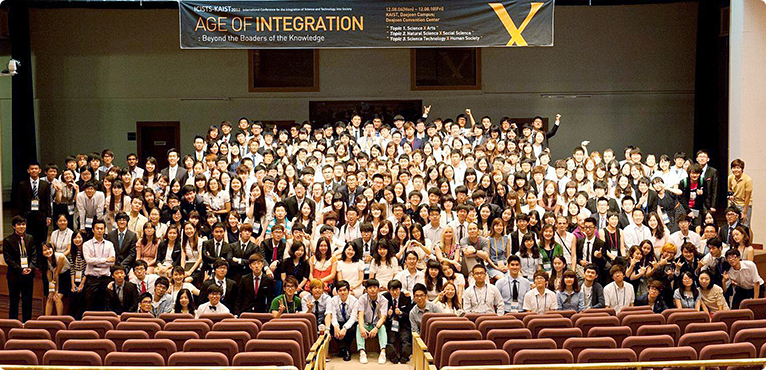 2013 International Conference for the Integration of Science, Technology, and Society at KAIST (ICISTS-KAIST)
The International Conference for the Integration of Science, Technology, and Society at KAIST (ICISTS-KAIST) is a global forum organized by KAIST undergraduate students to promote the exchange of ideas and facilitate the discussion of issues that are important to science, technology, society, and higher education. The ICISTS-KAIST conference has been held annually every summer since 2005, inviting distinguished speakers and guests from all around the world to share their insights and expertise with students gathered from Korea and abroad. Last year alone, more than 300 students from 22 nations and 40 speakers participated in the event.
Originally, the ICISTS-KAIST was established by KAIST students who were inspired by the Harvard Project for Asian and International Relations (HPAIR), which is one of the Harvard’s largest annual student conferences in Asia.
This year, 335 students from 103 universities in 22 countries joined the conference that was held on August 5th-9th in Daejeon, making the 2013 ICISTS-KAIST the biggest science and engineering gathering hosted by university students in Asia. About 36% of the participants were international students.
The theme of the conference was “Perfect Alliance: Coexistence for Human Society,” in which students and speakers addressed issues on how to harmonize the speed of scientific progress with the development of important values in society, as well as to explore solutions to overcome the chasm, if any, between the boundaries of science and society.
In his opening remarks, President Steve Kang said, “Creativity and innovation are born out of openness. Therefore, it is essential for young scientists and engineers to communicate with people from different cultural and political backgrounds. Through this kind of global interaction and exchange of ideas and views, students will have an opportunity to deepen their understanding of the world and to better examine the purpose of their intellectual exploration in science and technology.” At the 2013 ICISTS-KAIST, 25 distinguished speakers participated including Walter Bender, a former director of the Media Lab at MIT and David Christian, a professor of Macquarie University in Australia.
2013.08.08 View 8379
2013 International Conference for the Integration of Science, Technology, and Society at KAIST (ICISTS-KAIST)
The International Conference for the Integration of Science, Technology, and Society at KAIST (ICISTS-KAIST) is a global forum organized by KAIST undergraduate students to promote the exchange of ideas and facilitate the discussion of issues that are important to science, technology, society, and higher education. The ICISTS-KAIST conference has been held annually every summer since 2005, inviting distinguished speakers and guests from all around the world to share their insights and expertise with students gathered from Korea and abroad. Last year alone, more than 300 students from 22 nations and 40 speakers participated in the event.
Originally, the ICISTS-KAIST was established by KAIST students who were inspired by the Harvard Project for Asian and International Relations (HPAIR), which is one of the Harvard’s largest annual student conferences in Asia.
This year, 335 students from 103 universities in 22 countries joined the conference that was held on August 5th-9th in Daejeon, making the 2013 ICISTS-KAIST the biggest science and engineering gathering hosted by university students in Asia. About 36% of the participants were international students.
The theme of the conference was “Perfect Alliance: Coexistence for Human Society,” in which students and speakers addressed issues on how to harmonize the speed of scientific progress with the development of important values in society, as well as to explore solutions to overcome the chasm, if any, between the boundaries of science and society.
In his opening remarks, President Steve Kang said, “Creativity and innovation are born out of openness. Therefore, it is essential for young scientists and engineers to communicate with people from different cultural and political backgrounds. Through this kind of global interaction and exchange of ideas and views, students will have an opportunity to deepen their understanding of the world and to better examine the purpose of their intellectual exploration in science and technology.” At the 2013 ICISTS-KAIST, 25 distinguished speakers participated including Walter Bender, a former director of the Media Lab at MIT and David Christian, a professor of Macquarie University in Australia.
2013.08.08 View 8379 -
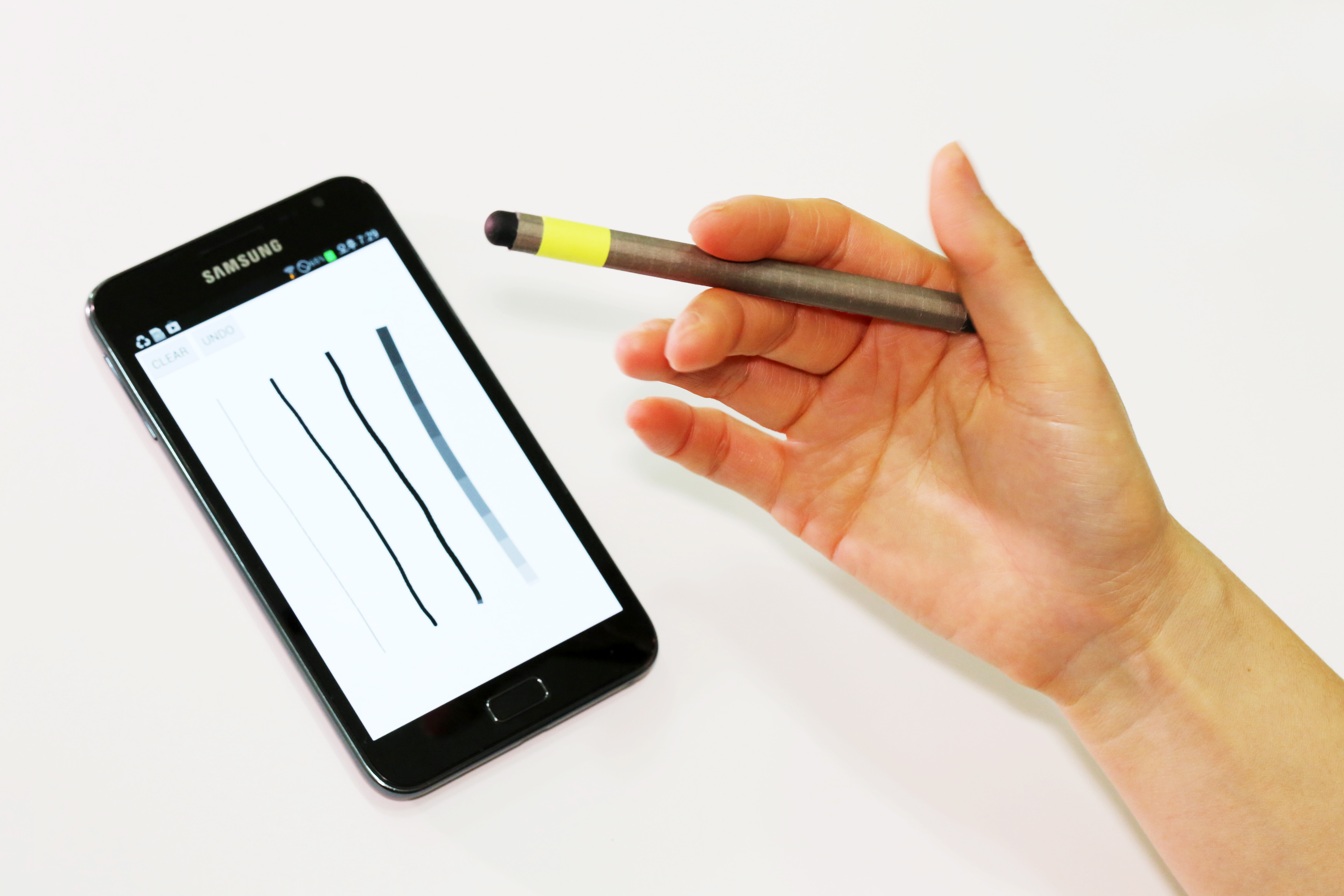 A magnetic pen for smartphones adds another level of conveniences
Utilizing existing features on smartphones, the MagPen provides users with a compatible and simple input tool regardless of the type of phones they are using.
A doctoral candidate at the Korea Advanced Institute of Science and Technology (KAIST) developed a magnetically driven pen interface that works both on and around mobile devices. This interface, called the MagPen, can be used for any type of smartphones and tablet computers so long as they have magnetometers embedded in.
Advised by Professor Kwang-yun Wohn of the Graduate School of Culture Technology (GSCT) at KAIST, Sungjae Hwang, a Ph.D. student, created the MagPen in collaboration with Myung-Wook Ahn, a master"s student at the GSCT of KAIST, and Andrea Bianchi, a professor at Sungkyunkwan University.
Almost all mobile devices today provide location-based services, and magnetometers are incorporated in the integrated circuits of smartphones or tablet PCs, functioning as compasses. Taking advantage of built-in magnetometers, Hwang"s team came up with a technology that enabled an input tool for mobile devices such as a capacitive stylus pen to interact more sensitively and effectively with the devices" touch screen. Text and command entered by a stylus pen are expressed better on the screen of mobile devices than those done by human fingers.
The MagPen utilizes magnetometers equipped with smartphones, thus there is no need to build an additional sensing panel for a touchscreen as well as circuits, communication modules, or batteries for the pen. With an application installed on smartphones, it senses and analyzes the magnetic field produced by a permanent magnet embedded in a standard capacitive stylus pen.
Sungjae Hwang said, "Our technology is eco-friendly and very affordable because we are able to improve the expressiveness of the stylus pen without requiring additional hardware beyond those already installed on the current mobile devices. The technology allows smartphone users to enjoy added convenience while no wastes generated."
The MagPen detects the direction at which a stylus pen is pointing; selects colors by dragging the pen across smartphone bezel; identifies pens with different magnetic properties; recognizes pen-spinning gestures; and estimates the finger pressure applied to the pen.
Notably, with its spinning motion, the MagPen expands the scope of input gestures recognized by a stylus pen beyond its existing vocabularies of gestures and techniques such as titling, hovering, and varying pressures. The tip of the pen switches from a pointer to an eraser and vice versa when spinning. Or, it can choose the thickness of the lines drawn on a screen by spinning.
"It"s quite remarkable to see that the MagPen can understand spinning motion. It"s like the pen changes its living environment from two dimensions to three dimensions. This is the most creative characteristic of our technology," added Sungjae Hwang.
Hwang"s initial research result was first presented at the International Conference on Intelligent User Interfaces organized by the Association for Computing Machinery and held on March 19-22 in Santa Monica, the US.
In the next month of August, the research team will present a paper on the MagPen technology, entitled "MagPen: Magnetically Driven Pen Interaction On and Around Conventional Smartphones" and receive an Honorable Mention Award at the 15th International Conference on Human-Computer Interaction with Mobile Devices and Services (MobileHCI 2013) to be held in Germany.
In addition to the MagPen, Hwang and his team are conducting other projects to develop different types of magnetic gadgets (collectively called "MagGetz") that include the Magnetic Marionette, a magnetic cover for a smartphone, which offers augmented interactions with the phone, as well as magnetic widgets such as buttons and toggle interface.
Hwang has filed ten patents for the MagGetz technology.
Youtube Links: http://www.youtube.com/watch?v=NkPo2las7wc, http://www.youtube.com/watch?v=J9GtgyzoZmM
2013.07.25 View 8443
A magnetic pen for smartphones adds another level of conveniences
Utilizing existing features on smartphones, the MagPen provides users with a compatible and simple input tool regardless of the type of phones they are using.
A doctoral candidate at the Korea Advanced Institute of Science and Technology (KAIST) developed a magnetically driven pen interface that works both on and around mobile devices. This interface, called the MagPen, can be used for any type of smartphones and tablet computers so long as they have magnetometers embedded in.
Advised by Professor Kwang-yun Wohn of the Graduate School of Culture Technology (GSCT) at KAIST, Sungjae Hwang, a Ph.D. student, created the MagPen in collaboration with Myung-Wook Ahn, a master"s student at the GSCT of KAIST, and Andrea Bianchi, a professor at Sungkyunkwan University.
Almost all mobile devices today provide location-based services, and magnetometers are incorporated in the integrated circuits of smartphones or tablet PCs, functioning as compasses. Taking advantage of built-in magnetometers, Hwang"s team came up with a technology that enabled an input tool for mobile devices such as a capacitive stylus pen to interact more sensitively and effectively with the devices" touch screen. Text and command entered by a stylus pen are expressed better on the screen of mobile devices than those done by human fingers.
The MagPen utilizes magnetometers equipped with smartphones, thus there is no need to build an additional sensing panel for a touchscreen as well as circuits, communication modules, or batteries for the pen. With an application installed on smartphones, it senses and analyzes the magnetic field produced by a permanent magnet embedded in a standard capacitive stylus pen.
Sungjae Hwang said, "Our technology is eco-friendly and very affordable because we are able to improve the expressiveness of the stylus pen without requiring additional hardware beyond those already installed on the current mobile devices. The technology allows smartphone users to enjoy added convenience while no wastes generated."
The MagPen detects the direction at which a stylus pen is pointing; selects colors by dragging the pen across smartphone bezel; identifies pens with different magnetic properties; recognizes pen-spinning gestures; and estimates the finger pressure applied to the pen.
Notably, with its spinning motion, the MagPen expands the scope of input gestures recognized by a stylus pen beyond its existing vocabularies of gestures and techniques such as titling, hovering, and varying pressures. The tip of the pen switches from a pointer to an eraser and vice versa when spinning. Or, it can choose the thickness of the lines drawn on a screen by spinning.
"It"s quite remarkable to see that the MagPen can understand spinning motion. It"s like the pen changes its living environment from two dimensions to three dimensions. This is the most creative characteristic of our technology," added Sungjae Hwang.
Hwang"s initial research result was first presented at the International Conference on Intelligent User Interfaces organized by the Association for Computing Machinery and held on March 19-22 in Santa Monica, the US.
In the next month of August, the research team will present a paper on the MagPen technology, entitled "MagPen: Magnetically Driven Pen Interaction On and Around Conventional Smartphones" and receive an Honorable Mention Award at the 15th International Conference on Human-Computer Interaction with Mobile Devices and Services (MobileHCI 2013) to be held in Germany.
In addition to the MagPen, Hwang and his team are conducting other projects to develop different types of magnetic gadgets (collectively called "MagGetz") that include the Magnetic Marionette, a magnetic cover for a smartphone, which offers augmented interactions with the phone, as well as magnetic widgets such as buttons and toggle interface.
Hwang has filed ten patents for the MagGetz technology.
Youtube Links: http://www.youtube.com/watch?v=NkPo2las7wc, http://www.youtube.com/watch?v=J9GtgyzoZmM
2013.07.25 View 8443 -
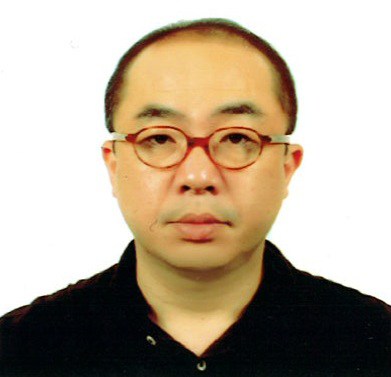 Prof. Song Chong received the IEEE William R. Bennett Prize Paper Award
The IEEE (Institute of Electrical and Electronics Engineers) Communications Society (ComSoc), a renowned global network of professionals with a common interest in advancing communications technologies, has announced the winner of the 2013 William R. Bennett Prize in the field of communications networking. The prize was given to a Korean research team led by Song Chong, Professor of Electrical Engineering at KAIST and Injong Rhee, Professor of Computer Science at North Carolina State University. In addition, Dr. Minsu Shin, Dr. Seongik Hong, and Dr. Seong Joon Kim of Samsung Electronics Co., Ltd. as well as Professor Kyunghan Lee from Ulsan National Institute of Science and Technology were recognized for their contribution.
The William R. Bennett Prize for communications networking has been awarded each year since 1994 in recognition of the best paper published in any journal financially sponsored or co-sponsored by ComSoc in the previous three calendar years. Only one paper per year is selected based on its quality, originality, scientific citation index, and peer reviews. Among the previous award winners are Robert Gallager of MIT, and Steven Low of the California Institute of Technology, and Kang G. Shin of the University of Michigan.
The Korean research team’s paper, On the Levy-Walk Nature of Human Mobility, was published in the June 2011 issue of IEEE/ACM Transactions on Networking, a bimonthly journal co-sponsored by the IEEE ComSoc, the IEEE Computer Society, and the Association for Computing Machinery (ACM) with its Special Interest Group on Data Communications (SIGCOMM).
In the paper, the research team proposed a new statistical model to effectively analyze the pattern of individual human mobility in daily life. The team handed out GPS (global positioning system) devices to 100 participants residing in five different university campuses in Korea and the US and collected data on their movements for 226 days. The mobility pattern obtained from the experiment predicted accurately how the participants actually moved around during their routines. Since publication, the paper has been cited by other papers approximately 350 times.
The team’s research results will apply to many fields such as the prevention and control of epidemics, the design of efficient communications networks, and the development of urban and transportation system.
The research team received the award on June 10th at the 2013 IEEE International Conference on Communications (ICC) held in Budapest, Hungary, from June 9-13, 2013.
Professor Song Chong
2013.07.06 View 10282
Prof. Song Chong received the IEEE William R. Bennett Prize Paper Award
The IEEE (Institute of Electrical and Electronics Engineers) Communications Society (ComSoc), a renowned global network of professionals with a common interest in advancing communications technologies, has announced the winner of the 2013 William R. Bennett Prize in the field of communications networking. The prize was given to a Korean research team led by Song Chong, Professor of Electrical Engineering at KAIST and Injong Rhee, Professor of Computer Science at North Carolina State University. In addition, Dr. Minsu Shin, Dr. Seongik Hong, and Dr. Seong Joon Kim of Samsung Electronics Co., Ltd. as well as Professor Kyunghan Lee from Ulsan National Institute of Science and Technology were recognized for their contribution.
The William R. Bennett Prize for communications networking has been awarded each year since 1994 in recognition of the best paper published in any journal financially sponsored or co-sponsored by ComSoc in the previous three calendar years. Only one paper per year is selected based on its quality, originality, scientific citation index, and peer reviews. Among the previous award winners are Robert Gallager of MIT, and Steven Low of the California Institute of Technology, and Kang G. Shin of the University of Michigan.
The Korean research team’s paper, On the Levy-Walk Nature of Human Mobility, was published in the June 2011 issue of IEEE/ACM Transactions on Networking, a bimonthly journal co-sponsored by the IEEE ComSoc, the IEEE Computer Society, and the Association for Computing Machinery (ACM) with its Special Interest Group on Data Communications (SIGCOMM).
In the paper, the research team proposed a new statistical model to effectively analyze the pattern of individual human mobility in daily life. The team handed out GPS (global positioning system) devices to 100 participants residing in five different university campuses in Korea and the US and collected data on their movements for 226 days. The mobility pattern obtained from the experiment predicted accurately how the participants actually moved around during their routines. Since publication, the paper has been cited by other papers approximately 350 times.
The team’s research results will apply to many fields such as the prevention and control of epidemics, the design of efficient communications networks, and the development of urban and transportation system.
The research team received the award on June 10th at the 2013 IEEE International Conference on Communications (ICC) held in Budapest, Hungary, from June 9-13, 2013.
Professor Song Chong
2013.07.06 View 10282