conference
-
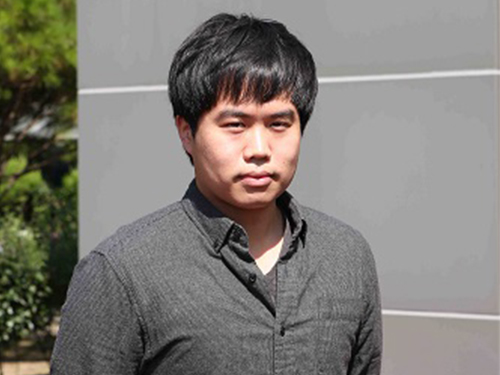 Sangeun Oh Recognized as a 2017 Google Fellow
Sangeun Oh, a Ph.D. candidate in the School of Computing was selected as a Google PhD Fellow in 2017. He is one of 47 awardees of the Google PhD Fellowship in the world.
The Google PhD Fellowship awards students showing outstanding performance in the field of computer science and related research. Since being established in 2009, the program has provided various benefits, including scholarships worth $10,000 USD and one-to-one research discussion with mentors from Google.
His research work on a mobile system that allows interactions among various kinds of smart devices was recognized in the field of mobile computing. He developed a mobile platform that allows smart devices to share diverse functions, including logins, payments, and sensors. This technology provides numerous user experiences that existing mobile platforms could not offer. Through cross-device functionality sharing, users can utilize multiple smart devices in a more convenient manner. The research was presented at The Annual International Conference on Mobile Systems, Applications, and Services (MobiSys) of the Association for Computing Machinery in July, 2017.
Oh said, “I would like to express my gratitude to my advisor, the professors in the School of Computing, and my lab colleagues. I will devote myself to carrying out more research in order to contribute to society.”
His advisor, Insik Shin, a professor in the School of Computing said, “Being recognized as a Google PhD Fellow is an honor to both the student as well as KAIST. I strongly anticipate and believe that Oh will make the next step by carrying out good quality research.”
2017.09.27 View 13972
Sangeun Oh Recognized as a 2017 Google Fellow
Sangeun Oh, a Ph.D. candidate in the School of Computing was selected as a Google PhD Fellow in 2017. He is one of 47 awardees of the Google PhD Fellowship in the world.
The Google PhD Fellowship awards students showing outstanding performance in the field of computer science and related research. Since being established in 2009, the program has provided various benefits, including scholarships worth $10,000 USD and one-to-one research discussion with mentors from Google.
His research work on a mobile system that allows interactions among various kinds of smart devices was recognized in the field of mobile computing. He developed a mobile platform that allows smart devices to share diverse functions, including logins, payments, and sensors. This technology provides numerous user experiences that existing mobile platforms could not offer. Through cross-device functionality sharing, users can utilize multiple smart devices in a more convenient manner. The research was presented at The Annual International Conference on Mobile Systems, Applications, and Services (MobiSys) of the Association for Computing Machinery in July, 2017.
Oh said, “I would like to express my gratitude to my advisor, the professors in the School of Computing, and my lab colleagues. I will devote myself to carrying out more research in order to contribute to society.”
His advisor, Insik Shin, a professor in the School of Computing said, “Being recognized as a Google PhD Fellow is an honor to both the student as well as KAIST. I strongly anticipate and believe that Oh will make the next step by carrying out good quality research.”
2017.09.27 View 13972 -
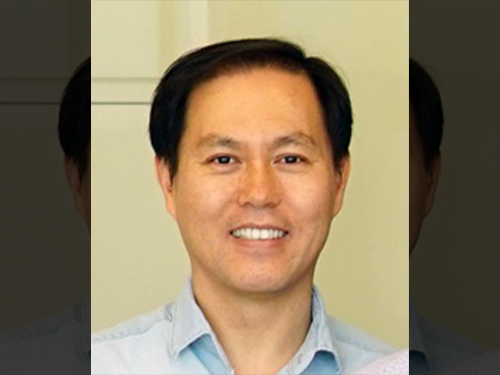 Professor Jin Woo Kim Wins the 14th Macrogen Scientist Award
Professor Jin Woo Kim of the Department of Biological Sciences at KAIST received the 14th Macrogen Scientist Award at the 2017 KSMCB International Conference held in COEX on September 12, 2017.
The award is given by the Korean Society for Molecular and Cellular Biology (KSMCB) and sponsored by Macrogen, a service provider of genome research. The award was established in 2004 to recognize biological scientists who have accomplished excellent performance in the field of basic life sciences.
Professor Kim has achieved outstanding research performances on nerve development, such as identifying the cause of senile retinal degenerative disease and finding retinal nerve cells that distinguish light and darkness in dark conditions.
Recently, he discovered intercellular communication, which controls the development of retinal neurons. His findings have contributed to addressing the principles of maintenance and regeneration of retinal neurons.
Since joining KAIST, he has presented approximately 20 papers and published in numerous international journals including Cell Reports, Genes and Development, and EMBO Journal. Moreover, he delivered special lectures at international conferences, universities, and institutes around the world.
2017.09.14 View 10428
Professor Jin Woo Kim Wins the 14th Macrogen Scientist Award
Professor Jin Woo Kim of the Department of Biological Sciences at KAIST received the 14th Macrogen Scientist Award at the 2017 KSMCB International Conference held in COEX on September 12, 2017.
The award is given by the Korean Society for Molecular and Cellular Biology (KSMCB) and sponsored by Macrogen, a service provider of genome research. The award was established in 2004 to recognize biological scientists who have accomplished excellent performance in the field of basic life sciences.
Professor Kim has achieved outstanding research performances on nerve development, such as identifying the cause of senile retinal degenerative disease and finding retinal nerve cells that distinguish light and darkness in dark conditions.
Recently, he discovered intercellular communication, which controls the development of retinal neurons. His findings have contributed to addressing the principles of maintenance and regeneration of retinal neurons.
Since joining KAIST, he has presented approximately 20 papers and published in numerous international journals including Cell Reports, Genes and Development, and EMBO Journal. Moreover, he delivered special lectures at international conferences, universities, and institutes around the world.
2017.09.14 View 10428 -
 FinTech Conference by KAIST, EDHEC-Risk Institute, Princeton, and Tsinghua
KAIST will partner with EDHEC-Risk Institute, Princeton University, and Tsinghua University to host a series of annual rotation conference on FinTech. The inaugural conference will be held in Princeton on April 26 and is entitled ‘Four-University Rotating FinTech Conference: Wealth Management Systems for Individual Investors.’
The conference will facilitate discussion among all interest parties of academics, practitioners, and regulators from around the world. Professor Woo Chang Kim of the Department of Industrial & Systems Engineering will represent KAIST. Professor Kim is also the head of the Center for Wealth Management Technologies at KAIST.
In addition to Professor Kim, leading experts from the US, Asia, and Europe will present at the conference, including Andrew Yao (Turing Award recipient and founder of IIIS FinTech Center at Tsinghua University), John Bogle (founder of the Vanguard Group, and president of the Bogle Financial Markets Research Center), Lionel Martellini (director of EDHEC-Risk Institute), John Mashey (Bell Labs/Silicon Valley computer scientist/corporate executive), and John Mulvey (professor and founding member of the Bendheim Center for Finance at Princeton University).
This year’s conference will feature following sessions:
· Mass-Customization of Goal-Based Investment Solutions: The New Frontier in Digital Wealth Management Services
· Goal-Based Investment via Multi-Stage Stochastic Goal Programming for Robo-Advisor Services
· Big Data – Yesterday, Today and Tomorrow
· Applying Machine Learning Concepts for Asset Allocation and ALM
· FinTech: Drawing Strengths from Computing Theories
· Savings and Investing to Achieve Retirement Goals: An Update Given Current Market Assumptions · The Rise of Robo-Advisors: A Threat or an Opportunity for the Wealth Management Industry?
The conference will include the participation of official partner Samsung Asset Management.
2017.04.20 View 10469
FinTech Conference by KAIST, EDHEC-Risk Institute, Princeton, and Tsinghua
KAIST will partner with EDHEC-Risk Institute, Princeton University, and Tsinghua University to host a series of annual rotation conference on FinTech. The inaugural conference will be held in Princeton on April 26 and is entitled ‘Four-University Rotating FinTech Conference: Wealth Management Systems for Individual Investors.’
The conference will facilitate discussion among all interest parties of academics, practitioners, and regulators from around the world. Professor Woo Chang Kim of the Department of Industrial & Systems Engineering will represent KAIST. Professor Kim is also the head of the Center for Wealth Management Technologies at KAIST.
In addition to Professor Kim, leading experts from the US, Asia, and Europe will present at the conference, including Andrew Yao (Turing Award recipient and founder of IIIS FinTech Center at Tsinghua University), John Bogle (founder of the Vanguard Group, and president of the Bogle Financial Markets Research Center), Lionel Martellini (director of EDHEC-Risk Institute), John Mashey (Bell Labs/Silicon Valley computer scientist/corporate executive), and John Mulvey (professor and founding member of the Bendheim Center for Finance at Princeton University).
This year’s conference will feature following sessions:
· Mass-Customization of Goal-Based Investment Solutions: The New Frontier in Digital Wealth Management Services
· Goal-Based Investment via Multi-Stage Stochastic Goal Programming for Robo-Advisor Services
· Big Data – Yesterday, Today and Tomorrow
· Applying Machine Learning Concepts for Asset Allocation and ALM
· FinTech: Drawing Strengths from Computing Theories
· Savings and Investing to Achieve Retirement Goals: An Update Given Current Market Assumptions · The Rise of Robo-Advisors: A Threat or an Opportunity for the Wealth Management Industry?
The conference will include the participation of official partner Samsung Asset Management.
2017.04.20 View 10469 -
 2017 Summer Nuclear Nonproliferation Education Program
The Nuclear Nonproliferation Education and Research Center (NEREC) at KAIST announced its 30 scholarship recipients for the 2017 Summer Nuclear Nonproliferation Education Program on April 18. The six-week program, starting from July 10, will be run in Korea, Japan, and China.
The program provides young global scholars with focused and challenging nuclear nonproliferation studies. Young scholars will be exposed to diverse science and technology policies and practices concurrently conducted in many countries and the future direction for enhancing nuclear nonproliferation. They will participate in a series of seminars, projects, international conferences, and field trips.
Since its launch in 2014, the program has educated 71 young scholars. This year, more than 150 scholars from 37 countries applied for the program, reflecting the growing reputation of the program both at home and abroad. The director of the NEREC, Professor Man-Sung Yim of the Department of Nuclear and Quantum Engineering at KAIST said that young scholars from very prestigious foreign universities have shown strong interest in the program. According to Professor Yim, this year’s recipients are from 26 universities from 16 countries including Harvard University, Oxford University, the National Research Nuclear University of Russia, and the Tokyo Institute of Technology
2017.04.19 View 9994
2017 Summer Nuclear Nonproliferation Education Program
The Nuclear Nonproliferation Education and Research Center (NEREC) at KAIST announced its 30 scholarship recipients for the 2017 Summer Nuclear Nonproliferation Education Program on April 18. The six-week program, starting from July 10, will be run in Korea, Japan, and China.
The program provides young global scholars with focused and challenging nuclear nonproliferation studies. Young scholars will be exposed to diverse science and technology policies and practices concurrently conducted in many countries and the future direction for enhancing nuclear nonproliferation. They will participate in a series of seminars, projects, international conferences, and field trips.
Since its launch in 2014, the program has educated 71 young scholars. This year, more than 150 scholars from 37 countries applied for the program, reflecting the growing reputation of the program both at home and abroad. The director of the NEREC, Professor Man-Sung Yim of the Department of Nuclear and Quantum Engineering at KAIST said that young scholars from very prestigious foreign universities have shown strong interest in the program. According to Professor Yim, this year’s recipients are from 26 universities from 16 countries including Harvard University, Oxford University, the National Research Nuclear University of Russia, and the Tokyo Institute of Technology
2017.04.19 View 9994 -
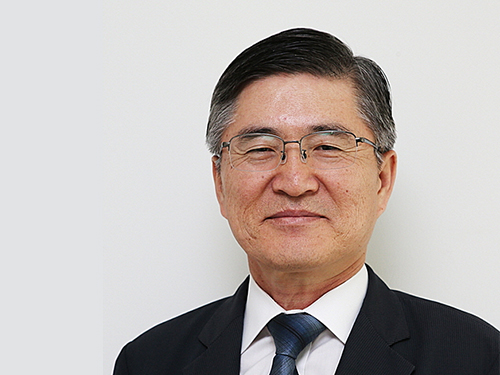 Professor Kwangjo Kim Named as Fellow of IACR
Professor Kwangjo Kim of the Graduate School of Information Security has been selected as a fellow of the International Association for Cryptologic Research (IACR).
The IACR has honored outstanding scholars who have achieved academic excellence in cryptologic research since 2004. He is the first Korean scholar to receive an IACR fellowship.
The IACR, established in 1981, is responsible for organizing international cryptologic conferences every year including the three major cryptologic academic conferences Eurocrypt, Crypto, and Asiacript. The IACR also sponsors workshop series such as the Theory of Cryptography Conference (TCC), the Workshop on Fast Software Encryption (FSE), the Public Key Cryptography Workshop (PKC), and Cryptographic Hardware and Embedded Systems (CHES).
Professor Kim, an internationally acclaimed scholar in the fields of cryptology and information security theory and its applications, was recognized for his outstanding academic achievements and leadership. He has made significant contributions to cryptology in Korea by hosting Asiacript in 1996 and 2001 as well as CHES in 2014. During his 34 years of academic activities, he has published more than 80 SCI journal papers and garnered more than 20,000 citations.
Professor Kim served on the board of the directors of the IACR from 2000 to 2004 and was the chairperson of the Asiacript Steering Committee from 2005 to 2008. He is on the editorial board of the online journal Cryptography.
Professor Kim said, “I am so humbled and honored to be named as a fellow of such a prestigious academic association. I will continue to strive to assist highly educated information security personnel with further research in cryptology.”
2017.03.16 View 9733
Professor Kwangjo Kim Named as Fellow of IACR
Professor Kwangjo Kim of the Graduate School of Information Security has been selected as a fellow of the International Association for Cryptologic Research (IACR).
The IACR has honored outstanding scholars who have achieved academic excellence in cryptologic research since 2004. He is the first Korean scholar to receive an IACR fellowship.
The IACR, established in 1981, is responsible for organizing international cryptologic conferences every year including the three major cryptologic academic conferences Eurocrypt, Crypto, and Asiacript. The IACR also sponsors workshop series such as the Theory of Cryptography Conference (TCC), the Workshop on Fast Software Encryption (FSE), the Public Key Cryptography Workshop (PKC), and Cryptographic Hardware and Embedded Systems (CHES).
Professor Kim, an internationally acclaimed scholar in the fields of cryptology and information security theory and its applications, was recognized for his outstanding academic achievements and leadership. He has made significant contributions to cryptology in Korea by hosting Asiacript in 1996 and 2001 as well as CHES in 2014. During his 34 years of academic activities, he has published more than 80 SCI journal papers and garnered more than 20,000 citations.
Professor Kim served on the board of the directors of the IACR from 2000 to 2004 and was the chairperson of the Asiacript Steering Committee from 2005 to 2008. He is on the editorial board of the online journal Cryptography.
Professor Kim said, “I am so humbled and honored to be named as a fellow of such a prestigious academic association. I will continue to strive to assist highly educated information security personnel with further research in cryptology.”
2017.03.16 View 9733 -
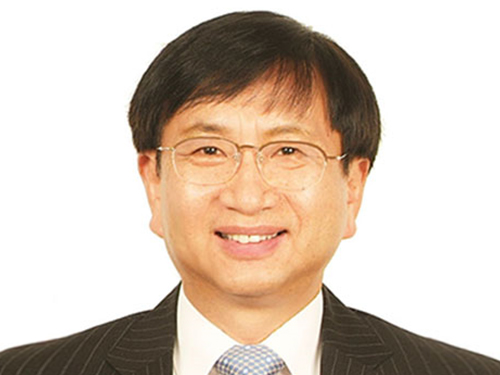 Professor Kwon to Represent the Asia-Pacific Region of the IEEE RAS
Professor Dong-Soon Kwon of the Mechanical Engineering Department at KAIST has been reappointed to the Administrative Committee of the Institute of Electrical and Electronics Engineers (IEEE) Robotics and Automation Society (IEEE RAS). Beginning January 1, 2017, he will serve his second three-year term, which will end in 2019. In 2014, he was the first Korean appointed to the committee, representing the Asia-Pacific community of the IEEE Society.
Professor Kwon said, “I feel thankful but, at the same time, it is a great responsibility to serve the Asian research community within the Society. I hope I can contribute to the development of robotics engineering in the region and in Korea as well.”
Consisted of 18 elected members, the administrative committee manages the major activities of IEEE RAS including hosting its annual flagship meeting, the International Conference on Robotics and Automation.
The IEEE RAS fosters the advancement in the theory and practice of robotics and automation engineering and facilitates the exchange of scientific and technological knowledge that supports the maintenance of high professional standards among its members.
2016.12.06 View 11469
Professor Kwon to Represent the Asia-Pacific Region of the IEEE RAS
Professor Dong-Soon Kwon of the Mechanical Engineering Department at KAIST has been reappointed to the Administrative Committee of the Institute of Electrical and Electronics Engineers (IEEE) Robotics and Automation Society (IEEE RAS). Beginning January 1, 2017, he will serve his second three-year term, which will end in 2019. In 2014, he was the first Korean appointed to the committee, representing the Asia-Pacific community of the IEEE Society.
Professor Kwon said, “I feel thankful but, at the same time, it is a great responsibility to serve the Asian research community within the Society. I hope I can contribute to the development of robotics engineering in the region and in Korea as well.”
Consisted of 18 elected members, the administrative committee manages the major activities of IEEE RAS including hosting its annual flagship meeting, the International Conference on Robotics and Automation.
The IEEE RAS fosters the advancement in the theory and practice of robotics and automation engineering and facilitates the exchange of scientific and technological knowledge that supports the maintenance of high professional standards among its members.
2016.12.06 View 11469 -
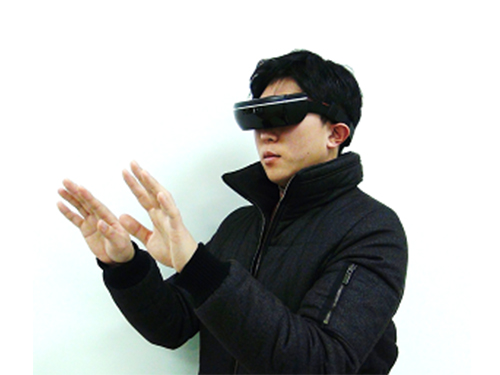 K-Glass 3 Offers Users a Keyboard to Type Text
KAIST researchers upgraded their smart glasses with a low-power multicore processor to employ stereo vision and deep-learning algorithms, making the user interface and experience more intuitive and convenient.
K-Glass, smart glasses reinforced with augmented reality (AR) that were first developed by KAIST in 2014, with the second version released in 2015, is back with an even stronger model. The latest version, which KAIST researchers are calling K-Glass 3, allows users to text a message or type in key words for Internet surfing by offering a virtual keyboard for text and even one for a piano.
Currently, most wearable head-mounted displays (HMDs) suffer from a lack of rich user interfaces, short battery lives, and heavy weight. Some HMDs, such as Google Glass, use a touch panel and voice commands as an interface, but they are considered merely an extension of smartphones and are not optimized for wearable smart glasses. Recently, gaze recognition was proposed for HMDs including K-Glass 2, but gaze cannot be realized as a natural user interface (UI) and experience (UX) due to its limited interactivity and lengthy gaze-calibration time, which can be up to several minutes.
As a solution, Professor Hoi-Jun Yoo and his team from the Electrical Engineering Department recently developed K-Glass 3 with a low-power natural UI and UX processor. This processor is composed of a pre-processing core to implement stereo vision, seven deep-learning cores to accelerate real-time scene recognition within 33 milliseconds, and one rendering engine for the display.
The stereo-vision camera, located on the front of K-Glass 3, works in a manner similar to three dimension (3D) sensing in human vision. The camera’s two lenses, displayed horizontally from one another just like depth perception produced by left and right eyes, take pictures of the same objects or scenes and combine these two different images to extract spatial depth information, which is necessary to reconstruct 3D environments. The camera’s vision algorithm has an energy efficiency of 20 milliwatts on average, allowing it to operate in the Glass more than 24 hours without interruption.
The research team adopted deep-learning-multi core technology dedicated for mobile devices. This technology has greatly improved the Glass’s recognition accuracy with images and speech, while shortening the time needed to process and analyze data. In addition, the Glass’s multi-core processor is advanced enough to become idle when it detects no motion from users. Instead, it executes complex deep-learning algorithms with a minimal power to achieve high performance.
Professor Yoo said, “We have succeeded in fabricating a low-power multi-core processer that consumes only 126 milliwatts of power with a high efficiency rate. It is essential to develop a smaller, lighter, and low-power processor if we want to incorporate the widespread use of smart glasses and wearable devices into everyday life. K-Glass 3’s more intuitive UI and convenient UX permit users to enjoy enhanced AR experiences such as a keyboard or a better, more responsive mouse.”
Along with the research team, UX Factory, a Korean UI and UX developer, participated in the K-Glass 3 project.
These research results entitled “A 126.1mW Real-Time Natural UI/UX Processor with Embedded Deep-Learning Core for Low-Power Smart Glasses” (lead author: Seong-Wook Park, a doctoral student in the Electrical Engineering Department, KAIST) were presented at the 2016 IEEE (Institute of Electrical and Electronics Engineers) International Solid-State Circuits Conference (ISSCC) that took place January 31-February 4, 2016 in San Francisco, California.
YouTube Link: https://youtu.be/If_anx5NerQ
Figure 1: K-Glass 3
K-Glass 3 is equipped with a stereo camera, dual microphones, a WiFi module, and eight batteries to offer higher recognition accuracy and enhanced augmented reality experiences than previous models.
Figure 2: Architecture of the Low-Power Multi-Core Processor
K-Glass 3’s processor is designed to include several cores for pre-processing, deep-learning, and graphic rendering.
Figure 3: Virtual Text and Piano Keyboard
K-Glass 3 can detect hands and recognize their movements to provide users with such augmented reality applications as a virtual text or piano keyboard.
2016.02.26 View 14240
K-Glass 3 Offers Users a Keyboard to Type Text
KAIST researchers upgraded their smart glasses with a low-power multicore processor to employ stereo vision and deep-learning algorithms, making the user interface and experience more intuitive and convenient.
K-Glass, smart glasses reinforced with augmented reality (AR) that were first developed by KAIST in 2014, with the second version released in 2015, is back with an even stronger model. The latest version, which KAIST researchers are calling K-Glass 3, allows users to text a message or type in key words for Internet surfing by offering a virtual keyboard for text and even one for a piano.
Currently, most wearable head-mounted displays (HMDs) suffer from a lack of rich user interfaces, short battery lives, and heavy weight. Some HMDs, such as Google Glass, use a touch panel and voice commands as an interface, but they are considered merely an extension of smartphones and are not optimized for wearable smart glasses. Recently, gaze recognition was proposed for HMDs including K-Glass 2, but gaze cannot be realized as a natural user interface (UI) and experience (UX) due to its limited interactivity and lengthy gaze-calibration time, which can be up to several minutes.
As a solution, Professor Hoi-Jun Yoo and his team from the Electrical Engineering Department recently developed K-Glass 3 with a low-power natural UI and UX processor. This processor is composed of a pre-processing core to implement stereo vision, seven deep-learning cores to accelerate real-time scene recognition within 33 milliseconds, and one rendering engine for the display.
The stereo-vision camera, located on the front of K-Glass 3, works in a manner similar to three dimension (3D) sensing in human vision. The camera’s two lenses, displayed horizontally from one another just like depth perception produced by left and right eyes, take pictures of the same objects or scenes and combine these two different images to extract spatial depth information, which is necessary to reconstruct 3D environments. The camera’s vision algorithm has an energy efficiency of 20 milliwatts on average, allowing it to operate in the Glass more than 24 hours without interruption.
The research team adopted deep-learning-multi core technology dedicated for mobile devices. This technology has greatly improved the Glass’s recognition accuracy with images and speech, while shortening the time needed to process and analyze data. In addition, the Glass’s multi-core processor is advanced enough to become idle when it detects no motion from users. Instead, it executes complex deep-learning algorithms with a minimal power to achieve high performance.
Professor Yoo said, “We have succeeded in fabricating a low-power multi-core processer that consumes only 126 milliwatts of power with a high efficiency rate. It is essential to develop a smaller, lighter, and low-power processor if we want to incorporate the widespread use of smart glasses and wearable devices into everyday life. K-Glass 3’s more intuitive UI and convenient UX permit users to enjoy enhanced AR experiences such as a keyboard or a better, more responsive mouse.”
Along with the research team, UX Factory, a Korean UI and UX developer, participated in the K-Glass 3 project.
These research results entitled “A 126.1mW Real-Time Natural UI/UX Processor with Embedded Deep-Learning Core for Low-Power Smart Glasses” (lead author: Seong-Wook Park, a doctoral student in the Electrical Engineering Department, KAIST) were presented at the 2016 IEEE (Institute of Electrical and Electronics Engineers) International Solid-State Circuits Conference (ISSCC) that took place January 31-February 4, 2016 in San Francisco, California.
YouTube Link: https://youtu.be/If_anx5NerQ
Figure 1: K-Glass 3
K-Glass 3 is equipped with a stereo camera, dual microphones, a WiFi module, and eight batteries to offer higher recognition accuracy and enhanced augmented reality experiences than previous models.
Figure 2: Architecture of the Low-Power Multi-Core Processor
K-Glass 3’s processor is designed to include several cores for pre-processing, deep-learning, and graphic rendering.
Figure 3: Virtual Text and Piano Keyboard
K-Glass 3 can detect hands and recognize their movements to provide users with such augmented reality applications as a virtual text or piano keyboard.
2016.02.26 View 14240 -
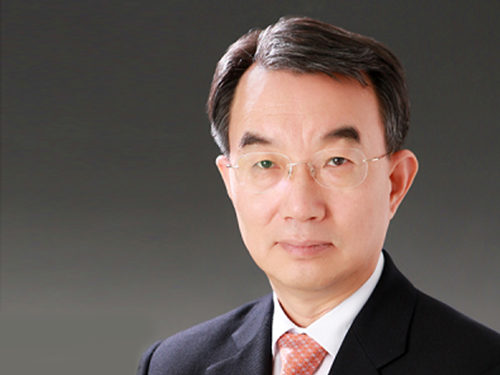 Professor Joonho Choe Appointed as the President of the KSMCB
Professor Joonho Choe of the Biological Sciences Department at KAIST has been elected the 25th president of Korean Society for Molecular and Cellular Biology (KSMCB).
His presidency will last one year, beginning on January 1, 2016.
Established in 1989, the Society has served as the largest academic gathering in the field of life sciences, holding an international conference every fall. It has more than 12,400 fellows.
Professor Choe served as the vice president of KSMC as well as the editor of its journal, Molecules and Cells.
He said, “The 2016 International Conference of the KSMCB will take place on October 12-14, 2016 at the COEX Convention and Exhibition Hall in Seoul. This year, we are preparing 20 symposiums and will invite four international renowned keynote speakers in the field including a Nobel Laureate. We hope many people, students and young researchers in particular, from academia and industry will join the conference.”
Professor Choe received his doctoral degree from the University of California, Los Angeles (UCLA) after graduating from Seoul National University with his bachelor and master’s degrees.
2016.01.05 View 9849
Professor Joonho Choe Appointed as the President of the KSMCB
Professor Joonho Choe of the Biological Sciences Department at KAIST has been elected the 25th president of Korean Society for Molecular and Cellular Biology (KSMCB).
His presidency will last one year, beginning on January 1, 2016.
Established in 1989, the Society has served as the largest academic gathering in the field of life sciences, holding an international conference every fall. It has more than 12,400 fellows.
Professor Choe served as the vice president of KSMC as well as the editor of its journal, Molecules and Cells.
He said, “The 2016 International Conference of the KSMCB will take place on October 12-14, 2016 at the COEX Convention and Exhibition Hall in Seoul. This year, we are preparing 20 symposiums and will invite four international renowned keynote speakers in the field including a Nobel Laureate. We hope many people, students and young researchers in particular, from academia and industry will join the conference.”
Professor Choe received his doctoral degree from the University of California, Los Angeles (UCLA) after graduating from Seoul National University with his bachelor and master’s degrees.
2016.01.05 View 9849 -
 Prof. Jae-Kyu Lee Campaigns on "Bright Internet" Worldwide
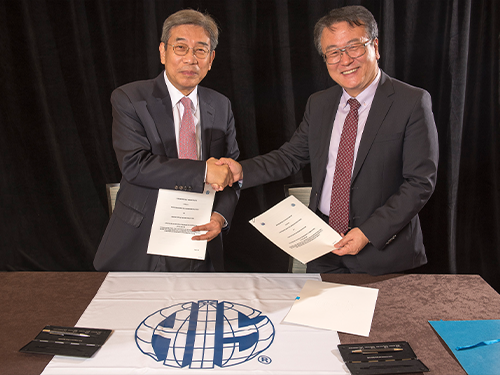
Professor Jae-Kyu Lee (pictured on the right) from the College of Business at KAIST is one step closer to fulfilling his dream of achieving the “Bright Internet,” a campaign that he first proposed as he became the president of the Association for Information Systems (AIS) in June 2015.
On December 12, 2015, Professor Lee signed a memorandum of understanding (MOU) at a convention center in Fort Worth, Texas, between the AIS and the International Telecommunication Union (ITU)—a specialized agency of the United Nations that is responsible for issues related to information and communication technologies—on a collaborative research and development program to make the Internet safer for everyone.
The MOU pursues building a trusted international information and communication technology (ICT) infrastructure by proposing telecommunication policies, developing international standards, and organizing interdisciplinary conferences.
The Bright Internet is an initiative to protect online users from cyber terrors, privacy breaches, and cyber-crimes. Further, it involves putting accountability to those who initiate or deliver cyber threats, thereby eliminating the possible source of Internet related crimes.
Following the MOU agreement, Prof. Lee delivered a speech on his campaign at the 2015 International Conference on Information Systems and received positive responses from the audience.
The Bright Internet campaign has been selected as visions of various ICT organizations worldwide including the Korea Society of Management Information System and the International Federation of Information Processing. KAIST and Tsinghua University in China adopted it as an academic topic for research and teaching.
Prof. Lee claimed that the Internet should be used in a manner based on the values of trust, ethics, and decorum. He further noted that it is important to build Internet environments that not only protect individuals from cyber threats or attacks, but also hold those who commit online crimes accountable for their actions.
2015.12.28 View 10912
Prof. Jae-Kyu Lee Campaigns on "Bright Internet" Worldwide
Professor Jae-Kyu Lee (pictured on the right) from the College of Business at KAIST is one step closer to fulfilling his dream of achieving the “Bright Internet,” a campaign that he first proposed as he became the president of the Association for Information Systems (AIS) in June 2015.
On December 12, 2015, Professor Lee signed a memorandum of understanding (MOU) at a convention center in Fort Worth, Texas, between the AIS and the International Telecommunication Union (ITU)—a specialized agency of the United Nations that is responsible for issues related to information and communication technologies—on a collaborative research and development program to make the Internet safer for everyone.
The MOU pursues building a trusted international information and communication technology (ICT) infrastructure by proposing telecommunication policies, developing international standards, and organizing interdisciplinary conferences.
The Bright Internet is an initiative to protect online users from cyber terrors, privacy breaches, and cyber-crimes. Further, it involves putting accountability to those who initiate or deliver cyber threats, thereby eliminating the possible source of Internet related crimes.
Following the MOU agreement, Prof. Lee delivered a speech on his campaign at the 2015 International Conference on Information Systems and received positive responses from the audience.
The Bright Internet campaign has been selected as visions of various ICT organizations worldwide including the Korea Society of Management Information System and the International Federation of Information Processing. KAIST and Tsinghua University in China adopted it as an academic topic for research and teaching.
Prof. Lee claimed that the Internet should be used in a manner based on the values of trust, ethics, and decorum. He further noted that it is important to build Internet environments that not only protect individuals from cyber threats or attacks, but also hold those who commit online crimes accountable for their actions.
2015.12.28 View 10912 -
 Professor Keon-Jae Lee Lectures at IEDM and ISSCC Forums
Professor Keon-Jae Lee of KAIST’s Materials Science and Engineering Department delivered a speech at the 2015 Institute of Electrical and Electronics Engineers (IEEE) International Electron Devices Meeting (IEDM) held on December 7-9, 2015 in Washington, D.C.
He will also present a speech at the 2016 International Solid-State Circuits Conference scheduled on January 31-February 4, 2016 in San Francisco, California.
Both professional gatherings are considered the world’s most renowned forums in electronic devices and semiconductor technology. It is rare for a Korean researcher to be invited to speak at these global conferences.
Professor Lee was recognized for his research on flexible NAND chips. The Korea Times, an English language daily newspaper in Korea, reported on his participation in the forums and his recent work. An excerpt of the article follows below:
“KAIST Professor to Lecture at Renowned Tech Forums”
By Lee Min-hyung, The Korea Times, November 26, 2015
Recently he has focused on delivering technologies for producing flexible materials that can be applied to everyday life. The flexible NAND flash memory chips are expected to be widely used for developing flexible handsets. His latest research also includes flexible light-emitting diodes (LED) for implantable biomedical applications.
Lee is currently running a special laboratory focused on developing new flexible nano-materials. The research group is working to develop what it calls “self-powered flexible electronic systems” using nanomaterials and electronic technology.
Lee’s achievement with flexible NAND chips was published in the October edition of Nano Letters, the renowned U.S.-based scientific journal.
He said that flexible memory chips will be used to develop wearable computers that can be installed anywhere.
2015.11.26 View 13436
Professor Keon-Jae Lee Lectures at IEDM and ISSCC Forums
Professor Keon-Jae Lee of KAIST’s Materials Science and Engineering Department delivered a speech at the 2015 Institute of Electrical and Electronics Engineers (IEEE) International Electron Devices Meeting (IEDM) held on December 7-9, 2015 in Washington, D.C.
He will also present a speech at the 2016 International Solid-State Circuits Conference scheduled on January 31-February 4, 2016 in San Francisco, California.
Both professional gatherings are considered the world’s most renowned forums in electronic devices and semiconductor technology. It is rare for a Korean researcher to be invited to speak at these global conferences.
Professor Lee was recognized for his research on flexible NAND chips. The Korea Times, an English language daily newspaper in Korea, reported on his participation in the forums and his recent work. An excerpt of the article follows below:
“KAIST Professor to Lecture at Renowned Tech Forums”
By Lee Min-hyung, The Korea Times, November 26, 2015
Recently he has focused on delivering technologies for producing flexible materials that can be applied to everyday life. The flexible NAND flash memory chips are expected to be widely used for developing flexible handsets. His latest research also includes flexible light-emitting diodes (LED) for implantable biomedical applications.
Lee is currently running a special laboratory focused on developing new flexible nano-materials. The research group is working to develop what it calls “self-powered flexible electronic systems” using nanomaterials and electronic technology.
Lee’s achievement with flexible NAND chips was published in the October edition of Nano Letters, the renowned U.S.-based scientific journal.
He said that flexible memory chips will be used to develop wearable computers that can be installed anywhere.
2015.11.26 View 13436 -
 Professor Junehwa Song Appointed as the General Chair of the Organizing Committee of ACM SenSys
Professor Junehwa Song from the Schooling of Computing at KAIST has been appointed the general chair of the organizing committee of ACM SenSys—the American Computing Machine (ACM) Conference on Embedded Networked Sensor Systems.
ACM SenSys held its first conference in 2003 to promote research on wireless sensor networks and embedded systems. Since then, it has expanded into an influential international conference especially with the increasing importance in sensor technologies. Recently the committee has expanded its field of interest to mobile sensors, the Internet of Things, smart device system, and security.
Professor Song is considered a world-renown researcher in mobile and ubiquitous computing system. He presented numerous research papers at various conferences organized by ACM. He is also a member of the editorial committee of the Institute of Electrical and Electronics Engineers (IEEE) Transactions on Mobile Computing journal. For his achievements in the field and flair for coordinating and planning conferences, he is now the first Korean researcher to be appointed the chair of ACM SenSys.
Professor Song said that, as the chair, he would help discover new technology in and applications of networked, wireless sensors that would meet the demands of our modern society.
The 13th ACM SenSys will take place in Seoul—the first one to be held in Asia. The event will begin on November 1, 2015 and last four days. More information about this year’s event can be found at http://sensys.acm.org/2015/.
2015.10.02 View 8857
Professor Junehwa Song Appointed as the General Chair of the Organizing Committee of ACM SenSys
Professor Junehwa Song from the Schooling of Computing at KAIST has been appointed the general chair of the organizing committee of ACM SenSys—the American Computing Machine (ACM) Conference on Embedded Networked Sensor Systems.
ACM SenSys held its first conference in 2003 to promote research on wireless sensor networks and embedded systems. Since then, it has expanded into an influential international conference especially with the increasing importance in sensor technologies. Recently the committee has expanded its field of interest to mobile sensors, the Internet of Things, smart device system, and security.
Professor Song is considered a world-renown researcher in mobile and ubiquitous computing system. He presented numerous research papers at various conferences organized by ACM. He is also a member of the editorial committee of the Institute of Electrical and Electronics Engineers (IEEE) Transactions on Mobile Computing journal. For his achievements in the field and flair for coordinating and planning conferences, he is now the first Korean researcher to be appointed the chair of ACM SenSys.
Professor Song said that, as the chair, he would help discover new technology in and applications of networked, wireless sensors that would meet the demands of our modern society.
The 13th ACM SenSys will take place in Seoul—the first one to be held in Asia. The event will begin on November 1, 2015 and last four days. More information about this year’s event can be found at http://sensys.acm.org/2015/.
2015.10.02 View 8857 -
 Professor Woontack Woo Demonstrates an Optical Platform Technology for Augmented Reality at Smart Cloud Show
Professor Woontack Woo of the Graduate School of Culture Technology at KAIST participated in the Smart Cloud Show, a technology exhibition, hosted by the university’s Augmented Human Research Center and presented the latest development of his research, an optical platform system for augmented reality.
This event took place on September 16-17, 2015 at Grand Seoul Nine Tree Convention Center in Seoul.
At the event, Professor Woo introduced a smart glass with an embedded augmented reality system, which permits remote collaboration between an avatar and the user’s hand.
The previous remote collaboration was difficult for ordinary users to employ because of its two-dimensional screen and complicated virtual reality system.
However, with the new technology, the camera attached to artificial reality (AR) glasses recognizes the user’s hand and tracks it down to collaborate. The avatar in the virtual space and the user’s hand interact in real space and time.
The key to this technology is the stable, real-time hand-tracking technique that allows the detection of the hand’s locations and the recognition of finger movements even in situations of self-occlusion.
Through this method, a user can touch and manipulate augmented contents as if they were real-life objects, thereby collaborating remotely with another user who is physically distant by linking his or her movements with an avatar.
If this technology is adopted widely, it may bring some economic benefits such as increased productivity due to lower costs for mobility and reduction in social overhead costs from the decrease in the need of traveling long distance.
Professor Woo said, “This technology will provide us with a greater opportunity for collaboration, not necessarily restricted to physical travelling, which can be widely used in the fields of medicine, education, entertainment, and tourism.”
Professor Woo plans to present his research results on hand-movement tracking and detection at the 12th International Conference on Ubiquitous Robots and Ambient Intelligence (URAI 2015), to be held on October 28-30, 2015, at Kintex in Goyang, Korea.
He will also present a research paper on remote collaboration at the ICAT-EGVE 2015 conference, the merger of the 25th International Conference on Artificial Reality and Telexistence (ICAT 2015) and the 20th Eurographics Symposium on Virtual Environments (EGVE 2015), which will take place on October 28-30, 2015 at the Kyoto International Community House, Kyoto, Japan.
2015.09.16 View 10606
Professor Woontack Woo Demonstrates an Optical Platform Technology for Augmented Reality at Smart Cloud Show
Professor Woontack Woo of the Graduate School of Culture Technology at KAIST participated in the Smart Cloud Show, a technology exhibition, hosted by the university’s Augmented Human Research Center and presented the latest development of his research, an optical platform system for augmented reality.
This event took place on September 16-17, 2015 at Grand Seoul Nine Tree Convention Center in Seoul.
At the event, Professor Woo introduced a smart glass with an embedded augmented reality system, which permits remote collaboration between an avatar and the user’s hand.
The previous remote collaboration was difficult for ordinary users to employ because of its two-dimensional screen and complicated virtual reality system.
However, with the new technology, the camera attached to artificial reality (AR) glasses recognizes the user’s hand and tracks it down to collaborate. The avatar in the virtual space and the user’s hand interact in real space and time.
The key to this technology is the stable, real-time hand-tracking technique that allows the detection of the hand’s locations and the recognition of finger movements even in situations of self-occlusion.
Through this method, a user can touch and manipulate augmented contents as if they were real-life objects, thereby collaborating remotely with another user who is physically distant by linking his or her movements with an avatar.
If this technology is adopted widely, it may bring some economic benefits such as increased productivity due to lower costs for mobility and reduction in social overhead costs from the decrease in the need of traveling long distance.
Professor Woo said, “This technology will provide us with a greater opportunity for collaboration, not necessarily restricted to physical travelling, which can be widely used in the fields of medicine, education, entertainment, and tourism.”
Professor Woo plans to present his research results on hand-movement tracking and detection at the 12th International Conference on Ubiquitous Robots and Ambient Intelligence (URAI 2015), to be held on October 28-30, 2015, at Kintex in Goyang, Korea.
He will also present a research paper on remote collaboration at the ICAT-EGVE 2015 conference, the merger of the 25th International Conference on Artificial Reality and Telexistence (ICAT 2015) and the 20th Eurographics Symposium on Virtual Environments (EGVE 2015), which will take place on October 28-30, 2015 at the Kyoto International Community House, Kyoto, Japan.
2015.09.16 View 10606