LED
-
 Nanofiber sensor detects diabetes or lung cancer faster and easier
Metal-oxide nanofiber based chemiresistive gas sensors offer greater usability for portable real-time breath tests that can be available on smart phones or tablet PCs in the near future.
Daejeon, Republic of Korea, June 11, 2013 -- Today"s technological innovation enables smartphone users to diagnose serious diseases such as diabetes or lung cancer quickly and effectively by simply breathing into a small gadget, a nanofiber breathing sensor, mounted on the phones.
Il-Doo Kim, Associate Professor of Materials Science and Engineering Department at the Korea Advanced Institute of Science and Technology (KAIST), and his research team have recently published a cover paper entitled "Thin-Wall Assembled SnO2 Fibers Functionalized by Catalytic Pt Nanoparticles and their Superior Exhaled Breath-Sensing Properties for the Diagnosis of Diabetes," in an academic journal, Advanced Functional Materials (May 20th issue), on the development of a highly sensitive exhaled breath sensor by using hierarchical SnO2 fibers that are assembled from wrinkled thin SnO2 nanotubes.
In the paper, the research team presented a morphological evolution of SnO2 fibers, called micro phase-separations, which takes place between polymers and other dissolved solutes when varying the flow rate of an electrospinning solution feed and applying a subsequent heat treatment afterward.
The morphological change results in nanofibers that are shaped like an open cylinder inside which thin-film SnO2 nanotubes are layered and then rolled up. A number of elongated pores ranging from 10 nanometers (nm) to 500 nm in length along the fiber direction were formed on the surface of the SnO2 fibers, allowing exhaled gas molecules to easily permeate the fibers. The inner and outer wall of SnO2 tubes is evenly coated with catalytic platinum (Pt) nanoparticles. According to the research team, highly porous SnO2 fibers, synthesized by eletrospinning at a high flow rate, showed five-fold higher acetone responses than that of the dense SnO2 nanofibers created under a low flow rate. The catalytic Pt coating shortened the fibers" gas response time dramatically as well.
The breath analysis for diabetes is largely based on an acetone breath test because acetone is one of the specific volatile organic compounds (VOC) produced in the human body to signal the onset of particular diseases. In other words, they are biomarkers to predict certain diseases such as acetone for diabetes, toluene for lung cancer, and ammonia for kidney malfunction. Breath analysis for medical evaluation has attracted much attention because it is less intrusive than conventional medical examination, as well as fast and convenient, and environmentally friendly, leaving almost no biohazard wastes.
Various gas-sensing techniques have been adopted to analyze VOCs including gas chromatography-mass spectroscopy (GC-MS), but these techniques are difficult to incorporate into portable real-time gas sensors because the testing equipment is bulky and expensive, and their operation is more complex. Metal-oxide based chemiresistive gas sensors, however, offer greater usability for portable real-time breath sensors.
Il-Doo Kim said, "Catalyst-loaded metal oxide nanofibers synthesized by electrospinning have a great potential for future exhaled breath sensor applications. From our research, we obtained the results that Pt-coated SnO2 fibers are able to identify promptly and accurately acetone or toluene even at very low concentration less than 100 parts per billion (ppb)."
The exhaled acetone level of diabetes patients exceeds 1.8 parts per million (ppm), which is two to six-fold higher than that (0.3-0.9 ppm) of healthy people. Therefore, a highly sensitive detection that responds to acetone below 1 ppm, in the presence of other exhaled gases as well as under the humid environment of human breath, is important for an accurate diagnosis of diabetes. In addition, Professor Kim said, "a trace concentration of toluene (30 ppb) in exhaled breath is regarded to be a distinctive early symptom of lung cancer, which we were able to detect with our prototype breath tester."
The research team has now been developing an array of breathing sensors using various catalysts and a number of semiconducting metal oxide fibers, which will offer patients a real-time easy diagnosis of diseases.
###
Youtube Link: http://www.youtube.com/watch?v=t_Hr11dRryg
For further inquires:
Il-Doo Kim, Professor of Materials Science and Engineering, KAIST
Advanced Nanomaterials and Energy Laboratory
Tel: +82-42-350-3329
Email: idkim@kaist.ac.kr
Clockwise from left to right: left upper shows a magnified SEM image of a broken thin-wall assembled SnO2 fiber. Left below is an array of breath sensors (Inset is an actual size of a breath sensor). The right is the cover of Advanced Functional Materials (May 20th issue) in which a research paper on the development of a highly sensitive exhaled breath sensor by using SnO2 fibers is published.
This is the microstructural evolution of SnO2 nanofibers as a function of flow rate during electrospinning.
2013.06.20 View 12359
Nanofiber sensor detects diabetes or lung cancer faster and easier
Metal-oxide nanofiber based chemiresistive gas sensors offer greater usability for portable real-time breath tests that can be available on smart phones or tablet PCs in the near future.
Daejeon, Republic of Korea, June 11, 2013 -- Today"s technological innovation enables smartphone users to diagnose serious diseases such as diabetes or lung cancer quickly and effectively by simply breathing into a small gadget, a nanofiber breathing sensor, mounted on the phones.
Il-Doo Kim, Associate Professor of Materials Science and Engineering Department at the Korea Advanced Institute of Science and Technology (KAIST), and his research team have recently published a cover paper entitled "Thin-Wall Assembled SnO2 Fibers Functionalized by Catalytic Pt Nanoparticles and their Superior Exhaled Breath-Sensing Properties for the Diagnosis of Diabetes," in an academic journal, Advanced Functional Materials (May 20th issue), on the development of a highly sensitive exhaled breath sensor by using hierarchical SnO2 fibers that are assembled from wrinkled thin SnO2 nanotubes.
In the paper, the research team presented a morphological evolution of SnO2 fibers, called micro phase-separations, which takes place between polymers and other dissolved solutes when varying the flow rate of an electrospinning solution feed and applying a subsequent heat treatment afterward.
The morphological change results in nanofibers that are shaped like an open cylinder inside which thin-film SnO2 nanotubes are layered and then rolled up. A number of elongated pores ranging from 10 nanometers (nm) to 500 nm in length along the fiber direction were formed on the surface of the SnO2 fibers, allowing exhaled gas molecules to easily permeate the fibers. The inner and outer wall of SnO2 tubes is evenly coated with catalytic platinum (Pt) nanoparticles. According to the research team, highly porous SnO2 fibers, synthesized by eletrospinning at a high flow rate, showed five-fold higher acetone responses than that of the dense SnO2 nanofibers created under a low flow rate. The catalytic Pt coating shortened the fibers" gas response time dramatically as well.
The breath analysis for diabetes is largely based on an acetone breath test because acetone is one of the specific volatile organic compounds (VOC) produced in the human body to signal the onset of particular diseases. In other words, they are biomarkers to predict certain diseases such as acetone for diabetes, toluene for lung cancer, and ammonia for kidney malfunction. Breath analysis for medical evaluation has attracted much attention because it is less intrusive than conventional medical examination, as well as fast and convenient, and environmentally friendly, leaving almost no biohazard wastes.
Various gas-sensing techniques have been adopted to analyze VOCs including gas chromatography-mass spectroscopy (GC-MS), but these techniques are difficult to incorporate into portable real-time gas sensors because the testing equipment is bulky and expensive, and their operation is more complex. Metal-oxide based chemiresistive gas sensors, however, offer greater usability for portable real-time breath sensors.
Il-Doo Kim said, "Catalyst-loaded metal oxide nanofibers synthesized by electrospinning have a great potential for future exhaled breath sensor applications. From our research, we obtained the results that Pt-coated SnO2 fibers are able to identify promptly and accurately acetone or toluene even at very low concentration less than 100 parts per billion (ppb)."
The exhaled acetone level of diabetes patients exceeds 1.8 parts per million (ppm), which is two to six-fold higher than that (0.3-0.9 ppm) of healthy people. Therefore, a highly sensitive detection that responds to acetone below 1 ppm, in the presence of other exhaled gases as well as under the humid environment of human breath, is important for an accurate diagnosis of diabetes. In addition, Professor Kim said, "a trace concentration of toluene (30 ppb) in exhaled breath is regarded to be a distinctive early symptom of lung cancer, which we were able to detect with our prototype breath tester."
The research team has now been developing an array of breathing sensors using various catalysts and a number of semiconducting metal oxide fibers, which will offer patients a real-time easy diagnosis of diseases.
###
Youtube Link: http://www.youtube.com/watch?v=t_Hr11dRryg
For further inquires:
Il-Doo Kim, Professor of Materials Science and Engineering, KAIST
Advanced Nanomaterials and Energy Laboratory
Tel: +82-42-350-3329
Email: idkim@kaist.ac.kr
Clockwise from left to right: left upper shows a magnified SEM image of a broken thin-wall assembled SnO2 fiber. Left below is an array of breath sensors (Inset is an actual size of a breath sensor). The right is the cover of Advanced Functional Materials (May 20th issue) in which a research paper on the development of a highly sensitive exhaled breath sensor by using SnO2 fibers is published.
This is the microstructural evolution of SnO2 nanofibers as a function of flow rate during electrospinning.
2013.06.20 View 12359 -
 Technology for Non-Breaking Smartphone Display Developed
High-strength plastic display has been developed by applying a glass-fiber fabric.
“Will bring about innovation to the field by replacing glass substrates”
It is now possible to manufacture non-breaking smartphone display. Heavy glass substrates of large-screen televisions will be replaced with light plastic films.
Professor Choon Sup Yoon from KAIST’s Department of Physics and KAIST Institute for Information Technology Convergence has developed the technology for high-strength plastic substrates to replace glass displays.
The plastic substrate created by Professor Yoon and his research team have greatly enhanced needed properties of heat resistance, transparency, flexibility, inner chemical capability, and tensile strength. Although the material retains flexibility as a native advantage of plastic film, its tensile strength is three times greater than that of normal glass, which is a degree similar to tempered glass. In addition, Professor Yoon’s substrate is as colorless and transparent as glass and resists heat up to 450℃, while its thermal expansivity is only 10% to 20% of existing plastics.
Glass substrates are currently used in practically every display such as mobile phone screens, televisions, and computer monitors for having smooth surface and satisfying basic conditions for display substrates. However, as glass substrates are heavy and easily broken, researchers studied colorless and transparent plastic polyimide films to replace glass substrates for their excellent thermal and chemical stability.
Nonetheless, colorless and transparent polyimide films do not have sufficient heat resistance and mechanical solidity. To resolve this problem, polyimide films are impregnated with glass-fiber fabrics, but it was far from commercialization as the impregnation exacerbates the roughness of surface and light transmittance. The roughness of the surface increases as the solvent evaporates in the impregnation process, resulting in surface roughness of around 0.4μm. The downturn in light transmittance is due to light scattering effect by the discording refractive index of polyimide film and glass-fiber fabric.
Professor Yoon’s research team resolved these issues by tuning the refractive indices of transparent polyimide film and glass-fiber fabric up to four decimal places, and by developing the technology of flattening the film’s surface roughness to a few nanometers. As a result, the research team achieved heat expansivity of 11ppm/℃, surface roughness of 0.9nm, tensile strength of 250MPa, bending curvature radius of 2mm, and light transmittance at 90% with a 110μm-thick glass-fiber fabric impregnated transparent polyimide film substrate.
“The developed substrate can not only replace the traditional glass substrate but also be applied as flexible display substrate,” said Professor Yoon in prospect, “it will bring about technological innovation in display industry as it can fundamentally resolve the issue of shattering mobile phone displays, reduce the weight and thickness of large-area televisions, and apply Roll to Roll process in display manufacture.”
Supported by the Ministry of Knowledge Economy for five years, the technology has applied for 3 patents and is in discussion for technology transfer with related business.
Figure 1. The according (left) and discording (right) refractive indices of glass-fiber fabric and polyimide film. The characters on the left are sharp and clear, but the characters on the right appear foggy.
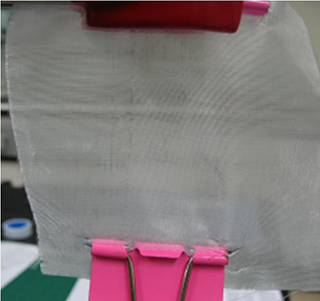
Figure 2. Picture of the developed glass-fiber fabric
2013.06.09 View 7854
Technology for Non-Breaking Smartphone Display Developed
High-strength plastic display has been developed by applying a glass-fiber fabric.
“Will bring about innovation to the field by replacing glass substrates”
It is now possible to manufacture non-breaking smartphone display. Heavy glass substrates of large-screen televisions will be replaced with light plastic films.
Professor Choon Sup Yoon from KAIST’s Department of Physics and KAIST Institute for Information Technology Convergence has developed the technology for high-strength plastic substrates to replace glass displays.
The plastic substrate created by Professor Yoon and his research team have greatly enhanced needed properties of heat resistance, transparency, flexibility, inner chemical capability, and tensile strength. Although the material retains flexibility as a native advantage of plastic film, its tensile strength is three times greater than that of normal glass, which is a degree similar to tempered glass. In addition, Professor Yoon’s substrate is as colorless and transparent as glass and resists heat up to 450℃, while its thermal expansivity is only 10% to 20% of existing plastics.
Glass substrates are currently used in practically every display such as mobile phone screens, televisions, and computer monitors for having smooth surface and satisfying basic conditions for display substrates. However, as glass substrates are heavy and easily broken, researchers studied colorless and transparent plastic polyimide films to replace glass substrates for their excellent thermal and chemical stability.
Nonetheless, colorless and transparent polyimide films do not have sufficient heat resistance and mechanical solidity. To resolve this problem, polyimide films are impregnated with glass-fiber fabrics, but it was far from commercialization as the impregnation exacerbates the roughness of surface and light transmittance. The roughness of the surface increases as the solvent evaporates in the impregnation process, resulting in surface roughness of around 0.4μm. The downturn in light transmittance is due to light scattering effect by the discording refractive index of polyimide film and glass-fiber fabric.
Professor Yoon’s research team resolved these issues by tuning the refractive indices of transparent polyimide film and glass-fiber fabric up to four decimal places, and by developing the technology of flattening the film’s surface roughness to a few nanometers. As a result, the research team achieved heat expansivity of 11ppm/℃, surface roughness of 0.9nm, tensile strength of 250MPa, bending curvature radius of 2mm, and light transmittance at 90% with a 110μm-thick glass-fiber fabric impregnated transparent polyimide film substrate.
“The developed substrate can not only replace the traditional glass substrate but also be applied as flexible display substrate,” said Professor Yoon in prospect, “it will bring about technological innovation in display industry as it can fundamentally resolve the issue of shattering mobile phone displays, reduce the weight and thickness of large-area televisions, and apply Roll to Roll process in display manufacture.”
Supported by the Ministry of Knowledge Economy for five years, the technology has applied for 3 patents and is in discussion for technology transfer with related business.
Figure 1. The according (left) and discording (right) refractive indices of glass-fiber fabric and polyimide film. The characters on the left are sharp and clear, but the characters on the right appear foggy.
Figure 2. Picture of the developed glass-fiber fabric
2013.06.09 View 7854 -
 Professor Soon-Heung Chang meets with Bill Gates and discusses possible collaboration
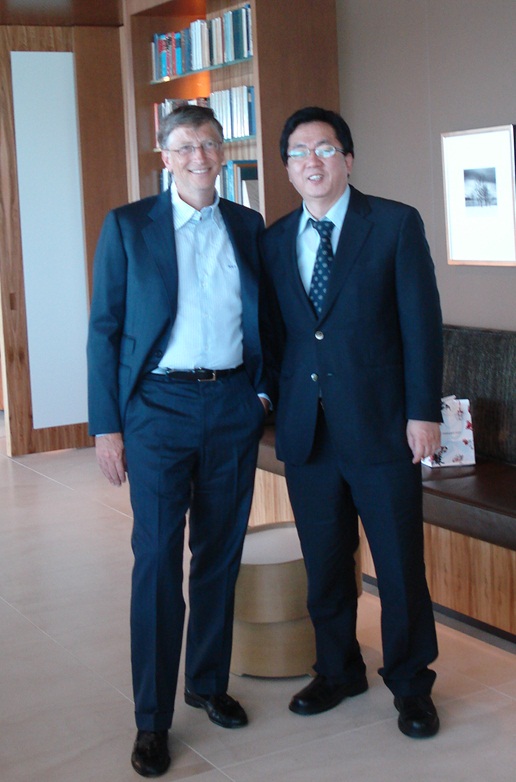
Professor Soon-Heung Chang from the Department of Nuclear and Quantum Engineering, KAIST, who is also the president of Korea Nuclear Society (KNS), met Bill Gates, the co-founder and former chief executive officer (CEO) of Microsoft, on August 16, 2012 and discussed ways to cooperate for the development of a sodium-cooled fast reactor (SFR), a next generation nuclear power reactor.
According to Professor Chang, Bill Gates was amazed at Korea’s successful bids for nuclear power plants in the United Arab Emirates, even though Korea was a latecomer in the field of nuclear power. Bill Gates also showed a keen interest in Korea’s low electricity rates.
Gates focuses on solving fundamental problems in order to help improve the quality of life for humanity, rather than short-term temporary solutions, through infrastructure development such as energy. Particularly, he considers nuclear power as one of the most effective ways to supply clean energy which can provide electricity at a low cost while keeping carbon dioxide emission levels much lower than fossil fuels.
Bill Gates is a primary investor for an energy company called “TerraPower” based in Bellevue, Washington. TerraPower develops and commercializes nuclear power technology for a traveling wave reactor (TWR) that is designed to use spent fuels, i.e., depleted uranium, and runs technically “forever” because once fueled, the reactor does not need to be refueled for over 50 years. TerraPower’s TWR is to use metallic fuel, and Korea is the only country that currently develops SFR (KALIMER 600) using metallic fuel.
“Korea has an outstanding supply chain for the entire lifecycle of a nuclear power station from equipment manufacturing to operation,” said Professor Chang, while emphasizing the synergistic effects of forming partnership between Korea and TerraPower.
Professor Chang emphasized that Korea should create an opportunity based on lessons learned from the Fukushima crisis and actively move forward to achieve its leading position in the field of next generation nuclear reactors. He said that cooperation with Bill Gates will be a significant step towards the development of next generation nuclear reactors.
About Sodium-cooled Fast Reactor (SFR)
Sodium-cooled Fast Reactor (SFR) is a next-generation nuclear power reactor that will use spent fuels from conventional reactors. Arrangement of a fuel recycling system in
conjunction with currently-developing pyroprocessing technology would enable U-238, which makes up over 99% of natural uranium, to be used as a nuclear fuel. This would greatly reduce the toxicity and volume of spent fuels by up to 1,000 times and 100 times respectively when compared to existing reactors. This is truly a breakthrough innovation in spent fuel disposal and recycling.
2012.09.20 View 9256
Professor Soon-Heung Chang meets with Bill Gates and discusses possible collaboration
Professor Soon-Heung Chang from the Department of Nuclear and Quantum Engineering, KAIST, who is also the president of Korea Nuclear Society (KNS), met Bill Gates, the co-founder and former chief executive officer (CEO) of Microsoft, on August 16, 2012 and discussed ways to cooperate for the development of a sodium-cooled fast reactor (SFR), a next generation nuclear power reactor.
According to Professor Chang, Bill Gates was amazed at Korea’s successful bids for nuclear power plants in the United Arab Emirates, even though Korea was a latecomer in the field of nuclear power. Bill Gates also showed a keen interest in Korea’s low electricity rates.
Gates focuses on solving fundamental problems in order to help improve the quality of life for humanity, rather than short-term temporary solutions, through infrastructure development such as energy. Particularly, he considers nuclear power as one of the most effective ways to supply clean energy which can provide electricity at a low cost while keeping carbon dioxide emission levels much lower than fossil fuels.
Bill Gates is a primary investor for an energy company called “TerraPower” based in Bellevue, Washington. TerraPower develops and commercializes nuclear power technology for a traveling wave reactor (TWR) that is designed to use spent fuels, i.e., depleted uranium, and runs technically “forever” because once fueled, the reactor does not need to be refueled for over 50 years. TerraPower’s TWR is to use metallic fuel, and Korea is the only country that currently develops SFR (KALIMER 600) using metallic fuel.
“Korea has an outstanding supply chain for the entire lifecycle of a nuclear power station from equipment manufacturing to operation,” said Professor Chang, while emphasizing the synergistic effects of forming partnership between Korea and TerraPower.
Professor Chang emphasized that Korea should create an opportunity based on lessons learned from the Fukushima crisis and actively move forward to achieve its leading position in the field of next generation nuclear reactors. He said that cooperation with Bill Gates will be a significant step towards the development of next generation nuclear reactors.
About Sodium-cooled Fast Reactor (SFR)
Sodium-cooled Fast Reactor (SFR) is a next-generation nuclear power reactor that will use spent fuels from conventional reactors. Arrangement of a fuel recycling system in
conjunction with currently-developing pyroprocessing technology would enable U-238, which makes up over 99% of natural uranium, to be used as a nuclear fuel. This would greatly reduce the toxicity and volume of spent fuels by up to 1,000 times and 100 times respectively when compared to existing reactors. This is truly a breakthrough innovation in spent fuel disposal and recycling.
2012.09.20 View 9256 -
Annual Future Knowledge Service International Symposium
Knowledge Service Research preparing for the future knowledge based society has been academically publicized.
The First Annual Future Knowledge Service International Symposium was held in COEX Grand Ball Room Hall by KAIST’s department of Knowledge Service Engineering.
Knowledge Service Engineering is a core component to the future knowledge based society and is the convergent result of decision making, recognition sciences, artificial intelligence, IT, and other knowledge management technologies from each of the industries. Therefore Knowledge Service Engineering will innovate the cooperation and communication between humans and machines thereby forming the center point of the development of knowledge society.
The symposium was attended by 9 important figures from domestic and foreign academia, government representative, and key figures from industries. The symposium was based around debates concerning the role of the Knowledge Service Engineering in the future knowledge based society.
The key note speaker was Chairman of Korea Science and Technology Information Research Institute Park Young Suh and the theme of the speech was ‘Change in Information Environment and Knowledge Service’.
Director of National IT Industry Promotion Agency Kang Hyun Gu gave a lecture on the topic of ‘Important Knowledge Service Policies by National IT Industry Promotion Agency’. And from industry experts, Bradley K. Jensen (Manager of Microsoft Industry-Education Cooperation), Lee Kang Yoon (Research Director at IBM), Choi Yoon Shik (Head of Asia Future Human Resource Institute) proposed a direction for research and gave their account on recent trends of knowledge service from the perspective of onsite experience.
Academic experts like Fred D. Davis (Professor at State University of Arkansas), Jussi Kantola (Professor at KAIST), Kim Young Gul (Professor at KAIST Management University), Yoon Wan Chul (Professor at KAIST Knowledge Service Engineering) gave the recent trends in academic research.
The symposium was held in 3 sessions: ▲Policy of Korean Government ▲Academic Research Trend ▲Recent Trend and Application.
More information can be found at http://kss.kaist.ac.kr
2012.01.31 View 7713
-
 Cancer detection from an implantable, flexible LED
Professor Keon Jae Lee
A KAIST research team has developed a new type of biocompatible and bendable GaN LED biosensor.
Daejeon, the Republic of Korea, August 8, 2011—Can a flexible LED conformably placed on the human heart, situated on the corrugated surface of the human brain, or rolled upon the blood vessels, diagnose or even treat various diseases? These things might be a reality in the near future.
The team of Professor Keon Jae Lee (Department of Materials Science and Engineering, KAIST) has developed a new concept: a biocompatible, flexible Gallium Nitride (GaN) LED that can detect prostate cancer.
GaN LED, a highly efficient light emitting device, has been commercialized in LED TVs and in the lighting industry. Until now, it has been difficult to use this semiconductor material to fabricate flexible electronic systems due to its brittleness. The research team, however, has succeeded in developing a highly efficient, flexible GaN LED and in detecting cancer using a flexible LED biosensor.
Prof. Lee was involved in the first co-invention of "High Performance Flexible Single Crystal GaN" during his PhD course at the University of Illinois at Urbana-Champaign (UIUC). This flexible GaN LED biosensor utilized a similar protocol to transfer thin GaN LED films onto flexible substrates, followed by a biocompatible packaging process; the system’s overall potential for use in implantable biomedical applications was demonstrated.
Professor John Roger (Department of Materials Science and Engineering, UIUC) said,
“Bio-integrated LEDs represent an exciting, new technology with strong potential to address important challenges in human health. This present work represents a very nice contribution to this emerging field.”
This paper was published in the online issue of Nano Energy Elsevier Journal (Editor, Prof. Zhong Lin Wang) dated September 16, 2011.
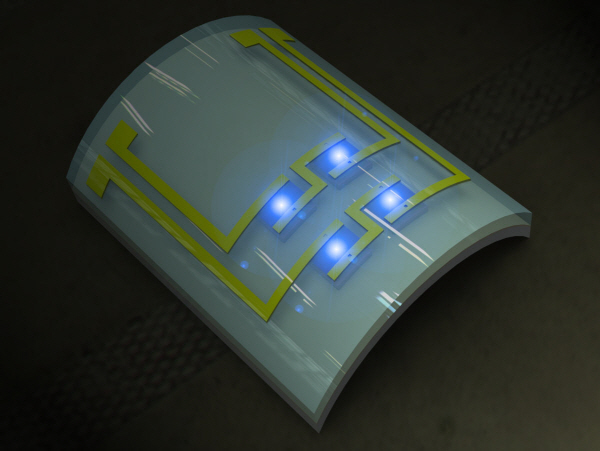
Flexible GaN LED produces blue light.
2011.09.20 View 9922
Cancer detection from an implantable, flexible LED
Professor Keon Jae Lee
A KAIST research team has developed a new type of biocompatible and bendable GaN LED biosensor.
Daejeon, the Republic of Korea, August 8, 2011—Can a flexible LED conformably placed on the human heart, situated on the corrugated surface of the human brain, or rolled upon the blood vessels, diagnose or even treat various diseases? These things might be a reality in the near future.
The team of Professor Keon Jae Lee (Department of Materials Science and Engineering, KAIST) has developed a new concept: a biocompatible, flexible Gallium Nitride (GaN) LED that can detect prostate cancer.
GaN LED, a highly efficient light emitting device, has been commercialized in LED TVs and in the lighting industry. Until now, it has been difficult to use this semiconductor material to fabricate flexible electronic systems due to its brittleness. The research team, however, has succeeded in developing a highly efficient, flexible GaN LED and in detecting cancer using a flexible LED biosensor.
Prof. Lee was involved in the first co-invention of "High Performance Flexible Single Crystal GaN" during his PhD course at the University of Illinois at Urbana-Champaign (UIUC). This flexible GaN LED biosensor utilized a similar protocol to transfer thin GaN LED films onto flexible substrates, followed by a biocompatible packaging process; the system’s overall potential for use in implantable biomedical applications was demonstrated.
Professor John Roger (Department of Materials Science and Engineering, UIUC) said,
“Bio-integrated LEDs represent an exciting, new technology with strong potential to address important challenges in human health. This present work represents a very nice contribution to this emerging field.”
This paper was published in the online issue of Nano Energy Elsevier Journal (Editor, Prof. Zhong Lin Wang) dated September 16, 2011.
Flexible GaN LED produces blue light.
2011.09.20 View 9922 -
 KAIST developed a plastic film board less sensitive to heat.
The research result was made the cover of magazine, Advanced Materials and is accredited to paving the way to commercialize flexible display screens and solar power cells.
Transparent plastic and glass cloths, which have a limited thermal expansion needed for the production of flexible display screens and solar power cells, were developed by Korean researchers.
The research, led by KAIST’s Professor Byoung-Soo Bae, was funded by the Engineering Research Center under the initiative of the Ministry of Education, Science and Technology and the National Research Foundation. The research result was printed as the cover paper of ‘Advanced Materials’ which is the leading magazine in the field of materials science.
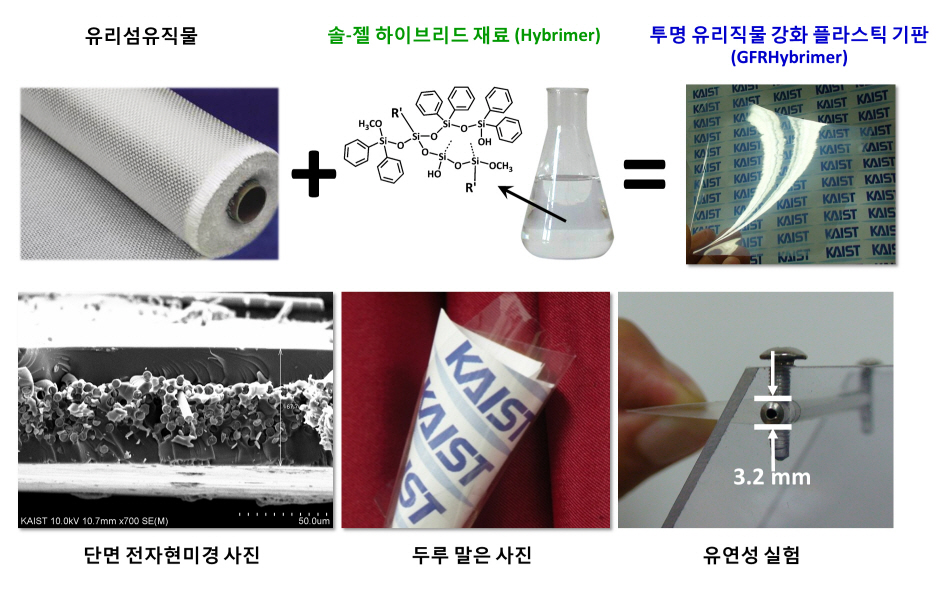
Professor Bae’s team developed a hybrid material with the same properties as fiber glass. With the material, they created a transparent, plastic film sheet resistant to heat. Transparent plastic film sheets were used by researchers all over the world to develop devices such as flexible displays or solar power cells that can be fit into various living spaces. However, plastic films are heat sensitive and tend to expand as temperature increases, thereby making it difficult to produce displays or solar power cells.
The new transparent, plastic film screen shows that heat expansion index (13ppm/oC) similar to that of glass fiber (9ppm/oC) due to the presence of glass fibers; its heat resistance allows to be used for displays and solar power cells over 250oC.
Professor Bae’s team succeeded in producing a flexible thin plastic film available for use in LCD or AMOLED screens and thin solar power cells.
Professor Bae commented, “Not only the newly developed plastic film has superior qualities, compared to the old models, but also it is cheap to produce, potentially bringing forward the day when flexible displays and solar panels become commonplace. With the cooperation of various industries, research institutes and universities, we will strive to improve the existing design and develop it further.”
2011.01.05 View 11584
KAIST developed a plastic film board less sensitive to heat.
The research result was made the cover of magazine, Advanced Materials and is accredited to paving the way to commercialize flexible display screens and solar power cells.
Transparent plastic and glass cloths, which have a limited thermal expansion needed for the production of flexible display screens and solar power cells, were developed by Korean researchers.
The research, led by KAIST’s Professor Byoung-Soo Bae, was funded by the Engineering Research Center under the initiative of the Ministry of Education, Science and Technology and the National Research Foundation. The research result was printed as the cover paper of ‘Advanced Materials’ which is the leading magazine in the field of materials science.
Professor Bae’s team developed a hybrid material with the same properties as fiber glass. With the material, they created a transparent, plastic film sheet resistant to heat. Transparent plastic film sheets were used by researchers all over the world to develop devices such as flexible displays or solar power cells that can be fit into various living spaces. However, plastic films are heat sensitive and tend to expand as temperature increases, thereby making it difficult to produce displays or solar power cells.
The new transparent, plastic film screen shows that heat expansion index (13ppm/oC) similar to that of glass fiber (9ppm/oC) due to the presence of glass fibers; its heat resistance allows to be used for displays and solar power cells over 250oC.
Professor Bae’s team succeeded in producing a flexible thin plastic film available for use in LCD or AMOLED screens and thin solar power cells.
Professor Bae commented, “Not only the newly developed plastic film has superior qualities, compared to the old models, but also it is cheap to produce, potentially bringing forward the day when flexible displays and solar panels become commonplace. With the cooperation of various industries, research institutes and universities, we will strive to improve the existing design and develop it further.”
2011.01.05 View 11584 -
International Workshop on EEWS 2010 was held.
On October 7 and 8th at Fusion Hall of KI Building, KAIST, the 2010 International Workshop on EEWS (Energy, Environment, Water, and Sustainability) was held.
The third to be held, forty national and international academic professionals including Mark Shannon, professor at University of Illinois at Urbana-Champaign, Domen Kazunari, Tokyo University professor, Dong Sub Kim, CTO of SK Energy and Doyoung Seung, Senior Vice President of GS Caltex, participated at this year’s workshop.
In twelve sessions, themes including Artificial Photosynthesis, Wireless Power Transfer, Green Aviation, Safe Nuclear Fuel Reuse, Fuel Cells in Action, LED 2.0, Foundation of Energy-Water Nexus, and Flexible Battery & Solar Cell were presented and discussed.
“Through this workshop, current EEWS policy and research progress from different countries and the future of related technologies will be foreseen,” said Jae Kyu Lee, Dean of KAIST EEWS Initiative. “I hope it became an opportunity to create cooperative relationships with leading researchers.”
EEWS is a research project conducted by KAIST to solve global issues that mankind faces today such as depletion of energy, environmental pollution, water shortage, and sustainability.
2010.10.15 View 13409
-
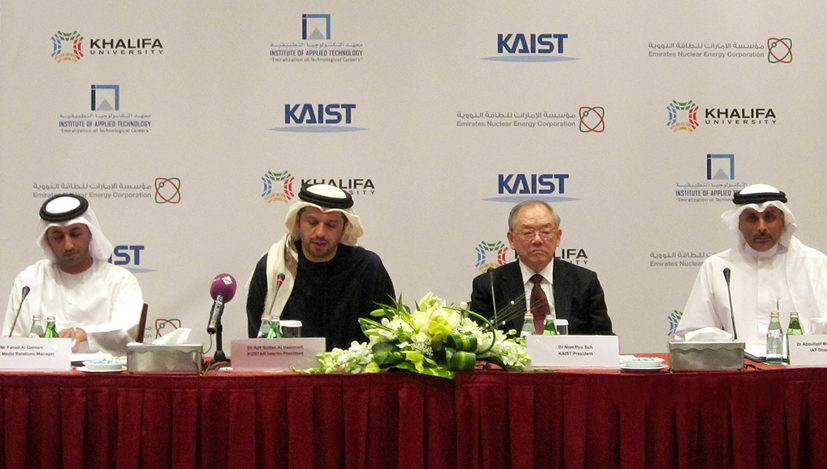 President Nam Pyo Suh of KAIST discussed cooperation with KUSTAR on the training of skilled manpower for research and development (R&D)
Representatives from Korea Advanced Institute of Science and Technology (KAIST), Khalifa University of Science, Technology and Research (KUSTAR), Emirate Nuclear Energy Corporation (ENEC), and the Institute of Applied Technology (IAT) had a meeting on mutual cooperation at the Intercontinental Hotel in Abu Dhabi, the United Arab Emirates (UAE), on January 14, 2009.
Participants of the meeting were President Nam Pyo Suh of KAIST, President Arif Sultan Al Hammadi of KUSTAR, President Mohamed Al Hammadi of ENEC, and Director General Abdullatif Mohamed Al Shamsi of IAT.
A press conference on the training of skilled manpower for research and development (R&D) in the UAE followed afterwards.
At the end of December in 2009, a Korean consortium led by Korea Electric Power Corporation (KEPCO) beat bids from its competitors to construct four nuclear power plants in the UAE. Representing the consortium, Minister Kyung Hwan Choi of Knowledge Economy Ministry signed a comprehensive agreement with KUSTAR and the Institute of Applied Technology (IAT) for the delivery of nuclear power plants.
On his visit, President Suh discussed with KUSTAR the agreement above in greater detail on subjects, where KAIST renders its cooperation, such as research collaboration, university degree program, and training to produce qualified personnel necessary for the development of UAE’s nuclear energy industry.
On research collaboration, sharing its expertise and knowledge accumulated years from the operation of academic and research programs, KAIST agreed to provide cooperation to KUSTAR in developing the latter as a leading science, technology, and research university in ten years through mutual activities such as research collaborations, recruitment and exchange of outstanding researchers and graduate students, expansion of research facilities, and creation of major research policies. Furthermore, in support of nuclear energy program in the UAE, KAIST agreed to develop a joint research program in nuclear engineering and exchange faculty members and students for research collaboration.
On a university degree program, KAIST agreed for mutual cooperation to launch academic programs at KUSTAR, covering BSc, MSc, and PhD degrees to specialize in areas such as mechanical engineering, electrical engineering, nuclear engineering, biomedical engineering, nano technology, science, and information technology. To that end, KAIST will dispatch its faculty to KUSTAR; provide assistance in developing curriculum and teaching materials; and exchange students for research collaboration.
President Arif of KUSTAR mentioned that the university will cooperate with the relevant institutions in Korea, i.e., Korea Development Institute (KDI) and the Korea Institute of Nuclear Safety (KINS), to train skilled workers required for the development of nuclear energy program in the UAE.
He also added, “These cooperative programs will introduce more educational opportunities to our students, and as a result, they can make greater contributions to the development of our nation’s future technologies in various areas. Our students will have a chance to study a broad range of academic subjects through partnership made with the Republic of Korea, and I expect to see improvements in our engineering programs by integrating KAIST’s state-of-the-art academic courses into our system.”
President Arif expressed his hope “to increase cooperation beyond the agreement made between the two countries, like allowing more exchanges and interactions with KAIST for the development of science and technology in Korea and the UAE.”
“Establishing mutual cooperation between KAIST and KUSTAR is a historic event not only for our two universities but also for our two countries. The two universities will make a great contribution to the improvement of the future of humanity by working together to solve the most important, difficult issues faced in the 21st century,” said President Suh.
He also said that “all members of KAIST community will make our utmost efforts to advance the quality of education in two schools and to implement innovative researches through mutual cooperation.”
KUSTAR, a national university in the UAE, was founded on February 13, 2007 by a mandate of the current President Shaikh Khalifa Bin Zayed Al Nahyan to create a higher education institute.
KUSTAR has been building its permanent campus in Abu Dhabi, the capital of UAE since establishment and merged with the campus in Sharjah (formerly known as Etisalat University College with 18 years of history) in 2008. The University offers education and research programs in five disciplines of engineering, logistics and management, health science, homeland security, and applied science.
There are more or less 30 foreign accredited universities set up in the UAE from countries like the US, UK, Australia, France, Ireland, and Canada. Examples of such, among other things, are New York University Abu Dhabi campus and Middlesex University Dubai campus.
Many of the foreign universities in the UAE, however, have colleges of pharmacy, computer science, aviation, management information, fashion design, business management, and medical science including Harvard Medical School Dubai Center, but not many in science and research. Therefore, KAIST’s assistance in KUSTAR’s endeavor to become a leading science and research university in the UAE is timely. The current government of UAE anticipates, with a great interest, to see a leading science and research intuition built in their nation.
Attachment: Current Status of Universities in the UAE as of 2009
Background Information
The United Arab Emirates (UAE) is a federation of seven emirates (Abu Dhabi, Dubai, Sharjah, Ajman, Umm al-Quwain, Ras al-Khaimah, and Fujairah) situated on the Arabian Peninsula, which borders with Oman and Saudi Arabia.
The UAE has the world"s sixth largest oil reserves. As of 2008, its gross domestic product is $2,621,000.5 million and its nominal per capita gross domestic product is $5 5,028, becoming one of the most developed economies in the Middle East. The UAE’s total population as of the said year is 4,760.4 thousand, and its purchasing power per capita is 40th largest in the world. The UAE’s Human Development Index for Asian continent is relatively high, ranking 31st globally.
In 1985, the UAE launched its own airline, Emirates Airline, which has become one of the fastest growing airlines in the world. The Emirates Airline is a sponsor for Arsenal soccer club.
The Republic of Korea established full diplomatic relations with the UAE in June of 1980. On December 27, 2009, a Korean consortium led by Korea Electrical Power Corporation (KEPCO) signed a contract with the UAE to build nuclear power plants.
2010.01.15 View 13627
President Nam Pyo Suh of KAIST discussed cooperation with KUSTAR on the training of skilled manpower for research and development (R&D)
Representatives from Korea Advanced Institute of Science and Technology (KAIST), Khalifa University of Science, Technology and Research (KUSTAR), Emirate Nuclear Energy Corporation (ENEC), and the Institute of Applied Technology (IAT) had a meeting on mutual cooperation at the Intercontinental Hotel in Abu Dhabi, the United Arab Emirates (UAE), on January 14, 2009.
Participants of the meeting were President Nam Pyo Suh of KAIST, President Arif Sultan Al Hammadi of KUSTAR, President Mohamed Al Hammadi of ENEC, and Director General Abdullatif Mohamed Al Shamsi of IAT.
A press conference on the training of skilled manpower for research and development (R&D) in the UAE followed afterwards.
At the end of December in 2009, a Korean consortium led by Korea Electric Power Corporation (KEPCO) beat bids from its competitors to construct four nuclear power plants in the UAE. Representing the consortium, Minister Kyung Hwan Choi of Knowledge Economy Ministry signed a comprehensive agreement with KUSTAR and the Institute of Applied Technology (IAT) for the delivery of nuclear power plants.
On his visit, President Suh discussed with KUSTAR the agreement above in greater detail on subjects, where KAIST renders its cooperation, such as research collaboration, university degree program, and training to produce qualified personnel necessary for the development of UAE’s nuclear energy industry.
On research collaboration, sharing its expertise and knowledge accumulated years from the operation of academic and research programs, KAIST agreed to provide cooperation to KUSTAR in developing the latter as a leading science, technology, and research university in ten years through mutual activities such as research collaborations, recruitment and exchange of outstanding researchers and graduate students, expansion of research facilities, and creation of major research policies. Furthermore, in support of nuclear energy program in the UAE, KAIST agreed to develop a joint research program in nuclear engineering and exchange faculty members and students for research collaboration.
On a university degree program, KAIST agreed for mutual cooperation to launch academic programs at KUSTAR, covering BSc, MSc, and PhD degrees to specialize in areas such as mechanical engineering, electrical engineering, nuclear engineering, biomedical engineering, nano technology, science, and information technology. To that end, KAIST will dispatch its faculty to KUSTAR; provide assistance in developing curriculum and teaching materials; and exchange students for research collaboration.
President Arif of KUSTAR mentioned that the university will cooperate with the relevant institutions in Korea, i.e., Korea Development Institute (KDI) and the Korea Institute of Nuclear Safety (KINS), to train skilled workers required for the development of nuclear energy program in the UAE.
He also added, “These cooperative programs will introduce more educational opportunities to our students, and as a result, they can make greater contributions to the development of our nation’s future technologies in various areas. Our students will have a chance to study a broad range of academic subjects through partnership made with the Republic of Korea, and I expect to see improvements in our engineering programs by integrating KAIST’s state-of-the-art academic courses into our system.”
President Arif expressed his hope “to increase cooperation beyond the agreement made between the two countries, like allowing more exchanges and interactions with KAIST for the development of science and technology in Korea and the UAE.”
“Establishing mutual cooperation between KAIST and KUSTAR is a historic event not only for our two universities but also for our two countries. The two universities will make a great contribution to the improvement of the future of humanity by working together to solve the most important, difficult issues faced in the 21st century,” said President Suh.
He also said that “all members of KAIST community will make our utmost efforts to advance the quality of education in two schools and to implement innovative researches through mutual cooperation.”
KUSTAR, a national university in the UAE, was founded on February 13, 2007 by a mandate of the current President Shaikh Khalifa Bin Zayed Al Nahyan to create a higher education institute.
KUSTAR has been building its permanent campus in Abu Dhabi, the capital of UAE since establishment and merged with the campus in Sharjah (formerly known as Etisalat University College with 18 years of history) in 2008. The University offers education and research programs in five disciplines of engineering, logistics and management, health science, homeland security, and applied science.
There are more or less 30 foreign accredited universities set up in the UAE from countries like the US, UK, Australia, France, Ireland, and Canada. Examples of such, among other things, are New York University Abu Dhabi campus and Middlesex University Dubai campus.
Many of the foreign universities in the UAE, however, have colleges of pharmacy, computer science, aviation, management information, fashion design, business management, and medical science including Harvard Medical School Dubai Center, but not many in science and research. Therefore, KAIST’s assistance in KUSTAR’s endeavor to become a leading science and research university in the UAE is timely. The current government of UAE anticipates, with a great interest, to see a leading science and research intuition built in their nation.
Attachment: Current Status of Universities in the UAE as of 2009
Background Information
The United Arab Emirates (UAE) is a federation of seven emirates (Abu Dhabi, Dubai, Sharjah, Ajman, Umm al-Quwain, Ras al-Khaimah, and Fujairah) situated on the Arabian Peninsula, which borders with Oman and Saudi Arabia.
The UAE has the world"s sixth largest oil reserves. As of 2008, its gross domestic product is $2,621,000.5 million and its nominal per capita gross domestic product is $5 5,028, becoming one of the most developed economies in the Middle East. The UAE’s total population as of the said year is 4,760.4 thousand, and its purchasing power per capita is 40th largest in the world. The UAE’s Human Development Index for Asian continent is relatively high, ranking 31st globally.
In 1985, the UAE launched its own airline, Emirates Airline, which has become one of the fastest growing airlines in the world. The Emirates Airline is a sponsor for Arsenal soccer club.
The Republic of Korea established full diplomatic relations with the UAE in June of 1980. On December 27, 2009, a Korean consortium led by Korea Electrical Power Corporation (KEPCO) signed a contract with the UAE to build nuclear power plants.
2010.01.15 View 13627 -
KAIST to Host ITTP Conference in Tunisia
KAIST"s Global IT Technology Program (ITTP) will host an international conference at Hammamet Hotel in Tunisia in cooperation with its counterpart at Seoul National University (SNU) on Nov. 23, university authorities said on Wednesday (Nov. 18).
The event is a pre-conference for the ICT4All Forum on Nov. 24-25 which the Tunisian government is organizing with the ADB, World Bank, Arab Society for Intellectual Property and the UTICA to deal with developing information and communication technologies.
KAIST"s ITTP which started in 2006 is designed to build global network of IT leaders around the world. The program supported by the Korean Ministry of Knowledge and Economy offers a customized master"s and doctoral degree program for foreign government officials, employees of public institutions and senior researchers at national research centers working in the IT fields. Scholarships are provided for all trainees, for up to 2 years for master"s students and up to 3 years for doctoral students.
The program focuses on transferring advanced technologies and business strategies of Korea to the global IT leaders of the next generation.
During the conference, seven government officials from as many countries currently under the KAIST or SNU programs will present international cooperation cases based on their own experiences in the IT fields. KAIST ITTP organizers will also provide an educational session on the mobile government for Tunisian experts and conference participants in the information and communications fields.
2009.11.20 View 11561
-
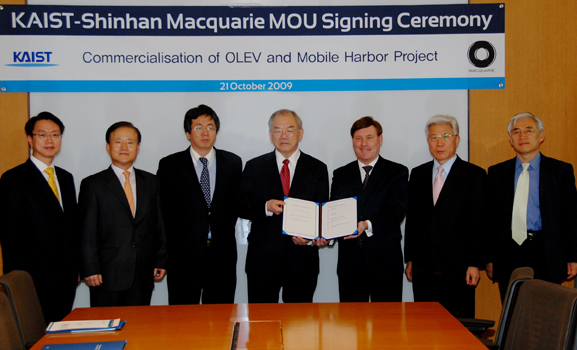 KAIST Signs MOU with Macquarie for Cooperation in Green Growth Projects
KAIST and Shinhan Macquarie Financial Advisory Co. have reached an agreement for cooperation in the development and commercialization of the KAIST-led two national green growth projects, On-line Electric Vehicle (OLEV) and Mobile Harbor (MH) programs, university authorities said.
KAIST President Nam-Pyo Suh signed a memorandum of understanding with John Walker, Chairman of Macquarie Group of Companies in Korea, and Woo-Gon Hwang, Representative Director of Shinhan Macquarie Financial Advisory Co. on Wednesday, Oct. 21.
Under the agreement, KAIST and Macquarie will cooperate in developing an optimal business structure for a rapid commercialization of OLEV and MH. Specifically, Shinhan Macquarie Financial Advisory will provide financial advice, including basis financial analysis, potential investor inducement and feasibility analysis of the projects.
Shinhan Macquarie Financial Advisory Co. is a joint venture between Shinhan Financial Group of Korea and the Australia-based Macquarie Bank Group which provides global investment banking and diversified financial services.
KAIST"s OLEV is a project to develop a new growth engine for Korea and lead the future of global automotive industry. It is an entirely new concept: the electric vehicle picks up power from underground power supplier lines, while either running or standing, through the non-contact magnetic charging method.
The MH program is designed to develop a system that can load/unload containers from a containership in the open sea and deliver them to their destinations at the harbor.
The Korean government has included these KAIST projects, which both are great technical and engineering challenges, in the nation"s sustainable growth programs, providing substantial research grants. KAIST offers its advanced research capabilities for the nation"s efforts to achieve efficient, environment-friendly utilization of resources as new growth engines that spur the development of related industries and explore global markets.
2009.10.22 View 12054
KAIST Signs MOU with Macquarie for Cooperation in Green Growth Projects
KAIST and Shinhan Macquarie Financial Advisory Co. have reached an agreement for cooperation in the development and commercialization of the KAIST-led two national green growth projects, On-line Electric Vehicle (OLEV) and Mobile Harbor (MH) programs, university authorities said.
KAIST President Nam-Pyo Suh signed a memorandum of understanding with John Walker, Chairman of Macquarie Group of Companies in Korea, and Woo-Gon Hwang, Representative Director of Shinhan Macquarie Financial Advisory Co. on Wednesday, Oct. 21.
Under the agreement, KAIST and Macquarie will cooperate in developing an optimal business structure for a rapid commercialization of OLEV and MH. Specifically, Shinhan Macquarie Financial Advisory will provide financial advice, including basis financial analysis, potential investor inducement and feasibility analysis of the projects.
Shinhan Macquarie Financial Advisory Co. is a joint venture between Shinhan Financial Group of Korea and the Australia-based Macquarie Bank Group which provides global investment banking and diversified financial services.
KAIST"s OLEV is a project to develop a new growth engine for Korea and lead the future of global automotive industry. It is an entirely new concept: the electric vehicle picks up power from underground power supplier lines, while either running or standing, through the non-contact magnetic charging method.
The MH program is designed to develop a system that can load/unload containers from a containership in the open sea and deliver them to their destinations at the harbor.
The Korean government has included these KAIST projects, which both are great technical and engineering challenges, in the nation"s sustainable growth programs, providing substantial research grants. KAIST offers its advanced research capabilities for the nation"s efforts to achieve efficient, environment-friendly utilization of resources as new growth engines that spur the development of related industries and explore global markets.
2009.10.22 View 12054 -
KAIST Secures Top Ranking of Korean Universities
KAIST won the No. 1 position for the second year in a row in the daily JoongAng Ilbo"s university rankings for 2009. Seoul National University took back the No. 2 spot, followed in order by POSTECH, Korea and Yonsei universities.
The survey was conducted in the four categories, educational environment/finance, professors" research, general reputation/social advancement and globalization. KAIST scored 293 points out of possible 400 this year, while the second-ranking SNU and third-ranking POSTECH earned 234 and 226 points, respectively.
The daily noted that KAIST particularly excelled in the category of educational environment/finance. It observed that donations to KAIST surged almost 100 times for the past three years since 2006 when President Suh took office.
In specific rankings of universities by academic disciplines, SNU came in first overall. KAIST topped in the science and engineering field, while Korea University ranked first in liberal arts studies.
This year, 88 four-year universities participated in the survey. The daily JoongAng Ilbo started its annual evaluation of Koran universities in 1994 to stimulate productive competition among institutions of higher learning and to provide objective standards for students and their parents to select schools for application.
For more information, news.joins.com/article/391/3789391.html
2009.09.24 View 12475
-
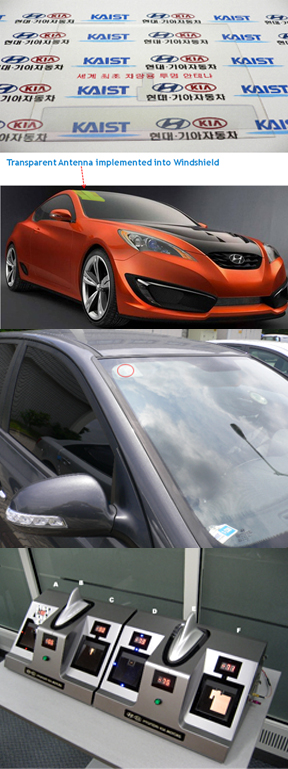 Transparent Antenna for Automobile Developed
A research team led by Prof. Jae-Woo Park of the School of Electrical Engineering & Computer Science, KAIST, developed a transparent antenna for the next-generation automobiles, university authorities said on Monday (Aug. 17).
The development was made possible through joint researches with the Hyundai-Kia Automotive Group; Winncom, a car antenna manufacturer; and a group of researchers led by Han-Ki Kim of the Department of Display Materials Engineering at Kyung Hee University in Seoul.
The transparent antennas were developed in two kinds -- one for the HSDPA (High-Speed Downlink Packet Access), a new protocol for mobile telephone data transmission, and the other for transmitting and receiving radio wave for emergency call.
Using the transparent electrically conductive film formation technology, the transparent antennas are to be mounted on the windshield of a vehicle.
"The development of transparent antenna represents a step forward for the advancement of the next-generation automotive electronic technology," said Seong-woo Kim, a senior researcher at the Hyundai-Kia Group.
2009.08.18 View 11294
Transparent Antenna for Automobile Developed
A research team led by Prof. Jae-Woo Park of the School of Electrical Engineering & Computer Science, KAIST, developed a transparent antenna for the next-generation automobiles, university authorities said on Monday (Aug. 17).
The development was made possible through joint researches with the Hyundai-Kia Automotive Group; Winncom, a car antenna manufacturer; and a group of researchers led by Han-Ki Kim of the Department of Display Materials Engineering at Kyung Hee University in Seoul.
The transparent antennas were developed in two kinds -- one for the HSDPA (High-Speed Downlink Packet Access), a new protocol for mobile telephone data transmission, and the other for transmitting and receiving radio wave for emergency call.
Using the transparent electrically conductive film formation technology, the transparent antennas are to be mounted on the windshield of a vehicle.
"The development of transparent antenna represents a step forward for the advancement of the next-generation automotive electronic technology," said Seong-woo Kim, a senior researcher at the Hyundai-Kia Group.
2009.08.18 View 11294