KAIST
-
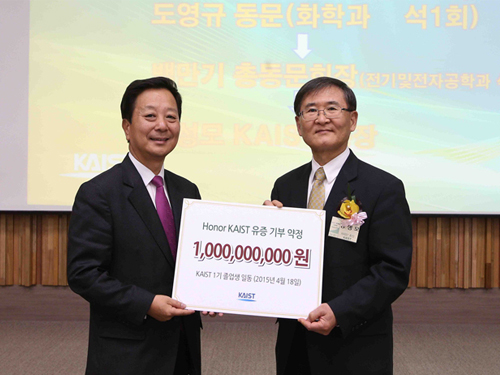 KAIST's Alumni Announces Its Vision to Raise Development Funds
The 40th anniversary of the Graduation and Homecoming Day took place at Seoul campus on April 18, 2015.
KAIST’s alumni announced its long-term vision called “Honor KAIST” to raise the development fund of USD 1 billion by 2100 at the 40th anniversary of “The First Master’s Graduation and Homecoming Day.” The anniversary ceremony took place at the Seoul campus on April 18, 2015. President Steve Kang, Man-Ki Paik, President of KAIST Alumni Association, and the first graduates of KAIST master’s program attended the event.
The first 106 master’s graduates of KAIST, the Class of 1975, received their degrees from eight departments. About 18 professors, including Dr. KunMo Chung, who taught the Class of 1975, and 52 graduates such as Suk-Joong Kang, Sik-Chol Kwon, Youngkyu Do, Sung Joo Park, Joon-Taik Park, Hyung-Kang Shin, Dong-Yol Yang, Seong Ihl Woo, Jae Kyu Lee, In-Won Lee, Byoung-Kyu Choi, and Kyu-Young Hwang participated in the homecoming event that proceeded with the tour of Seoul campus and the ceremony to deliver the first donation by the graduates.
The graduates involved in the vision campaign declared: “KAIST graduates have great pride in having taken part in advancing science and technology in Korea and are grateful for the education given by the nation. There is still a long way ahead for KAIST and Korea. The alumni should work together to help shaping the future of KAIST with great interest and affection for the institution.” They also urged KAIST graduates to donate more for their alma mater: “Let us try to participate in donating USD 100,000 in our lifetime!” The graduates added, “Having donations up to USD 1 billion helped MIT become a great university. We should take the lead in aiming to collect such amount by 2100 for KAIST.”
President Kang addressed the ceremony and said in his speech, “The Honor KAIST Development Funds will serve as the foundation for the university’s continuous, strong growth. Every member of KAIST will work in harmony to transfer KAIST into one of the top ten research universities in the world.” He continued, “The funds will be used to further future strategies of KAIST such as high impact Nobel-prize level research and innovative education.”
Contributors will receive benefits including an honorary lifetime email account entitled “Honor.KAIST” and will have their names listed on “The Honor KAIST” website and “The Honor KAIST” commemorative wall.
Picture 1: The First Master’s Graduation and Homecoming Day 2015
Picture 2: President Steve Kang (right) and President Man-Ki Paik of the KAIST Alumni Association
2015.04.22 View 10468
KAIST's Alumni Announces Its Vision to Raise Development Funds
The 40th anniversary of the Graduation and Homecoming Day took place at Seoul campus on April 18, 2015.
KAIST’s alumni announced its long-term vision called “Honor KAIST” to raise the development fund of USD 1 billion by 2100 at the 40th anniversary of “The First Master’s Graduation and Homecoming Day.” The anniversary ceremony took place at the Seoul campus on April 18, 2015. President Steve Kang, Man-Ki Paik, President of KAIST Alumni Association, and the first graduates of KAIST master’s program attended the event.
The first 106 master’s graduates of KAIST, the Class of 1975, received their degrees from eight departments. About 18 professors, including Dr. KunMo Chung, who taught the Class of 1975, and 52 graduates such as Suk-Joong Kang, Sik-Chol Kwon, Youngkyu Do, Sung Joo Park, Joon-Taik Park, Hyung-Kang Shin, Dong-Yol Yang, Seong Ihl Woo, Jae Kyu Lee, In-Won Lee, Byoung-Kyu Choi, and Kyu-Young Hwang participated in the homecoming event that proceeded with the tour of Seoul campus and the ceremony to deliver the first donation by the graduates.
The graduates involved in the vision campaign declared: “KAIST graduates have great pride in having taken part in advancing science and technology in Korea and are grateful for the education given by the nation. There is still a long way ahead for KAIST and Korea. The alumni should work together to help shaping the future of KAIST with great interest and affection for the institution.” They also urged KAIST graduates to donate more for their alma mater: “Let us try to participate in donating USD 100,000 in our lifetime!” The graduates added, “Having donations up to USD 1 billion helped MIT become a great university. We should take the lead in aiming to collect such amount by 2100 for KAIST.”
President Kang addressed the ceremony and said in his speech, “The Honor KAIST Development Funds will serve as the foundation for the university’s continuous, strong growth. Every member of KAIST will work in harmony to transfer KAIST into one of the top ten research universities in the world.” He continued, “The funds will be used to further future strategies of KAIST such as high impact Nobel-prize level research and innovative education.”
Contributors will receive benefits including an honorary lifetime email account entitled “Honor.KAIST” and will have their names listed on “The Honor KAIST” website and “The Honor KAIST” commemorative wall.
Picture 1: The First Master’s Graduation and Homecoming Day 2015
Picture 2: President Steve Kang (right) and President Man-Ki Paik of the KAIST Alumni Association
2015.04.22 View 10468 -
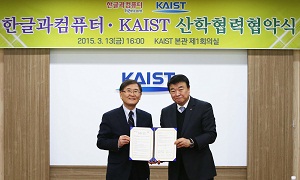 KAIST and Hancom Sign for Development of Mobile Healthcare
KAIST signed a memorandum of understanding with Hancom, Inc., an office suite developer in Korea, to foster mobile healthcare software programs. President Steve Kang and Chairman Sang-Chul Kim of Hancom held a signing ceremony on March 13, 2015 at the KAIST campus.
Based on the agreement, KAIST and Hancom will exchange research personnel to build Dr. M, a smart healthcare platform developed by the university, collaborate in research and development, and cooperate in the transfer of research developments from the university to the software industry including Hancom.
KAIST and Hancom also signed a memorandum of understanding on the development of software in April 2014. The Hancom-KAIST Research Center opened on campus last October.
2015.03.20 View 11007
KAIST and Hancom Sign for Development of Mobile Healthcare
KAIST signed a memorandum of understanding with Hancom, Inc., an office suite developer in Korea, to foster mobile healthcare software programs. President Steve Kang and Chairman Sang-Chul Kim of Hancom held a signing ceremony on March 13, 2015 at the KAIST campus.
Based on the agreement, KAIST and Hancom will exchange research personnel to build Dr. M, a smart healthcare platform developed by the university, collaborate in research and development, and cooperate in the transfer of research developments from the university to the software industry including Hancom.
KAIST and Hancom also signed a memorandum of understanding on the development of software in April 2014. The Hancom-KAIST Research Center opened on campus last October.
2015.03.20 View 11007 -
 Dr. Dong-Hee Chung Honored with OYRA by Korean Physicists in America
Dr. Dong-Hee Chung, a KAIST alumnus (class of 2002) who is currently a professor of the Physics Department at the Pennsylvania State University (Penn State), received the 2015 Outstanding Young Researcher Award (OYRA) by the Association of Korean Physicists in America (AKPA).
The award ceremony was held on March 3, 2015 at AKPA’s annual conference. According to AKPA, Dr. Chung was recognized for his research achievements in the fields of the early universe, dark energy, and galaxy formation.
Dr. Chung finished both his undergraduate and graduate degrees at KAIST and received his doctorate in 2004 from the University of Texas at Austin. He was appointed a professor at Penn State in 2014.
2015.02.27 View 8526
Dr. Dong-Hee Chung Honored with OYRA by Korean Physicists in America
Dr. Dong-Hee Chung, a KAIST alumnus (class of 2002) who is currently a professor of the Physics Department at the Pennsylvania State University (Penn State), received the 2015 Outstanding Young Researcher Award (OYRA) by the Association of Korean Physicists in America (AKPA).
The award ceremony was held on March 3, 2015 at AKPA’s annual conference. According to AKPA, Dr. Chung was recognized for his research achievements in the fields of the early universe, dark energy, and galaxy formation.
Dr. Chung finished both his undergraduate and graduate degrees at KAIST and received his doctorate in 2004 from the University of Texas at Austin. He was appointed a professor at Penn State in 2014.
2015.02.27 View 8526 -
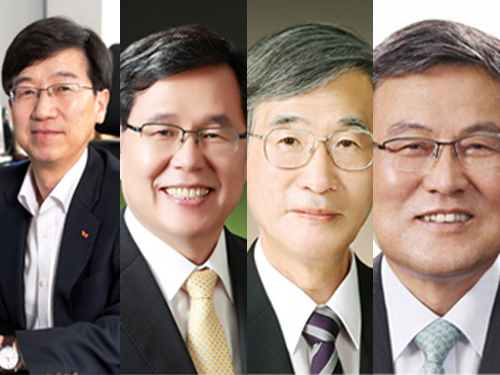 KAIST Announces the Recipients of Distinguished Alumni Awards
The KAIST Alumni Association (KAA) announced four “Proud KAIST Alumni” awards recipients for the year 2014: Sung-Wook Park, the Chief Executive Officer and President of SK Hynix; Seung Ho Shin, the President of Kangwon National University; Kew-Ho Lee, the President of the Korea Research Institute of Chemical Technology; and Mun-Kee Choi, the former Minister of Science, ICT and Future Planning of the Republic of Korea. The award ceremony took place during the 2015 KAA’s New Year's ceremony on January 17, 2015 at the Palace Hotel in Seoul.
Sung-Wook Park (M.S. ’82 and Ph.D. ’88, Department of Materials Science and Engineering), the Chief Executive Officer and President of SK Hynix, has worked as an expert in the field of memory semi-conductors for the past 30 years. He developed innovative technology and improved production efficiency, enabling the Korean semi-conductor industry to become a global leader.
Seung Ho Shin (M.S. ’79 and Ph.D. ’87, Department of Physics), the President of Kangwon National University (KNU), worked in the field of optical information processing, producing excellent research achievements and teaching the next generation of scientists. As the president of KNU, he has set an exemplary leadership in higher education.
Kew-Ho Lee (M.S. ’75, Department of Chemistry), the President of the Korea Research Institute of Chemical Technology, pioneered the field of separation film production which contributed greatly to Korean technological developments. He led several domestic and international societies to facilitate dynamic exchanges between industry and academia and with the international community.
Mun-Kee Choi (M.S. ’76, Department of Industrial and Systems Engineering), the former Minister of Science, ICT and Future Planning, the Republic of Korea, is a great contributor to the information and communications technology in Korea, working as a leader in the field of broadband integrated service digital network. He is also an educator for gifted students in science and technology, and a manager of the Electronics and Telecommunications Research Institute.
The Alumni Association established the “Proud KAIST Alumni Awards” in 1992 to recognize its alumni’s outstanding contributions to Korea and KAIST.
Pictured from left to right, Sung-Wook Park (the Chief Executive Officer and President of SK Hynix), Seung Ho Shin (the President of Kangwon National University), Kew-Ho Lee (the President of the Korea Research Institute of Chemical Technology), and Mun-Kee Choi (the former Minister of Science, ICT and Future Planning)
2015.01.19 View 17700
KAIST Announces the Recipients of Distinguished Alumni Awards
The KAIST Alumni Association (KAA) announced four “Proud KAIST Alumni” awards recipients for the year 2014: Sung-Wook Park, the Chief Executive Officer and President of SK Hynix; Seung Ho Shin, the President of Kangwon National University; Kew-Ho Lee, the President of the Korea Research Institute of Chemical Technology; and Mun-Kee Choi, the former Minister of Science, ICT and Future Planning of the Republic of Korea. The award ceremony took place during the 2015 KAA’s New Year's ceremony on January 17, 2015 at the Palace Hotel in Seoul.
Sung-Wook Park (M.S. ’82 and Ph.D. ’88, Department of Materials Science and Engineering), the Chief Executive Officer and President of SK Hynix, has worked as an expert in the field of memory semi-conductors for the past 30 years. He developed innovative technology and improved production efficiency, enabling the Korean semi-conductor industry to become a global leader.
Seung Ho Shin (M.S. ’79 and Ph.D. ’87, Department of Physics), the President of Kangwon National University (KNU), worked in the field of optical information processing, producing excellent research achievements and teaching the next generation of scientists. As the president of KNU, he has set an exemplary leadership in higher education.
Kew-Ho Lee (M.S. ’75, Department of Chemistry), the President of the Korea Research Institute of Chemical Technology, pioneered the field of separation film production which contributed greatly to Korean technological developments. He led several domestic and international societies to facilitate dynamic exchanges between industry and academia and with the international community.
Mun-Kee Choi (M.S. ’76, Department of Industrial and Systems Engineering), the former Minister of Science, ICT and Future Planning, the Republic of Korea, is a great contributor to the information and communications technology in Korea, working as a leader in the field of broadband integrated service digital network. He is also an educator for gifted students in science and technology, and a manager of the Electronics and Telecommunications Research Institute.
The Alumni Association established the “Proud KAIST Alumni Awards” in 1992 to recognize its alumni’s outstanding contributions to Korea and KAIST.
Pictured from left to right, Sung-Wook Park (the Chief Executive Officer and President of SK Hynix), Seung Ho Shin (the President of Kangwon National University), Kew-Ho Lee (the President of the Korea Research Institute of Chemical Technology), and Mun-Kee Choi (the former Minister of Science, ICT and Future Planning)
2015.01.19 View 17700 -
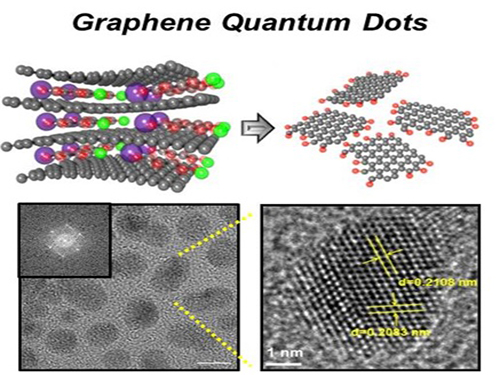 Extracting Light from Graphite: Core Technology of Graphene Quantum Dots Display Developed
Professor Seokwoo Jeon of the Department of Materials Science and Engineering, Professor Yong-Hoon Cho of the Department of Physics, and Professor Seunghyup Yoo of the Department of Electrical Engineering announced that they were able to develop topnotch graphene quantum dots from graphite.
Using the method of synthesizing graphite intercalation compound from graphite with salt and water, the research team developed graphene quantum dots in an ecofriendly way.
The quantum dots have a diameter of 5 nanometers with their sizes equal and yield high quantum efficiency. Unlike conventional quantum dots, they are not comprised of toxic materials such as lead or cadmium. As the quantum dots can be developed from materials which can be easily found in the nature, researchers look forward to putting these into mass production at low cost.
The research team also discovered a luminescence mechanism of graphene quantum dots and confirmed the possibility of commercial use by developing quantum dot light-emitting diodes with brightness of 1,000 cd/m2, which is greater than that of cellphone displays.
Professor Seokwoo Jeon said, “Although quantum dot LEDs have a lower luminous efficiency than existing ones, their luminescent property can be further improved” and emphasized that “using quantum dot displays will allow us to develop not only paper-thin displays but also flexible ones.”
Sponsored by Graphene Research Center in KAIST Institute for NanoCentury, the research finding was published online in the April 20th issue of Advanced Optical Materials.
Picture 1: Graphene quantum dots and their synthesis
Picture 2: Luminescence mechanism of graphene quantum dots
Picture 3: Structure of graphene quantum dots LED and its emission
2014.09.06 View 20657
Extracting Light from Graphite: Core Technology of Graphene Quantum Dots Display Developed
Professor Seokwoo Jeon of the Department of Materials Science and Engineering, Professor Yong-Hoon Cho of the Department of Physics, and Professor Seunghyup Yoo of the Department of Electrical Engineering announced that they were able to develop topnotch graphene quantum dots from graphite.
Using the method of synthesizing graphite intercalation compound from graphite with salt and water, the research team developed graphene quantum dots in an ecofriendly way.
The quantum dots have a diameter of 5 nanometers with their sizes equal and yield high quantum efficiency. Unlike conventional quantum dots, they are not comprised of toxic materials such as lead or cadmium. As the quantum dots can be developed from materials which can be easily found in the nature, researchers look forward to putting these into mass production at low cost.
The research team also discovered a luminescence mechanism of graphene quantum dots and confirmed the possibility of commercial use by developing quantum dot light-emitting diodes with brightness of 1,000 cd/m2, which is greater than that of cellphone displays.
Professor Seokwoo Jeon said, “Although quantum dot LEDs have a lower luminous efficiency than existing ones, their luminescent property can be further improved” and emphasized that “using quantum dot displays will allow us to develop not only paper-thin displays but also flexible ones.”
Sponsored by Graphene Research Center in KAIST Institute for NanoCentury, the research finding was published online in the April 20th issue of Advanced Optical Materials.
Picture 1: Graphene quantum dots and their synthesis
Picture 2: Luminescence mechanism of graphene quantum dots
Picture 3: Structure of graphene quantum dots LED and its emission
2014.09.06 View 20657 -
 2014 NEREC Conference on Nuclear Nonproliferation: July 31-August 1, 2014, Seoul
The Nonproliferation Education and Research Center (NEREC) at KAIST hosted an international conference on nuclear nonproliferation on July 31-August 1, 2014 in Seoul. The Ministry of Science, ICT and Future Planning, the Korean Nuclear Safety and Security Commission, and the Korea Nuclear Policy Society (KNPS) sponsored the event.
Over one hundred experts and "thought leaders" in nuclear security and nonproliferation attended the conference and discussed issues related to the nonproliferation of nuclear weapons, the role of scientific community in mitigating nuclear threat and promoting the peaceful use of nuclear power, and nuclear disarmament policy.
Keynote speakers were: Steven E. Miller, Director of International Security Program at Belfer Center for Science and International Affairs, Harvard University; Scott D. Sagan, Senior Fellow of the Center for International Security and Cooperation, Freeman Spogli Institute for International Studies, Stanford University; Mark Fitzpatrick, Director of the Nonproliferation and Disarmament Programme, International Institute for Strategic Studies; Sang-Hyun Lee, Director of Security Strategy, Sejong Institute; and Man-Sung Yim, Professor of Nuclear and Quantum Engineering, KAIST.
At the conference, Professor Yim, Director of KAIST NEREC said, “Korea has grown to become a key player in the development of commercial nuclear energy over the past decades. We hope that our conference encourages Korea to be more involved in the efforts of the international community to enhance the global nonproliferation regime.”
2014.08.05 View 16800
2014 NEREC Conference on Nuclear Nonproliferation: July 31-August 1, 2014, Seoul
The Nonproliferation Education and Research Center (NEREC) at KAIST hosted an international conference on nuclear nonproliferation on July 31-August 1, 2014 in Seoul. The Ministry of Science, ICT and Future Planning, the Korean Nuclear Safety and Security Commission, and the Korea Nuclear Policy Society (KNPS) sponsored the event.
Over one hundred experts and "thought leaders" in nuclear security and nonproliferation attended the conference and discussed issues related to the nonproliferation of nuclear weapons, the role of scientific community in mitigating nuclear threat and promoting the peaceful use of nuclear power, and nuclear disarmament policy.
Keynote speakers were: Steven E. Miller, Director of International Security Program at Belfer Center for Science and International Affairs, Harvard University; Scott D. Sagan, Senior Fellow of the Center for International Security and Cooperation, Freeman Spogli Institute for International Studies, Stanford University; Mark Fitzpatrick, Director of the Nonproliferation and Disarmament Programme, International Institute for Strategic Studies; Sang-Hyun Lee, Director of Security Strategy, Sejong Institute; and Man-Sung Yim, Professor of Nuclear and Quantum Engineering, KAIST.
At the conference, Professor Yim, Director of KAIST NEREC said, “Korea has grown to become a key player in the development of commercial nuclear energy over the past decades. We hope that our conference encourages Korea to be more involved in the efforts of the international community to enhance the global nonproliferation regime.”
2014.08.05 View 16800 -
 A KAIST startup, YBrain, builds a wearable device to cure Alzheimer's
A group of KAIST graduates from the Departments of Bio and Brain Engineering, Computer Science, Materials Science Engineering, and Industrial Design created a startup called YBrain (http://ybrain.com/). YBrain develops a wearable neuroscience technology to treat or reduce the symptoms of degenerative brain diseases such as dementia and Alzheimer’s. Their recent technological developments were covered in e27, one of the leading blogs based in Singapore. The blog covers topics like the latest technology innovation, startups, and entrepreneurship in Asia. A news article follows below:
e27, June 24, 2014
“This wearable tech may be able to combat effects of Alzheimer’s”
http://e27.co/this-wearable-tech-may-be-able-combat-effects-of-alzheimers-20140624/
2014.06.25 View 14414
A KAIST startup, YBrain, builds a wearable device to cure Alzheimer's
A group of KAIST graduates from the Departments of Bio and Brain Engineering, Computer Science, Materials Science Engineering, and Industrial Design created a startup called YBrain (http://ybrain.com/). YBrain develops a wearable neuroscience technology to treat or reduce the symptoms of degenerative brain diseases such as dementia and Alzheimer’s. Their recent technological developments were covered in e27, one of the leading blogs based in Singapore. The blog covers topics like the latest technology innovation, startups, and entrepreneurship in Asia. A news article follows below:
e27, June 24, 2014
“This wearable tech may be able to combat effects of Alzheimer’s”
http://e27.co/this-wearable-tech-may-be-able-combat-effects-of-alzheimers-20140624/
2014.06.25 View 14414 -
 KAIST's graduate, the first Ph.D. holder in games, is appointed professor at Michigan State University in East Lansing
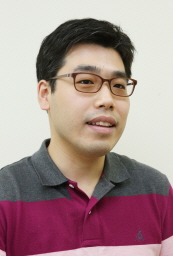
Dr. Tae-Woo Park
The academic community recognizes the study in games as a field for research
Dr. Tae-Woo Park, a graduate of KAIST, has been appointed a professor at Michigan State University (MSU) in East Lansing. He will start working in August at the Department of Telecommunications, Information Studies, and Media, the College of Communications Arts, MSU.
Dr. Park received a doctoral degree in games, the first of its kind in KAIST. His research focus is game design, research, and development.
Dr. Park has strived to enhance user experience by incorporating various aspects of everyday life into games and made efforts to introduce measures limiting or preventing game addiction, a major concern among young people in South Korea. Professor Joon-Hwa Song of Computer Science at KAIST, Dr. Park's advisor, commented that "KAIST graduates have been the main actors in the development of Korea's gaming industry. Our efforts to systemize the field of games into an academic discipline have been recognized through Dr. Park's appointment."
Dr. Park said that he plans "to apply mobile device and ubiquitous technology and develop games that will not only entertain users but also help them have a better life.”
2014.05.29 View 12960
KAIST's graduate, the first Ph.D. holder in games, is appointed professor at Michigan State University in East Lansing
Dr. Tae-Woo Park
The academic community recognizes the study in games as a field for research
Dr. Tae-Woo Park, a graduate of KAIST, has been appointed a professor at Michigan State University (MSU) in East Lansing. He will start working in August at the Department of Telecommunications, Information Studies, and Media, the College of Communications Arts, MSU.
Dr. Park received a doctoral degree in games, the first of its kind in KAIST. His research focus is game design, research, and development.
Dr. Park has strived to enhance user experience by incorporating various aspects of everyday life into games and made efforts to introduce measures limiting or preventing game addiction, a major concern among young people in South Korea. Professor Joon-Hwa Song of Computer Science at KAIST, Dr. Park's advisor, commented that "KAIST graduates have been the main actors in the development of Korea's gaming industry. Our efforts to systemize the field of games into an academic discipline have been recognized through Dr. Park's appointment."
Dr. Park said that he plans "to apply mobile device and ubiquitous technology and develop games that will not only entertain users but also help them have a better life.”
2014.05.29 View 12960 -
 Establishment Agreement for KAIST-Poongsan Future Technology Research Center
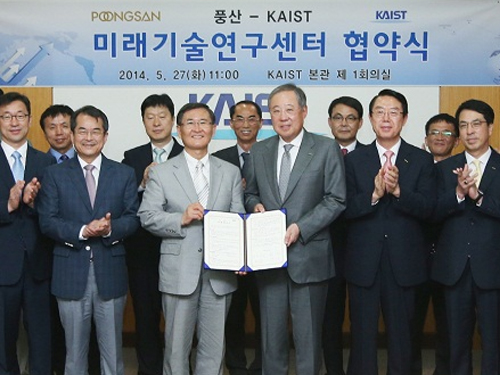
KAIST and Poongsan Corporation agreed to found the KAIST-Poongsan Future Technology Research Center and held a ceremony to sign a memorandum of understanding in front of 30 attendees including KAIST President Steve Kang and Poongsan Chairman Jin Ryu on May 27 at KAIST.
The Research Center will develop basic technology in the fields of defense and high tech materials as well as build a new foundation for future Poongsan projects. Research areas include technologies for new materials, propulsion control, and defense.
To further this endeavor, Poongsan Corporation will support the KAIST-Poongsan Future Technology Research Center for 3 years through an investment of USD 2.95 million, personnel, and technology.
An agreement was made between KAIST and Poongsan to establish the Future Technology Research Center.
2014.05.29 View 9174
Establishment Agreement for KAIST-Poongsan Future Technology Research Center
KAIST and Poongsan Corporation agreed to found the KAIST-Poongsan Future Technology Research Center and held a ceremony to sign a memorandum of understanding in front of 30 attendees including KAIST President Steve Kang and Poongsan Chairman Jin Ryu on May 27 at KAIST.
The Research Center will develop basic technology in the fields of defense and high tech materials as well as build a new foundation for future Poongsan projects. Research areas include technologies for new materials, propulsion control, and defense.
To further this endeavor, Poongsan Corporation will support the KAIST-Poongsan Future Technology Research Center for 3 years through an investment of USD 2.95 million, personnel, and technology.
An agreement was made between KAIST and Poongsan to establish the Future Technology Research Center.
2014.05.29 View 9174 -
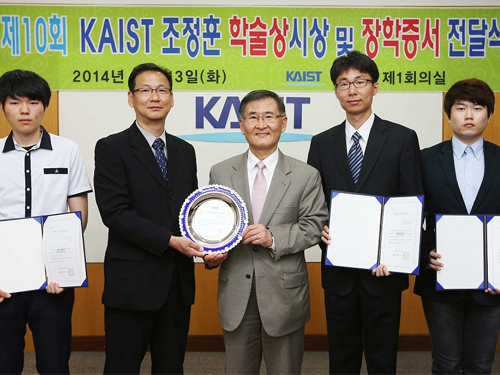 Dr. Sung-Gu Kim of KARI receives the 10th KAIST Jung-Hun Cho Academic Award
KAIST President Steve Kang awarded the 10th "KAIST Jung-Hun Cho Academic Award" to Dr. Sung-Gu Kim of Korea Aerospace Research Institute (KARI) along with Byeong-Sup Park, a graduate student of KAIST Aerospace Engineering, Hee-Won Chae of Korea University, and Jin-Hyung Noh of Kongju National University High School on May 13, 2014.
Dr. Sung-Gu Kim was recognized for his development of a 30-ton class reproduction cooling burner and the securing of essential factor technology for liquid-fuel rocket engines on the Naro project.
The KAIST Jung-Hun Cho Academic Award was established to commemorate Jung-Hun Cho who was killed while researching in the rocket laboratory on May 13, 2003. From 2005, young scientists from the Aerospace Engineering field have been recognized every year. One student each from KAIST, Korea University, and Kongju National University High School, where the honorary doctorate Dr. Cho attended, has been chosen as a scholarship recipient.
The KAIST Jung-Hun Cho Academic Award was established with USD 460,000 in funds donated from Cho's family.
2014.05.17 View 11421
Dr. Sung-Gu Kim of KARI receives the 10th KAIST Jung-Hun Cho Academic Award
KAIST President Steve Kang awarded the 10th "KAIST Jung-Hun Cho Academic Award" to Dr. Sung-Gu Kim of Korea Aerospace Research Institute (KARI) along with Byeong-Sup Park, a graduate student of KAIST Aerospace Engineering, Hee-Won Chae of Korea University, and Jin-Hyung Noh of Kongju National University High School on May 13, 2014.
Dr. Sung-Gu Kim was recognized for his development of a 30-ton class reproduction cooling burner and the securing of essential factor technology for liquid-fuel rocket engines on the Naro project.
The KAIST Jung-Hun Cho Academic Award was established to commemorate Jung-Hun Cho who was killed while researching in the rocket laboratory on May 13, 2003. From 2005, young scientists from the Aerospace Engineering field have been recognized every year. One student each from KAIST, Korea University, and Kongju National University High School, where the honorary doctorate Dr. Cho attended, has been chosen as a scholarship recipient.
The KAIST Jung-Hun Cho Academic Award was established with USD 460,000 in funds donated from Cho's family.
2014.05.17 View 11421 -
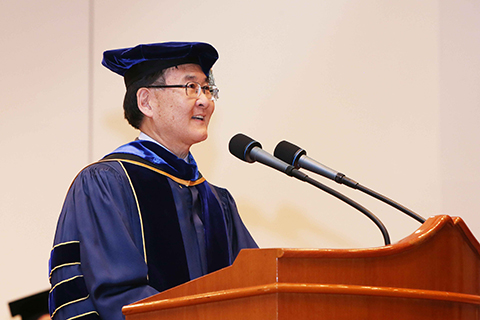 Welcoming the Class of 2014
“The four years from today will go quickly, and I urge you to make the most of your time in KAIST, a great educational and research institution where you will explore the frontiers of science and technology and take part in the creation of new knowledge,” President Kang told the freshmen at the convocation ceremony.
Freshmen Convocation for the Class of 2014 took place on March 3, 2014 at the auditorium on the main campus. Members of the KAIST community, along with hundreds of parents and guests, welcomed the incoming 800 freshmen, celebrating the beginning of their four-year college life.
Kwang-Joon Ahn, a graduate of the Korea Science Academy, and Ha-Rim Jin, a graduate of Daegu Il Science High School, were representatives of the incoming students, and they took the “Class of 2014 Pledge,” a commitment to uphold KAIST’s core values, which is "creativity and challenge (endeavoring spirit)," and to pursue intellectual passion and discovery.
President Steve Kang delivered congratulatory remarks, encouraging students to use their opportunities to the fullest while at KAIST to broaden their knowledge and experience. He also stressed the following four important principles they should cultivate to become the leaders of tomorrow: be grateful, excel in their field, keep open minds about what the globalized world would bring, and never give up on their dreams and belief.
President Kang said:
“Probably, many of you, the graduates of the best high schools in Korea, will find KAIST a tougher place to be in than you imagined. But challenges, particularly intellectual challenges, should be viewed as an opportunity to grow. It is ok to fail. In fact, without risking failures, there won’t be a meaningful growth because the real growth comes from overcoming challenges.”
“You can’t avoid failing in the course of your college life, but your perseverance to do it over will allow you to develop the skills and passion needed to become a leader who will contribute to the local community, as well as to the betterment of humanity.”
The KAIST Alumni Scholarship Foundation presented a scholarship of USD 3,700 to 24 freshmen.
The convocation ended with music performances by members of the student clubs at KAIST.
2014.03.04 View 9821
Welcoming the Class of 2014
“The four years from today will go quickly, and I urge you to make the most of your time in KAIST, a great educational and research institution where you will explore the frontiers of science and technology and take part in the creation of new knowledge,” President Kang told the freshmen at the convocation ceremony.
Freshmen Convocation for the Class of 2014 took place on March 3, 2014 at the auditorium on the main campus. Members of the KAIST community, along with hundreds of parents and guests, welcomed the incoming 800 freshmen, celebrating the beginning of their four-year college life.
Kwang-Joon Ahn, a graduate of the Korea Science Academy, and Ha-Rim Jin, a graduate of Daegu Il Science High School, were representatives of the incoming students, and they took the “Class of 2014 Pledge,” a commitment to uphold KAIST’s core values, which is "creativity and challenge (endeavoring spirit)," and to pursue intellectual passion and discovery.
President Steve Kang delivered congratulatory remarks, encouraging students to use their opportunities to the fullest while at KAIST to broaden their knowledge and experience. He also stressed the following four important principles they should cultivate to become the leaders of tomorrow: be grateful, excel in their field, keep open minds about what the globalized world would bring, and never give up on their dreams and belief.
President Kang said:
“Probably, many of you, the graduates of the best high schools in Korea, will find KAIST a tougher place to be in than you imagined. But challenges, particularly intellectual challenges, should be viewed as an opportunity to grow. It is ok to fail. In fact, without risking failures, there won’t be a meaningful growth because the real growth comes from overcoming challenges.”
“You can’t avoid failing in the course of your college life, but your perseverance to do it over will allow you to develop the skills and passion needed to become a leader who will contribute to the local community, as well as to the betterment of humanity.”
The KAIST Alumni Scholarship Foundation presented a scholarship of USD 3,700 to 24 freshmen.
The convocation ended with music performances by members of the student clubs at KAIST.
2014.03.04 View 9821 -
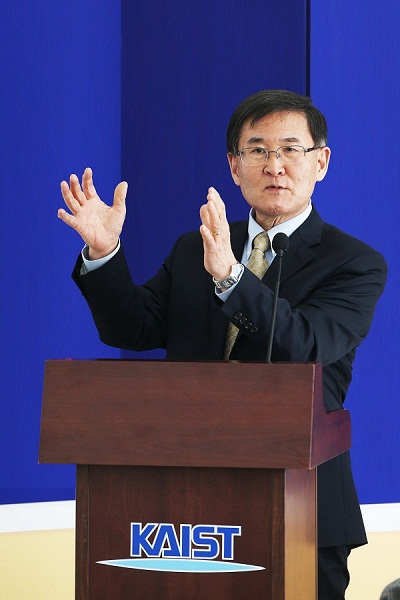 KAIST President Held One-year Anniversary Press Conference
President Steve Kang had a press conference
on February 25, 2014 at the Faculty Club on campus, commemorating the first
year of his presidency. About 30 different media representatives nationwide
attended the meeting.
At his first press conference on the anniversary of his tenure, President Kang
described what he has achieved in the past year, which were: 1) rebuilding the
campus culture to start a campaign for mutual respect, trust, and open
communication by holding meetings with the members of the KAIST community more
than 60 times, 2) establishing core values, creativity and challenge, to
enhance the fabric of the community, 3) restructuring of the university
administration, and 4) the announcement of the mid- and long-term development
plan.
He also mentioned that “2014 will be another exciting year for KAIST to make
more progress” and laid out a few major projects to be implemented this year:
launching of the “Committee for Engineering Education Innovation,” “Startup
KAIST” (an entrepreneurship program), “Greater Collaboration in Technology
Translation and Management with Seoul National University,” and “KAIST End Run”
(a global business incubation program).Explanation of 2014 Major Endeavors by President KangFor
the past decade, domestic engineering schools weighed SCI dissertation
publication more heavily in university evaluations, yielding a world-class
research level. However, such an approach resulted in placing less importance
on entrepreneurship, commercialization, or creating economic values.As a
result, engineering Professors have been evaluated as being too focused on theoretical
SCI dissertation research rather than practical research that could yield
economic benefits through commercialization of developed technology. In
addition, some have criticized that engineering universities have not educated
creative researchers demanded by the industry.KAIST
has begun responding to these criticisms and has made a few suggestions to strengthen
engineering education, promote entrepreneurship in engineers, and globalize Korean
venture companies.As
part of such efforts, KAIST established the KAIST Education and Research
Innovation Committee, composed of various individuals from the industry,
research institutes, alumni, faculty members, and others, to discuss ways to reinforce
engineering education.
A
course to encourage entrepreneurship will be implemented.Startup
KAIST will develop and commercialize innovative ideas from members of KAIST, and
the End Run project will enable students and faculty to establish a global,
venture company. KAIST hopes that a new entrepreneurial culture will be created
on campus, thereby the research success of KAIST members will lead to commercialization
and startups.KAIST
plans on releasing free internet lectures as part of its knowledge contribution
and sponsoring programs which will level the playing field in eduation.KAIST
will establish the KAIST Open Online Course (KOOC). An entrepreneurship
curriculum will be developed for KOOC. KAIST will start trials for KOOC from
2015, gradually expanding to include more courses.
2014.02.27 View 10829
KAIST President Held One-year Anniversary Press Conference
President Steve Kang had a press conference
on February 25, 2014 at the Faculty Club on campus, commemorating the first
year of his presidency. About 30 different media representatives nationwide
attended the meeting.
At his first press conference on the anniversary of his tenure, President Kang
described what he has achieved in the past year, which were: 1) rebuilding the
campus culture to start a campaign for mutual respect, trust, and open
communication by holding meetings with the members of the KAIST community more
than 60 times, 2) establishing core values, creativity and challenge, to
enhance the fabric of the community, 3) restructuring of the university
administration, and 4) the announcement of the mid- and long-term development
plan.
He also mentioned that “2014 will be another exciting year for KAIST to make
more progress” and laid out a few major projects to be implemented this year:
launching of the “Committee for Engineering Education Innovation,” “Startup
KAIST” (an entrepreneurship program), “Greater Collaboration in Technology
Translation and Management with Seoul National University,” and “KAIST End Run”
(a global business incubation program).Explanation of 2014 Major Endeavors by President KangFor
the past decade, domestic engineering schools weighed SCI dissertation
publication more heavily in university evaluations, yielding a world-class
research level. However, such an approach resulted in placing less importance
on entrepreneurship, commercialization, or creating economic values.As a
result, engineering Professors have been evaluated as being too focused on theoretical
SCI dissertation research rather than practical research that could yield
economic benefits through commercialization of developed technology. In
addition, some have criticized that engineering universities have not educated
creative researchers demanded by the industry.KAIST
has begun responding to these criticisms and has made a few suggestions to strengthen
engineering education, promote entrepreneurship in engineers, and globalize Korean
venture companies.As
part of such efforts, KAIST established the KAIST Education and Research
Innovation Committee, composed of various individuals from the industry,
research institutes, alumni, faculty members, and others, to discuss ways to reinforce
engineering education.
A
course to encourage entrepreneurship will be implemented.Startup
KAIST will develop and commercialize innovative ideas from members of KAIST, and
the End Run project will enable students and faculty to establish a global,
venture company. KAIST hopes that a new entrepreneurial culture will be created
on campus, thereby the research success of KAIST members will lead to commercialization
and startups.KAIST
plans on releasing free internet lectures as part of its knowledge contribution
and sponsoring programs which will level the playing field in eduation.KAIST
will establish the KAIST Open Online Course (KOOC). An entrepreneurship
curriculum will be developed for KOOC. KAIST will start trials for KOOC from
2015, gradually expanding to include more courses.
2014.02.27 View 10829