Humanoid+robot
-
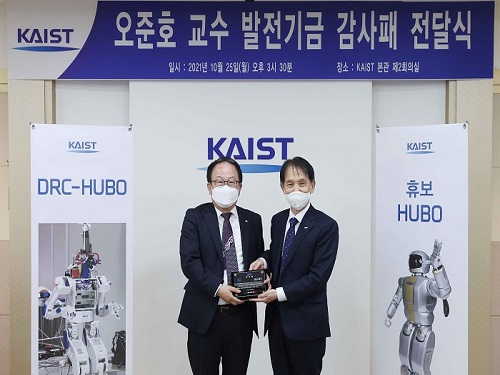 Hubo Professor Jun-Ho Oh Donates Startup Shares Worth 5 Billion KRW
Rainbow Robotics stock used to endow the development fund
Emeritus Professor Jun-Ho Oh, who developed the 2015 DARPA Challenge winning humanoid robot DRC-Hubo, donated 5 billion KRW on October 25 during a ceremony held at the KAIST campus in Daejeon.
Professor Oh donated his 20% share (400 shares) of his startup Rainbow Robotics, which was established in 2011. Rainbow Robotics was listed on the KOSDAQ this February. The 400 shares were converted to 200,000 shares with a value of approximately 5 billion KRW when listed this year.
KAIST sold the stocks and endowed the Jun-Ho Oh Fund, which will be used for the development of the university. He was the 39th faculty member who launched a startup with technology from his lab and became the biggest faculty entrepreneur donor.
“I have received huge support and funding for my research. Fortunately, the research had a good result and led to the startup. Now I am very delighted to pay back the university. I feel that I have played a part in building the school’s startup ecosystem and creating a virtuous circle,” said Professor Oh during the ceremony.
KAIST President Kwang Hyung Lee declared, “Professor Oh has been a very impressive exemplary model for our aspiring faculty and student tech startups. We will spare no effort to support startups at KAIST.”
Professor Oh, who retired from the Department of Mechanical Engineering last year, now serves as the CTO at Rainbow Robotics. The company is developing humanoid bipedal robots and collaborative robots, and advancing robot technology including parts for astronomical observations.
Professor Hae-Won Park and Professor Je Min Hwangbo, who are now responsible for the Hubo Lab, also joined the ceremony along with employees of Rainbow Robotics.
2021.10.26 View 5754
Hubo Professor Jun-Ho Oh Donates Startup Shares Worth 5 Billion KRW
Rainbow Robotics stock used to endow the development fund
Emeritus Professor Jun-Ho Oh, who developed the 2015 DARPA Challenge winning humanoid robot DRC-Hubo, donated 5 billion KRW on October 25 during a ceremony held at the KAIST campus in Daejeon.
Professor Oh donated his 20% share (400 shares) of his startup Rainbow Robotics, which was established in 2011. Rainbow Robotics was listed on the KOSDAQ this February. The 400 shares were converted to 200,000 shares with a value of approximately 5 billion KRW when listed this year.
KAIST sold the stocks and endowed the Jun-Ho Oh Fund, which will be used for the development of the university. He was the 39th faculty member who launched a startup with technology from his lab and became the biggest faculty entrepreneur donor.
“I have received huge support and funding for my research. Fortunately, the research had a good result and led to the startup. Now I am very delighted to pay back the university. I feel that I have played a part in building the school’s startup ecosystem and creating a virtuous circle,” said Professor Oh during the ceremony.
KAIST President Kwang Hyung Lee declared, “Professor Oh has been a very impressive exemplary model for our aspiring faculty and student tech startups. We will spare no effort to support startups at KAIST.”
Professor Oh, who retired from the Department of Mechanical Engineering last year, now serves as the CTO at Rainbow Robotics. The company is developing humanoid bipedal robots and collaborative robots, and advancing robot technology including parts for astronomical observations.
Professor Hae-Won Park and Professor Je Min Hwangbo, who are now responsible for the Hubo Lab, also joined the ceremony along with employees of Rainbow Robotics.
2021.10.26 View 5754 -
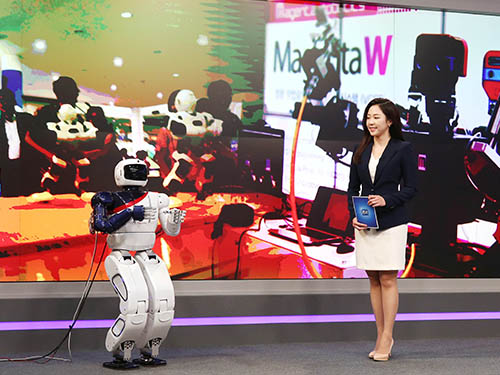 Hubo Debuts as a News Anchor
HUBO, a humanoid robot developed by Professor Jun-Ho Oh’s team, made its debut as a co-anchor during the TJB prime time news 8 on May 14.
“Un-contact" became the new normal after Covid-19 and many business solutions are being transformed using robotics. HUBO made two news reports on contactless services using robots in medical, manufacturing, and logistics industries. HUBO 2, the second generation of HUBO, appeared as a special anchor on the local broadcasting network’s special program in celebration of its 25th anniversary.
HUBO is the champion of the 2015 DARPA Robotics Challenge held in the USA. Its FX-2 riding robot also participated in the Olympic torch relay during the 2018 PyeongChang Winter Olympics.
Click here to watch a full video of HUBO anchoring the news.
(END)
2020.05.14 View 8450
Hubo Debuts as a News Anchor
HUBO, a humanoid robot developed by Professor Jun-Ho Oh’s team, made its debut as a co-anchor during the TJB prime time news 8 on May 14.
“Un-contact" became the new normal after Covid-19 and many business solutions are being transformed using robotics. HUBO made two news reports on contactless services using robots in medical, manufacturing, and logistics industries. HUBO 2, the second generation of HUBO, appeared as a special anchor on the local broadcasting network’s special program in celebration of its 25th anniversary.
HUBO is the champion of the 2015 DARPA Robotics Challenge held in the USA. Its FX-2 riding robot also participated in the Olympic torch relay during the 2018 PyeongChang Winter Olympics.
Click here to watch a full video of HUBO anchoring the news.
(END)
2020.05.14 View 8450 -
 Hubo Completes New Mission at the Winter Olympic Torch Relay
KAIST-born humanoid robot, Hubo, completed its special new mission: carrying the Olympic torch. The Winter Olympics will be held in PyeongChang for two weeks beginning February 9.
On December 11, the final leg of the torch relay in Daejeon for the PyeongChang Olympics 2018 took place inside KAIST. A city known for science and technology hosted special torch relay runners over three days.
Hubo arrived at the campus with Dr. Dennis Hong, a professor from the University of California at Los Angeles, in an autonomous vehicle. Then, Hubo received the flame from Professor Hong. Hubo, a robot developed by Professor Jun Ho Oh from the Department of Mechanical Engineering at KAIST, is best known for being the winner of the DARPA Robotics Challenge in 2015.
Hubo successfully completed its Olympic mission. That is, it had to drill through a wall to deliver the torch to the next runner. After completing the mission successfully, the torch was passed to Professor Oh. He ran a few steps and handed it over to the last runner of the Daejeon leg.
The last runner was Jung Jae Lee, who is a winning team member of the Samsung Junior Software Cup. Lee also had the honor of riding and controlling FX-2 which is another robot developed by Professor Oh for this peace torch relay. FX-2 took a few steps to finalize the relay.
Lee said, “I would like to become an expert in security. As I was riding the robot, I felt every step I took was one step closer to achieving of making major developments in the field of security.
Professor Oh said, “It is meaningful to see humans and robots cooperating with each other to carry out the torch relay.”
The torch relay, participated in by both humans and robots in Daejeon, was successfully completed and the torch headed off to Boryeong, Chungcheongnam-do.
2017.12.12 View 8367
Hubo Completes New Mission at the Winter Olympic Torch Relay
KAIST-born humanoid robot, Hubo, completed its special new mission: carrying the Olympic torch. The Winter Olympics will be held in PyeongChang for two weeks beginning February 9.
On December 11, the final leg of the torch relay in Daejeon for the PyeongChang Olympics 2018 took place inside KAIST. A city known for science and technology hosted special torch relay runners over three days.
Hubo arrived at the campus with Dr. Dennis Hong, a professor from the University of California at Los Angeles, in an autonomous vehicle. Then, Hubo received the flame from Professor Hong. Hubo, a robot developed by Professor Jun Ho Oh from the Department of Mechanical Engineering at KAIST, is best known for being the winner of the DARPA Robotics Challenge in 2015.
Hubo successfully completed its Olympic mission. That is, it had to drill through a wall to deliver the torch to the next runner. After completing the mission successfully, the torch was passed to Professor Oh. He ran a few steps and handed it over to the last runner of the Daejeon leg.
The last runner was Jung Jae Lee, who is a winning team member of the Samsung Junior Software Cup. Lee also had the honor of riding and controlling FX-2 which is another robot developed by Professor Oh for this peace torch relay. FX-2 took a few steps to finalize the relay.
Lee said, “I would like to become an expert in security. As I was riding the robot, I felt every step I took was one step closer to achieving of making major developments in the field of security.
Professor Oh said, “It is meaningful to see humans and robots cooperating with each other to carry out the torch relay.”
The torch relay, participated in by both humans and robots in Daejeon, was successfully completed and the torch headed off to Boryeong, Chungcheongnam-do.
2017.12.12 View 8367 -
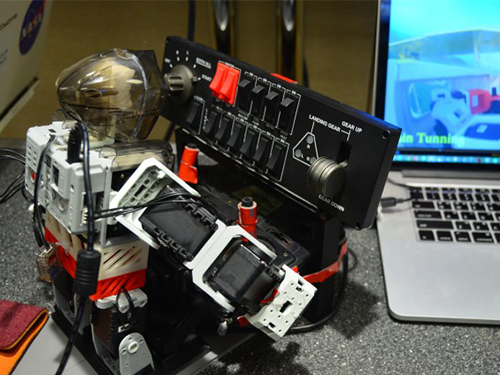 PIBOT, a small humanoid robot flies an aircraft
The 2014 IEEE/RSJ International Conference on Intelligent Robots and Systems (IROS 2014) took place in Chicago, Illinois, on September 14-18, 2014.
Professor David Hyunchul Shim and his students from the Department of Aerospace Engineering, KAIST, presented a research paper entitled “A Robot-machine Interface for Full-functionality Automation Using a Humanoid” at the conference.
The robot called “PIBOT,” a pint-sized, tiny humanoid robot, uses a mixture of flight data and visuals to fly an airplane, capable of identifying and operating all of the buttons and switches in the cockpit of a normal light aircraft designed for humans.
For now, the robot is only flying a simulator, but Professor Shim expects that “PIBOT will help us have a fully automated flight experience, eventually replacing human pilots.”
The IEEE Spectrum magazine published an article on PIBOT posted online September 18, 2014. Please follow the link below for the article:
IEEE Spectrum, September 18, 2014
Tiny Humanoid Robot Learning to Fly Real Airplanes
http://spectrum.ieee.org/automaton/robotics/humanoids/tiny-humanoid-robot-learning-to-fly-real-airplanes
2014.09.23 View 11474
PIBOT, a small humanoid robot flies an aircraft
The 2014 IEEE/RSJ International Conference on Intelligent Robots and Systems (IROS 2014) took place in Chicago, Illinois, on September 14-18, 2014.
Professor David Hyunchul Shim and his students from the Department of Aerospace Engineering, KAIST, presented a research paper entitled “A Robot-machine Interface for Full-functionality Automation Using a Humanoid” at the conference.
The robot called “PIBOT,” a pint-sized, tiny humanoid robot, uses a mixture of flight data and visuals to fly an airplane, capable of identifying and operating all of the buttons and switches in the cockpit of a normal light aircraft designed for humans.
For now, the robot is only flying a simulator, but Professor Shim expects that “PIBOT will help us have a fully automated flight experience, eventually replacing human pilots.”
The IEEE Spectrum magazine published an article on PIBOT posted online September 18, 2014. Please follow the link below for the article:
IEEE Spectrum, September 18, 2014
Tiny Humanoid Robot Learning to Fly Real Airplanes
http://spectrum.ieee.org/automaton/robotics/humanoids/tiny-humanoid-robot-learning-to-fly-real-airplanes
2014.09.23 View 11474 -
 KAIST sells eight HUBO 2 robots to US and Singapore.
HUBO, a humanoid robot developed by KAIST, has made its journey to the US and Singapore for the development of robotics engineering in those nations. Details on the movements of HOBO being exported aboard, please click the link of the news article:
http://www.slashgear.com/kaist-sells-eight-hubo-2-robots-to-us-and-singapore-14119320/
2010.12.20 View 9359
KAIST sells eight HUBO 2 robots to US and Singapore.
HUBO, a humanoid robot developed by KAIST, has made its journey to the US and Singapore for the development of robotics engineering in those nations. Details on the movements of HOBO being exported aboard, please click the link of the news article:
http://www.slashgear.com/kaist-sells-eight-hubo-2-robots-to-us-and-singapore-14119320/
2010.12.20 View 9359 -
 KAIST was invited to the World Economic Forum's fourth "Summer Davos."
KAIST attended the World Economic Forum’s “Summer Davos Forum” held from September 13 to 15 in Tianjin, China. The Summer Davos Forum hosted various sessions and meetings with international dignitaries from governments, business and public organizations, and academia on the main theme of “Driving Growth through Sustainability.”
On September 14, four subjects including “Electric Vehicles,” “Humanoid Robotics,” “Next Generation of Biomaterials,” and “New Developments in Neuroengineering” were presented by KAIST, followed by discussions with forum participants.
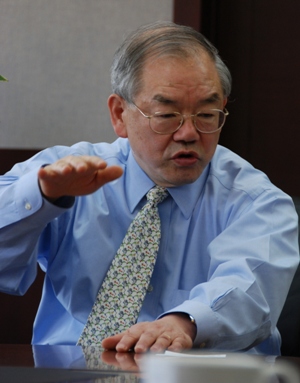
Professor Jae-Seung Jeong of the Bio and Brain Engineering Department, Sang-Yup Lee of the Chemical and Biomolecular Engineering Department, Joon-Ho Oh of the Mechanical Engineering Department, and President Nam-Pyo Suh participated in the forum as presenters of the topic. Of these speakers, Professors Jae-Seung Jeong and Sang-Yup Lee were nominated by the World Economic Forum (WEF) as members of the “Young Global Leader” and “Global Agenda Council on Emerging Technologies,” respectively.
President Suh was also invited to the CEO Insight Group and delivered an opening speech on OLEV (Online Electric Vehicle) and the Mobile Harbor. President Suh plans to sign an MOU for research cooperation with Jong-Hoo Kim of Bell Lab and Shirley Jackson of the Rensselaer Polytechnic Institute in the near future, respectively.
Since 2007, the WEF, in charge of the world’s largest international conference called “Davos Forum” has hosted a “Summer Davos Forum,” also called as the “Annual Meeting of New Champions.” The Summer Davos Forum consists of nations, rising global companies, next generation of global leaders, and cities or nations that lead technological innovations. Unlike the annual Davos Forum held in January, the “Annual Meeting of New Champions” is held in September of each year in Tianjin and Dalian, China.
Since 2009, the WEF has added a special session called IdeasLab in the Davos and Summer Davos Forums. Through IdeasLab, prominent universities from all over the world, research organizations, venture businesses, NGOs, and NPOs are invited to exchange and discuss innovative and creative ideas that can contribute to the development of mankind. Until now, universities including INSEAD, EPFL-ETH, MIT, Oxford, Yale, Harvard, Rensselaer Polytechnic Institute, Tsinghua University, and Keio University have been invited to the IdeasLab. KAIST is the first Korean university to attend this session.
2010.09.17 View 15467
KAIST was invited to the World Economic Forum's fourth "Summer Davos."
KAIST attended the World Economic Forum’s “Summer Davos Forum” held from September 13 to 15 in Tianjin, China. The Summer Davos Forum hosted various sessions and meetings with international dignitaries from governments, business and public organizations, and academia on the main theme of “Driving Growth through Sustainability.”
On September 14, four subjects including “Electric Vehicles,” “Humanoid Robotics,” “Next Generation of Biomaterials,” and “New Developments in Neuroengineering” were presented by KAIST, followed by discussions with forum participants.
Professor Jae-Seung Jeong of the Bio and Brain Engineering Department, Sang-Yup Lee of the Chemical and Biomolecular Engineering Department, Joon-Ho Oh of the Mechanical Engineering Department, and President Nam-Pyo Suh participated in the forum as presenters of the topic. Of these speakers, Professors Jae-Seung Jeong and Sang-Yup Lee were nominated by the World Economic Forum (WEF) as members of the “Young Global Leader” and “Global Agenda Council on Emerging Technologies,” respectively.
President Suh was also invited to the CEO Insight Group and delivered an opening speech on OLEV (Online Electric Vehicle) and the Mobile Harbor. President Suh plans to sign an MOU for research cooperation with Jong-Hoo Kim of Bell Lab and Shirley Jackson of the Rensselaer Polytechnic Institute in the near future, respectively.
Since 2007, the WEF, in charge of the world’s largest international conference called “Davos Forum” has hosted a “Summer Davos Forum,” also called as the “Annual Meeting of New Champions.” The Summer Davos Forum consists of nations, rising global companies, next generation of global leaders, and cities or nations that lead technological innovations. Unlike the annual Davos Forum held in January, the “Annual Meeting of New Champions” is held in September of each year in Tianjin and Dalian, China.
Since 2009, the WEF has added a special session called IdeasLab in the Davos and Summer Davos Forums. Through IdeasLab, prominent universities from all over the world, research organizations, venture businesses, NGOs, and NPOs are invited to exchange and discuss innovative and creative ideas that can contribute to the development of mankind. Until now, universities including INSEAD, EPFL-ETH, MIT, Oxford, Yale, Harvard, Rensselaer Polytechnic Institute, Tsinghua University, and Keio University have been invited to the IdeasLab. KAIST is the first Korean university to attend this session.
2010.09.17 View 15467 -
President of Israel visited KAIST on June 9, 2010.
President of Israel, Shimon Peres, visited KAIST today on June 9, 2010 to witness the development of science and technology in Korea and explore ways of establishing collaboration and cooperation with industries and universities between Korea and Israel. President Peres led a delegation consisted of the Israeli Mister of Industry, Trade, and Labor, the Minister of Communication, and 60 business leaders from the top companies in the security, infrastructure, communication, high-tech, and water industries.
Upon their arrival to the campus, the Israeli delegation was greeted by KAIST’s humanoid robot, “HUBO,” and then moved to its branch campus, IT Convergence Campus, for a ride of Online Electric Vehicle (OLEV) that has been developed by KAIST. The OLEV receives the necessary power through the cable lines buried underground, so it can be provided with a constant and continuous supply of electricity while running or stopping.
Between roads and OLEVs is nothing but space. There is no electrical wires intricately crossed underbody of the electric car or above the road. The pick-up equipment installed beneath the body of the electric car collects magnetic fields created around the underground cables, which then converts the filed into electricity. The OLEV’s wireless, non-contact charging system made it possible for a battery currently used for hybrid or pure electric cars on the market to be smaller and cheaper.
President Peres expressed a great interest in the technology applied to the OLVE, quoting, “the OLEV system is indeed very impressive.” He talked about efforts being made in Israel with respect to the development of electric cars. The country plans to replace the conventional transportation system with electric cars by constructing a network of battery exchange stations and roadside charge points which allow the cars to be charged whenever they are parked.
“Despite the different approach taken by the two nations for the development of electric cars, I believe that transforming the automobile industry from combustion engine to electric system is the right direction we should all follow. Without addressing the current transportation system that heavily dependent on natural resources, we will not be able to promote “green growth on a global scale,” added President Peres.
In addition to electric cars, President Peres took up a considerable portion of his time to exchange ideas on how to expand cooperative relations between universities in Korea and Israel, specifically in the area of space, biotechnology, nanotechnology, high-tech, renewable and alternative energy, and the EEWS initiatives that have been implemented by KAIST to find answers to global issues such as climate change and depletion of natural resources. The EEWS stands for energy, environment, water, and sustainability.
In response, the president of KAIST pledged to set up a stronger and greater tie with research universities in Israel, particularly called for more collaboration between KAIST and Technion-Israel Institute of Technology.
Also, the Israeli delegation had a tour for several Korean research and development centers in Daedeok Innopolis, located in the City of Daejeon, which is the 2nd largest science and research complex in Korea.
Shimon Peres, the 9th president of Israel, held many of important government positions in Israel, among other things, Prime Minster and Minister of Defense. He won Nobel Peace Prize in 1994, together with Yitzhak Rabin and Yasser Arafat for the conclusion of a peace agreement, Oslo Accords, between Israel and Palestine Liberation Organization.
2010.06.09 View 13845
-
"The 2010 Artificial Intelligence Robot War Competition" begins to receive applications
[Event Notice]
“The 2010 Artificial Intelligence Robot War Competition” begins to receive applications
A good opportunity to gauge the intelligence of your robots
“The 2010 Artificial Intelligence (AI) Robot War Competition” will be held in October 2010, and the Competition has been receiving applications from contestants since April 1st. The deadline for the application will be May 31st, 2010.
Qualified contestants must be a minimum of two, but less than six, team members, and they will compete in one of the two fields: System on Chip (SoC) Taekwon Robot and Humanoid Robot (HURO). Winners will be decided based on the intelligence capabilities presented by a robot’s platform that mimics key functions of the human brain.
SoC Taekwon Robot will compete against one another by using a camera installed on its head to recognize visual images, locations, distances, and gestures of the other competing robot.
HURO competition is a new entry begun this year, and winners will be determined in accordance with the robot’s ability to perform given missions and fights. Missions are to go through a track installed with obstacles, recognize colors and shapes of barriers, and knock down barriers to earn scores. Fighting will be performed in the form of a Korean martial art, Tae-kwon-do.
The Korean government has nominated Robotics as one of the key growth engines to develop IT industry and Korean economy. Robotics converge many of different engineering fields, such as machinery, materials, components, and embedded software. In particular, the SoC is an essential technology for Korea to continuously take lead in the semi-conductor industry in the world, which is an important element for robotics.
SoC stands for System on Chip, an integrated chip that assembles various chips and components to be fabricated together on a single chip, instead of building them on a circuit board. The SoC technology has advantages of higher performance, smaller space requirements, lower memory requirements, higher system reliability, and lower consumer costs.
An artificial intelligence SoC robot is autonomous because it can adapt itself to changes in various environments and reach a given goal without constantly receiving external orders.
For details of the event, please refer to the website of www.socrobotwar.org.
2010.04.06 View 10937
-
Prime Minister Lars Løkke Rasmussen of the Kingdom of Denmark visited KAIST on March 11, 2010.
Prime Minister Lars Løkke Rasmussen of the Kingdom of Denmark visited KAIST on March 11, 2010. HUBO, a humanoid robotdeveloped by KAIST, gave a warm welcome to the prime minister and his delegation.
Prime Minister Lars Løkke Rasmussen of Denmark visited Moon-Ji Campus of KAIST on March 11, 2010 and had a chance to meet a humanoid robot, HUBO. Since the first appearance in 2005, HUBO has been continuously developed by KAIST for further refinements.
HUBO welcomed the prime minister and offered him a flower bouquet. They also shook hands and exchanged small talks in Danish, which made the delegation pleasantly surprised.
The Danish delegation had a ride on Online Electric Vehicle (OLEV) and showed a great interest in the technology applied therein.
The prime minister said, “Denmark has a keen interest in green technology, and I was very impressed by OLEV. It is just amazing to see how fast KAIST has developed as an outstanding research university in the world during a short period of time.”
President Lee Myung-bak invited the Danish prime minister to discuss current international developments, including issues involving the Korean Peninsula, and ways to enhance bilateral cooperation in such areas as trade, investment, renewable energy and green growth.
2010.03.17 View 11206
-
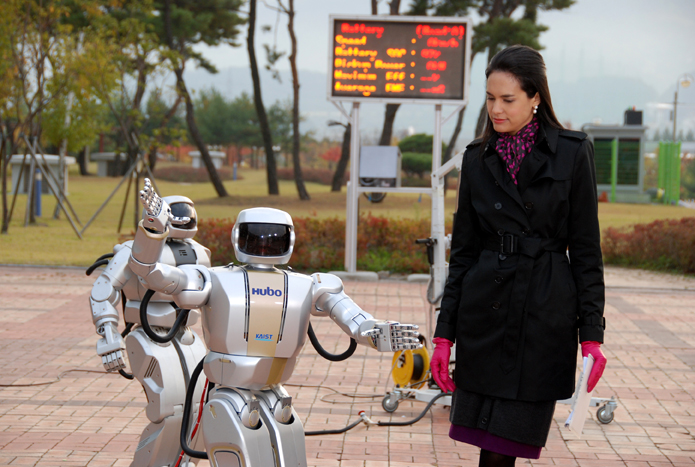 National Green Growth Project, Online Electric Vehicle, Showcased on CNN
KAIST"s green growth technologies were broadcast live on U.S. cable news network CNN from 8 a.m. to 9:30 a.m. Oct. 21.
The program was part of CNN"s week-long series, titled "Eye on South Korea," focusing on how Korea is working to become a brand leader on an international scale and how the nation is recovering from the global economic recession.
During the broadcast, award-winning CNN anchor and correspondent Kristie Lu Stout interviewed KAIST President Nam-Pyo Suh to hear about KAIST-developed two green-growth projects, On-Line Electric Car and Mobile Harbor. KAIST"s humanoid robot Hubo was also showcased.
Live broadcasts of "Eye on South Korea" aired from Oct. 21 through 23.
2009.10.21 View 12380
National Green Growth Project, Online Electric Vehicle, Showcased on CNN
KAIST"s green growth technologies were broadcast live on U.S. cable news network CNN from 8 a.m. to 9:30 a.m. Oct. 21.
The program was part of CNN"s week-long series, titled "Eye on South Korea," focusing on how Korea is working to become a brand leader on an international scale and how the nation is recovering from the global economic recession.
During the broadcast, award-winning CNN anchor and correspondent Kristie Lu Stout interviewed KAIST President Nam-Pyo Suh to hear about KAIST-developed two green-growth projects, On-Line Electric Car and Mobile Harbor. KAIST"s humanoid robot Hubo was also showcased.
Live broadcasts of "Eye on South Korea" aired from Oct. 21 through 23.
2009.10.21 View 12380 -
2008 IEEE International Conference on Humanoid Robots Opens
The 2008 IEEE-RAS International Conference on Humanoid Robots, an international gathering to identify new research trends and technology in humanoid robotics, will open a three-day session on Monday (Dec. 1) at the Hotel Rivera and KAIST in Daejeon.
The annual conference is organized by KAIST and the Robotics and Automation Society of the Institute for Electric and Electronic Engineers, a U.S.-based international non-profit, professional organization for the advancement of technology related to electricity.
The conference is expected to draw a total of 200 robotics researchers from 19 different countries. Prof. Jun-Ho Oh, at the Department of Mechanical Engineering who led the creation of Korea"s first humanoid robot Hubo, is serving as general chair of the conference. Prof. Oh was named the host of the 2008 conference at the 2007 conference held at the Carnegie Melon University of the United States. The eight-year old conference was inaugurated in Boston in 2000.
On the opening day of Dec. 1, seven lectures will be given on diverse areas of robotics including cognitive humanoid vision, and robot vision sensor and sensing. On the subsequent two days, a total of 110 papers will be presented.
During the conference period, a variety of robots produced by six local and foreign robot makers will be on demonstration, providing opportunities for researchers and industrial robot makers to share technological ideas.
Highlights of the conference will be special lectures by world-renowned robot researchers Prof. Yoshiyuki Sankai of University of Tsukuba, who has created an exoskeletal "robot suit," and Prof. Art Kuo of Univerity of Michigan who is regarded as a leading authority in dynamic walking.
Following the conference, all participants are scheduled to tour Prof. Oh"s Hubo Lab and the Human-Robot Interaction Research Center, both located at KAIST.
2008.12.01 View 11907
-
 KAIST Collaborating with U.S. Universities to Advance Humanoid Robotics
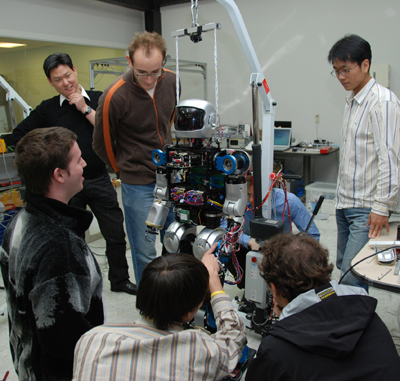
Hubo, a life-size walking bipedal humanoid robot, is perhaps the best-known character in Korea that KAIST has ever produced. It was shown to the government heads of the Asia-Pacific region during the APEC held in Busan, Korea, in 2005 and appeared at the hit concerts of the pop singer Jang-Hoon Kim. The humanoid robot is soon likely to catch the fancy of Americans as a U.S. government-funded project seeks to create a Hubo that can work and interact with people in collaboration with Korean scientists.
"We are going to give the brains to Hubo. (Japanese) Asimo can do only pre-programmed actions. We want to create a Hubo that can help people, interact with people," said Prof. Paul Oh of the Department of Mechanical Engineering & Mechanics at Drexel University in Philadelphia and leader of the five-year international project which was launched in November 2007.
The U.S.$2.5 million project is funded through the Partnership for International Research and Education (PIRE) Program of the National Science Foundation (NSF) of the United States. It brings together world-renowned experts in humanoid design and information technologies.
"Dr. Jun-Ho Oh"s lab at KAIST (that has created Hubo) is the world"s leader in humanoid design and the U.S. has advanced technologies in the areas such as artificial intelligence, mechanical learning and robot vision. Combining the strengths of the two countries can create a synergy effect and develop a more advanced humanoid robot," said Paul Oh. He is currently serving as Program Director of Robotics of the NSF which is overseeing robotics research (non-military) in the U.S. consisting over 150 robotics faculty.
Paul Oh"s research team consists of experts from five U.S. universities -- Drexel, Bryn Mawr College, Colby College, the University of Pennsylvania and Virginia Tech -- and KAIST.
Leading a delegation of six professors and eight students, Dr. Paul Oh made a two-day visit to KAIST on Nov. 18-19 to review the progress of the project and have a technical meeting with participants.
"The U.S. universities participating in this program are scattered across the nation. So we decided to have a technical meeting here in Korea," he said.
Asked the reason why he chose KAIST as a partner for the program, Dr. Oh said that KAIST is willing to open Hugo to international researchers, whereas in Japan only Honda engineers are allowed to touch Asimo, which is a humanoid robot created by Honda Motor Company.
The project is to establish no barrier for roboticists anywhere in the world to pursue the humanoid research; a suite of humanoid platforms will be available for researchers to develop and advance capabilities like locomotion and human-robot interaction.
The team has been initially involved in development of three tools, all of which are based on the Hubo platform, in order to kick-start humanoid research in the U.S. They are the Mini-Hubo (a small, light-weight and affordable humanoid purchasable at the price lower than $8,000), On-Line Hubo (a program to operate Hubo online) and Virtual Hubo (a simulation program to do researches in cyberspace). As the first outcome of the project, the Mini-Hubo is expected to be released in the U.S. around next April.
Another important purpose of the PIRE program is to seek transformative models to train scientists and engineers to effectively work in global multi-disciplined design teams. To this end, an aggregate number of 20 students from U.S. universities are to stay at the KAIST during the next five years, with two students taking turns on a six-month term.
"I was really amazed how much work is done with small funding here. This is really an excellent example to learn," said Roy Gross, an undergraduate from Drexel who has been staying at Prof. Oh"s Lab for the past three months.
2008.11.21 View 15018
KAIST Collaborating with U.S. Universities to Advance Humanoid Robotics
Hubo, a life-size walking bipedal humanoid robot, is perhaps the best-known character in Korea that KAIST has ever produced. It was shown to the government heads of the Asia-Pacific region during the APEC held in Busan, Korea, in 2005 and appeared at the hit concerts of the pop singer Jang-Hoon Kim. The humanoid robot is soon likely to catch the fancy of Americans as a U.S. government-funded project seeks to create a Hubo that can work and interact with people in collaboration with Korean scientists.
"We are going to give the brains to Hubo. (Japanese) Asimo can do only pre-programmed actions. We want to create a Hubo that can help people, interact with people," said Prof. Paul Oh of the Department of Mechanical Engineering & Mechanics at Drexel University in Philadelphia and leader of the five-year international project which was launched in November 2007.
The U.S.$2.5 million project is funded through the Partnership for International Research and Education (PIRE) Program of the National Science Foundation (NSF) of the United States. It brings together world-renowned experts in humanoid design and information technologies.
"Dr. Jun-Ho Oh"s lab at KAIST (that has created Hubo) is the world"s leader in humanoid design and the U.S. has advanced technologies in the areas such as artificial intelligence, mechanical learning and robot vision. Combining the strengths of the two countries can create a synergy effect and develop a more advanced humanoid robot," said Paul Oh. He is currently serving as Program Director of Robotics of the NSF which is overseeing robotics research (non-military) in the U.S. consisting over 150 robotics faculty.
Paul Oh"s research team consists of experts from five U.S. universities -- Drexel, Bryn Mawr College, Colby College, the University of Pennsylvania and Virginia Tech -- and KAIST.
Leading a delegation of six professors and eight students, Dr. Paul Oh made a two-day visit to KAIST on Nov. 18-19 to review the progress of the project and have a technical meeting with participants.
"The U.S. universities participating in this program are scattered across the nation. So we decided to have a technical meeting here in Korea," he said.
Asked the reason why he chose KAIST as a partner for the program, Dr. Oh said that KAIST is willing to open Hugo to international researchers, whereas in Japan only Honda engineers are allowed to touch Asimo, which is a humanoid robot created by Honda Motor Company.
The project is to establish no barrier for roboticists anywhere in the world to pursue the humanoid research; a suite of humanoid platforms will be available for researchers to develop and advance capabilities like locomotion and human-robot interaction.
The team has been initially involved in development of three tools, all of which are based on the Hubo platform, in order to kick-start humanoid research in the U.S. They are the Mini-Hubo (a small, light-weight and affordable humanoid purchasable at the price lower than $8,000), On-Line Hubo (a program to operate Hubo online) and Virtual Hubo (a simulation program to do researches in cyberspace). As the first outcome of the project, the Mini-Hubo is expected to be released in the U.S. around next April.
Another important purpose of the PIRE program is to seek transformative models to train scientists and engineers to effectively work in global multi-disciplined design teams. To this end, an aggregate number of 20 students from U.S. universities are to stay at the KAIST during the next five years, with two students taking turns on a six-month term.
"I was really amazed how much work is done with small funding here. This is really an excellent example to learn," said Roy Gross, an undergraduate from Drexel who has been staying at Prof. Oh"s Lab for the past three months.
2008.11.21 View 15018