Fellow
-
 KAIST-Google Partnership for AI Education and Research
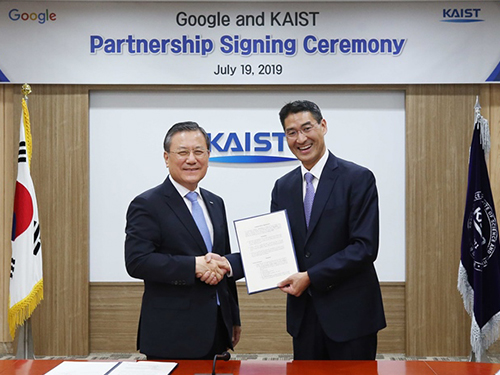
Google has agreed to support KAIST students and professors in the fields of AI research and education. President Sung-Chul Shin and Google Korea Country Director John Lee signed the collaboration agreement during a ceremony on July 19 at KAIST.
Under the agreement, Google will fund the Google AI-Focused Research Awards Program, the PhD Fellowship Program, and Student Travel Grants for KAIST. In addition, Google will continue to provide more academic and career building opportunities for students, including Google internship programs.
KAIST and Google has been collaborating for years. Professor Steven Whang at the School of Electrical Engineering and Professor Sung Ju Hwang at the School of Computing won the AI-Focused Award in 2018 and conduct their researches on "Improving Generalization and Reliability of Any Deep Neural Networks" and "Automatic and Acitionable Model Analysis for TFX," respectively. Outstanding PhD students have been recognized through the PhD Fellowship Program. However, this new collaboration agreement will focus on research, academic development, and technological innovation in AI.
Google plans to support research in the fields of deep learning, cloud machine learning, and voice technologies. Google will fund the development of two educational programs based on Google open source technology each year for two years that will be used in the new AI Graduate School opening for the fall semester.
John Lee of Google Korea said, “This partnership lays a solid foundation for deeper collaboration.” President Shin added, “This partnership will not only advance Korea’s global competitiveness in AI-powered industries but also contribute to the global community by nurturing talents in this most extensive discipline.”
2019.07.22 View 5308
KAIST-Google Partnership for AI Education and Research
Google has agreed to support KAIST students and professors in the fields of AI research and education. President Sung-Chul Shin and Google Korea Country Director John Lee signed the collaboration agreement during a ceremony on July 19 at KAIST.
Under the agreement, Google will fund the Google AI-Focused Research Awards Program, the PhD Fellowship Program, and Student Travel Grants for KAIST. In addition, Google will continue to provide more academic and career building opportunities for students, including Google internship programs.
KAIST and Google has been collaborating for years. Professor Steven Whang at the School of Electrical Engineering and Professor Sung Ju Hwang at the School of Computing won the AI-Focused Award in 2018 and conduct their researches on "Improving Generalization and Reliability of Any Deep Neural Networks" and "Automatic and Acitionable Model Analysis for TFX," respectively. Outstanding PhD students have been recognized through the PhD Fellowship Program. However, this new collaboration agreement will focus on research, academic development, and technological innovation in AI.
Google plans to support research in the fields of deep learning, cloud machine learning, and voice technologies. Google will fund the development of two educational programs based on Google open source technology each year for two years that will be used in the new AI Graduate School opening for the fall semester.
John Lee of Google Korea said, “This partnership lays a solid foundation for deeper collaboration.” President Shin added, “This partnership will not only advance Korea’s global competitiveness in AI-powered industries but also contribute to the global community by nurturing talents in this most extensive discipline.”
2019.07.22 View 5308 -
 New Members of KAST and Y-KAST 2019
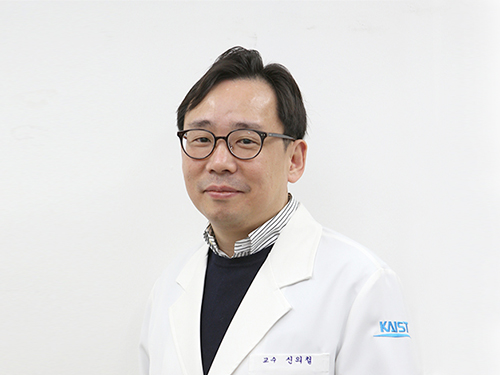
(Professor Eui-Cheol Shin from the Graduate School of Medical Science and Engineering)
Professor Eui-Cheol Shin from the Graduate School of Medical Science and Engineering became a new fellow of the Korean Academy of Science and Technology (KAST) along with 25 other scientists in Korea. He is one of the top virus immunologists in Korea and has published a review article in Nature Reviews Immunology.
Meanwhile KAST selected and announced 26 young scientists under the age 43 who have shown great potential and the creativity to carry out next-generation research. The list of Y-KAST (Young Korean Academy of Science and Technology) includes six KAIST professors: Professor Ji Oon Lee from the Department of Mathematical Sciences, Professor Mi Hee Lim from the Department of Chemistry, Professor Shin-Hyun Kim from the Department of Chemical and Biomolecular Engineering, Professor Jung-Ryul Lee from the Department of Aerospace Engineering, Professor Hyunjoo Jenny Lee from the School of Electrical Engineering, and Professor Yeon Sik Jung from the Department of Materials Science and Engineering.
KAST conferred their fellowships and Y-KAST membership during the New Year Reception.
2019.01.22 View 5812
New Members of KAST and Y-KAST 2019
(Professor Eui-Cheol Shin from the Graduate School of Medical Science and Engineering)
Professor Eui-Cheol Shin from the Graduate School of Medical Science and Engineering became a new fellow of the Korean Academy of Science and Technology (KAST) along with 25 other scientists in Korea. He is one of the top virus immunologists in Korea and has published a review article in Nature Reviews Immunology.
Meanwhile KAST selected and announced 26 young scientists under the age 43 who have shown great potential and the creativity to carry out next-generation research. The list of Y-KAST (Young Korean Academy of Science and Technology) includes six KAIST professors: Professor Ji Oon Lee from the Department of Mathematical Sciences, Professor Mi Hee Lim from the Department of Chemistry, Professor Shin-Hyun Kim from the Department of Chemical and Biomolecular Engineering, Professor Jung-Ryul Lee from the Department of Aerospace Engineering, Professor Hyunjoo Jenny Lee from the School of Electrical Engineering, and Professor Yeon Sik Jung from the Department of Materials Science and Engineering.
KAST conferred their fellowships and Y-KAST membership during the New Year Reception.
2019.01.22 View 5812 -
 NEREC Summer Program Keeps Fellows Thinking, Engaged in Nuclear Nonproliferation
Nuclear technology is more than just technology. It is the fruit of the most advanced science and technology. It also requires high standards of policymaking and global cooperation for benefiting the technology.
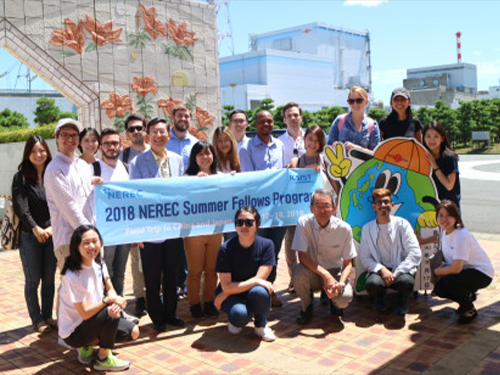
As part of the fifth annual Nuclear Nonproliferation Education and Research Center (NEREC) Summer Fellows Program at KAIST, 24 students from 15 countries participated in six-week intensive education and training program. NEREC is the only university-based center dedicated to nuclear nonproliferation education and research established in 2014.
The program, which provides multidisciplinary lectures and seminars on nuclear technology and policy as well as international relations, was designed to nurture global nuclear technology experts well equipped in three areas: in-depth knowledge of technology, applicability gained from sound policy building, and negotiating for international cooperation. It now has grown into the most popular summer program at KAIST.
During the program from July 6 to August 18, participants were able to engage in enriching and stimulating learning experiences in tandem with policies and technology for the utilization and provision of peaceful and safe nuclear technology.
Participating fellows also had to conduct a group research project on a given topic. This year, they explored nuclear nonproliferation issues in relation to nuclear exports and brainstormed some recommendations for current policy. They presented their outcomes at the 2018 NEREC Conference on Nuclear Nonproliferation. After intensive lecture sessions and group research work, the fellows went off to key policy think-tanks, nuclear research institutes, and research power facilities in Korea, Japan, and China.
“NEREC emphasizes nuclear nonproliferation issues related to civilian nuclear power and the associated nuclear fuel cycle development from the point of technology users. I am very glad that the number of participants are increasing year by year,” said the Director of NEREC Man-Sung Yim, a professor in the Department of Nuclear and Quantum Engineering.
Participants’ majors vary from nuclear engineering to international relations to economics. The fellows divided into two groups of graduate and undergraduate courses. They expressed their deep satisfactory in the multidisciplinary lectures by scholars from KAIST, Seoul National University, and Korea National Defense University.
Many participants reported that they learned a lot, not only about policy and international relations but on the research they are conducting and what the key issues will be in dealing for producing meaningful research work.
Moad Aldbissi from the KTH Royal Institute of Technology is one of the students who shared the same view. He said, “Coming from a technical background in nuclear engineering, I managed to learn a lot about nuclear policy and international relations. The importance of integrating the technical and political fields became even clearer.”
Most students concurred that they recognized how important it was to make international collaboration in this powerful field for each country through this program.
“As an engineering student, I just approached this program like an empty glass in policy areas. While working with colleagues during the program, I came to understand how important it is to make cooperation in these fields for the better result of national development and international relations,” said Thanataon Pornphatdetaudom from the Tokyo Institute of Technology.
To Director Yim, this program is becoming well positioned to educate nuclear policy experts in a number of countries of strategic importance. He believes the continuous supply of these experts will contribute to promoting global nuclear nonproliferation and the peaceful use of nuclear energy while the use of nuclear technology continues.
2018.09.04 View 7058
NEREC Summer Program Keeps Fellows Thinking, Engaged in Nuclear Nonproliferation
Nuclear technology is more than just technology. It is the fruit of the most advanced science and technology. It also requires high standards of policymaking and global cooperation for benefiting the technology.
As part of the fifth annual Nuclear Nonproliferation Education and Research Center (NEREC) Summer Fellows Program at KAIST, 24 students from 15 countries participated in six-week intensive education and training program. NEREC is the only university-based center dedicated to nuclear nonproliferation education and research established in 2014.
The program, which provides multidisciplinary lectures and seminars on nuclear technology and policy as well as international relations, was designed to nurture global nuclear technology experts well equipped in three areas: in-depth knowledge of technology, applicability gained from sound policy building, and negotiating for international cooperation. It now has grown into the most popular summer program at KAIST.
During the program from July 6 to August 18, participants were able to engage in enriching and stimulating learning experiences in tandem with policies and technology for the utilization and provision of peaceful and safe nuclear technology.
Participating fellows also had to conduct a group research project on a given topic. This year, they explored nuclear nonproliferation issues in relation to nuclear exports and brainstormed some recommendations for current policy. They presented their outcomes at the 2018 NEREC Conference on Nuclear Nonproliferation. After intensive lecture sessions and group research work, the fellows went off to key policy think-tanks, nuclear research institutes, and research power facilities in Korea, Japan, and China.
“NEREC emphasizes nuclear nonproliferation issues related to civilian nuclear power and the associated nuclear fuel cycle development from the point of technology users. I am very glad that the number of participants are increasing year by year,” said the Director of NEREC Man-Sung Yim, a professor in the Department of Nuclear and Quantum Engineering.
Participants’ majors vary from nuclear engineering to international relations to economics. The fellows divided into two groups of graduate and undergraduate courses. They expressed their deep satisfactory in the multidisciplinary lectures by scholars from KAIST, Seoul National University, and Korea National Defense University.
Many participants reported that they learned a lot, not only about policy and international relations but on the research they are conducting and what the key issues will be in dealing for producing meaningful research work.
Moad Aldbissi from the KTH Royal Institute of Technology is one of the students who shared the same view. He said, “Coming from a technical background in nuclear engineering, I managed to learn a lot about nuclear policy and international relations. The importance of integrating the technical and political fields became even clearer.”
Most students concurred that they recognized how important it was to make international collaboration in this powerful field for each country through this program.
“As an engineering student, I just approached this program like an empty glass in policy areas. While working with colleagues during the program, I came to understand how important it is to make cooperation in these fields for the better result of national development and international relations,” said Thanataon Pornphatdetaudom from the Tokyo Institute of Technology.
To Director Yim, this program is becoming well positioned to educate nuclear policy experts in a number of countries of strategic importance. He believes the continuous supply of these experts will contribute to promoting global nuclear nonproliferation and the peaceful use of nuclear energy while the use of nuclear technology continues.
2018.09.04 View 7058 -
 Park Chosen for Principality of Monaco/ITER Postdoctoral Fellowship
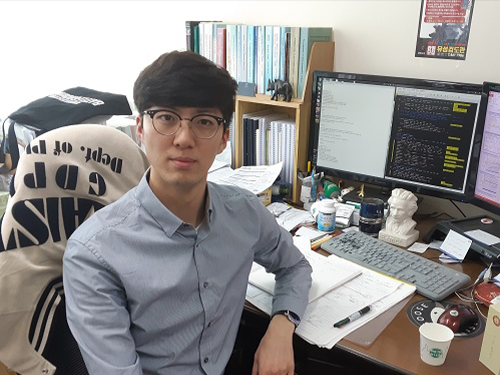
(Jaesun Park in the Integrated Master's and Doctoral Degree Program )
Jaesun Park from the Department of Physics, was selected as a Principality of Monaco/ITER Postdoctoral Fellowship recipient.
This program was established by the Principality of Monaco and an international organization, ITER, in January 2008 to support postdoctoral researchers who will be working for ITER. It is a relatively competitive program because it chooses only five people every two years.
The selected postdoctoral researchers will be working for ITER for two years while conducting research projects with outstanding researchers in the field of nuclear fusion.
ITER, one of the most ambitious energy projects, was launched in 1985 with the purpose of carrying out joint research on nuclear fusion energy. Currently, about 800 people are working for this organization.
Seven ITER member countries (i.e. Korea, the European Union, the United States, China, Japan, Russia, and India) are sharing the expenses and engaging in mega-scale science projects. Korea shares 9.1% (20 billion Euro) of the total construction costs of ITER experimental devices.
Park will begin his duties in early 2019.
2018.05.04 View 6336
Park Chosen for Principality of Monaco/ITER Postdoctoral Fellowship
(Jaesun Park in the Integrated Master's and Doctoral Degree Program )
Jaesun Park from the Department of Physics, was selected as a Principality of Monaco/ITER Postdoctoral Fellowship recipient.
This program was established by the Principality of Monaco and an international organization, ITER, in January 2008 to support postdoctoral researchers who will be working for ITER. It is a relatively competitive program because it chooses only five people every two years.
The selected postdoctoral researchers will be working for ITER for two years while conducting research projects with outstanding researchers in the field of nuclear fusion.
ITER, one of the most ambitious energy projects, was launched in 1985 with the purpose of carrying out joint research on nuclear fusion energy. Currently, about 800 people are working for this organization.
Seven ITER member countries (i.e. Korea, the European Union, the United States, China, Japan, Russia, and India) are sharing the expenses and engaging in mega-scale science projects. Korea shares 9.1% (20 billion Euro) of the total construction costs of ITER experimental devices.
Park will begin his duties in early 2019.
2018.05.04 View 6336 -
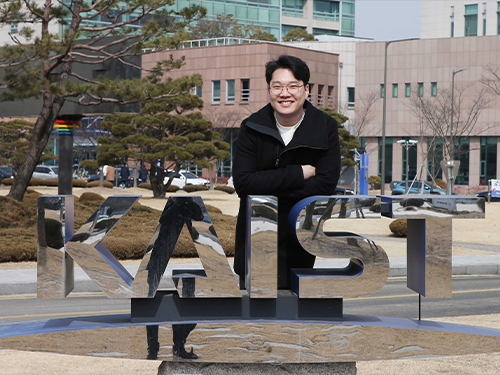 Soul-Searching & Odds-Defying Determination: A Commencement Story of Dr. Tae-Hyun Oh
(Dr. Tae-Hyun Oh, one of the 2736 graduates of the 2018)
Each and every one of the 2,736 graduates has come a long way to the 2018 Commencement. Tae-Hyun Oh, who just started his new research career at MIT after completing his Ph.D. at KAIST, is no exception.
Unlike the most KAIST freshmen straight out of the ingenious science academies of Korea, he is among the many who endured very challenging and turbulent adolescent years. Buffeted by family instability and struggling during his time at school, he saw himself trapped by seemingly impenetrable barriers. His mother, who hated to see his struggling, advised him to take a break to reflect on who he is and what he wanted to do.
After dropping out of high school in his first year, ways to make money and support his family occupied his thoughts. He took on odd jobs from a car body shop to a gas station, but the real world was very tough and sometimes even cruel to the high school dropout.
Bias and prejudice stigmatizing dropouts hurt him so much. He often overheard a parent who dropped by the body shop that he worked in saying, “If you do not study hard, you will end up like this guy.” Hearing such things terrified him and awoke his sense of purpose. So he decided to do something meaningful and be a better man than he was.
“I didn’t like the person I was growing up to become. I needed to find myself and get away from the place I was growing up. It was my adventure and it was the best decision I ever made,” says Oh.
After completing his high school diploma national certificate, he planned to apply to an engineering college. On his second try, he gained admission into the Department of Electrical Engineering at Kwang Woon University with a full scholarship. He was so thrilled for this opportunity and hoped he could do well at college. Signal processing and image processing became the interest of his research and he finished his undergraduate degree summa cum laude.
Gaining confidence in his studies, he searched around graduate school department websites in Korea to select the path he was interested in. Among others, the Robotics and Computer Vision Lab of Professor In-So Kweon at the Department of Electrical Engineering at KAIST was attractive to him.
Professor Kweon’s lab is globally renowned for robot vision technology. Their technologies were applied into HUBO, the KAIST-developed bimodal humanoid robot that won the 2015 DARPA Challenges.
“I am so appreciate of Professor Kweon, who accepted and guided me,” he said. Under Professor Kweon’s advising, he could finish his Master’s and Ph.D. courses in seven years. The mathematical modeling on fundamental computer algorithms became his main research topic.
While at KAIST, his academic research has blossomed. He won a total of 13 research prizes sponsored by corporations at home and abroad such as Kolon, Samsung, Hyundai Motors, and Qualcomm.
In 2015, he won the Microsoft Research Asia Fellowship as the sole Korean among 13 Ph.D. candidates in the Asian region. With the MSRA fellowship, he could intern at the MS Research Beijing Office for half a year and then in Redmond, Washington in the US.
“Professor Kweon’s lab filled me up with knowledge. Whenever I presented our team’s paper at an international conference, I was amazed by the strong interest shown by foreign experts, researchers, and professors. Their strong support and interest encouraged me a lot. I was fully charged with the belief that I could go abroad and explore more opportunities,” he said.
Dr. Oh, who completed his dissertation last fall, now works at the Department of Electrical Engineering and Computer Science at MIT under Professor Wojciech Matusik.
“I think the research environment at KAIST is on par with MIT. I have very rich resources for my studies and research at both schools, but at MIT the working culture is a little different and it remains a big challenge for me. I am still not familiar with collaborative work with colleagues from very diverse backgrounds and countries, and to persuade them and communicate with them is very tough. But I think I am getting better and better,” he said.
Oh, who is an avid computer game player as well, said life seems to be a game. The level of the game will be upgraded to the next level after something is accomplished. He feels great joy when he is moving up and he believes such diverse experiences have helped him become a better person day by day. Once he identified what gave him a strong sense of purpose, he wasn’t stressed out by his studies any more. He was so excited to be able to follow his passion and is ready for the next challenge.
2018.02.23 View 7242
Soul-Searching & Odds-Defying Determination: A Commencement Story of Dr. Tae-Hyun Oh
(Dr. Tae-Hyun Oh, one of the 2736 graduates of the 2018)
Each and every one of the 2,736 graduates has come a long way to the 2018 Commencement. Tae-Hyun Oh, who just started his new research career at MIT after completing his Ph.D. at KAIST, is no exception.
Unlike the most KAIST freshmen straight out of the ingenious science academies of Korea, he is among the many who endured very challenging and turbulent adolescent years. Buffeted by family instability and struggling during his time at school, he saw himself trapped by seemingly impenetrable barriers. His mother, who hated to see his struggling, advised him to take a break to reflect on who he is and what he wanted to do.
After dropping out of high school in his first year, ways to make money and support his family occupied his thoughts. He took on odd jobs from a car body shop to a gas station, but the real world was very tough and sometimes even cruel to the high school dropout.
Bias and prejudice stigmatizing dropouts hurt him so much. He often overheard a parent who dropped by the body shop that he worked in saying, “If you do not study hard, you will end up like this guy.” Hearing such things terrified him and awoke his sense of purpose. So he decided to do something meaningful and be a better man than he was.
“I didn’t like the person I was growing up to become. I needed to find myself and get away from the place I was growing up. It was my adventure and it was the best decision I ever made,” says Oh.
After completing his high school diploma national certificate, he planned to apply to an engineering college. On his second try, he gained admission into the Department of Electrical Engineering at Kwang Woon University with a full scholarship. He was so thrilled for this opportunity and hoped he could do well at college. Signal processing and image processing became the interest of his research and he finished his undergraduate degree summa cum laude.
Gaining confidence in his studies, he searched around graduate school department websites in Korea to select the path he was interested in. Among others, the Robotics and Computer Vision Lab of Professor In-So Kweon at the Department of Electrical Engineering at KAIST was attractive to him.
Professor Kweon’s lab is globally renowned for robot vision technology. Their technologies were applied into HUBO, the KAIST-developed bimodal humanoid robot that won the 2015 DARPA Challenges.
“I am so appreciate of Professor Kweon, who accepted and guided me,” he said. Under Professor Kweon’s advising, he could finish his Master’s and Ph.D. courses in seven years. The mathematical modeling on fundamental computer algorithms became his main research topic.
While at KAIST, his academic research has blossomed. He won a total of 13 research prizes sponsored by corporations at home and abroad such as Kolon, Samsung, Hyundai Motors, and Qualcomm.
In 2015, he won the Microsoft Research Asia Fellowship as the sole Korean among 13 Ph.D. candidates in the Asian region. With the MSRA fellowship, he could intern at the MS Research Beijing Office for half a year and then in Redmond, Washington in the US.
“Professor Kweon’s lab filled me up with knowledge. Whenever I presented our team’s paper at an international conference, I was amazed by the strong interest shown by foreign experts, researchers, and professors. Their strong support and interest encouraged me a lot. I was fully charged with the belief that I could go abroad and explore more opportunities,” he said.
Dr. Oh, who completed his dissertation last fall, now works at the Department of Electrical Engineering and Computer Science at MIT under Professor Wojciech Matusik.
“I think the research environment at KAIST is on par with MIT. I have very rich resources for my studies and research at both schools, but at MIT the working culture is a little different and it remains a big challenge for me. I am still not familiar with collaborative work with colleagues from very diverse backgrounds and countries, and to persuade them and communicate with them is very tough. But I think I am getting better and better,” he said.
Oh, who is an avid computer game player as well, said life seems to be a game. The level of the game will be upgraded to the next level after something is accomplished. He feels great joy when he is moving up and he believes such diverse experiences have helped him become a better person day by day. Once he identified what gave him a strong sense of purpose, he wasn’t stressed out by his studies any more. He was so excited to be able to follow his passion and is ready for the next challenge.
2018.02.23 View 7242 -
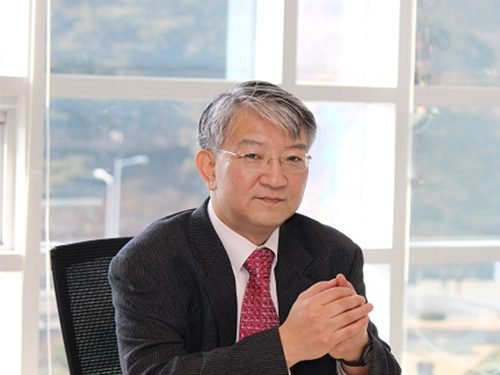 Distinguished Professor Sang Yup Lee Named NAI Fellow
(Distinguished Professor Sang Yup Lee)
Distinguished Professor Sang Yup Lee of the Department of Chemical and Biomolecular Engineering was named to the National Academy of Inventors in the US. He is the first Korean scholar ever elected as a NAI fellow.
The NAI is a non-profit member organization with over 4,000 individual inventors and fellows spanning more than 250 institutions worldwide. It is comprised of universities as well as governmental and non-profit research institutes. The academy was founded in 2010 to recognize and encourage inventors with patents from the US Patent and Trademark Office. So far, 575 fellows from 229 institutions have been elected.
The academy said Professor Lee has been recognized for fellowship induction as he has demonstrated a highly prolific spirit of innovation in creating or facilitating outstanding inventions that have made a tangible impact on quality of life, economic development, and the welfare of society.
Distinguished Professor Lee, a pioneering researcher and scholar in the field of systems metabolic engineering, was ranked in the top 1% of highly cited researchers (HCR) this year. Over the past 11 years, he published more than 130,000 articles in prestigious journals around the world. He has been cited more than 34,000 times since he started working at KAIST in 1994.
He is also the first Korean ever elected to both the National Academy of Sciences (NAS) and the National Academy of Engineering (NAE) in the US, becoming the one of 13 foreign scholars in the world holding two prestigious institutions’ fellowships.
Dr. Lee is currently the dean of KAIST Institutes, the world-leading institute for multi and interdisciplinary research. He is also serving as co-chair of the Global Council on Biotechnology and is a member of the Global Future Council on the Fourth Industrial Revolution at the World Economic Forum.
2017.12.13 View 5782
Distinguished Professor Sang Yup Lee Named NAI Fellow
(Distinguished Professor Sang Yup Lee)
Distinguished Professor Sang Yup Lee of the Department of Chemical and Biomolecular Engineering was named to the National Academy of Inventors in the US. He is the first Korean scholar ever elected as a NAI fellow.
The NAI is a non-profit member organization with over 4,000 individual inventors and fellows spanning more than 250 institutions worldwide. It is comprised of universities as well as governmental and non-profit research institutes. The academy was founded in 2010 to recognize and encourage inventors with patents from the US Patent and Trademark Office. So far, 575 fellows from 229 institutions have been elected.
The academy said Professor Lee has been recognized for fellowship induction as he has demonstrated a highly prolific spirit of innovation in creating or facilitating outstanding inventions that have made a tangible impact on quality of life, economic development, and the welfare of society.
Distinguished Professor Lee, a pioneering researcher and scholar in the field of systems metabolic engineering, was ranked in the top 1% of highly cited researchers (HCR) this year. Over the past 11 years, he published more than 130,000 articles in prestigious journals around the world. He has been cited more than 34,000 times since he started working at KAIST in 1994.
He is also the first Korean ever elected to both the National Academy of Sciences (NAS) and the National Academy of Engineering (NAE) in the US, becoming the one of 13 foreign scholars in the world holding two prestigious institutions’ fellowships.
Dr. Lee is currently the dean of KAIST Institutes, the world-leading institute for multi and interdisciplinary research. He is also serving as co-chair of the Global Council on Biotechnology and is a member of the Global Future Council on the Fourth Industrial Revolution at the World Economic Forum.
2017.12.13 View 5782 -
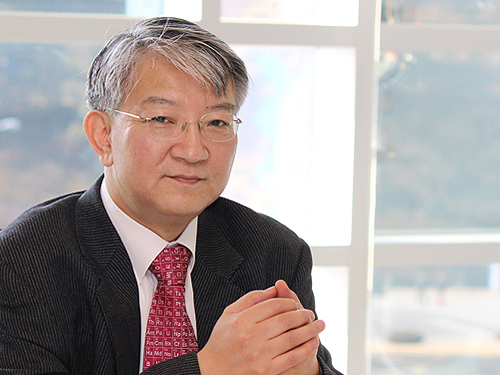 Distinguished Professor Lee Named International Fellow of the CAS
Distinguished Professor Sang Yup Lee from the Department of Chemical and Biomolecular Engineering at KAIST was awarded the title of distinguished professor and international fellow from the Chinese Academy of Sciences (CAS), and honorary professor from its affiliated organization the Tianjin Institute of Industrial Biotechnology (TIB).
The CAS recognized Distinguished Professor Lee for his significant contributions to biotechnology. He has made significant pioneering academic achievements in the area of systems metabolic engineering, which produces useful chemicals from microorganisms. Not only did he develop the first and best source technology in that field, but also came out with processes for the production of biofuel and environmentally-friendly chemicals.”
As a global leader in systems metabolic engineering, Distinguished Professor Lee has also been appointed as an honorary professor at Jiangnan University in Wuxi, China.
Distinguished Professor Lee was listed in the ‘Top 20 Translational Researchers of 2014’ selected by the renowned international journal Nature Biotechnology. Moreover, he was the first Asian recipient of the James E. Bailey Award in 2016 and Marvin J. Johnson Award in 2012, which are given to scholars in the field of biotechnology.
He is also one of 13 global scientists who are foreign members of the renowned academic societies the National Academy of Engineering and the National Academy of Sciences in the US. Furthermore, he received the ‘2017 Korea Best Scientist Award’ from the president of Korea in July. Finally, his founding field, systems metabolic engineering, was chosen as one of the ‘Top 10 Emerging Technologies of 2016’ by the World Economic Forum.
The Chinese Academy of Sciences, established in November 1949, is an academic organization that carries out research on basic sciences and natural sciences in China. It defined its science and technology system to include the fields of basic sciences, natural sciences, and high technology. While having a base in Beijing, its branch academies are located in 12 main cities along with 117 affiliates and 100 national key labs.
2017.10.26 View 7551
Distinguished Professor Lee Named International Fellow of the CAS
Distinguished Professor Sang Yup Lee from the Department of Chemical and Biomolecular Engineering at KAIST was awarded the title of distinguished professor and international fellow from the Chinese Academy of Sciences (CAS), and honorary professor from its affiliated organization the Tianjin Institute of Industrial Biotechnology (TIB).
The CAS recognized Distinguished Professor Lee for his significant contributions to biotechnology. He has made significant pioneering academic achievements in the area of systems metabolic engineering, which produces useful chemicals from microorganisms. Not only did he develop the first and best source technology in that field, but also came out with processes for the production of biofuel and environmentally-friendly chemicals.”
As a global leader in systems metabolic engineering, Distinguished Professor Lee has also been appointed as an honorary professor at Jiangnan University in Wuxi, China.
Distinguished Professor Lee was listed in the ‘Top 20 Translational Researchers of 2014’ selected by the renowned international journal Nature Biotechnology. Moreover, he was the first Asian recipient of the James E. Bailey Award in 2016 and Marvin J. Johnson Award in 2012, which are given to scholars in the field of biotechnology.
He is also one of 13 global scientists who are foreign members of the renowned academic societies the National Academy of Engineering and the National Academy of Sciences in the US. Furthermore, he received the ‘2017 Korea Best Scientist Award’ from the president of Korea in July. Finally, his founding field, systems metabolic engineering, was chosen as one of the ‘Top 10 Emerging Technologies of 2016’ by the World Economic Forum.
The Chinese Academy of Sciences, established in November 1949, is an academic organization that carries out research on basic sciences and natural sciences in China. It defined its science and technology system to include the fields of basic sciences, natural sciences, and high technology. While having a base in Beijing, its branch academies are located in 12 main cities along with 117 affiliates and 100 national key labs.
2017.10.26 View 7551 -
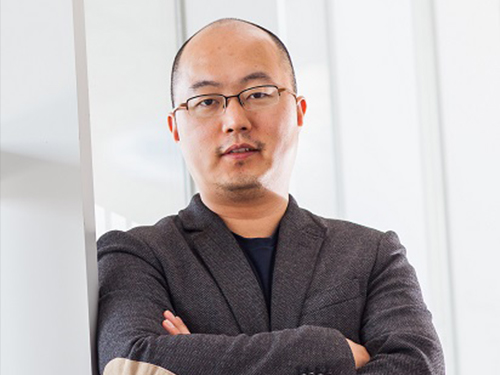 Professor YongKeun Park Elected as a Fellow of the Optical Society
Professor YongKeun Park, from the Department of Physics at KAIST, was elected as a fellow member of the Optical Society (OSA) in Washington, D.C. on September 12. Fellow membership is given to members who have made a significant contribution to the advancement of optics and photonics.
Professor Park was recognized for his research on digital holography and wavefront control technology.
Professor Park has been producing outstanding research outcomes in the field of holographic technology and light scattering control since joining KAIST in 2010. In particular, he developed and commercialized technology for a holographic telescope. He applied it to various medical and biological research projects, leading the field worldwide.
In the past, cells needed to be dyed with fluorescent materials to capture a 3-D image. However, Professor Park’s holotomography (HT) technology can capture 3-D images of living cells and tissues in real time without color dyeing. This technology allows diversified research in the biological and medical field.
Professor Park established a company, Tomocube, Inc. in 2015 to commercialize the technology. In 2016, he received funding from SoftBank Ventures and Hanmi Pharmaceutical. Currently, major institutes, including MIT, the University of Pittsburgh, the German Cancer Research Center, and Seoul National University Hospital are using his equipment.
Recently, Professor Park and his team developed technology based on light scattering measurements. With this technology, they established a company called The Wave Talk and received funding from various organizations, such as NAVER. Its first product is about to be released.
Professor Park said, “I am glad to become a fellow member based on the research outcomes I produced since I was appointed as a professor at KAIST. I would like to thank the excellent researchers as well as the school for its support. I will devote myself to continuously producing novel outcomes in both basic and applied fields.”
Professor Park has published nearly 100 papers in renowned journals including Nature Photonics, Nature Communications, Science Advances, and Physical Review Letters.
2017.10.18 View 8228
Professor YongKeun Park Elected as a Fellow of the Optical Society
Professor YongKeun Park, from the Department of Physics at KAIST, was elected as a fellow member of the Optical Society (OSA) in Washington, D.C. on September 12. Fellow membership is given to members who have made a significant contribution to the advancement of optics and photonics.
Professor Park was recognized for his research on digital holography and wavefront control technology.
Professor Park has been producing outstanding research outcomes in the field of holographic technology and light scattering control since joining KAIST in 2010. In particular, he developed and commercialized technology for a holographic telescope. He applied it to various medical and biological research projects, leading the field worldwide.
In the past, cells needed to be dyed with fluorescent materials to capture a 3-D image. However, Professor Park’s holotomography (HT) technology can capture 3-D images of living cells and tissues in real time without color dyeing. This technology allows diversified research in the biological and medical field.
Professor Park established a company, Tomocube, Inc. in 2015 to commercialize the technology. In 2016, he received funding from SoftBank Ventures and Hanmi Pharmaceutical. Currently, major institutes, including MIT, the University of Pittsburgh, the German Cancer Research Center, and Seoul National University Hospital are using his equipment.
Recently, Professor Park and his team developed technology based on light scattering measurements. With this technology, they established a company called The Wave Talk and received funding from various organizations, such as NAVER. Its first product is about to be released.
Professor Park said, “I am glad to become a fellow member based on the research outcomes I produced since I was appointed as a professor at KAIST. I would like to thank the excellent researchers as well as the school for its support. I will devote myself to continuously producing novel outcomes in both basic and applied fields.”
Professor Park has published nearly 100 papers in renowned journals including Nature Photonics, Nature Communications, Science Advances, and Physical Review Letters.
2017.10.18 View 8228 -
 Sangeun Oh Recognized as a 2017 Google Fellow
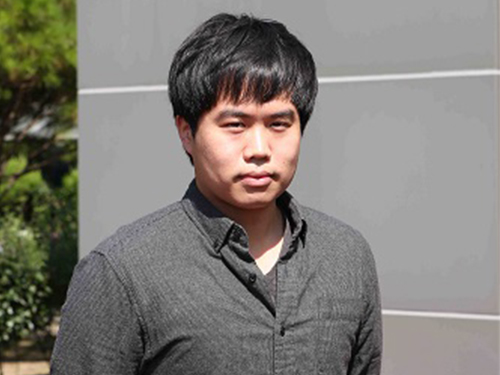
Sangeun Oh, a Ph.D. candidate in the School of Computing was selected as a Google PhD Fellow in 2017. He is one of 47 awardees of the Google PhD Fellowship in the world.
The Google PhD Fellowship awards students showing outstanding performance in the field of computer science and related research. Since being established in 2009, the program has provided various benefits, including scholarships worth $10,000 USD and one-to-one research discussion with mentors from Google.
His research work on a mobile system that allows interactions among various kinds of smart devices was recognized in the field of mobile computing. He developed a mobile platform that allows smart devices to share diverse functions, including logins, payments, and sensors. This technology provides numerous user experiences that existing mobile platforms could not offer. Through cross-device functionality sharing, users can utilize multiple smart devices in a more convenient manner. The research was presented at The Annual International Conference on Mobile Systems, Applications, and Services (MobiSys) of the Association for Computing Machinery in July, 2017.
Oh said, “I would like to express my gratitude to my advisor, the professors in the School of Computing, and my lab colleagues. I will devote myself to carrying out more research in order to contribute to society.”
His advisor, Insik Shin, a professor in the School of Computing said, “Being recognized as a Google PhD Fellow is an honor to both the student as well as KAIST. I strongly anticipate and believe that Oh will make the next step by carrying out good quality research.”
2017.09.27 View 8269
Sangeun Oh Recognized as a 2017 Google Fellow
Sangeun Oh, a Ph.D. candidate in the School of Computing was selected as a Google PhD Fellow in 2017. He is one of 47 awardees of the Google PhD Fellowship in the world.
The Google PhD Fellowship awards students showing outstanding performance in the field of computer science and related research. Since being established in 2009, the program has provided various benefits, including scholarships worth $10,000 USD and one-to-one research discussion with mentors from Google.
His research work on a mobile system that allows interactions among various kinds of smart devices was recognized in the field of mobile computing. He developed a mobile platform that allows smart devices to share diverse functions, including logins, payments, and sensors. This technology provides numerous user experiences that existing mobile platforms could not offer. Through cross-device functionality sharing, users can utilize multiple smart devices in a more convenient manner. The research was presented at The Annual International Conference on Mobile Systems, Applications, and Services (MobiSys) of the Association for Computing Machinery in July, 2017.
Oh said, “I would like to express my gratitude to my advisor, the professors in the School of Computing, and my lab colleagues. I will devote myself to carrying out more research in order to contribute to society.”
His advisor, Insik Shin, a professor in the School of Computing said, “Being recognized as a Google PhD Fellow is an honor to both the student as well as KAIST. I strongly anticipate and believe that Oh will make the next step by carrying out good quality research.”
2017.09.27 View 8269 -
 Professor Poong Hyun Seong Selected as Fellow of the ANS
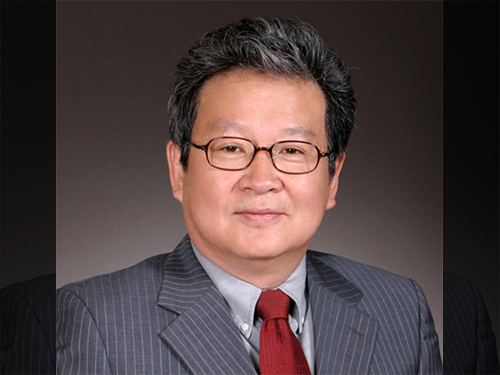
Professor Poong Hyun Seong of the Department of Nuclear and Quantum Engineering was selected as a fellow of the American Nuclear Society.
The selection was announced at their annual meeting held in San Francisco on June 12, in recognition of Professor Seong's contributions to the field of nuclear instrumentation, control andhuman factors engineering.
Founded in 1954, the American Nuclear Society selects scholars who have made outstanding achievements and contributions to the development of the nuclear engineering field each year.
Professor Seong's researches in the field of nuclear instrumentation, control and human factors engineering have contributed to the safe operation of nuclear power plants, to the development of systems to maintain nuclear power plants safely in the event of emergency and to the enhancement of effective response capabilities of nuclear power plant operators. His researches significantly contributed to the safety improvement of nuclear power plants and have been recognized worldwide.
Professor Seong said, "Korea has emerged as a nuclear powerhouse. I think not only my academic career but our national reputation in the field of nuclear research has been well recognized by our global peers.” Professor Seong has served as president of the Korean Nuclear Society, editor in chief of Nuclear Engineering and Technology, and as a commissioner of the Korean Nuclear Safety Commission. He is currently working as a commissioner of the Korean Atomic Energy Commission.
2017.06.29 View 5095
Professor Poong Hyun Seong Selected as Fellow of the ANS
Professor Poong Hyun Seong of the Department of Nuclear and Quantum Engineering was selected as a fellow of the American Nuclear Society.
The selection was announced at their annual meeting held in San Francisco on June 12, in recognition of Professor Seong's contributions to the field of nuclear instrumentation, control andhuman factors engineering.
Founded in 1954, the American Nuclear Society selects scholars who have made outstanding achievements and contributions to the development of the nuclear engineering field each year.
Professor Seong's researches in the field of nuclear instrumentation, control and human factors engineering have contributed to the safe operation of nuclear power plants, to the development of systems to maintain nuclear power plants safely in the event of emergency and to the enhancement of effective response capabilities of nuclear power plant operators. His researches significantly contributed to the safety improvement of nuclear power plants and have been recognized worldwide.
Professor Seong said, "Korea has emerged as a nuclear powerhouse. I think not only my academic career but our national reputation in the field of nuclear research has been well recognized by our global peers.” Professor Seong has served as president of the Korean Nuclear Society, editor in chief of Nuclear Engineering and Technology, and as a commissioner of the Korean Nuclear Safety Commission. He is currently working as a commissioner of the Korean Atomic Energy Commission.
2017.06.29 View 5095 -
 Professor Kwangjo Kim Named as Fellow of IACR
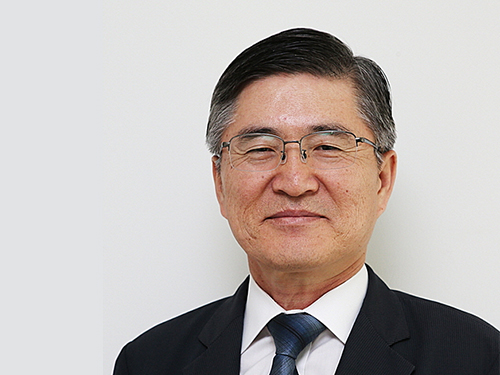
Professor Kwangjo Kim of the Graduate School of Information Security has been selected as a fellow of the International Association for Cryptologic Research (IACR).
The IACR has honored outstanding scholars who have achieved academic excellence in cryptologic research since 2004. He is the first Korean scholar to receive an IACR fellowship.
The IACR, established in 1981, is responsible for organizing international cryptologic conferences every year including the three major cryptologic academic conferences Eurocrypt, Crypto, and Asiacript. The IACR also sponsors workshop series such as the Theory of Cryptography Conference (TCC), the Workshop on Fast Software Encryption (FSE), the Public Key Cryptography Workshop (PKC), and Cryptographic Hardware and Embedded Systems (CHES).
Professor Kim, an internationally acclaimed scholar in the fields of cryptology and information security theory and its applications, was recognized for his outstanding academic achievements and leadership. He has made significant contributions to cryptology in Korea by hosting Asiacript in 1996 and 2001 as well as CHES in 2014. During his 34 years of academic activities, he has published more than 80 SCI journal papers and garnered more than 20,000 citations.
Professor Kim served on the board of the directors of the IACR from 2000 to 2004 and was the chairperson of the Asiacript Steering Committee from 2005 to 2008. He is on the editorial board of the online journal Cryptography.
Professor Kim said, “I am so humbled and honored to be named as a fellow of such a prestigious academic association. I will continue to strive to assist highly educated information security personnel with further research in cryptology.”
2017.03.16 View 5569
Professor Kwangjo Kim Named as Fellow of IACR
Professor Kwangjo Kim of the Graduate School of Information Security has been selected as a fellow of the International Association for Cryptologic Research (IACR).
The IACR has honored outstanding scholars who have achieved academic excellence in cryptologic research since 2004. He is the first Korean scholar to receive an IACR fellowship.
The IACR, established in 1981, is responsible for organizing international cryptologic conferences every year including the three major cryptologic academic conferences Eurocrypt, Crypto, and Asiacript. The IACR also sponsors workshop series such as the Theory of Cryptography Conference (TCC), the Workshop on Fast Software Encryption (FSE), the Public Key Cryptography Workshop (PKC), and Cryptographic Hardware and Embedded Systems (CHES).
Professor Kim, an internationally acclaimed scholar in the fields of cryptology and information security theory and its applications, was recognized for his outstanding academic achievements and leadership. He has made significant contributions to cryptology in Korea by hosting Asiacript in 1996 and 2001 as well as CHES in 2014. During his 34 years of academic activities, he has published more than 80 SCI journal papers and garnered more than 20,000 citations.
Professor Kim served on the board of the directors of the IACR from 2000 to 2004 and was the chairperson of the Asiacript Steering Committee from 2005 to 2008. He is on the editorial board of the online journal Cryptography.
Professor Kim said, “I am so humbled and honored to be named as a fellow of such a prestigious academic association. I will continue to strive to assist highly educated information security personnel with further research in cryptology.”
2017.03.16 View 5569 -
 Professor Kun-pyo Lee Appointed Honorary Fellow of the Design Research Society
Founded in the United Kingdom (UK) in 1966, the Design Research Society is an international academic organization that promotes excellence in design and supports the interests of the design research community.
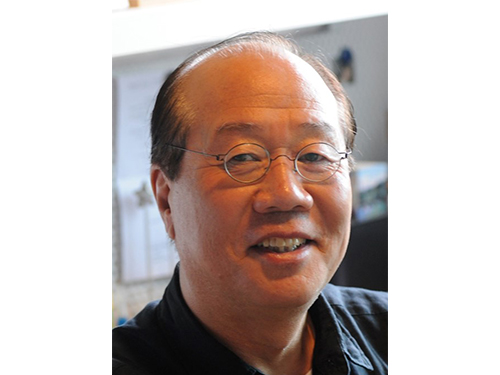
Professor Kun-pyo Lee of the Industrial Design Department at KAIST received his honorary fellowship from the Society at its 50th international conference held from June 27, 2016 to July 3, 2016 in Brighton, UK.
The Society recognized Professor Lee’s academic achievements and his contribution to the advancement of design research nationally and globally. To date, only eight researchers have received honorary fellowships from the Society, and he is the first Asian to become an honorary fellow.
Professor Lee has worked at KAIST for more than 30 years as a professor in industrial engineering and served on various important positions such as the president of the Korean Society of Design Science, the president of the International Association of Societies of Design Research, an executive vice president of the Corporate Design Center at LG Electronics, and an advisory board member for Human-centered Design Network in Japan and UXnet in the United States.
By introducing the concept of user experience (UX) in Korea for the first time, he developed this field while focusing on user-centered designs to optimize interactive digital products as well as interaction design to create mental and physical interfaces between people and interactive digital products, services, and systems.
Professor Lee said, “I am pleased to become an honorary fellow of the Design Research Society. For quiet some time, industrial design remained in the domain of practical studies, lacking the kind of support needed to grow as an independent academic and research discipline, but this has changed rapidly in recent years. I will continue to remain actively involved in the development of industrial design engineering in Korea and the world.”
2016.07.19 View 5534
Professor Kun-pyo Lee Appointed Honorary Fellow of the Design Research Society
Founded in the United Kingdom (UK) in 1966, the Design Research Society is an international academic organization that promotes excellence in design and supports the interests of the design research community.
Professor Kun-pyo Lee of the Industrial Design Department at KAIST received his honorary fellowship from the Society at its 50th international conference held from June 27, 2016 to July 3, 2016 in Brighton, UK.
The Society recognized Professor Lee’s academic achievements and his contribution to the advancement of design research nationally and globally. To date, only eight researchers have received honorary fellowships from the Society, and he is the first Asian to become an honorary fellow.
Professor Lee has worked at KAIST for more than 30 years as a professor in industrial engineering and served on various important positions such as the president of the Korean Society of Design Science, the president of the International Association of Societies of Design Research, an executive vice president of the Corporate Design Center at LG Electronics, and an advisory board member for Human-centered Design Network in Japan and UXnet in the United States.
By introducing the concept of user experience (UX) in Korea for the first time, he developed this field while focusing on user-centered designs to optimize interactive digital products as well as interaction design to create mental and physical interfaces between people and interactive digital products, services, and systems.
Professor Lee said, “I am pleased to become an honorary fellow of the Design Research Society. For quiet some time, industrial design remained in the domain of practical studies, lacking the kind of support needed to grow as an independent academic and research discipline, but this has changed rapidly in recent years. I will continue to remain actively involved in the development of industrial design engineering in Korea and the world.”
2016.07.19 View 5534