department+of+mechanical+engineering
-
 Artificial Muscles Bloom, Dance, and Wave
Wearing a flower brooch that blooms before your eyes sounds like magic. KAIST researchers have made it real with robotic muscles.
Researchers have developed an ultrathin, artificial muscle for soft robotics. The advancement, recently reported in the journal Science Robotics, was demonstrated with a robotic blooming flower brooch, dancing robotic butterflies and fluttering tree leaves on a kinetic art piece.
The robotic equivalent of a muscle that can move is called an actuator. The actuator expands, contracts or rotates like muscle fibers using a stimulus such as electricity. Engineers around the world are striving to develop more dynamic actuators that respond quickly, can bend without breaking, and are very durable. Soft, robotic muscles could have a wide variety of applications, from wearable electronics to advanced prosthetics.
The team from KAIST’s Creative Research Initiative Center for Functionally Antagonistic Nano-Engineering developed a very thin, responsive, flexible and durable artificial muscle. The actuator looks like a skinny strip of paper about an inch long. They used a particular type of material called MXene, which is class of compounds that have layers only a few atoms thick.
Their chosen MXene material (T3C2Tx) is made of thin layers of titanium and carbon compounds. It was not flexible by itself; sheets of material would flake off the actuator when bent in a loop. That changed when the MXene was “ionically cross-linked” — connected through an ionic bond — to a synthetic polymer. The combination of materials made the actuator flexible, while still maintaining strength and conductivity, which is critical for movements driven by electricity.
Their particular combination performed better than others reported. Their actuator responded very quickly to low voltage, and lasted for more than five hours moving continuously.
To prove the tiny robotic muscle works, the team incorporated the actuator into wearable art: an origami-inspired brooch mimics how a narcissus flower unfolds its petals when a small amount of electricity is applied. They also designed robotic butterflies that move their wings up and down, and made the leaves of a tree sculpture flutter.
“Wearable robotics and kinetic art demonstrate how robotic muscles can have fun and beautiful applications,” said Il-Kwon Oh, lead paper author and professor of mechanical engineering. “It also shows the enormous potential for small, artificial muscles for a variety of uses, such as haptic feedback systems and active biomedical devices.”
The team next plans to investigate more practical applications of MXene-based soft actuators and other engineering applications of MXene 2D nanomaterials.
2019.08.22 View 26260
Artificial Muscles Bloom, Dance, and Wave
Wearing a flower brooch that blooms before your eyes sounds like magic. KAIST researchers have made it real with robotic muscles.
Researchers have developed an ultrathin, artificial muscle for soft robotics. The advancement, recently reported in the journal Science Robotics, was demonstrated with a robotic blooming flower brooch, dancing robotic butterflies and fluttering tree leaves on a kinetic art piece.
The robotic equivalent of a muscle that can move is called an actuator. The actuator expands, contracts or rotates like muscle fibers using a stimulus such as electricity. Engineers around the world are striving to develop more dynamic actuators that respond quickly, can bend without breaking, and are very durable. Soft, robotic muscles could have a wide variety of applications, from wearable electronics to advanced prosthetics.
The team from KAIST’s Creative Research Initiative Center for Functionally Antagonistic Nano-Engineering developed a very thin, responsive, flexible and durable artificial muscle. The actuator looks like a skinny strip of paper about an inch long. They used a particular type of material called MXene, which is class of compounds that have layers only a few atoms thick.
Their chosen MXene material (T3C2Tx) is made of thin layers of titanium and carbon compounds. It was not flexible by itself; sheets of material would flake off the actuator when bent in a loop. That changed when the MXene was “ionically cross-linked” — connected through an ionic bond — to a synthetic polymer. The combination of materials made the actuator flexible, while still maintaining strength and conductivity, which is critical for movements driven by electricity.
Their particular combination performed better than others reported. Their actuator responded very quickly to low voltage, and lasted for more than five hours moving continuously.
To prove the tiny robotic muscle works, the team incorporated the actuator into wearable art: an origami-inspired brooch mimics how a narcissus flower unfolds its petals when a small amount of electricity is applied. They also designed robotic butterflies that move their wings up and down, and made the leaves of a tree sculpture flutter.
“Wearable robotics and kinetic art demonstrate how robotic muscles can have fun and beautiful applications,” said Il-Kwon Oh, lead paper author and professor of mechanical engineering. “It also shows the enormous potential for small, artificial muscles for a variety of uses, such as haptic feedback systems and active biomedical devices.”
The team next plans to investigate more practical applications of MXene-based soft actuators and other engineering applications of MXene 2D nanomaterials.
2019.08.22 View 26260 -
 Wearable Robot 'WalkON Suit' Off to Cybathlon 2020
Standing upright and walking alone are very simple but noble motions that separate humans from many other creatures. Wearable and prosthetic technologies have emerged to augment human function in locomotion and manipulation. However, advances in wearable robot technology have been especially momentous to Byoung-Wook Kim, a triplegic for 22 years following a devastating car accident.
Kim rejoiced after standing upright and walking again by putting on the ‘WalkON Suit,’ the wearable robot developed by Professor Kyoungchul Kong’s team. Even more, Kim won third prize in the powered exoskeleton race at Cybathlon 2016, an international cyborg Olympics hosted by ETH Zurich.
Now Kim and Professor Kong’s team are all geared up for the Cybathlon Championship 2020. Professor Kong and his startup, Angel Robotics, held a kickoff ceremony for Cybathlon 2020 at KAIST on June 24. The 2020 championship will take place in Switzerland.
Only pilots with complete paralysis of the legs resulting from spinal cord injuries are eligible to participate in the Cybathlon, which takes place every four years. Pilots compete against each other while completing everyday tasks using technical assistance systems in six different disciplines: a brain-computer interface race, a functional electrical stimulation bike race, a powered arm prosthesis race, a powered leg prosthesis race, a powered exoskeleton race, and a powered wheelchair race. The 2016 championship drew 66 pilots from 56 teams representing 25 countries.
In the powered exoskeleton race, pilots complete everyday activities such as getting up from a sofa and overcoming obstacles such as stairs, ramps, or slopes and up to four pilots compete simultaneously on tracks to solve six tasks; and the pilot that solves the most tasks in the least amount of time wins the race.
(Kim, a triplegic for 22 years demonstrates walking and climbing the stairs (below photo) wearing the WalkOn Suit during the media day on June 21 at KAIST.)
Kim, who demonstrated walking and climbing the stairs wearing the WalkON Suit during the media day for the Cybathlon 2020 kickoff ceremony on June 21 at KAIST, said, “I have been confined to a wheelchair for more than 20 years. I am used to it so I feel like the wheelchair is one of my body parts. Actually, I don’t feel any big difficulties in doing everyday tasks in wheelchair. But whenever I face the fact that I will never be able to stand up with my own two legs again, I am so devastated.” He continued, “I still remember the day when I stood up with my own two legs by myself after 22 years. It was beyond description.”
The market for wearable robots, especially for exoskeleton robots, is continuing to grow as the aging population has been a major challenge in almost every advanced country. The global market for these robots expects to see annual growth of 41.2% to 8.3 billion US dollars by 2025. Healthcare wearable robots for the elderly and rehabilitation take up the half of the market share followed by wearable robots for industrial and defense purposes.
Professor Kong from the Department of Mechanical Engineering and his colleagues have developed two wearable robot systems in 2014: The "WalkON Suit" for complete paraplegics and “Angel Suit” for those with partial impairment in walking ability such as the elderly and rehabilitation patients.
Professor Kong said after 15 years of basic research, the team is now able to develop its own distinct technologies. He said their robots are powered by non-resistant precision drives with algorithms recognizing the user’s moving intention. Incorporated with prosthetic devices technology from the Severance Rehabilitation Hospital, their control technology has led to the production of a customizable robot suit optimized for each user’s physical condition.
The WalkON Suit, which boasts a maximum force of 250 Nm and maximum rotation speed of 45 RPM, gives the user high-energy efficiency modeled after the physiology of the human leg. It allows users to walk on flat ground and down stairs, climb up and down inclines, and sit and lie down. Currently the battery lasts five to six hours for locomotion and the approximate 25 kg of robot weight still remains a technical challenge to upgrade.
Professor Kong’s team has grafted AR glass technology into the WalkOn Suit that one of his pilots put on for the torch relay of the PyongChang Paralympics in 2018. His team is now upgrading the WalkON Suit 4.0 for next year’s competition. Severance Rehabilitation Hospital will help the seven pilots with their training.
Professor Kong said his goal is to make robots that can make people with disabilities much more independent. He stressed, “Wearable robots should be designed for each single user. We provide a very good graphical user interface so that we can design, check, and also verify our optimized design for users’ best performance.”
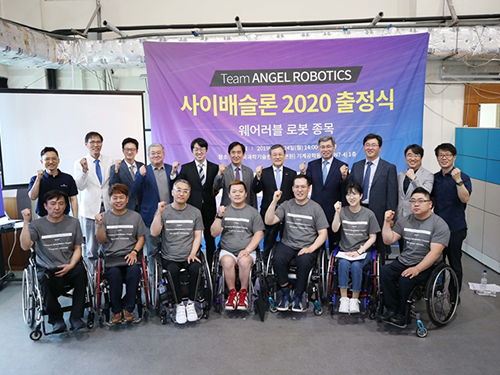
(Seven pilots and Professor Kong (fifth from left in second row) pose with guests who joined the Cybathlon 2020 kickoff ceremony. President Shin (fifth from right) made a congratulatory remarks during the ceremony.)
2019.06.25 View 42467
Wearable Robot 'WalkON Suit' Off to Cybathlon 2020
Standing upright and walking alone are very simple but noble motions that separate humans from many other creatures. Wearable and prosthetic technologies have emerged to augment human function in locomotion and manipulation. However, advances in wearable robot technology have been especially momentous to Byoung-Wook Kim, a triplegic for 22 years following a devastating car accident.
Kim rejoiced after standing upright and walking again by putting on the ‘WalkON Suit,’ the wearable robot developed by Professor Kyoungchul Kong’s team. Even more, Kim won third prize in the powered exoskeleton race at Cybathlon 2016, an international cyborg Olympics hosted by ETH Zurich.
Now Kim and Professor Kong’s team are all geared up for the Cybathlon Championship 2020. Professor Kong and his startup, Angel Robotics, held a kickoff ceremony for Cybathlon 2020 at KAIST on June 24. The 2020 championship will take place in Switzerland.
Only pilots with complete paralysis of the legs resulting from spinal cord injuries are eligible to participate in the Cybathlon, which takes place every four years. Pilots compete against each other while completing everyday tasks using technical assistance systems in six different disciplines: a brain-computer interface race, a functional electrical stimulation bike race, a powered arm prosthesis race, a powered leg prosthesis race, a powered exoskeleton race, and a powered wheelchair race. The 2016 championship drew 66 pilots from 56 teams representing 25 countries.
In the powered exoskeleton race, pilots complete everyday activities such as getting up from a sofa and overcoming obstacles such as stairs, ramps, or slopes and up to four pilots compete simultaneously on tracks to solve six tasks; and the pilot that solves the most tasks in the least amount of time wins the race.
(Kim, a triplegic for 22 years demonstrates walking and climbing the stairs (below photo) wearing the WalkOn Suit during the media day on June 21 at KAIST.)
Kim, who demonstrated walking and climbing the stairs wearing the WalkON Suit during the media day for the Cybathlon 2020 kickoff ceremony on June 21 at KAIST, said, “I have been confined to a wheelchair for more than 20 years. I am used to it so I feel like the wheelchair is one of my body parts. Actually, I don’t feel any big difficulties in doing everyday tasks in wheelchair. But whenever I face the fact that I will never be able to stand up with my own two legs again, I am so devastated.” He continued, “I still remember the day when I stood up with my own two legs by myself after 22 years. It was beyond description.”
The market for wearable robots, especially for exoskeleton robots, is continuing to grow as the aging population has been a major challenge in almost every advanced country. The global market for these robots expects to see annual growth of 41.2% to 8.3 billion US dollars by 2025. Healthcare wearable robots for the elderly and rehabilitation take up the half of the market share followed by wearable robots for industrial and defense purposes.
Professor Kong from the Department of Mechanical Engineering and his colleagues have developed two wearable robot systems in 2014: The "WalkON Suit" for complete paraplegics and “Angel Suit” for those with partial impairment in walking ability such as the elderly and rehabilitation patients.
Professor Kong said after 15 years of basic research, the team is now able to develop its own distinct technologies. He said their robots are powered by non-resistant precision drives with algorithms recognizing the user’s moving intention. Incorporated with prosthetic devices technology from the Severance Rehabilitation Hospital, their control technology has led to the production of a customizable robot suit optimized for each user’s physical condition.
The WalkON Suit, which boasts a maximum force of 250 Nm and maximum rotation speed of 45 RPM, gives the user high-energy efficiency modeled after the physiology of the human leg. It allows users to walk on flat ground and down stairs, climb up and down inclines, and sit and lie down. Currently the battery lasts five to six hours for locomotion and the approximate 25 kg of robot weight still remains a technical challenge to upgrade.
Professor Kong’s team has grafted AR glass technology into the WalkOn Suit that one of his pilots put on for the torch relay of the PyongChang Paralympics in 2018. His team is now upgrading the WalkON Suit 4.0 for next year’s competition. Severance Rehabilitation Hospital will help the seven pilots with their training.
Professor Kong said his goal is to make robots that can make people with disabilities much more independent. He stressed, “Wearable robots should be designed for each single user. We provide a very good graphical user interface so that we can design, check, and also verify our optimized design for users’ best performance.”
(Seven pilots and Professor Kong (fifth from left in second row) pose with guests who joined the Cybathlon 2020 kickoff ceremony. President Shin (fifth from right) made a congratulatory remarks during the ceremony.)
2019.06.25 View 42467 -
 On-chip Drug Screening for Identifying Antibiotic Interactions in Eight Hours
(from left: Seunggyu Kimand Professor Jessie Sungyun Jeon)
A KAIST research team developed a microfluidic-based drug screening chip that identifies synergistic interactions between two antibiotics in eight hours. This chip can be a cell-based drug screening platform for exploring critical pharmacological patterns of antibiotic interactions, along with potential applications in screening other cell-type agents and guidance for clinical therapies.
Antibiotic susceptibility testing, which determines types and doses of antibiotics that can effectively inhibit bacterial growth, has become more critical in recent years with the emergence of antibiotic-resistant pathogenic bacteria strains.
To overcome the antibiotic-resistant bacteria, combinatory therapy using two or more kinds of antibiotics has been gaining considerable attention. However, the major problem is that this therapy is not always effective; occasionally, unfavorable antibiotic pairs may worsen results, leading to suppressed antimicrobial effects. Therefore, combinatory testing is a crucial preliminary process to find suitable antibiotic pairs and their concentration range against unknown pathogens, but the conventional testing methods are inconvenient for concentration dilution and sample preparation, and they take more than 24 hours to produce the results.
To reduce time and enhance the efficiency of combinatory testing, Professor Jessie Sungyun Jeon from the Department of Mechanical Engineering, in collaboration with Professor Hyun Jung Chung from the Department of Biological Sciences, developed a high-throughput drug screening chip that generates 121 pairwise concentrations between two antibiotics.
The team utilized a microfluidic chip with a sample volume of a few tens of microliters. This chip enabled 121 pairwise concentrations of two antibiotics to be automatically formed in only 35 minutes.
They loaded a mixture of bacterial samples and agarose into the microchannel and injected reagents with or without antibiotics into the surrounding microchannel. The diffusion of antibiotic molecules from the channel with antibiotics to the one without antibiotics resulted in the formation of two orthogonal concentration gradients of the two antibiotics on the bacteria-trapping agarose gel.
The team observed the inhibition of bacterial growth by the antibiotic orthogonal gradients over six hours with a microscope, and confirmed different patterns of antibiotic pairs, classifying the interaction types into either synergy or antagonism.
Professor Jeon said, “The feasibility of microfluidic-based drug screening chips is promising, and we expect our microfluidic chip to be commercialized and utilized in near future.”
This study, led by Seunggyu Kim, was published in Lab on a Chip (10.1039/c8lc01406j) on March 21, 2019.
Figure 1. Back cover image for the “Lab on a Chip”.
Figure 2. Examples of testing results using the microfluidic chips developed in this research.
2019.04.18 View 31888
On-chip Drug Screening for Identifying Antibiotic Interactions in Eight Hours
(from left: Seunggyu Kimand Professor Jessie Sungyun Jeon)
A KAIST research team developed a microfluidic-based drug screening chip that identifies synergistic interactions between two antibiotics in eight hours. This chip can be a cell-based drug screening platform for exploring critical pharmacological patterns of antibiotic interactions, along with potential applications in screening other cell-type agents and guidance for clinical therapies.
Antibiotic susceptibility testing, which determines types and doses of antibiotics that can effectively inhibit bacterial growth, has become more critical in recent years with the emergence of antibiotic-resistant pathogenic bacteria strains.
To overcome the antibiotic-resistant bacteria, combinatory therapy using two or more kinds of antibiotics has been gaining considerable attention. However, the major problem is that this therapy is not always effective; occasionally, unfavorable antibiotic pairs may worsen results, leading to suppressed antimicrobial effects. Therefore, combinatory testing is a crucial preliminary process to find suitable antibiotic pairs and their concentration range against unknown pathogens, but the conventional testing methods are inconvenient for concentration dilution and sample preparation, and they take more than 24 hours to produce the results.
To reduce time and enhance the efficiency of combinatory testing, Professor Jessie Sungyun Jeon from the Department of Mechanical Engineering, in collaboration with Professor Hyun Jung Chung from the Department of Biological Sciences, developed a high-throughput drug screening chip that generates 121 pairwise concentrations between two antibiotics.
The team utilized a microfluidic chip with a sample volume of a few tens of microliters. This chip enabled 121 pairwise concentrations of two antibiotics to be automatically formed in only 35 minutes.
They loaded a mixture of bacterial samples and agarose into the microchannel and injected reagents with or without antibiotics into the surrounding microchannel. The diffusion of antibiotic molecules from the channel with antibiotics to the one without antibiotics resulted in the formation of two orthogonal concentration gradients of the two antibiotics on the bacteria-trapping agarose gel.
The team observed the inhibition of bacterial growth by the antibiotic orthogonal gradients over six hours with a microscope, and confirmed different patterns of antibiotic pairs, classifying the interaction types into either synergy or antagonism.
Professor Jeon said, “The feasibility of microfluidic-based drug screening chips is promising, and we expect our microfluidic chip to be commercialized and utilized in near future.”
This study, led by Seunggyu Kim, was published in Lab on a Chip (10.1039/c8lc01406j) on March 21, 2019.
Figure 1. Back cover image for the “Lab on a Chip”.
Figure 2. Examples of testing results using the microfluidic chips developed in this research.
2019.04.18 View 31888 -
 Technology to Control Near-Field Thermal Radiation
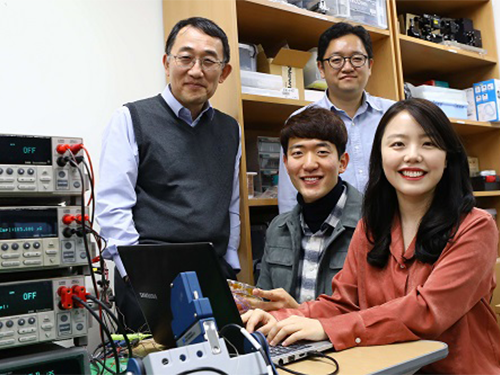
(from left clockwise: Professor Seung Seob Lee, Professor Bong Jae Lee, PhD Mikyung Lim and PhD candidate Jaeman Song)
A KAIST research team succeeded in measuring and controlling the near-field thermal radiation between metallo-dielectric (MD) multilayer structures.
Their thermal radiation control technology can be applied to next-generation semiconductor packaging, thermophotovoltaic cells and thermal management systems. It also has the potential to be applied to a sustainable energy source for IoT sensors.
In the nanoscale gaps, thermal radiation between objects increases greatly with closer distances. The amount of heat transfer in this scale was found to be from 1,000 to 10,000 times greater than the blackbody radiation heat transfer, which was once considered the theoretical maximum for the rate of thermal radiation. This phenomenon is called near-field thermal radiation. With recent developments in nanotechnology, research into near-field thermal radiation between various materials has been actively carried out.
Surface polariton coupling generated from nanostructures has been of particular interest because it enhances the amount of near-field thermal radiation between two objects, and allows the spectral control of near-field thermal radiation. This advantage has motivated much of the recent theoretical research on the application of near-field thermal radiation using nanostructures, such as thin films, multilayer nanostructures, and nanowires. Nevertheless, thus far, most of the studies have focused on measuring near-field thermal radiation between isotropic materials.
A joint team led by Professor Bong Jae Lee and Professor Seung Seob Lee from the Department of Mechanical Engineering succeeded in measuring near-field thermal radiation according to the vacuum distance between MD multilayer nanostructures by using a custom MEMS (Micro-Electro-Mechanical Systems)-device-integrated platform with three-axis nanopositioner.
MD multilayer nanostructures refer to structures in which metal and dielectric layers with regular thickness alternate. The MD single-layer pair is referred to as a unit cell, and the ratio of the thickness occupied by the metal layer in the unit cell is called the fill factor.
By measuring the near-field thermal radiation with a varying number of unit cells and the fill factor of the multilayer nanostructures, the team demonstrated that the surface plasmon polariton coupling enhances near-field thermal radiation greatly, and allows spectral control over the heat transfer.
Professor B. J. Lee said, “The isotropic materials that have so far been studied experimentally had limited spectral control over the near-field thermal radiation. Our near-field thermal radiation control technology using multilayer nanostructures is expected to become the first step toward developing various near-field thermal radiation applications.”
This research, led by PhD Mikyung Lim and PhD candidate Jaeman Song, was published in Nature Communications on October 16.
Figure 1. Experimental setup for measuring near-field thermal radiation between MD multilayers
Figure 2. Investigation of manipulated near-field heat flux by modifying the surface conditions with MD multilayers
2019.01.04 View 6956
Technology to Control Near-Field Thermal Radiation
(from left clockwise: Professor Seung Seob Lee, Professor Bong Jae Lee, PhD Mikyung Lim and PhD candidate Jaeman Song)
A KAIST research team succeeded in measuring and controlling the near-field thermal radiation between metallo-dielectric (MD) multilayer structures.
Their thermal radiation control technology can be applied to next-generation semiconductor packaging, thermophotovoltaic cells and thermal management systems. It also has the potential to be applied to a sustainable energy source for IoT sensors.
In the nanoscale gaps, thermal radiation between objects increases greatly with closer distances. The amount of heat transfer in this scale was found to be from 1,000 to 10,000 times greater than the blackbody radiation heat transfer, which was once considered the theoretical maximum for the rate of thermal radiation. This phenomenon is called near-field thermal radiation. With recent developments in nanotechnology, research into near-field thermal radiation between various materials has been actively carried out.
Surface polariton coupling generated from nanostructures has been of particular interest because it enhances the amount of near-field thermal radiation between two objects, and allows the spectral control of near-field thermal radiation. This advantage has motivated much of the recent theoretical research on the application of near-field thermal radiation using nanostructures, such as thin films, multilayer nanostructures, and nanowires. Nevertheless, thus far, most of the studies have focused on measuring near-field thermal radiation between isotropic materials.
A joint team led by Professor Bong Jae Lee and Professor Seung Seob Lee from the Department of Mechanical Engineering succeeded in measuring near-field thermal radiation according to the vacuum distance between MD multilayer nanostructures by using a custom MEMS (Micro-Electro-Mechanical Systems)-device-integrated platform with three-axis nanopositioner.
MD multilayer nanostructures refer to structures in which metal and dielectric layers with regular thickness alternate. The MD single-layer pair is referred to as a unit cell, and the ratio of the thickness occupied by the metal layer in the unit cell is called the fill factor.
By measuring the near-field thermal radiation with a varying number of unit cells and the fill factor of the multilayer nanostructures, the team demonstrated that the surface plasmon polariton coupling enhances near-field thermal radiation greatly, and allows spectral control over the heat transfer.
Professor B. J. Lee said, “The isotropic materials that have so far been studied experimentally had limited spectral control over the near-field thermal radiation. Our near-field thermal radiation control technology using multilayer nanostructures is expected to become the first step toward developing various near-field thermal radiation applications.”
This research, led by PhD Mikyung Lim and PhD candidate Jaeman Song, was published in Nature Communications on October 16.
Figure 1. Experimental setup for measuring near-field thermal radiation between MD multilayers
Figure 2. Investigation of manipulated near-field heat flux by modifying the surface conditions with MD multilayers
2019.01.04 View 6956 -
 Characteristics of Submesoscale Geophysical Turbulence Reported
A KAIST research team has reported some of unique characteristics and driving forces behind submesoscale geophysical turbulence. Using big data analysis on ocean surface currents and chlorophyll concentrations observed using coastal radars and satellites has brought better understanding of oceanic processes in space and time scales of O(1) kilometer and O(1) hour. The outcomes of this work will lead to improved tracking of water-borne materials and performance in global and regional climate prediction models.
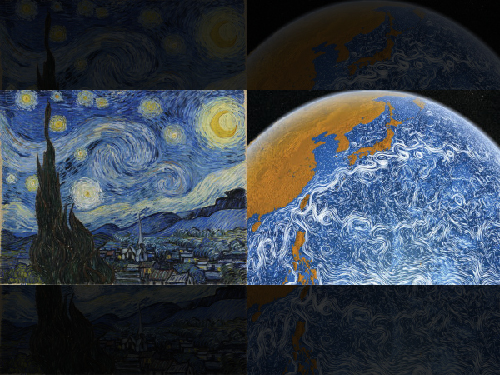
In 2012, United States National Aeronautics and Space Administration (NASA) released a movie clip called “Perpetual Oceans”, which visualized ocean circulation obtained from satellite altimeter-derived sea surface height observations over two and a half years. When the movie was released to the public, it received a great deal of attention because the circulation patterns were strikingly similar to “The Starry Night” by Vincent van Gogh.
“Perpetual Oceans” is full of vortical flow patterns describing the oceanic turbulent motions at mesoscale (a scale of 100 km or larger). Meanwhile, Professor Sung Yong Kim from the Department of Mechanical Engineering and his team focused on the study of the oceanic turbulence at sub-mesoscale (space and time scales of 1 to 100 km and hours).
Sub-mesoscale processes are important because they contribute to the vertical transport of oceanic tracers, mass, buoyancy, and nutrients and rectify both the mixed layer structure and upper ocean stratification. These process studies have been primarily based on numerical simulations because traditional in situ ocean measurements can be limited in their capability to resolve the detailed horizontal and vertical structures of these processes.
The team conducted big data analysis on hourly observations of one-year ocean surface current maps and five-year chlorophyll concentration maps, obtained from remote sensing instruments such as coastal high-frequency radars (HFRs) and geostationary ocean color imagery (GOCI) to examine the unique characteristics of oceanic submesoscale processes.
The team analyzed the slope change of the wavenumber energy spectra of the observations in terms of season and sampling directions. Through the analysis, the team proved that energy cascade (a phenomenon in which large-scale energy transfers to small-scale energy or vice-versa during the turbulent energy transit) occurs in the spatial scale of 10 km in the forward and inverse directions. This is driven by baroclinic instability as opposed to the mesoscale eddy-driven frontogenesis at the O(100) km scale based on the observed regional submesoscale circulations.
This work will contribute to the parameterization of physical phenomenon of sub-mesoscale in the field of global high-resolution modeling within ocean physics and atmospheric as well as climate change. Based on the understanding of the principle of sub-mesoscale surface circulation, practical applications can be further derived for radioactivity, oil spill recovery, and marine pollutant tracking.
Moreover, the data used in this research was based on long-term observations on sub-mesoscale surface currents and concentrations of chlorophyll, which may reflect the submesoscale processes actively generated in the subpolar front off the east coast of Korea. Hence, this study can potentially be beneficial for integrated big data analyses using high-resolution coastal radar-derived surface currents and satellite-derived products and motivate interdisciplinary research between ocean physics and biology.
This research was published as two companion papers in the Journal of Geophysical Research: Oceans on August 6, 2018. (doi:10.1002/2016JC012517; doi:10.1002/2017JC013732)
Figure 1.'The Starry Night' of Van Gogh and the 'Perpetual Ocean' created by NASA's Goddard Space Flight Center.
Figure 2. A schematic diagram of the energy cascades in forward and backward directions and the spatial scale where the energy is injected.
Figure 3. A snapshot of the chlorophyll concentration map derived from geostationary ocean color imagery (GOCI) off the east coast of Korea presenting several examples of sub-mesoscale turbulent flows.
Figure 4. Energy spectra of the HFR-derived surface currents and GOCI-derived chlorophyll concentrations and the temporal variability of spectral decay slopes in the cross-shore and along-shore directions.
2018.12.13 View 5991
Characteristics of Submesoscale Geophysical Turbulence Reported
A KAIST research team has reported some of unique characteristics and driving forces behind submesoscale geophysical turbulence. Using big data analysis on ocean surface currents and chlorophyll concentrations observed using coastal radars and satellites has brought better understanding of oceanic processes in space and time scales of O(1) kilometer and O(1) hour. The outcomes of this work will lead to improved tracking of water-borne materials and performance in global and regional climate prediction models.
In 2012, United States National Aeronautics and Space Administration (NASA) released a movie clip called “Perpetual Oceans”, which visualized ocean circulation obtained from satellite altimeter-derived sea surface height observations over two and a half years. When the movie was released to the public, it received a great deal of attention because the circulation patterns were strikingly similar to “The Starry Night” by Vincent van Gogh.
“Perpetual Oceans” is full of vortical flow patterns describing the oceanic turbulent motions at mesoscale (a scale of 100 km or larger). Meanwhile, Professor Sung Yong Kim from the Department of Mechanical Engineering and his team focused on the study of the oceanic turbulence at sub-mesoscale (space and time scales of 1 to 100 km and hours).
Sub-mesoscale processes are important because they contribute to the vertical transport of oceanic tracers, mass, buoyancy, and nutrients and rectify both the mixed layer structure and upper ocean stratification. These process studies have been primarily based on numerical simulations because traditional in situ ocean measurements can be limited in their capability to resolve the detailed horizontal and vertical structures of these processes.
The team conducted big data analysis on hourly observations of one-year ocean surface current maps and five-year chlorophyll concentration maps, obtained from remote sensing instruments such as coastal high-frequency radars (HFRs) and geostationary ocean color imagery (GOCI) to examine the unique characteristics of oceanic submesoscale processes.
The team analyzed the slope change of the wavenumber energy spectra of the observations in terms of season and sampling directions. Through the analysis, the team proved that energy cascade (a phenomenon in which large-scale energy transfers to small-scale energy or vice-versa during the turbulent energy transit) occurs in the spatial scale of 10 km in the forward and inverse directions. This is driven by baroclinic instability as opposed to the mesoscale eddy-driven frontogenesis at the O(100) km scale based on the observed regional submesoscale circulations.
This work will contribute to the parameterization of physical phenomenon of sub-mesoscale in the field of global high-resolution modeling within ocean physics and atmospheric as well as climate change. Based on the understanding of the principle of sub-mesoscale surface circulation, practical applications can be further derived for radioactivity, oil spill recovery, and marine pollutant tracking.
Moreover, the data used in this research was based on long-term observations on sub-mesoscale surface currents and concentrations of chlorophyll, which may reflect the submesoscale processes actively generated in the subpolar front off the east coast of Korea. Hence, this study can potentially be beneficial for integrated big data analyses using high-resolution coastal radar-derived surface currents and satellite-derived products and motivate interdisciplinary research between ocean physics and biology.
This research was published as two companion papers in the Journal of Geophysical Research: Oceans on August 6, 2018. (doi:10.1002/2016JC012517; doi:10.1002/2017JC013732)
Figure 1.'The Starry Night' of Van Gogh and the 'Perpetual Ocean' created by NASA's Goddard Space Flight Center.
Figure 2. A schematic diagram of the energy cascades in forward and backward directions and the spatial scale where the energy is injected.
Figure 3. A snapshot of the chlorophyll concentration map derived from geostationary ocean color imagery (GOCI) off the east coast of Korea presenting several examples of sub-mesoscale turbulent flows.
Figure 4. Energy spectra of the HFR-derived surface currents and GOCI-derived chlorophyll concentrations and the temporal variability of spectral decay slopes in the cross-shore and along-shore directions.
2018.12.13 View 5991 -
 Reducing the Drag Force of a Moving Body Underwater
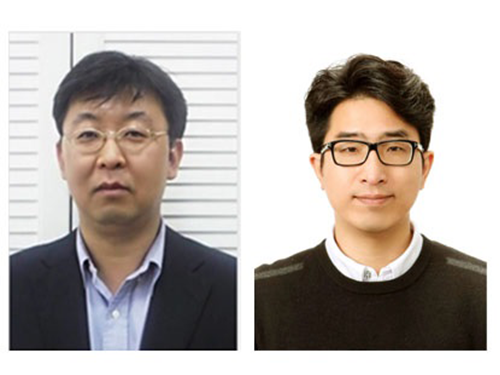
(from left: Professor Yeunwoo Cho and PhD Jaeho Chung)
Professor Yeunwoo Cho and his team from the Department of Mechanical Engineering developed new technology that reduces the drag force of a moving body in a still fluid by using the supercavitation phenomenon.
When a body moves in air, the frictional drag is lower than that of the same body moving in water. Therefore, the body that moves in water can reduce the drag significantly when it is completely enveloped in a gaseous cavity.
The team used compressed air to create so-called supercavitation, which is a phenomenon created by completely enveloping a body in a single large gaseous cavity. The drag force exerted on the body is then measured.
As a result, the team confirmed that the drag force for a moving body enveloped in air is about 25% of the drag force for a moving body without envelopment.
These results can be applied for developing high-speed underwater vehicles and the development of air-lubricated, high-speed vessels.
The team expects that the results can be applied for developing high-speed underwater vehicles and the development of air lubrication for a ship’s hull.
This research, led by PhD Jaeho Chung, was published in the Journal of Fluid Mechanics as a cover article on November 10, 2018.
Figure 1. The cover article of the Journal of Fluid Mechanics Vol. 854
2018.12.04 View 4734
Reducing the Drag Force of a Moving Body Underwater
(from left: Professor Yeunwoo Cho and PhD Jaeho Chung)
Professor Yeunwoo Cho and his team from the Department of Mechanical Engineering developed new technology that reduces the drag force of a moving body in a still fluid by using the supercavitation phenomenon.
When a body moves in air, the frictional drag is lower than that of the same body moving in water. Therefore, the body that moves in water can reduce the drag significantly when it is completely enveloped in a gaseous cavity.
The team used compressed air to create so-called supercavitation, which is a phenomenon created by completely enveloping a body in a single large gaseous cavity. The drag force exerted on the body is then measured.
As a result, the team confirmed that the drag force for a moving body enveloped in air is about 25% of the drag force for a moving body without envelopment.
These results can be applied for developing high-speed underwater vehicles and the development of air-lubricated, high-speed vessels.
The team expects that the results can be applied for developing high-speed underwater vehicles and the development of air lubrication for a ship’s hull.
This research, led by PhD Jaeho Chung, was published in the Journal of Fluid Mechanics as a cover article on November 10, 2018.
Figure 1. The cover article of the Journal of Fluid Mechanics Vol. 854
2018.12.04 View 4734 -
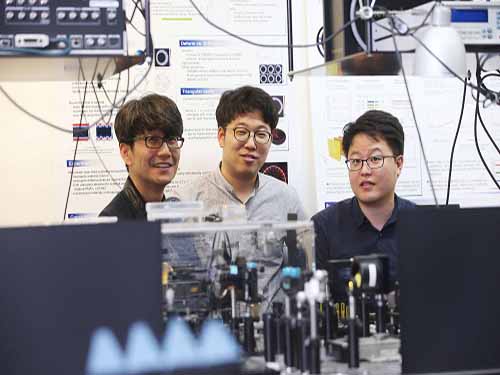 From Concept to Reality: Changing Color of Light Using a Spatiotemporal Boundary
(from left: Professor Bumki Min, PhD candidate Jaehyeon Son and PhD Kanghee Lee)
A KAIST team developed an optical technique to change the color (frequency) of light using a spatiotemporal boundary. The research focuses on realizing a spatiotemporal boundary with a much higher degree of freedom than the results of previous studies by fabricating a thin metal structure on a semiconductor surface. Such a spatiotemporal boundary is expected to be applicable to an ultra-thin film type optical device capable of changing the color of light.
The optical frequency conversion device plays a key role in precision measurement and communication technology, and the device has been developed mainly based on optical nonlinearity.
If the intensity of light is very strong, the optical medium responds nonlinearly so the nonlinear optical phenomena, such as frequency doubling or frequency mixing, can be observed. Such optical nonlinear phenomena are realized usually by the interaction between a high-intensity laser and a nonlinear medium.
As an alternative method frequency conversion is observed by temporally modifying the optical properties of the medium through which light travels using an external stimulus. Since frequency conversion in this way can be observed even in weak light, such a technique could be particularly useful in communication technology.
However, rapid optical property modification of the medium by an external stimulus and subsequent light frequency conversion techniques have been researched only in the pertubative regime, and it has been difficult to realize these theoretical results in practical applications.
To realize such a conceptual idea, Professor Bumki Min from the Department of Mechanical Engineering and his team collaborated with Professor Wonju Jeon from the Department of Mechanical Engineering and Professor Fabian Rotermund from the Department of Physics. They developed an artificial optical material (metamaterial) by arranging a metal microstructure that mimics an atomic structure and succeeded in creating a spatiotemporal boundary by changing the optical property of the artificial material abruptly.
While previous studies only slightly modified the refractive index of the medium, this study provided a spatiotemporal boundary as a platform for freely designing and changing the spectral properties of the medium. Using this, the research team developed a device that can control the frequency of light to a large degree.
The research team said a spatiotemporal boundary, which was only conceptually considered in previous research and realized in the pertubative regime, was developed as a step that can be realized and applied.
Professor Min said, “The frequency conversion of light becomes designable and predictable, so our research could be applied in many optical applications. This research will present a new direction for time-variant media research projects in the field of optics.”
This research, led by PhD Kanghee Lee and PhD candidate Jaehyeon Son, was published online in Nature Photonics on October 8, 2018.
This work was supported by the National Research Foundation of Korea (NRF) through the government of Korea. The work was also supported by the Center for Advanced Meta-Materials (CAMM) funded by the Korea Government (MSIP) as the Global Frontier Project (NRF-2014M3A6B3063709).
Figure 1. The frequency conversion process of light using a spatiotemporal boundary.
Figure 2. The complex amplitude of light at the converted frequency with the variation of a spatiotemporal boundary.
2018.11.29 View 8869
From Concept to Reality: Changing Color of Light Using a Spatiotemporal Boundary
(from left: Professor Bumki Min, PhD candidate Jaehyeon Son and PhD Kanghee Lee)
A KAIST team developed an optical technique to change the color (frequency) of light using a spatiotemporal boundary. The research focuses on realizing a spatiotemporal boundary with a much higher degree of freedom than the results of previous studies by fabricating a thin metal structure on a semiconductor surface. Such a spatiotemporal boundary is expected to be applicable to an ultra-thin film type optical device capable of changing the color of light.
The optical frequency conversion device plays a key role in precision measurement and communication technology, and the device has been developed mainly based on optical nonlinearity.
If the intensity of light is very strong, the optical medium responds nonlinearly so the nonlinear optical phenomena, such as frequency doubling or frequency mixing, can be observed. Such optical nonlinear phenomena are realized usually by the interaction between a high-intensity laser and a nonlinear medium.
As an alternative method frequency conversion is observed by temporally modifying the optical properties of the medium through which light travels using an external stimulus. Since frequency conversion in this way can be observed even in weak light, such a technique could be particularly useful in communication technology.
However, rapid optical property modification of the medium by an external stimulus and subsequent light frequency conversion techniques have been researched only in the pertubative regime, and it has been difficult to realize these theoretical results in practical applications.
To realize such a conceptual idea, Professor Bumki Min from the Department of Mechanical Engineering and his team collaborated with Professor Wonju Jeon from the Department of Mechanical Engineering and Professor Fabian Rotermund from the Department of Physics. They developed an artificial optical material (metamaterial) by arranging a metal microstructure that mimics an atomic structure and succeeded in creating a spatiotemporal boundary by changing the optical property of the artificial material abruptly.
While previous studies only slightly modified the refractive index of the medium, this study provided a spatiotemporal boundary as a platform for freely designing and changing the spectral properties of the medium. Using this, the research team developed a device that can control the frequency of light to a large degree.
The research team said a spatiotemporal boundary, which was only conceptually considered in previous research and realized in the pertubative regime, was developed as a step that can be realized and applied.
Professor Min said, “The frequency conversion of light becomes designable and predictable, so our research could be applied in many optical applications. This research will present a new direction for time-variant media research projects in the field of optics.”
This research, led by PhD Kanghee Lee and PhD candidate Jaehyeon Son, was published online in Nature Photonics on October 8, 2018.
This work was supported by the National Research Foundation of Korea (NRF) through the government of Korea. The work was also supported by the Center for Advanced Meta-Materials (CAMM) funded by the Korea Government (MSIP) as the Global Frontier Project (NRF-2014M3A6B3063709).
Figure 1. The frequency conversion process of light using a spatiotemporal boundary.
Figure 2. The complex amplitude of light at the converted frequency with the variation of a spatiotemporal boundary.
2018.11.29 View 8869 -
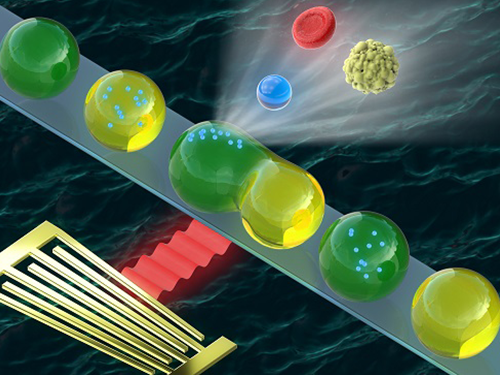 Washing and Enrichment of Micro-Particles Encapsulated in Droplets
Researchers developed microfluidic technology for the washing and enrichment of in-droplet micro-particles. They presented the technology using a microfluidic chip based on surface acoustic wave (SAW)-driven acoustic radiation force (ARF).
The team demonstrated the first instance of acoustic in-droplet micro-particle washing with a particle recovery rate of approximately 90 percent. They further extended the applicability of the proposed method to in-droplet particle enrichment with the unprecedented abilities to increase the in-droplet particle quantity and exchange the droplet dispersed phase.
This proposed method enabled on-chip, label-free, continuous, and selective in-droplet micro-particle manipulation. The team demonstrated the first instance of in-droplet micro-particle washing between two types of alternating droplets in a simple microchannel, proving that the method can increase the particle quantity, which has not been achieved by previously reported methods.
The study aimed to develop an in-droplet micro-particle washing and enrichment method based on SAW-driven ARF. When a droplet containing particles is exposed to an acoustic field, both the droplet and suspended particles experience ARF arising from inhomogeneous wave scattering at the liquid-liquid and liquid-solid interfaces. Unlike previous in-droplet particle manipulation methods, this method allows simultaneous and precise control over the droplets and suspended particles. Moreover, the proposed acoustic method does not require labelled particles, such as magnetic particles, and employs a simple microchannel geometry.
Microfluidic sample washing has emerged as an alternative to centrifugation because the limitations of centrifugation-based washing methods can be addressed using continuous washing processes. It also has considerable potential and importance in a variety of applications such as single-cell/particle assays, high-throughput screening of rare samples, and cell culture medium exchange.
Compared to continuous flow-based microfluidic methods, droplet-based microfluidic sample washing has been rarely explored due to technological difficulties. On-chip, in-droplet sample washing requires sample transfer across the droplet interface composed of two immiscible fluids. This process involves simultaneous and precise control over the encapsulated sample and droplet interface during the medium exchange of the in-droplet sample.
Sample encapsulation within individual microscale droplets offers isolated microenvironments for the samples. Experimental uncertainties due to cross-contamination and Taylor dispersion between multiple reagents can be reduced in droplet-based microfluidics.
This is the first research achievement made by the Acousto-Microfluidics Research Center for Next-Generation Healthcare, the cross-generation collaborative lab KAIST opened in May. This novel approach pairs senior and junior faculty members for sustaining the research legacy even after the senior researcher retires. The research center, which paired Chair Professor Hyung Jin Sung and Professors Hyoungsoo Kim and Yeunwoo Cho, made a breakthrough in microfluidics along with PhD candidate Jinsoo Park. The study was featured as the cover of Lab on a Chip published by Royal Society of Chemistry.
Jinsoo Park, first author of the study, believes this technology will may serve as an in-droplet sample preparation platform with in-line integration of other droplet microfluidic components. Chair Professor Sung said, “The proposed acoustic method will offer new perspectives on sample washing and enrichment by performing the operation in microscale droplets.”
Figure 1. (a) A microfluidic device for in-droplet micro-particle washing and enrichment; (b) alternatingly produced droplets of two kinds at a double T-junction; (c) a droplet and encapsulated micro-particles exposed to surface acoustic wave-driven acoustic radiation force; (d-h) sequential processes of in-droplet micro-particle washing and enrichment operation.
2018.10.19 View 8545
Washing and Enrichment of Micro-Particles Encapsulated in Droplets
Researchers developed microfluidic technology for the washing and enrichment of in-droplet micro-particles. They presented the technology using a microfluidic chip based on surface acoustic wave (SAW)-driven acoustic radiation force (ARF).
The team demonstrated the first instance of acoustic in-droplet micro-particle washing with a particle recovery rate of approximately 90 percent. They further extended the applicability of the proposed method to in-droplet particle enrichment with the unprecedented abilities to increase the in-droplet particle quantity and exchange the droplet dispersed phase.
This proposed method enabled on-chip, label-free, continuous, and selective in-droplet micro-particle manipulation. The team demonstrated the first instance of in-droplet micro-particle washing between two types of alternating droplets in a simple microchannel, proving that the method can increase the particle quantity, which has not been achieved by previously reported methods.
The study aimed to develop an in-droplet micro-particle washing and enrichment method based on SAW-driven ARF. When a droplet containing particles is exposed to an acoustic field, both the droplet and suspended particles experience ARF arising from inhomogeneous wave scattering at the liquid-liquid and liquid-solid interfaces. Unlike previous in-droplet particle manipulation methods, this method allows simultaneous and precise control over the droplets and suspended particles. Moreover, the proposed acoustic method does not require labelled particles, such as magnetic particles, and employs a simple microchannel geometry.
Microfluidic sample washing has emerged as an alternative to centrifugation because the limitations of centrifugation-based washing methods can be addressed using continuous washing processes. It also has considerable potential and importance in a variety of applications such as single-cell/particle assays, high-throughput screening of rare samples, and cell culture medium exchange.
Compared to continuous flow-based microfluidic methods, droplet-based microfluidic sample washing has been rarely explored due to technological difficulties. On-chip, in-droplet sample washing requires sample transfer across the droplet interface composed of two immiscible fluids. This process involves simultaneous and precise control over the encapsulated sample and droplet interface during the medium exchange of the in-droplet sample.
Sample encapsulation within individual microscale droplets offers isolated microenvironments for the samples. Experimental uncertainties due to cross-contamination and Taylor dispersion between multiple reagents can be reduced in droplet-based microfluidics.
This is the first research achievement made by the Acousto-Microfluidics Research Center for Next-Generation Healthcare, the cross-generation collaborative lab KAIST opened in May. This novel approach pairs senior and junior faculty members for sustaining the research legacy even after the senior researcher retires. The research center, which paired Chair Professor Hyung Jin Sung and Professors Hyoungsoo Kim and Yeunwoo Cho, made a breakthrough in microfluidics along with PhD candidate Jinsoo Park. The study was featured as the cover of Lab on a Chip published by Royal Society of Chemistry.
Jinsoo Park, first author of the study, believes this technology will may serve as an in-droplet sample preparation platform with in-line integration of other droplet microfluidic components. Chair Professor Sung said, “The proposed acoustic method will offer new perspectives on sample washing and enrichment by performing the operation in microscale droplets.”
Figure 1. (a) A microfluidic device for in-droplet micro-particle washing and enrichment; (b) alternatingly produced droplets of two kinds at a double T-junction; (c) a droplet and encapsulated micro-particles exposed to surface acoustic wave-driven acoustic radiation force; (d-h) sequential processes of in-droplet micro-particle washing and enrichment operation.
2018.10.19 View 8545 -
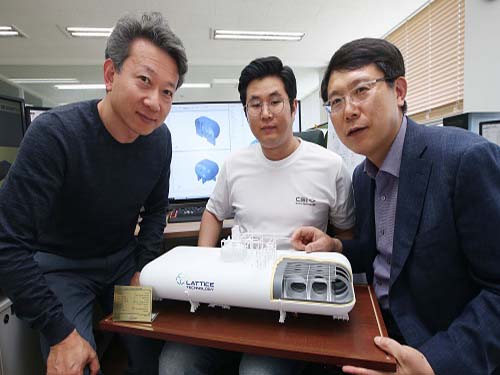 KAIST-Developed LPV to Launch in LNG-Fueled Port Cleaning Ship in Ulsan
(From left:CEO of LATTICE Technology Kun-Oh Park, research fellow Hwa-Ryong Yu, and Professor Chang )
A KAIST-developed Lattice Pressure Vessel (LPV) will launch inside a 150-ton class port cleaning ship that the Ulsan Port Authority will deploy in December. The ship will operate off the coast of Ulsan and will be the first LNG-fueled public service vessel run by the government.
LATTICE Technology, a tech-startup established in 2012 by two KAIST professors, announced last week that the company signed a contract with the Ulsan Port Authority to install the LPV into the hull of the port cleaning ship.
The company setup by Professors Daejun Chang and Pål G. Bergan in the Department of Mechanical Engineering accomplished the feat seven years after they first registered their original technology patent.
The free-shaped pressure vessel developed by the two professors is applicable to any type of ship structure, a technological breakthrough addressing the wasted installing space of the conventional pressure vessel types that either spherical or cylindrical designs would result in.
The LPV has an internal lattice structure for load carrying caused by pressure, providing 50 percent more capacity than that of a cylindrical pressure vessel.
According to Professor Chang, the essence of the LPV is an internal, modular structure that carries the load by balancing the pressure on opposite walls. He said that the LPV has a number of merits thanks to the lattice structure. While its structural redundancy improves safety, it is fully scalable in any direction as well as being able to mitigate the sloshing load, resulting in a negligible level of fatigue risk. Its modularity also cuts the production cost. The technology has already earned seven internationally authorized certificates, and the company has already built four prototype tanks.
The LPV has significant market potential in the energy storage industry, especially transportation sectors. One imminent application is LNG fuel storage on ships. This cryogenic fuel is expected to replace the conventional marine fuel or heavy fuel oil that is the source of a number of polluting emissions (SOx, NOx, CO2, and particle matters).
This LPV technology will contribute to the efficient storage LNG in volume. As liquid hydrogen increasingly emerges to decarbonate the energy mix, the storage and transportation of liquid hydrogen will be also a critical issue. The researchers expect that this LPV technology will be further applied into the entire supply chain of various fields including production, transportation, storage, and utilization of such decarbonated energy sources.
Professor Chang said, “Pressure vessels are one of the most common devices for storing materials and energy. The areas for which the LPV can create value will expand into various industrial sectors.”
The research team plans to conduct further research and development to realize various LPV applications to store LNG, LPG, liquid hydrogen, carbon dioxide, and steam for ships, land facilities, vehicles, trains, and automobiles.
Figure 1: The internal strucutre of a lattice pressure vessel. The middle part of the tank is repetition of a modular lattice strucutre while the end part is specially designed.
Figure 2: Lattice pressure vessels in shapes and sizes. Unlike conventional cylinders, the lattice pressure vessel can freely assume different shapes and be scaled up through the repetition of modular internal units.
Figure 3: A cylinder tank of 24 m3 and a lattice pressure vessel of 22 m3. They are similar in volume but show a big difference in installation space.
Figure 4: LNF-fueld cruised ships with six cylinders and one lattice pressure vessel. Thanks to its high-volume efficiency, the lattice pressure vessel doubles the stroage volume with one sixth of the piping, instruments, and operational complexity.
2018.05.30 View 8538
KAIST-Developed LPV to Launch in LNG-Fueled Port Cleaning Ship in Ulsan
(From left:CEO of LATTICE Technology Kun-Oh Park, research fellow Hwa-Ryong Yu, and Professor Chang )
A KAIST-developed Lattice Pressure Vessel (LPV) will launch inside a 150-ton class port cleaning ship that the Ulsan Port Authority will deploy in December. The ship will operate off the coast of Ulsan and will be the first LNG-fueled public service vessel run by the government.
LATTICE Technology, a tech-startup established in 2012 by two KAIST professors, announced last week that the company signed a contract with the Ulsan Port Authority to install the LPV into the hull of the port cleaning ship.
The company setup by Professors Daejun Chang and Pål G. Bergan in the Department of Mechanical Engineering accomplished the feat seven years after they first registered their original technology patent.
The free-shaped pressure vessel developed by the two professors is applicable to any type of ship structure, a technological breakthrough addressing the wasted installing space of the conventional pressure vessel types that either spherical or cylindrical designs would result in.
The LPV has an internal lattice structure for load carrying caused by pressure, providing 50 percent more capacity than that of a cylindrical pressure vessel.
According to Professor Chang, the essence of the LPV is an internal, modular structure that carries the load by balancing the pressure on opposite walls. He said that the LPV has a number of merits thanks to the lattice structure. While its structural redundancy improves safety, it is fully scalable in any direction as well as being able to mitigate the sloshing load, resulting in a negligible level of fatigue risk. Its modularity also cuts the production cost. The technology has already earned seven internationally authorized certificates, and the company has already built four prototype tanks.
The LPV has significant market potential in the energy storage industry, especially transportation sectors. One imminent application is LNG fuel storage on ships. This cryogenic fuel is expected to replace the conventional marine fuel or heavy fuel oil that is the source of a number of polluting emissions (SOx, NOx, CO2, and particle matters).
This LPV technology will contribute to the efficient storage LNG in volume. As liquid hydrogen increasingly emerges to decarbonate the energy mix, the storage and transportation of liquid hydrogen will be also a critical issue. The researchers expect that this LPV technology will be further applied into the entire supply chain of various fields including production, transportation, storage, and utilization of such decarbonated energy sources.
Professor Chang said, “Pressure vessels are one of the most common devices for storing materials and energy. The areas for which the LPV can create value will expand into various industrial sectors.”
The research team plans to conduct further research and development to realize various LPV applications to store LNG, LPG, liquid hydrogen, carbon dioxide, and steam for ships, land facilities, vehicles, trains, and automobiles.
Figure 1: The internal strucutre of a lattice pressure vessel. The middle part of the tank is repetition of a modular lattice strucutre while the end part is specially designed.
Figure 2: Lattice pressure vessels in shapes and sizes. Unlike conventional cylinders, the lattice pressure vessel can freely assume different shapes and be scaled up through the repetition of modular internal units.
Figure 3: A cylinder tank of 24 m3 and a lattice pressure vessel of 22 m3. They are similar in volume but show a big difference in installation space.
Figure 4: LNF-fueld cruised ships with six cylinders and one lattice pressure vessel. Thanks to its high-volume efficiency, the lattice pressure vessel doubles the stroage volume with one sixth of the piping, instruments, and operational complexity.
2018.05.30 View 8538 -
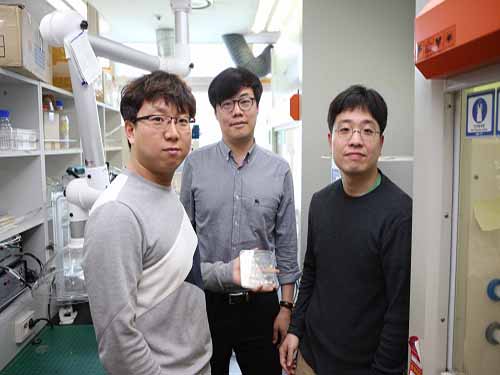 A High-Performance and Cost Effective Hydrogen Sensor
(Research team of Professor Park, Professor Jung, and research fellow Gao Min)
A KAIST research team reported a high-performance and cost effective hydrogen sensor using novel fabrication process based on the combination of polystyrene nanosphere lithography and semiconductor microfabrication processes.
The research team, led by Professor Inkyu Park in the Department of Mechanical Engineering and Professor Yeon Sik Jung in the Department of Materials Science and Engineering, fabricated a nanostructured high-performance hydrogen gas sensor based on a palladium-decorated silicon nanomesh structure made using a polystyrene nanosphere self-assembly method. Their study was featured as the front cover article of journal “Small” (Publisher: Wiley-VCH) on March 8, 2018.
The nanosphere lithography method utilizes the self-assembly of a nanosphere monolayer. This could be an alternative choice for achieving uniform and well-ordered nanopatterns with minimum sub-10 nanometer dimensions. The research team said that the small dimensions of the silicon enhanced the palladium-gating effect and thus dramatically improved the sensitivity.
Hydrogen gas is widely considered to be one of the most promising next-generation energy resources. Also, it is a very important material for various industrial applications such as hydrogen-cooled systems, petroleum refinement, and metallurgical processes. However, hydrogen, which is highly flammable, is colorless and odorless and thus difficult to detect with human senses. Therefore, developing hydrogen gas sensors with high sensitivity, fast response, high selectivity, and good stability is of significant importance for the rising hydrogen economy.
Silicon nanowire-based devices have been employed as efficient components in high-performance sensors for detecting gases and other chemical and biological components. Since the nanowires have a high surface-to-volume ratio, they respond more sensitively to the surrounding environment.
The research team’s gas sensor shows dramatically improved hydrogen gas sensitivity compared with a silicon thin film sensor without nanopatterns. Furthermore, a buffered oxide etchant (BOE) treatment of the silicon nanomesh structure results in an additional performance improvement through suspension of nanomesh strutures from the substrate and surface roughening. The sensor device shows a fast hydrogen response (response time < 5 seconds) and 10 times higher selectivity to hydrogen gas among other gases. Their sensing performance is stable and shows repeatable responses in both dry and high-humidity ambient environments.
Professor Park said that his approach will be very useful for the fabrication of low-cost, high-performance sensors for chemical and biological detection with applications to mobile and wearable devices in the coming era of internet of things (IoTs).
(Figure 1: The front cover image of Small dated on March 8.)
(Figure 2: Gas sensor responses upon the exposure to H2 at various concentrations.)
2018.05.21 View 9924
A High-Performance and Cost Effective Hydrogen Sensor
(Research team of Professor Park, Professor Jung, and research fellow Gao Min)
A KAIST research team reported a high-performance and cost effective hydrogen sensor using novel fabrication process based on the combination of polystyrene nanosphere lithography and semiconductor microfabrication processes.
The research team, led by Professor Inkyu Park in the Department of Mechanical Engineering and Professor Yeon Sik Jung in the Department of Materials Science and Engineering, fabricated a nanostructured high-performance hydrogen gas sensor based on a palladium-decorated silicon nanomesh structure made using a polystyrene nanosphere self-assembly method. Their study was featured as the front cover article of journal “Small” (Publisher: Wiley-VCH) on March 8, 2018.
The nanosphere lithography method utilizes the self-assembly of a nanosphere monolayer. This could be an alternative choice for achieving uniform and well-ordered nanopatterns with minimum sub-10 nanometer dimensions. The research team said that the small dimensions of the silicon enhanced the palladium-gating effect and thus dramatically improved the sensitivity.
Hydrogen gas is widely considered to be one of the most promising next-generation energy resources. Also, it is a very important material for various industrial applications such as hydrogen-cooled systems, petroleum refinement, and metallurgical processes. However, hydrogen, which is highly flammable, is colorless and odorless and thus difficult to detect with human senses. Therefore, developing hydrogen gas sensors with high sensitivity, fast response, high selectivity, and good stability is of significant importance for the rising hydrogen economy.
Silicon nanowire-based devices have been employed as efficient components in high-performance sensors for detecting gases and other chemical and biological components. Since the nanowires have a high surface-to-volume ratio, they respond more sensitively to the surrounding environment.
The research team’s gas sensor shows dramatically improved hydrogen gas sensitivity compared with a silicon thin film sensor without nanopatterns. Furthermore, a buffered oxide etchant (BOE) treatment of the silicon nanomesh structure results in an additional performance improvement through suspension of nanomesh strutures from the substrate and surface roughening. The sensor device shows a fast hydrogen response (response time < 5 seconds) and 10 times higher selectivity to hydrogen gas among other gases. Their sensing performance is stable and shows repeatable responses in both dry and high-humidity ambient environments.
Professor Park said that his approach will be very useful for the fabrication of low-cost, high-performance sensors for chemical and biological detection with applications to mobile and wearable devices in the coming era of internet of things (IoTs).
(Figure 1: The front cover image of Small dated on March 8.)
(Figure 2: Gas sensor responses upon the exposure to H2 at various concentrations.)
2018.05.21 View 9924 -
 Easier Way to Produce High Performing, Flexible Micro-Supercapacitor
(Professor Minyang Yang and PhD Student Jae Hak Lee)
Professor Minyang Yang from the Department of Mechanical Engineering and his team developed a high-energy, flexible micro-supercapacitor in a simple and cost-effective way.
Compared to conventional micro-batteries, such as lithium-ion batteries, these new batteries, also called supercapacitors, are significantly faster to charge and semi-permanent.
Thin, flexible micro-supercapacitors can be a power source directly attached to wearable and flexible electronics.
However, fabrication of these micro-supercapacitors requires a complex patterning process, such as lithography techniques and vacuum evaporation. Hence, the process requires expensive instruments and toxic chemicals.
To simplify the fabrication of micro-supercapacitors in an eco-friendly manner, the team developed laser growth sintering technology. This technology manufactures superporous silver electrodes and applies them to the supercapacitors’ electrodes.
The team used a laser to form micro-patterns and generated nanoporous structures inside. This laser-induced growth sintering contributed to shortening the manufacturing process from ten steps to one.
Moreover, the team explored this unique laser growth sintering process –nucleation, growth, and sintering –by employing a particle-free, organometallic solution, which is not costly compared to typical laser-sintering methods for metallic nanoparticle solutions used in the printing of micro-electrodes.
Finally, unlike the typical supercapacitors comprised of a single substance, the team applied an asymmetric electrode configuration of nanoporous gold and manganese dioxide, which exhibits a highly-specific capacitance, to operate at a high voltage.
This method allows the team to develop energy storage with a high capacity. This developed micro-supercapacitor only requires four seconds to be charged and passed more than 5,000 durability tests.
Professor Yang said, “This research outcome can be used as energy storage installed in wearable and flexible electronic devices. Through this research, we are one step closer to realizing a complete version of flexible electronic devices by incorporating a power supply.”
This research, led by PhD candidate Jae Hak Lee, was selected as the cover of Journal of Materials Chemistry A on December 21, 2017.
Figure 1. Cover of the Journal Materials Chemistry A
Figure 2. Manufactured micro-supercapacitor and its performance
Figure 3. Laser growth sintering mechanism
Figure 4. Structural change of the silver conductor according to the irradiated laser energy
2018.01.18 View 8618
Easier Way to Produce High Performing, Flexible Micro-Supercapacitor
(Professor Minyang Yang and PhD Student Jae Hak Lee)
Professor Minyang Yang from the Department of Mechanical Engineering and his team developed a high-energy, flexible micro-supercapacitor in a simple and cost-effective way.
Compared to conventional micro-batteries, such as lithium-ion batteries, these new batteries, also called supercapacitors, are significantly faster to charge and semi-permanent.
Thin, flexible micro-supercapacitors can be a power source directly attached to wearable and flexible electronics.
However, fabrication of these micro-supercapacitors requires a complex patterning process, such as lithography techniques and vacuum evaporation. Hence, the process requires expensive instruments and toxic chemicals.
To simplify the fabrication of micro-supercapacitors in an eco-friendly manner, the team developed laser growth sintering technology. This technology manufactures superporous silver electrodes and applies them to the supercapacitors’ electrodes.
The team used a laser to form micro-patterns and generated nanoporous structures inside. This laser-induced growth sintering contributed to shortening the manufacturing process from ten steps to one.
Moreover, the team explored this unique laser growth sintering process –nucleation, growth, and sintering –by employing a particle-free, organometallic solution, which is not costly compared to typical laser-sintering methods for metallic nanoparticle solutions used in the printing of micro-electrodes.
Finally, unlike the typical supercapacitors comprised of a single substance, the team applied an asymmetric electrode configuration of nanoporous gold and manganese dioxide, which exhibits a highly-specific capacitance, to operate at a high voltage.
This method allows the team to develop energy storage with a high capacity. This developed micro-supercapacitor only requires four seconds to be charged and passed more than 5,000 durability tests.
Professor Yang said, “This research outcome can be used as energy storage installed in wearable and flexible electronic devices. Through this research, we are one step closer to realizing a complete version of flexible electronic devices by incorporating a power supply.”
This research, led by PhD candidate Jae Hak Lee, was selected as the cover of Journal of Materials Chemistry A on December 21, 2017.
Figure 1. Cover of the Journal Materials Chemistry A
Figure 2. Manufactured micro-supercapacitor and its performance
Figure 3. Laser growth sintering mechanism
Figure 4. Structural change of the silver conductor according to the irradiated laser energy
2018.01.18 View 8618 -
 Hubo Completes New Mission at the Winter Olympic Torch Relay
KAIST-born humanoid robot, Hubo, completed its special new mission: carrying the Olympic torch. The Winter Olympics will be held in PyeongChang for two weeks beginning February 9.
On December 11, the final leg of the torch relay in Daejeon for the PyeongChang Olympics 2018 took place inside KAIST. A city known for science and technology hosted special torch relay runners over three days.
Hubo arrived at the campus with Dr. Dennis Hong, a professor from the University of California at Los Angeles, in an autonomous vehicle. Then, Hubo received the flame from Professor Hong. Hubo, a robot developed by Professor Jun Ho Oh from the Department of Mechanical Engineering at KAIST, is best known for being the winner of the DARPA Robotics Challenge in 2015.
Hubo successfully completed its Olympic mission. That is, it had to drill through a wall to deliver the torch to the next runner. After completing the mission successfully, the torch was passed to Professor Oh. He ran a few steps and handed it over to the last runner of the Daejeon leg.
The last runner was Jung Jae Lee, who is a winning team member of the Samsung Junior Software Cup. Lee also had the honor of riding and controlling FX-2 which is another robot developed by Professor Oh for this peace torch relay. FX-2 took a few steps to finalize the relay.
Lee said, “I would like to become an expert in security. As I was riding the robot, I felt every step I took was one step closer to achieving of making major developments in the field of security.
Professor Oh said, “It is meaningful to see humans and robots cooperating with each other to carry out the torch relay.”
The torch relay, participated in by both humans and robots in Daejeon, was successfully completed and the torch headed off to Boryeong, Chungcheongnam-do.
2017.12.12 View 11653
Hubo Completes New Mission at the Winter Olympic Torch Relay
KAIST-born humanoid robot, Hubo, completed its special new mission: carrying the Olympic torch. The Winter Olympics will be held in PyeongChang for two weeks beginning February 9.
On December 11, the final leg of the torch relay in Daejeon for the PyeongChang Olympics 2018 took place inside KAIST. A city known for science and technology hosted special torch relay runners over three days.
Hubo arrived at the campus with Dr. Dennis Hong, a professor from the University of California at Los Angeles, in an autonomous vehicle. Then, Hubo received the flame from Professor Hong. Hubo, a robot developed by Professor Jun Ho Oh from the Department of Mechanical Engineering at KAIST, is best known for being the winner of the DARPA Robotics Challenge in 2015.
Hubo successfully completed its Olympic mission. That is, it had to drill through a wall to deliver the torch to the next runner. After completing the mission successfully, the torch was passed to Professor Oh. He ran a few steps and handed it over to the last runner of the Daejeon leg.
The last runner was Jung Jae Lee, who is a winning team member of the Samsung Junior Software Cup. Lee also had the honor of riding and controlling FX-2 which is another robot developed by Professor Oh for this peace torch relay. FX-2 took a few steps to finalize the relay.
Lee said, “I would like to become an expert in security. As I was riding the robot, I felt every step I took was one step closer to achieving of making major developments in the field of security.
Professor Oh said, “It is meaningful to see humans and robots cooperating with each other to carry out the torch relay.”
The torch relay, participated in by both humans and robots in Daejeon, was successfully completed and the torch headed off to Boryeong, Chungcheongnam-do.
2017.12.12 View 11653