Campus/People
-
 A Team of Three PhD Candidates Wins the Korea Semiconductor Design Contest
“We felt a sense of responsibility to help the nation advance its semiconductor design technology”
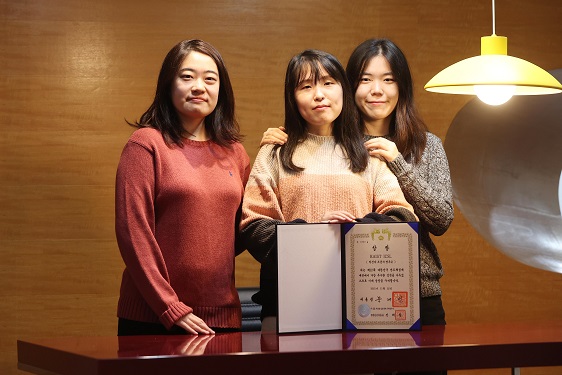
A CMOS (complementary metal-oxide semiconductor)-based “ultra-low noise signal chip” for 6G communications designed by three PhD candidates at the KAIST School of Electrical Engineering won the Presidential Award at the 22nd Korea Semiconductor Design Contest.
The winners are PhD candidates Sun-Eui Park, Yoon-Seo Cho, and Ju-Eun Bang from the Integrated Circuits and System Lab run by Professor Jaehyouk Choi. The contest, which is hosted by the Ministry of Trade, Industry and Energy and the Korea Semiconductors Industry Association, is one of the top national semiconductor design contests for college students.
Park said the team felt a sense of responsibility to help advance semiconductor design technology in Korea when deciding to participate the contest. The team expressed deep gratitude to Professor Choi for guiding their research on 6G communications.
“Our colleagues from other labs and seniors who already graduated helped us a great deal, so we owe them a lot,” explained Park. Cho added that their hard work finally got recognized and that acknowledgement pushes her to move forward with her research. Meanwhile, Bang said she is delighted to see that many people seem to be interested in her research topic.
Research for 6G is attempting to reach 1 tera bps (Tbps), 50 times faster than 5G communications with transmission speeds of up to 20 gigabytes. In general, the wider the communication frequency band, the higher the data transmission speed. Thus, the use of frequency bands above 100 gigahertz is essential for delivering high data transmission speeds for 6G communications.
However, it remains a big challenge to make a precise benchmark signal that can be used as a carrier wave in a high frequency band. Despite the advantages of CMOS’s ultra-small and low-power design, it still has limitations at high frequency bands and its operating frequency. Thus, it was difficult to achieve a frequency band above 100 gigahertz.
To overcome these challenges, the three students introduced ultra-low noise signal generation technology that can support high-order modulation technologies. This technology is expected to contribute to increasing the price competitiveness and density of 6G communication chips that will be used in the future.
5G just got started in 2020 and still has long way to go for full commercialization. Nevertheless, many researchers have started preparing for 6G technology, targeting 2030 since a new cellular communication appears in every other decade.
Professor Choi said, “Generating ultra-high frequency signals in bands above 100 GHz with highly accurate timing is one of the key technologies for implementing 6G communication hardware. Our research is significant for the development of the world’s first semiconductor chip that will use the CMOS process to achieve noise performance of less than 80fs in a frequency band above 100 GHz.”
The team members plan to work as circuit designers in Korean semiconductor companies after graduation. “We will continue to research the development of signal generators on the topic of award-winning 6G. We would like to continue our research on high-speed circuit designs such as ultra-fast analog-to-digital converters,” Park added.
2021.11.30 View 5354
A Team of Three PhD Candidates Wins the Korea Semiconductor Design Contest
“We felt a sense of responsibility to help the nation advance its semiconductor design technology”
A CMOS (complementary metal-oxide semiconductor)-based “ultra-low noise signal chip” for 6G communications designed by three PhD candidates at the KAIST School of Electrical Engineering won the Presidential Award at the 22nd Korea Semiconductor Design Contest.
The winners are PhD candidates Sun-Eui Park, Yoon-Seo Cho, and Ju-Eun Bang from the Integrated Circuits and System Lab run by Professor Jaehyouk Choi. The contest, which is hosted by the Ministry of Trade, Industry and Energy and the Korea Semiconductors Industry Association, is one of the top national semiconductor design contests for college students.
Park said the team felt a sense of responsibility to help advance semiconductor design technology in Korea when deciding to participate the contest. The team expressed deep gratitude to Professor Choi for guiding their research on 6G communications.
“Our colleagues from other labs and seniors who already graduated helped us a great deal, so we owe them a lot,” explained Park. Cho added that their hard work finally got recognized and that acknowledgement pushes her to move forward with her research. Meanwhile, Bang said she is delighted to see that many people seem to be interested in her research topic.
Research for 6G is attempting to reach 1 tera bps (Tbps), 50 times faster than 5G communications with transmission speeds of up to 20 gigabytes. In general, the wider the communication frequency band, the higher the data transmission speed. Thus, the use of frequency bands above 100 gigahertz is essential for delivering high data transmission speeds for 6G communications.
However, it remains a big challenge to make a precise benchmark signal that can be used as a carrier wave in a high frequency band. Despite the advantages of CMOS’s ultra-small and low-power design, it still has limitations at high frequency bands and its operating frequency. Thus, it was difficult to achieve a frequency band above 100 gigahertz.
To overcome these challenges, the three students introduced ultra-low noise signal generation technology that can support high-order modulation technologies. This technology is expected to contribute to increasing the price competitiveness and density of 6G communication chips that will be used in the future.
5G just got started in 2020 and still has long way to go for full commercialization. Nevertheless, many researchers have started preparing for 6G technology, targeting 2030 since a new cellular communication appears in every other decade.
Professor Choi said, “Generating ultra-high frequency signals in bands above 100 GHz with highly accurate timing is one of the key technologies for implementing 6G communication hardware. Our research is significant for the development of the world’s first semiconductor chip that will use the CMOS process to achieve noise performance of less than 80fs in a frequency band above 100 GHz.”
The team members plan to work as circuit designers in Korean semiconductor companies after graduation. “We will continue to research the development of signal generators on the topic of award-winning 6G. We would like to continue our research on high-speed circuit designs such as ultra-fast analog-to-digital converters,” Park added.
2021.11.30 View 5354 -
 Renault 5 EV and Canoo’s Pickup Truck Win the 2021 FMOTY Awards
KAIST Future Mobility of the Year Awards recognize the most innovative concept cars of the year
The Renault 5 EV from France and a pickup truck from the US startup Canoo won the 2021 Future Mobility of the Year Awards (FMOTY) hosted by the Cho Chun Shik Graduate School of Green Transportation at KAIST. The awards ceremony was held at Renault Samsung Motors in Seoul on November 25.
KAIST began the FMOTY in 2019 to advance future car technology and stimulate growth in the industry. The award recognizes the most innovative ideas for making the most futuristic concept car and improving the technological and social value of the industry.
The awards ceremony was attended by KAIST President Kwang Hyung Lee, the dean of the Cho Chun Shik Graduate School of Green Transportation In Gwun Jang, CEO of Renault Samsung Motors Dominique Signora, and CEO of Canoo Tony Aquila. President Lee said, “The new world order will be impacted by new technology developers who envision the future. Their innovation and creative ideas will open a new world of sustainable future transportation.”
Out of the 46 concept cars revealed at global motor exhibitions between last year and the first quarter of this year, models demonstrating transport technology useful for future society and innovative service were selected in the categories of passenger cars and commercial vehicles.
Sixteen automotive journalists from 11 countries, including the chief editor of Car Magazine in Germany Georg Kacher and editorial director of BBC Top Gear Charlie Turner, participated as judges.
This year’s award for the best concept car for a passenger vehicle went to an electric vehicle, the Renault 5 EV. The compact electric car was highly regarded for its practicality and environmental friendliness. A pickup truck by Canoo, an American EV manufacturing start-up, won the award in the commercial vehicle category. The pickup features an innovative design allowing for a variety of functions topped with a competitive price and it received overwhelming support from the judges.
While Hyundai Motors swept both prizes at the awards last year and demonstrated the potential of Korean concept cars, Canoo’s win in the commercial vehicle section as a young American venture company brought attention to the changing dynamics in the automotive market. This shows that young EV start-ups can compete with existing car companies as the automotive paradigm is shifting from those with internal combustion engines to EVs.
The awards organizers said that the Cho Chun Shik Graduate School of Green Transportation will continue to hold the FMOTY to lead the fast-changing global mobility market. For more information, please visit www.fmoty.org.
2021.11.26 View 4478
Renault 5 EV and Canoo’s Pickup Truck Win the 2021 FMOTY Awards
KAIST Future Mobility of the Year Awards recognize the most innovative concept cars of the year
The Renault 5 EV from France and a pickup truck from the US startup Canoo won the 2021 Future Mobility of the Year Awards (FMOTY) hosted by the Cho Chun Shik Graduate School of Green Transportation at KAIST. The awards ceremony was held at Renault Samsung Motors in Seoul on November 25.
KAIST began the FMOTY in 2019 to advance future car technology and stimulate growth in the industry. The award recognizes the most innovative ideas for making the most futuristic concept car and improving the technological and social value of the industry.
The awards ceremony was attended by KAIST President Kwang Hyung Lee, the dean of the Cho Chun Shik Graduate School of Green Transportation In Gwun Jang, CEO of Renault Samsung Motors Dominique Signora, and CEO of Canoo Tony Aquila. President Lee said, “The new world order will be impacted by new technology developers who envision the future. Their innovation and creative ideas will open a new world of sustainable future transportation.”
Out of the 46 concept cars revealed at global motor exhibitions between last year and the first quarter of this year, models demonstrating transport technology useful for future society and innovative service were selected in the categories of passenger cars and commercial vehicles.
Sixteen automotive journalists from 11 countries, including the chief editor of Car Magazine in Germany Georg Kacher and editorial director of BBC Top Gear Charlie Turner, participated as judges.
This year’s award for the best concept car for a passenger vehicle went to an electric vehicle, the Renault 5 EV. The compact electric car was highly regarded for its practicality and environmental friendliness. A pickup truck by Canoo, an American EV manufacturing start-up, won the award in the commercial vehicle category. The pickup features an innovative design allowing for a variety of functions topped with a competitive price and it received overwhelming support from the judges.
While Hyundai Motors swept both prizes at the awards last year and demonstrated the potential of Korean concept cars, Canoo’s win in the commercial vehicle section as a young American venture company brought attention to the changing dynamics in the automotive market. This shows that young EV start-ups can compete with existing car companies as the automotive paradigm is shifting from those with internal combustion engines to EVs.
The awards organizers said that the Cho Chun Shik Graduate School of Green Transportation will continue to hold the FMOTY to lead the fast-changing global mobility market. For more information, please visit www.fmoty.org.
2021.11.26 View 4478 -
 Professor Sung-Ju Lee’s Team Wins the Best Paper and the Methods Recognition Awards at the ACM CSCW
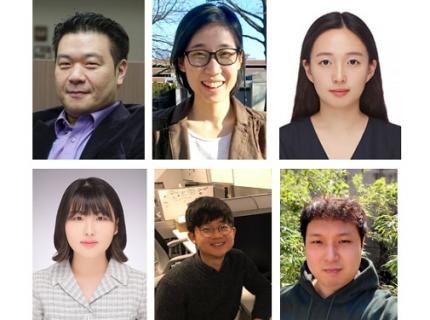
A research team led by Professor Sung-Ju Lee at the School of Electrical Engineering won the Best Paper Award and the Methods Recognition Award from ACM CSCW (International Conference on Computer-Supported Cooperative Work and Social Computing) 2021 for their paper “Reflect, not Regret: Understanding Regretful Smartphone Use with App Feature-Level Analysis”.
Founded in 1986, CSCW has been a premier conference on HCI (Human Computer Interaction) and Social Computing. This year, 340 full papers were presented and the best paper awards are given to the top 1% papers of the submitted. Methods Recognition, which is a new award, is given “for strong examples of work that includes well developed, explained, or implemented methods, and methodological innovation.”
Hyunsung Cho (KAIST alumus and currently a PhD candidate at Carnegie Mellon University), Daeun Choi (KAIST undergraduate researcher), Donghwi Kim (KAIST PhD Candidate), Wan Ju Kang (KAIST PhD Candidate), and Professor Eun Kyoung Choe (University of Maryland and KAIST alumna) collaborated on this research.
The authors developed a tool that tracks and analyzes which features of a mobile app (e.g., Instagram’s following post, following story, recommended post, post upload, direct messaging, etc.) are in use based on a smartphone’s User Interface (UI) layout. Utilizing this novel method, the authors revealed which feature usage patterns result in regretful smartphone use.
Professor Lee said, “Although many people enjoy the benefits of smartphones, issues have emerged from the overuse of smartphones. With this feature level analysis, users can reflect on their smartphone usage based on finer grained analysis and this could contribute to digital wellbeing.”
2021.11.22 View 4316
Professor Sung-Ju Lee’s Team Wins the Best Paper and the Methods Recognition Awards at the ACM CSCW
A research team led by Professor Sung-Ju Lee at the School of Electrical Engineering won the Best Paper Award and the Methods Recognition Award from ACM CSCW (International Conference on Computer-Supported Cooperative Work and Social Computing) 2021 for their paper “Reflect, not Regret: Understanding Regretful Smartphone Use with App Feature-Level Analysis”.
Founded in 1986, CSCW has been a premier conference on HCI (Human Computer Interaction) and Social Computing. This year, 340 full papers were presented and the best paper awards are given to the top 1% papers of the submitted. Methods Recognition, which is a new award, is given “for strong examples of work that includes well developed, explained, or implemented methods, and methodological innovation.”
Hyunsung Cho (KAIST alumus and currently a PhD candidate at Carnegie Mellon University), Daeun Choi (KAIST undergraduate researcher), Donghwi Kim (KAIST PhD Candidate), Wan Ju Kang (KAIST PhD Candidate), and Professor Eun Kyoung Choe (University of Maryland and KAIST alumna) collaborated on this research.
The authors developed a tool that tracks and analyzes which features of a mobile app (e.g., Instagram’s following post, following story, recommended post, post upload, direct messaging, etc.) are in use based on a smartphone’s User Interface (UI) layout. Utilizing this novel method, the authors revealed which feature usage patterns result in regretful smartphone use.
Professor Lee said, “Although many people enjoy the benefits of smartphones, issues have emerged from the overuse of smartphones. With this feature level analysis, users can reflect on their smartphone usage based on finer grained analysis and this could contribute to digital wellbeing.”
2021.11.22 View 4316 -
 Marien Buissonniere Awarded the 9th Grand Award for Future Strategy
Global healthcare and humanitarian activist honored by the Grand Award for Future Strategy
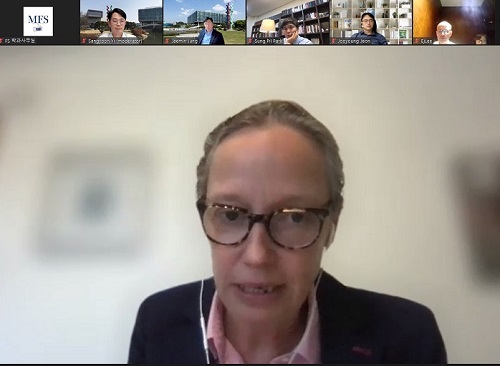
The Moon Soul Graduate School of Future Strategy awarded the 9th Grand Award for Future Strategy to Marine Buissonniere, an independent advisor and practitioner in the fields of global health and humanitarian action. She currently works as a senior advisor to the Prevent Epidemics team at Resolve to Save Lives. She also co-chairs Doctors Without Borders’ Transformational Investment Capacity.
Buissonniere was recognized for designing and implementing global response strategies in global strife and disaster stricken areas over the 25 years while serving as secretary general of Doctors Without Borders. She has been working with various government agencies around the world including Resolve to Save Lives to respond to the Covid-19 pandemic and preparing global future strategies for the post-pandemic era.
The Grand Award for Future Strategy recognizes individual and organization who have contributed to the nation and humanity through future research and strategies in the fields of science and technology, economy and industry, society and culture, politics and governance, and resources and environment.
The selection committee place particular emphasis on her humanitarian efforts toward North Korea. She was in charge of the task force for resuming the health project in North Korea and facilitated the North Korean program in 2002. She also played a significant role in raising awareness of North Korea’s humanitarian issues in the international community by lecturing at Columbia and Princeton.
Buissonniere said during the awards ceremony held online on November 5, “I am very grateful to receive this award from KAIST, a world’s top-flight university as well as from South Korea related to the Korean Peninsula and North Korea, where I have spent most of my life. What makes this award even more special is it is about the international medical relief activities and system innovations that I’ve devoted my life to over the last 25 years. I am going to continue this journey to help many people in difficult situations. Eventually, I would like to make it possible for those people in need to make their own future by themselves.”
2021.11.11 View 3950
Marien Buissonniere Awarded the 9th Grand Award for Future Strategy
Global healthcare and humanitarian activist honored by the Grand Award for Future Strategy
The Moon Soul Graduate School of Future Strategy awarded the 9th Grand Award for Future Strategy to Marine Buissonniere, an independent advisor and practitioner in the fields of global health and humanitarian action. She currently works as a senior advisor to the Prevent Epidemics team at Resolve to Save Lives. She also co-chairs Doctors Without Borders’ Transformational Investment Capacity.
Buissonniere was recognized for designing and implementing global response strategies in global strife and disaster stricken areas over the 25 years while serving as secretary general of Doctors Without Borders. She has been working with various government agencies around the world including Resolve to Save Lives to respond to the Covid-19 pandemic and preparing global future strategies for the post-pandemic era.
The Grand Award for Future Strategy recognizes individual and organization who have contributed to the nation and humanity through future research and strategies in the fields of science and technology, economy and industry, society and culture, politics and governance, and resources and environment.
The selection committee place particular emphasis on her humanitarian efforts toward North Korea. She was in charge of the task force for resuming the health project in North Korea and facilitated the North Korean program in 2002. She also played a significant role in raising awareness of North Korea’s humanitarian issues in the international community by lecturing at Columbia and Princeton.
Buissonniere said during the awards ceremony held online on November 5, “I am very grateful to receive this award from KAIST, a world’s top-flight university as well as from South Korea related to the Korean Peninsula and North Korea, where I have spent most of my life. What makes this award even more special is it is about the international medical relief activities and system innovations that I’ve devoted my life to over the last 25 years. I am going to continue this journey to help many people in difficult situations. Eventually, I would like to make it possible for those people in need to make their own future by themselves.”
2021.11.11 View 3950 -
 Metaverse Factory Center to Improve SME’s Competitiveness
The center is expected to enhance the manufacturing competitiveness of SMEs and root industry
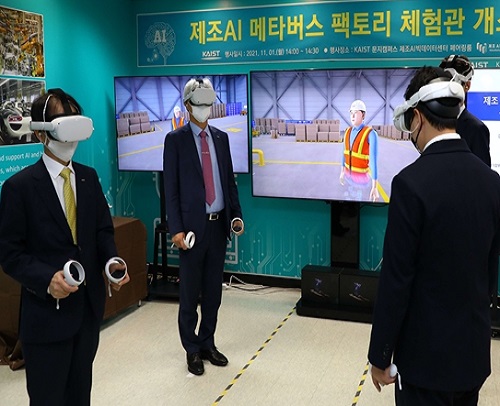
KAIST opened the ‘Metaverse Factory Experience Center for Manufacturing AI’ on November 1 at the KAIST Bigdata Center for Manufacturing AI. The AI-powered manufacturing metaverse factory will provide real-life experiences for the analysis and application of manufacturing data. Funded by the Ministry of SMEs and Startups, the center is a collaboration with Digiforet, which donated the software system to KAIST.
The center allows users to experience the collection, analysis, and utilization process of manufacturing data equivalent to that of real manufacturing sites. Users can connect to the service from anywhere in the world using AR/VR/XR equipment and a metaverse solution, which allows small and middle-sized domestic manufacturing companies to overcome the challenges of entering and selling their production lines overseas in the post-COVID-19 era. The platform is an opportunity for such companies to introduce and export their excellent manufacturing techniques.
With the same manufacturing and AI processes of real production sites, the injection molding metaverse factory for plastic screw production runs simulations of the products they will make. Based on the data collection parameters (temperature, pressure, speed, location, time, etc.) built into the Korea AI Manufacturing Platform, an AI-powered SME manufacturing platform, the metaverse factory can detect causes of defects, provide analysis, and guide improvements in productivity and product quality.
Starting with the injection molding equipment metaverse factory, the platform aims to expand into plating, welding, molding, casting, forging, and annealing, and become a root industry to contribute greatly to enhancing the manufacturing competitiveness of Korea’s small and middle-sized root industries.
Il-Joong Kim, head of the KAIST Manufacturing AI Bigdata Center where the metaverse factory is located, said, “To successfully incorporate manufacturing AI into production sites, it is indispensable that various AI algorithms are tested to optimize decisions. The platform allows users to collect manufacturing data and to experience and test AI analysis simultaneously without interrupting the production process, making it highly effective.”
KAIST President Kwang Hyung Lee said, “We will support the close academic-industrial cooperation with Digiforet such as this collaborative for improving SMEs’ competitiveness.”
Digiforet CEO Sunghoon Park, who donated a whole HW/SW interface for the construction of the Metaverse Factory Experience Center for Manufacturing AI, said, “I will do my best to realize the best “Metaverse Factory for Manufacturing AI” in the world by combining the AI and bigdata accumulated at KAIST and Digiforet’s XR metaverse technology.”
2021.11.03 View 4677
Metaverse Factory Center to Improve SME’s Competitiveness
The center is expected to enhance the manufacturing competitiveness of SMEs and root industry
KAIST opened the ‘Metaverse Factory Experience Center for Manufacturing AI’ on November 1 at the KAIST Bigdata Center for Manufacturing AI. The AI-powered manufacturing metaverse factory will provide real-life experiences for the analysis and application of manufacturing data. Funded by the Ministry of SMEs and Startups, the center is a collaboration with Digiforet, which donated the software system to KAIST.
The center allows users to experience the collection, analysis, and utilization process of manufacturing data equivalent to that of real manufacturing sites. Users can connect to the service from anywhere in the world using AR/VR/XR equipment and a metaverse solution, which allows small and middle-sized domestic manufacturing companies to overcome the challenges of entering and selling their production lines overseas in the post-COVID-19 era. The platform is an opportunity for such companies to introduce and export their excellent manufacturing techniques.
With the same manufacturing and AI processes of real production sites, the injection molding metaverse factory for plastic screw production runs simulations of the products they will make. Based on the data collection parameters (temperature, pressure, speed, location, time, etc.) built into the Korea AI Manufacturing Platform, an AI-powered SME manufacturing platform, the metaverse factory can detect causes of defects, provide analysis, and guide improvements in productivity and product quality.
Starting with the injection molding equipment metaverse factory, the platform aims to expand into plating, welding, molding, casting, forging, and annealing, and become a root industry to contribute greatly to enhancing the manufacturing competitiveness of Korea’s small and middle-sized root industries.
Il-Joong Kim, head of the KAIST Manufacturing AI Bigdata Center where the metaverse factory is located, said, “To successfully incorporate manufacturing AI into production sites, it is indispensable that various AI algorithms are tested to optimize decisions. The platform allows users to collect manufacturing data and to experience and test AI analysis simultaneously without interrupting the production process, making it highly effective.”
KAIST President Kwang Hyung Lee said, “We will support the close academic-industrial cooperation with Digiforet such as this collaborative for improving SMEs’ competitiveness.”
Digiforet CEO Sunghoon Park, who donated a whole HW/SW interface for the construction of the Metaverse Factory Experience Center for Manufacturing AI, said, “I will do my best to realize the best “Metaverse Factory for Manufacturing AI” in the world by combining the AI and bigdata accumulated at KAIST and Digiforet’s XR metaverse technology.”
2021.11.03 View 4677 -
 Seegene Opens Covid-19 Testing Mobile Station on Campus
Seegene donates testing reagents for 40,000 people with results available in three hours
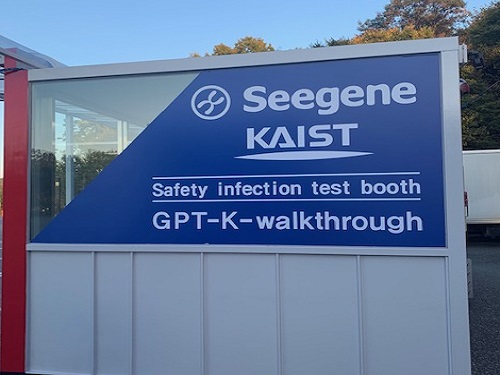
Seegene, a molecular diagnostic testing company, donated enough testing reagents for 40,000 COVID-19 tests for the KAIST community and set up a mobile testing station run by the Seegene Medical Foundation on October 28.
The entire COVID-19 diagnosis process, including specimen collection, PCR testing, and results analysis, can be conducted at the mobile testing unit developed by Seegene. The on-site testing station will help the campus get ready to return to normal, especially as the government is transitioning toward its ‘living with Covid-19’ policy, which eases a range of social distancing restrictions. Any KAIST community member can get a Covid-19 test on campus and receive the results within three hours. The station can conduct up to 7,500 tests per day.
This is an extension of the agreement between KAIST and Seegene made in July for research collaboration. The two institutions will work together on various research projects including ultrafast PCR testing, sample collection, and cloud-based data transmission and analysis.
Prior to this donation, according to an administrative order from Daejeon City, KAIST opened a temporary COVID-19 testing center in collaboration with Seegene and conducted COVID-19 tests at the KAIST Clinic over four days starting from September 28. All students living on campus were tested, and all 2,775 tested negative.
Seegene CEO Jong-Yoon Chun said, "KAIST and Seegene signed an agreement for collaborative research on molecular diagnosis in July prior to this donation, and we are happy to maintain a connection with KAIST.” He added, “We hope that this donation will help students return to their ordinary university lives.”
Vice President for Planning and Budget Bowon Kim said, "As KAIST is currently planning to conduct offline lectures in preparation for ‘living with COVID-19’, Seegene’s donation will be particularly helpful.” He added, “The two institutions will continue to cooperate, leading to not only the short-term stabilization of the campus, but also collaborative research for the vitalization of molecular diagnosis technology and the bio industry.”
2021.11.03 View 3841
Seegene Opens Covid-19 Testing Mobile Station on Campus
Seegene donates testing reagents for 40,000 people with results available in three hours
Seegene, a molecular diagnostic testing company, donated enough testing reagents for 40,000 COVID-19 tests for the KAIST community and set up a mobile testing station run by the Seegene Medical Foundation on October 28.
The entire COVID-19 diagnosis process, including specimen collection, PCR testing, and results analysis, can be conducted at the mobile testing unit developed by Seegene. The on-site testing station will help the campus get ready to return to normal, especially as the government is transitioning toward its ‘living with Covid-19’ policy, which eases a range of social distancing restrictions. Any KAIST community member can get a Covid-19 test on campus and receive the results within three hours. The station can conduct up to 7,500 tests per day.
This is an extension of the agreement between KAIST and Seegene made in July for research collaboration. The two institutions will work together on various research projects including ultrafast PCR testing, sample collection, and cloud-based data transmission and analysis.
Prior to this donation, according to an administrative order from Daejeon City, KAIST opened a temporary COVID-19 testing center in collaboration with Seegene and conducted COVID-19 tests at the KAIST Clinic over four days starting from September 28. All students living on campus were tested, and all 2,775 tested negative.
Seegene CEO Jong-Yoon Chun said, "KAIST and Seegene signed an agreement for collaborative research on molecular diagnosis in July prior to this donation, and we are happy to maintain a connection with KAIST.” He added, “We hope that this donation will help students return to their ordinary university lives.”
Vice President for Planning and Budget Bowon Kim said, "As KAIST is currently planning to conduct offline lectures in preparation for ‘living with COVID-19’, Seegene’s donation will be particularly helpful.” He added, “The two institutions will continue to cooperate, leading to not only the short-term stabilization of the campus, but also collaborative research for the vitalization of molecular diagnosis technology and the bio industry.”
2021.11.03 View 3841 -
 Minister of Justice Meets with KAIST International Community Members
The Office of Immigration Service in Daejeon will dispatch On-Site Immigration Service Team at the campus once a week
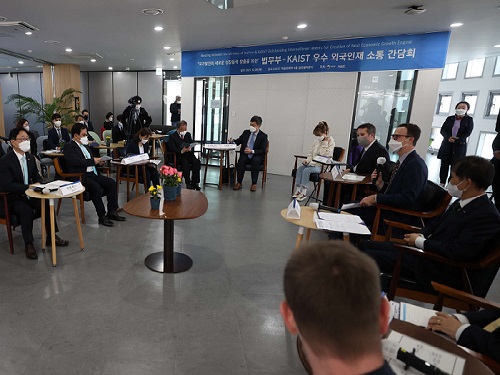
Minister of Justice Beom Kye Park met with international students and faculty members on October 29 at the KAIST campus and promised the government’s prompt and flexible revision of the process for acquiring legal residency and Korean citizenship for talents in the fields of science and technology.
During the meeting to discuss immigration difficulties with foreign students, researchers, and faculty at KAIST, many KAIST international students expressed their wishes to continue their research in Korea after graduation and asked for legal support to acquire permanent residence status.
International faculty members including PhD and Master’s candidate and postdoc fellows attended the meeting along with KAIST President Kwang Hyung Lee and Assistant Vice President of the International Office Scott Knowles.
Currently, there are 1,100 international members on campus: 421 undergraduates, 236 Master’s student, 266 PhD candidates, 79 researchers, and 67 faculty members.
President Lee said, “It is prerequisite to nurture the outstanding talents who earned their degrees in Korea for raising our national competitiveness. We would like to ask the government to ease the current system to embrace those excellent talents. That will definitely be necessary for securing new talents as well as for invigorating the domestic industry and R&D sector, which will lead to attracting the next excellent groups of talented students from abroad.”
Minister Park said that the government now needs more inclusive immigration policies granting legal residency and citizenship to the highly talented group. He added that the ministry will make every effort to help our degree holders acquire the relevant legal status to settle down here.
Meanwhile, the Office of Immigration Services in Daejeon set up the ‘On-Site Immigration Service’ at the campus and provided one-on-one consultation services for KAIST international community regarding extension of stays and alien registration affairs.
The On-Site Immigration Service will continue at the campus once a week for convenience of KAIST international community in the very near future.
2021.10.29 View 3278
Minister of Justice Meets with KAIST International Community Members
The Office of Immigration Service in Daejeon will dispatch On-Site Immigration Service Team at the campus once a week
Minister of Justice Beom Kye Park met with international students and faculty members on October 29 at the KAIST campus and promised the government’s prompt and flexible revision of the process for acquiring legal residency and Korean citizenship for talents in the fields of science and technology.
During the meeting to discuss immigration difficulties with foreign students, researchers, and faculty at KAIST, many KAIST international students expressed their wishes to continue their research in Korea after graduation and asked for legal support to acquire permanent residence status.
International faculty members including PhD and Master’s candidate and postdoc fellows attended the meeting along with KAIST President Kwang Hyung Lee and Assistant Vice President of the International Office Scott Knowles.
Currently, there are 1,100 international members on campus: 421 undergraduates, 236 Master’s student, 266 PhD candidates, 79 researchers, and 67 faculty members.
President Lee said, “It is prerequisite to nurture the outstanding talents who earned their degrees in Korea for raising our national competitiveness. We would like to ask the government to ease the current system to embrace those excellent talents. That will definitely be necessary for securing new talents as well as for invigorating the domestic industry and R&D sector, which will lead to attracting the next excellent groups of talented students from abroad.”
Minister Park said that the government now needs more inclusive immigration policies granting legal residency and citizenship to the highly talented group. He added that the ministry will make every effort to help our degree holders acquire the relevant legal status to settle down here.
Meanwhile, the Office of Immigration Services in Daejeon set up the ‘On-Site Immigration Service’ at the campus and provided one-on-one consultation services for KAIST international community regarding extension of stays and alien registration affairs.
The On-Site Immigration Service will continue at the campus once a week for convenience of KAIST international community in the very near future.
2021.10.29 View 3278 -
 GSI Forum Highlights Global Collaboration Toward a Sustainable Global Economy
The forum stresses global collaboration to make the global value chain more resilient
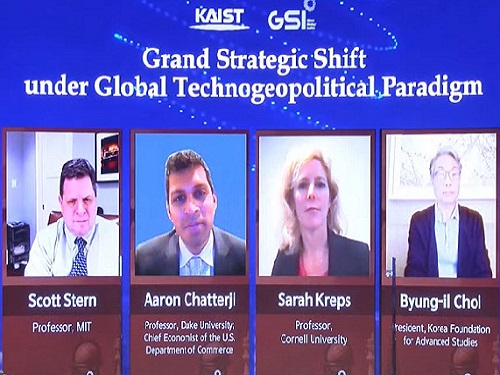
Speakers at the 5th Global Strategy Institute International Forum on October 28 stressed the importance of global collaboration for rebuilding the global economy and making innovations in national science and technology governance in order to enhance national competitiveness. The forum entitled “Grand Strategic Shift under Global Techno-Geopolitical Paradigm” examined strategies for making the global supply chain more resilient and rebuild the global economy as well as how Korea could advance in the technology race.
Speakers concurred that technology has become an issue of national security. The global supply chain has been disrupted amid the global pandemic and intense conflict between the U.S. and China. Speakers presented a common solution: global collaboration and innovations in science and technology governance.
KAIST President Kwang Hyung Lee said in his opening remarks that the future ‘world map’ may turn out very differently depending on how we prepare and what we envision for the future. He also stressed the importance of technology sovereignty, adding that only those who can create their own new technology independently will be the future leaders.
Prime Minister Boo Kyum Kim and Vice Minister of Science and ICT Hongtaek Yong delivered congratulatory remarks. Keynote speakers included Professor Scott Stern from the MIT Sloan School of Management, Professor Aaron Chatterji from the Fuqua School of Business at Duke University, Professor Sarah Kreps from the Department of Government at Cornell University, SK Group Chairperson Tae-Won Chey, President Woo Il Lee of the Korean Federation of Science and Technology Societies, Professor Young Kwan Yoon at Seoul National University, President Eun Mee Kim of Ewha Womans University, and President Ieehwan Kim of the University of Science and Technology.
During the first session, Professor Chatterji stressed that how to make supply chains resilience will be the key for making long-term strategy with relevant government policy. He said that AI has become a general purpose technology (GPT) and Korea ranked 4th in AI innovation in the world, but how to translate this innovativeness into national strategic leadership will be a new challenge for Korea. He suggested that Korea strengthen its strategic partnerships with allies such as the U.S. and provide opportunities not only for established players but start-ups and entrepreneurs. Meanwhile, Professor Kreps said that industrial policy should also leverage trust and innovations for building technology alliances with a more longer-term approach, without antagonizing certain groups of nations.
Vice President for Planning and Budget Bowon Kim who joined the forum as a discussant pointed out that in this hyper-connected era, nothing can be manufactured in a single company and country without the global supply chain. “In longer-term policy and strategies, we should embrace China as a global economy partner and include all nations around the world.”
Chairman Chey from SK said that the clear role among universities, industry, and the government doesn’t exist any longer. Now, universities are working hard for the commercialization of technology from their labs. Industry is nurturing the talents inept for future industry, and the government is trying to introduce a more private-sector approach. As such, universities, the government, and industry should embrace all-inclusive approaches encompassing global politics and trade to lead on the global stage.
Meanwhile in the second session, all of the speakers stressed innovation in science and technology governance in order to adopt to the new industrial paradigm. They agreed to make prompt innovations and solid collaborative systems among the government ministries to ensure national competitiveness, especially in the field of science and technology.
President Lee from KOFST said Korea should adopt a first mover strategy and the government should adopt a mission-oriented projects and deregulate more. He pointed out that when mandating more autonomy in decision making, scientists and students can make more creative outcomes.
Professor Yoon at SNU stressed the close alliance with the U.S. in the technology race, but suggested that Korea should also seek ways to help minimize the technology gap between advanced and developing countries. Universities should also be allowed more autonomy in running creative curriculum and academic affairs to in order boost the competitiveness of science and technology.
President Kim from Ewha pointed out the role of education as a public good. In some countries, strengthening science and technology can be accomplished with wider educational opportunities in middle and high schools. President Kim also stressed expanding strategic partnerships. She said Korea should expand its alliances and partnerships, not only with the U.S. but with European countries and other niche countries where certain technologies are superior.
President Kim of UST stressed a new science and technology leadership is required to build technology sovereignty and the government should spearhead the deregulations of the government policy.
This GSI forum was co-hosted by two think-tanks at KAIST, the Korea Policy Center for the Fourth Industrial Revolution (KPC4IR) and the Innovation Strategy and Policy Institute (ISPI).
2021.10.28 View 5484
GSI Forum Highlights Global Collaboration Toward a Sustainable Global Economy
The forum stresses global collaboration to make the global value chain more resilient
Speakers at the 5th Global Strategy Institute International Forum on October 28 stressed the importance of global collaboration for rebuilding the global economy and making innovations in national science and technology governance in order to enhance national competitiveness. The forum entitled “Grand Strategic Shift under Global Techno-Geopolitical Paradigm” examined strategies for making the global supply chain more resilient and rebuild the global economy as well as how Korea could advance in the technology race.
Speakers concurred that technology has become an issue of national security. The global supply chain has been disrupted amid the global pandemic and intense conflict between the U.S. and China. Speakers presented a common solution: global collaboration and innovations in science and technology governance.
KAIST President Kwang Hyung Lee said in his opening remarks that the future ‘world map’ may turn out very differently depending on how we prepare and what we envision for the future. He also stressed the importance of technology sovereignty, adding that only those who can create their own new technology independently will be the future leaders.
Prime Minister Boo Kyum Kim and Vice Minister of Science and ICT Hongtaek Yong delivered congratulatory remarks. Keynote speakers included Professor Scott Stern from the MIT Sloan School of Management, Professor Aaron Chatterji from the Fuqua School of Business at Duke University, Professor Sarah Kreps from the Department of Government at Cornell University, SK Group Chairperson Tae-Won Chey, President Woo Il Lee of the Korean Federation of Science and Technology Societies, Professor Young Kwan Yoon at Seoul National University, President Eun Mee Kim of Ewha Womans University, and President Ieehwan Kim of the University of Science and Technology.
During the first session, Professor Chatterji stressed that how to make supply chains resilience will be the key for making long-term strategy with relevant government policy. He said that AI has become a general purpose technology (GPT) and Korea ranked 4th in AI innovation in the world, but how to translate this innovativeness into national strategic leadership will be a new challenge for Korea. He suggested that Korea strengthen its strategic partnerships with allies such as the U.S. and provide opportunities not only for established players but start-ups and entrepreneurs. Meanwhile, Professor Kreps said that industrial policy should also leverage trust and innovations for building technology alliances with a more longer-term approach, without antagonizing certain groups of nations.
Vice President for Planning and Budget Bowon Kim who joined the forum as a discussant pointed out that in this hyper-connected era, nothing can be manufactured in a single company and country without the global supply chain. “In longer-term policy and strategies, we should embrace China as a global economy partner and include all nations around the world.”
Chairman Chey from SK said that the clear role among universities, industry, and the government doesn’t exist any longer. Now, universities are working hard for the commercialization of technology from their labs. Industry is nurturing the talents inept for future industry, and the government is trying to introduce a more private-sector approach. As such, universities, the government, and industry should embrace all-inclusive approaches encompassing global politics and trade to lead on the global stage.
Meanwhile in the second session, all of the speakers stressed innovation in science and technology governance in order to adopt to the new industrial paradigm. They agreed to make prompt innovations and solid collaborative systems among the government ministries to ensure national competitiveness, especially in the field of science and technology.
President Lee from KOFST said Korea should adopt a first mover strategy and the government should adopt a mission-oriented projects and deregulate more. He pointed out that when mandating more autonomy in decision making, scientists and students can make more creative outcomes.
Professor Yoon at SNU stressed the close alliance with the U.S. in the technology race, but suggested that Korea should also seek ways to help minimize the technology gap between advanced and developing countries. Universities should also be allowed more autonomy in running creative curriculum and academic affairs to in order boost the competitiveness of science and technology.
President Kim from Ewha pointed out the role of education as a public good. In some countries, strengthening science and technology can be accomplished with wider educational opportunities in middle and high schools. President Kim also stressed expanding strategic partnerships. She said Korea should expand its alliances and partnerships, not only with the U.S. but with European countries and other niche countries where certain technologies are superior.
President Kim of UST stressed a new science and technology leadership is required to build technology sovereignty and the government should spearhead the deregulations of the government policy.
This GSI forum was co-hosted by two think-tanks at KAIST, the Korea Policy Center for the Fourth Industrial Revolution (KPC4IR) and the Innovation Strategy and Policy Institute (ISPI).
2021.10.28 View 5484 -
 Hubo Professor Jun-Ho Oh Donates Startup Shares Worth 5 Billion KRW
Rainbow Robotics stock used to endow the development fund
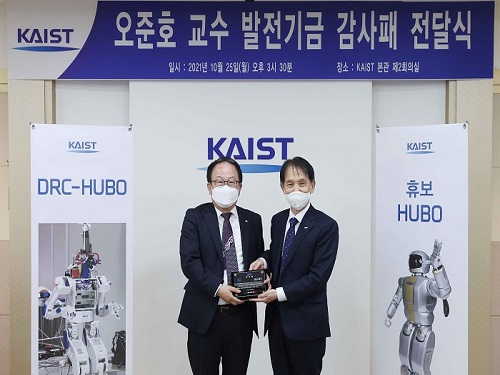
Emeritus Professor Jun-Ho Oh, who developed the 2015 DARPA Challenge winning humanoid robot DRC-Hubo, donated 5 billion KRW on October 25 during a ceremony held at the KAIST campus in Daejeon.
Professor Oh donated his 20% share (400 shares) of his startup Rainbow Robotics, which was established in 2011. Rainbow Robotics was listed on the KOSDAQ this February. The 400 shares were converted to 200,000 shares with a value of approximately 5 billion KRW when listed this year.
KAIST sold the stocks and endowed the Jun-Ho Oh Fund, which will be used for the development of the university. He was the 39th faculty member who launched a startup with technology from his lab and became the biggest faculty entrepreneur donor.
“I have received huge support and funding for my research. Fortunately, the research had a good result and led to the startup. Now I am very delighted to pay back the university. I feel that I have played a part in building the school’s startup ecosystem and creating a virtuous circle,” said Professor Oh during the ceremony.
KAIST President Kwang Hyung Lee declared, “Professor Oh has been a very impressive exemplary model for our aspiring faculty and student tech startups. We will spare no effort to support startups at KAIST.”
Professor Oh, who retired from the Department of Mechanical Engineering last year, now serves as the CTO at Rainbow Robotics. The company is developing humanoid bipedal robots and collaborative robots, and advancing robot technology including parts for astronomical observations.
Professor Hae-Won Park and Professor Je Min Hwangbo, who are now responsible for the Hubo Lab, also joined the ceremony along with employees of Rainbow Robotics.
2021.10.26 View 5746
Hubo Professor Jun-Ho Oh Donates Startup Shares Worth 5 Billion KRW
Rainbow Robotics stock used to endow the development fund
Emeritus Professor Jun-Ho Oh, who developed the 2015 DARPA Challenge winning humanoid robot DRC-Hubo, donated 5 billion KRW on October 25 during a ceremony held at the KAIST campus in Daejeon.
Professor Oh donated his 20% share (400 shares) of his startup Rainbow Robotics, which was established in 2011. Rainbow Robotics was listed on the KOSDAQ this February. The 400 shares were converted to 200,000 shares with a value of approximately 5 billion KRW when listed this year.
KAIST sold the stocks and endowed the Jun-Ho Oh Fund, which will be used for the development of the university. He was the 39th faculty member who launched a startup with technology from his lab and became the biggest faculty entrepreneur donor.
“I have received huge support and funding for my research. Fortunately, the research had a good result and led to the startup. Now I am very delighted to pay back the university. I feel that I have played a part in building the school’s startup ecosystem and creating a virtuous circle,” said Professor Oh during the ceremony.
KAIST President Kwang Hyung Lee declared, “Professor Oh has been a very impressive exemplary model for our aspiring faculty and student tech startups. We will spare no effort to support startups at KAIST.”
Professor Oh, who retired from the Department of Mechanical Engineering last year, now serves as the CTO at Rainbow Robotics. The company is developing humanoid bipedal robots and collaborative robots, and advancing robot technology including parts for astronomical observations.
Professor Hae-Won Park and Professor Je Min Hwangbo, who are now responsible for the Hubo Lab, also joined the ceremony along with employees of Rainbow Robotics.
2021.10.26 View 5746 -
 3 KAIST PhD Candidates Selected as the 2021 Google PhD Fellows
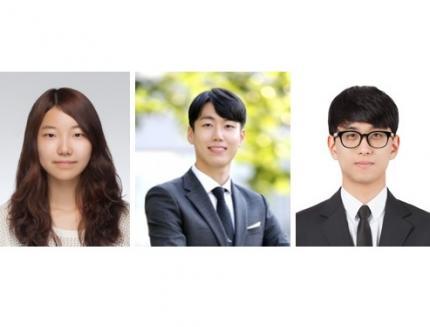
PhD candidates Soo Ye Kim and Sanghyun Woo from the KAIST School of Electrical Engineering and Hae Beom Lee from the Kim Jaechul Graduate School of AI were selected as the 2021 Google PhD Fellows. The Google PhD Fellowship is a scholarship program that supports graduate school students from around the world that have produced excellent achievements from promising computer science-related fields. The 75 selected fellows will receive ten thousand dollars of funding with the opportunity to discuss research and receive one-on-one feedback from experts in related fields at Google.
Kim and Woo were named fellows in the field of "Machine Perception, Speech Technology and Computer Vision" with research of deep learning based super-resolution and computer vision respectively. Lee was named a fellow in the field of "Machine Learning" for his research in meta-learning.
Kim's research includes the formulation of novel methods for super-resolution and HDR video restoration and deep joint frame interpolation and super-resolution methods. Many of her works have been presented in leading conferences in computer vision and AI such as CVPR, ICCV, and AAAI. In addition, she has been collaborating as a research intern with the Vision Group Team at Adobe Research to study depth map refinement techniques.
(Kim's research on deep learning based joint super-resolution and inverse tone-mapping framework for HDR videos)
Woo’s research includes an effective deep learning model design based on the attention mechanism and learning methods based on self-learning and simulators. His works have been also presented in leading conferences such as CVPR, ECCV, and NeurIPS. In particular, his work on the Convolutional Block Attention Module (CBAM) which was presented at ECCV in 2018 has surpassed over 2700 citations on Google Scholar after being referenced in many computer vision applications. He was also a recipient of Microsoft Research PhD Fellowship in 2020.
(Woo's research on attention mechanism based deep learning models)
Lee’s research focuses effectively overcoming various limitations of the existing meta-learning framework. Specifically, he proposed to deal with a realistic task distribution with imbalances, improved the practicality of meta-knowledge, and made meta-learning possible even in large-scale task scenarios. These various studies have been accepted to numerous top-tier machine learning conferences such as NeurIPS, ICML, and ICLR. In particular, one of his papers has been selected as an oral presentation at ICLR 2020 and another as a spotlight presentation at NeurIPS 2020.
(Lee's research on learning to balance and continual trajectory shifting)
Due to the COVID-19 pandemic, the award ceremony was held virtually at the Google PhD Fellowship Summit from August 31st to September 1st. The list of fellowship recipients is displayed on the Google webpage.
2021.10.18 View 3941
3 KAIST PhD Candidates Selected as the 2021 Google PhD Fellows
PhD candidates Soo Ye Kim and Sanghyun Woo from the KAIST School of Electrical Engineering and Hae Beom Lee from the Kim Jaechul Graduate School of AI were selected as the 2021 Google PhD Fellows. The Google PhD Fellowship is a scholarship program that supports graduate school students from around the world that have produced excellent achievements from promising computer science-related fields. The 75 selected fellows will receive ten thousand dollars of funding with the opportunity to discuss research and receive one-on-one feedback from experts in related fields at Google.
Kim and Woo were named fellows in the field of "Machine Perception, Speech Technology and Computer Vision" with research of deep learning based super-resolution and computer vision respectively. Lee was named a fellow in the field of "Machine Learning" for his research in meta-learning.
Kim's research includes the formulation of novel methods for super-resolution and HDR video restoration and deep joint frame interpolation and super-resolution methods. Many of her works have been presented in leading conferences in computer vision and AI such as CVPR, ICCV, and AAAI. In addition, she has been collaborating as a research intern with the Vision Group Team at Adobe Research to study depth map refinement techniques.
(Kim's research on deep learning based joint super-resolution and inverse tone-mapping framework for HDR videos)
Woo’s research includes an effective deep learning model design based on the attention mechanism and learning methods based on self-learning and simulators. His works have been also presented in leading conferences such as CVPR, ECCV, and NeurIPS. In particular, his work on the Convolutional Block Attention Module (CBAM) which was presented at ECCV in 2018 has surpassed over 2700 citations on Google Scholar after being referenced in many computer vision applications. He was also a recipient of Microsoft Research PhD Fellowship in 2020.
(Woo's research on attention mechanism based deep learning models)
Lee’s research focuses effectively overcoming various limitations of the existing meta-learning framework. Specifically, he proposed to deal with a realistic task distribution with imbalances, improved the practicality of meta-knowledge, and made meta-learning possible even in large-scale task scenarios. These various studies have been accepted to numerous top-tier machine learning conferences such as NeurIPS, ICML, and ICLR. In particular, one of his papers has been selected as an oral presentation at ICLR 2020 and another as a spotlight presentation at NeurIPS 2020.
(Lee's research on learning to balance and continual trajectory shifting)
Due to the COVID-19 pandemic, the award ceremony was held virtually at the Google PhD Fellowship Summit from August 31st to September 1st. The list of fellowship recipients is displayed on the Google webpage.
2021.10.18 View 3941 -
 Diva Sumi Jo to Join the KAIST Faculty
Visiting Distinguished Professor Jo will enrich KAIST’s scholarship and inspire futuristic art and technology research
Soprano Sumi Jo will join the KAIST faculty from the spring 2022 semester. Named as a visiting distinguished professor in the Graduate School of Culture Technology, she will give special leadership lectures. Her tenure will be through September 2024.
Jo joined the appointment ceremony held online at KAIST on October 14 from Portugal and expressed her high expectations for teaching KAIST students from next year. “I am very grateful for this opportunity to meet students at KAIST, the birthplace of advanced science and technology in Korea,” she said.
KAIST President Kwang Hyung Lee, who has stressed the importance of humanities and the arts in convergence studies of science and technology, lauded her joining the faculty as a big asset who will enrich KAIST’s scholarship. “Soprano Sumi Jo rose to stardom on the global music stage with her unrivaled talent and effort. I truly believe her experience and passion will inspire our students to expand their horizon of thought and knowledge,” said President Lee.
Distinguished Professor Jo will also participate in convergence research at the Graduate School of Culture Technology with KAIST professors and many other experts. The Sumi Jo Performing Arts Research Center at the Graduate School of Culture Technology will conduct research on the converging of imaging and audio processing technologies that will enhance virtual artists’ performances. Distinguished Professor Jo explained, “The world is changing so fast. I look forward to working on culture technology research at KAIST that will raise our life quality.”
Professor Juhan Nam from the Graduate School of Culture Technology said, “We look forward to working closely with her and her team to develop research themes that envision futuristic art combined with technology such as the metaverse and non-fungible tokens (NFTs).
Coloratura soprano Jo was born in Seoul and educated at Seoul National University and the Conservatorio Santa Cecilia in Italy. Among her teachers were Carolo Bergonzi and Giasnnelas Borelli. Following her graduation from the Conservatorio Santa Cecilia in 1985, she swept major international competitions in Seoul and Europe. In 1986, she was unanimously awarded the first prize in the Carlo Alberto Cappelli International Competition in Verona which is open only to the first-prize winners of major competitions.
Since her debut in the role of Gilda in Verdi’s Rigolleto in Italy in 1986, she has performed on the world's biggest stages along with noted maestros such as Herbert von Karajan, Georg Solti, Zubin Mehta, and James Levine. Distinguished Professor Jo, one of the most sought-after sopranos in the world, released more than 40 albums.
2021.10.15 View 3932
Diva Sumi Jo to Join the KAIST Faculty
Visiting Distinguished Professor Jo will enrich KAIST’s scholarship and inspire futuristic art and technology research
Soprano Sumi Jo will join the KAIST faculty from the spring 2022 semester. Named as a visiting distinguished professor in the Graduate School of Culture Technology, she will give special leadership lectures. Her tenure will be through September 2024.
Jo joined the appointment ceremony held online at KAIST on October 14 from Portugal and expressed her high expectations for teaching KAIST students from next year. “I am very grateful for this opportunity to meet students at KAIST, the birthplace of advanced science and technology in Korea,” she said.
KAIST President Kwang Hyung Lee, who has stressed the importance of humanities and the arts in convergence studies of science and technology, lauded her joining the faculty as a big asset who will enrich KAIST’s scholarship. “Soprano Sumi Jo rose to stardom on the global music stage with her unrivaled talent and effort. I truly believe her experience and passion will inspire our students to expand their horizon of thought and knowledge,” said President Lee.
Distinguished Professor Jo will also participate in convergence research at the Graduate School of Culture Technology with KAIST professors and many other experts. The Sumi Jo Performing Arts Research Center at the Graduate School of Culture Technology will conduct research on the converging of imaging and audio processing technologies that will enhance virtual artists’ performances. Distinguished Professor Jo explained, “The world is changing so fast. I look forward to working on culture technology research at KAIST that will raise our life quality.”
Professor Juhan Nam from the Graduate School of Culture Technology said, “We look forward to working closely with her and her team to develop research themes that envision futuristic art combined with technology such as the metaverse and non-fungible tokens (NFTs).
Coloratura soprano Jo was born in Seoul and educated at Seoul National University and the Conservatorio Santa Cecilia in Italy. Among her teachers were Carolo Bergonzi and Giasnnelas Borelli. Following her graduation from the Conservatorio Santa Cecilia in 1985, she swept major international competitions in Seoul and Europe. In 1986, she was unanimously awarded the first prize in the Carlo Alberto Cappelli International Competition in Verona which is open only to the first-prize winners of major competitions.
Since her debut in the role of Gilda in Verdi’s Rigolleto in Italy in 1986, she has performed on the world's biggest stages along with noted maestros such as Herbert von Karajan, Georg Solti, Zubin Mehta, and James Levine. Distinguished Professor Jo, one of the most sought-after sopranos in the world, released more than 40 albums.
2021.10.15 View 3932 -
 KAIST Entrepreneurial Partnership to Accelerate Startups and Venture Ecosystem
KAIST will launch the KAIST Entrepreneurial Partnership (KEP) program, which connects faculty members who own technology with those who want to launch startup.
The program encourages open innovation startups using strategies tailored to market-client demand requirements. This is also one of efforts to help realize ‘one startup per lab,’ initiated by President Kwang Hyung Lee’s new innovation strategy. KEP also aims to introduce the best technologies developing at KAIST to startups and to raise the success rate of technology commercialization.
The program will match KAIST faculty and student entrepreneur candidates with parties enrolled in the new Entrepreneur in Residence and Entrepreneurial Partner programs. Each team will be given a six-month test period with funding support.
KAIST will invite entrepreneurial experts from both technology and management fields to support the program participants. Around 30 experts with experience in developing new businesses, startups, and investments in large corporations or venture companies will be recruited as entrepreneurial partners. They will offer support for research and business development (R&BD), technology marketing, attracting venture investment from corporations, mergers and acquisitions, and business openings.
A survey showed that KAIST members who are interested in starting a business are experiencing difficulties finding an entrepreneurial expert (72.2%), with the complicated startup approval procedures (33.3%), and their lack of knowledge on entrepreneurship and funding (27.8%). The KEP program hopes to encourage KAIST faculty members and students who have well-developed business ideas and the appropriate technology but lack the capabilities to realize and develop them into a business.
Associate Vice President of Startups Young-Tae Kim said, “We will develop KEP into KAIST’s distinct entrepreneurial support system and produce exemplary outcomes of faculty and student startups. We will spread the startup DNA and lead the building of a virtuous cycle between entrepreneurship and the venture ecosystem.”
2021.10.14 View 3763
KAIST Entrepreneurial Partnership to Accelerate Startups and Venture Ecosystem
KAIST will launch the KAIST Entrepreneurial Partnership (KEP) program, which connects faculty members who own technology with those who want to launch startup.
The program encourages open innovation startups using strategies tailored to market-client demand requirements. This is also one of efforts to help realize ‘one startup per lab,’ initiated by President Kwang Hyung Lee’s new innovation strategy. KEP also aims to introduce the best technologies developing at KAIST to startups and to raise the success rate of technology commercialization.
The program will match KAIST faculty and student entrepreneur candidates with parties enrolled in the new Entrepreneur in Residence and Entrepreneurial Partner programs. Each team will be given a six-month test period with funding support.
KAIST will invite entrepreneurial experts from both technology and management fields to support the program participants. Around 30 experts with experience in developing new businesses, startups, and investments in large corporations or venture companies will be recruited as entrepreneurial partners. They will offer support for research and business development (R&BD), technology marketing, attracting venture investment from corporations, mergers and acquisitions, and business openings.
A survey showed that KAIST members who are interested in starting a business are experiencing difficulties finding an entrepreneurial expert (72.2%), with the complicated startup approval procedures (33.3%), and their lack of knowledge on entrepreneurship and funding (27.8%). The KEP program hopes to encourage KAIST faculty members and students who have well-developed business ideas and the appropriate technology but lack the capabilities to realize and develop them into a business.
Associate Vice President of Startups Young-Tae Kim said, “We will develop KEP into KAIST’s distinct entrepreneurial support system and produce exemplary outcomes of faculty and student startups. We will spread the startup DNA and lead the building of a virtuous cycle between entrepreneurship and the venture ecosystem.”
2021.10.14 View 3763