%48%65%65%20%54%61%6b%20%4b%69%6d
-
 KAIST brings ‘giant batteries’ closer to commercialization in the AI data center era
The explosive growth of AI data centers has brought the commercialization of "giant batteries" one step closer. A KAIST research team has developed a process that cuts the production time for a core material used in large-capacity batteries by 67%, resolving the largest production bottleneck standing in the way of commercialization.
KAIST (President Choongsik Bae) announced on August 5 that a research team led by Professor Hee-Tak Kim from the Department of Chemical and Biomolecular Engineering has developed a process for producing the core electrolyte of vanadium redox flow batteries (VRFBs)—a leading candidate for large-capacity energy storage systems (ESS)—faster and more stably.
As AI data centers operate around the clock in growing numbers, large-capacity ESS that can store electricity generated from solar and wind power and supply it reliably when needed have become increasingly important.
Because VRFBs use nonflammable, water-based electrolytes, they have a lower fire risk than many conventional battery systems. And their energy-storage capacity can be scaled by increasing the amount of electrolyte stored in external tanks. This has drawn attention to VRFBs as ultra-large batteries suited to AI data centers and renewable energy storage. However, producing the vanadium electrolyte with an average oxidation state of 3.5+—the standard starting composition for VRFB operation— has been slow and costly, making it a critical obstacle to commercialization.
The conventional process first produces the electrolyte through chemical reduction—a reaction in which a chemical reducing agent causes vanadium ions to gain electrons—and then refines it through electrochemical reduction, which applies electric current to adjust the vanadium ions' electron state to the desired level. This final electrochemical step, however, relies on a costly VRFB stack and significant electrical energy, increasing both operational complexity and capital costs.Beyond the limitations of the electrochemical reduction process, the research team found, for the first time, that the alternative chemical reduction process also suffers from a distinct kinetic bottleneck. The reaction rate slows sharply at a specific point, much like highway traffic suddenly backing up at a bottleneck. This bottleneck occurs when the average vanadium oxidation state reaches approximately +4.1, an intermediate stage in the production of V3.5+ electrolyte.
In previous research, the team had replaced the conventional electrochemical adjustment step with a Pt/C-catalyzed reduction process, preventing the waste of leftover electrolyte. In the present study, it further extended the catalytic process into the bottleneck region of oxalic-acid-based chemical reduction. By switching from chemical to catalytic reduction at an average oxidation state of approximately +4.1, the team was able to bypass the slowest stage of the production process.
As a result, production time for V3.5+ electrolyte was cut by 67% compared to the conventional process. The switch also eliminated residual oxalic acid, an impurity that can degrade battery performance. The same catalyst was reused more than 2,500 times without a notable drop in performance, demonstrating the process's viability for industrial-scale production.
"This study combined reaction engineering principles with thermodynamic predictions to identify the rate-determining step in the chemical reduction and redesigned the electrolyte production process to overcome this major bottleneck to the commercialization of large-scale batteries," said Hee-Tak Kim, professor in the Department of Chemical and Biomolecular Engineering. He added, "By scientifically identifying the conditions under which the catalyst operates stably without degrading in the electrolyte environment, we resolved a production bottleneck relevant to industry, and we expect this to significantly accelerate the commercialization of large-capacity energy storage technology."
Kyunghwa Seok, a PhD candidate in the Department of Chemical and Biomolecular Engineering, led the research as first author. The findings were published online in Advanced Energy Materials—a leading international journal in the energy field—on May 7. In particular, in recognition of its academic significance, the study was selected as the cover article for Issue 34, which is scheduled to be published online in early September.
Paper title: Streamlined V3.5+ Electrolyte Production by Leveraging Chemical and Catalytic Reductions
DOI: https://doi.org/10.1002/aenm.71029
Authors: Kyunghwa Seok (KAIST, first author), Minseong Kang (KAIST, second author), and Hee-Tak Kim (KAIST, corresponding author).
This research was supported by Lotte Chemical.
2026.08.05 View 3818
-
 Batteries Make 12Minute Charge for 800km Drive a Reality
<Photo 1. (From left in the front row) Dr. Hyeokjin Kwon from Chemical and Biomolecular Engineering, Professor Hee Tak Kim, and Professor Seong Su Kim from Mechanical Engineering>
Korean researchers have ushered in a new era for electric vehicle (EV) battery technology by solving the long-standing dendrite problem in lithium-metal batteries. While conventional lithium-ion batteries are limited to a maximum range of 600 km, the new battery can achieve a range of 800 km on a single charge, a lifespan of over 300,000 km, and a super-fast charging time of just 12 minutes.
KAIST (President Kwang Hyung Lee) announced on the 4th of September that a research team from the Frontier Research Laboratory (FRL), a joint project between Professor Hee Tak Kim from the Department of Chemical and Biomolecular Engineering, and LG Energy Solution, has developed a "cohesion-inhibiting new liquid electrolyte" original technology that can dramatically increase the performance of lithium-metal batteries.
Lithium-metal batteries replace the graphite anode, a key component of lithium-ion batteries, with lithium metal. However, lithium metal has a technical challenge known as dendrite, which makes it difficult to secure the battery's lifespan and stability. Dendrites are tree-like lithium crystals that form on the anode surface during battery charging, negatively affecting battery performance and stability.
This dendrite phenomenon becomes more severe during rapid charging and can cause an internal short-circuit, making it very difficult to implement a lithium-metal battery that can be recharged under fast-charging conditions.
The FRL joint research team has identified that the fundamental cause of dendrite formation during rapid charging of lithium metal is due to non-uniform interfacial cohesion on the surface of the lithium metal. To solve this problem, they developed a "cohesion-inhibiting new liquid electrolyte."
The new liquid electrolyte utilizes an anion structure with a weak binding affinity to lithium ions (Li⁺), minimizing the non-uniformity of the lithium interface. This effectively suppresses dendrite growth even during rapid charging.
This technology overcomes the slow charging speed, which was a major limitation of existing lithium-metal batteries, while maintaining high energy density. It enables a long driving range and stable operation even with fast charging.
Je-Young Kim, CTO of LG Energy Solution, said, "The four years of collaboration between LG Energy Solution and KAIST through FRL are producing meaningful results. We will continue to strengthen our industry-academia collaboration to solve technical challenges and create the best results in the field of next-generation batteries."
<Figure 1. Infographic on the KAIST-LGES FRL Lithium-Metal Battery Technology>
Hee Tak Kim, Professor from Chemical and Biomolecular Engineering at KAIST, commented, "This research has become a key foundation for overcoming the technical challenges of lithium-metal batteries by understanding the interfacial structure. It has overcome the biggest barrier to the introduction of lithium-metal batteries for electric vehicles."
The study, with Dr. Hyeokjin Kwon from the KAIST Department of Chemical and Biomolecular Engineering as the first author, was published in the prestigious journal Nature Energy on September 3.
Nature Energy: According to the Journal Impact Factor announced by Clarivate Analytics in 2024, it ranks first among 182 energy journals and 23rd among more than 21,000 journals overall.
Article Title: Covariance of interphasic properties and fast chargeability of energy-dense lithium metal batteries
DOI: 10.1038/s41560-025-01838-1
The research was conducted through the Frontier Research Laboratory (FRL, Director Professor Hee Tak Kim), which was established in 2021 by KAIST and LG Energy Solution to develop next-generation lithium-metal battery technology.
2025.09.04 View 13643
-
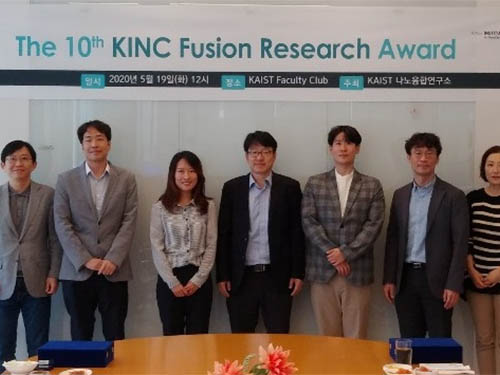 The 10th KINC Fusion Research Awardees
The KAIST Institute for NanoCentury (KINC) recognized three distinguished researchers whose convergence studies made significant impacts. The KINC presented the 10th KINC Fusion Research Awards during a ceremony that took place at KAIST’s main campus in Daejeon on May 19.
This year’s ‘best’ convergence research award went to a joint research group led by Professor Hee Tak Kim from the Department of Chemical and Biomolecular Engineering and Professor Sang Ouk Kim from the Department of Materials Science and Engineering. Their research, featured in the December 27 issue of Advanced Materials as a front cover article last year, introduced the world’s first high-energy efficiency, membraneless, flowless, zinc-bromine battery. This study, in which research professor Gyoung Hwa Jeong, postdoctoral researcher Yearin Byun, and PhD candidate Ju-Hyuck Lee took part as co-lead authors, is deemed as an example of a best practice in convergence research in which two groups’ respective expertise in the fields of carbon materials and electrochemical analysis created a synergistic effect.
Professor Bumjoon Kim from the Department of Chemical and Biomolecular Engineering was also recognized for having published the most interdisciplinary research papers on polymer electronics and nanomaterials at home and abroad.
Professor Hee-Tae Jung, the Director of KINC and the host of the KINC Fusion Research Awards, said, “The KINC is happy to announce the 10th awardees in nano-fusion research this year. Since convergence is crucial for making revolutionary changes, the importance of convergence studies should be recognized. Our institute will spare no effort to create a research environment suitable for convergence studies, which will be crucial for making a significant difference.”
The KINC was established in June 2006 under the KAIST Institute with the mission of facilitating convergence studies by tearing down boarders among departments and carrying out interdisciplinary joint research. Currently, the institute is comprised of approximately 90 professors from 13 departments. It aims to become a hub of university institutes for nano-fusion research.
(END)
2020.05.19 View 26086