research
In this digital era, there has been growing concern that children spend most of their playtime watching TV, playing computer games, and staring at mobile phones with ‘head-down’ posture even outdoors.
To counter such concerns, KAIST researchers designed a wearable bracelet using sound augmentation to leverage play benefits by employing digital technology. The research team also investigated how sound influences children’s play experiences according to their physical, social, and imaginative aspects.
Playing is a large part of enjoyable and rewarding lives, especially for children. Previously, a large part of children’s playtime used to take place outdoors, and playing outdoors has long been praised for playing an essential role in providing opportunities to perform physical activity, improve social skills, and boost imaginative thinking.
Motivated by these concerns, a KAIST research team led by Professor Woohun Lee and his researcher Jiwoo Hong from the Department of Industrial Design made use of sound augmentation, which is beneficial for motivating playful experiences by facilitating imagination and enhancing social awareness with its ambient and omnidirectional characteristics.
Despite the beneficial characteristics of sound augmentation, only a few studies have explored sound interaction as a technology to augment outdoor play due to its abstractness when conveying information in an open space outdoors. There is also a lack of empirical evidence regarding its effect on children's play experiences.
Professor Lee’s team designed and implemented an original bracelet-type wearable device called SoundWear. This device uses non-speech sound as a core digital feature for children to broaden their imaginations and improvise their outdoor games.
Children equipped with SoundWear were allowed to explore multiple sounds (i.e., everyday and instrumental sounds) on SoundPalette, pick a desired sound, generate the sound with a swinging movement, and transfer the sound between multiple devices for their outdoor play.
Both the quantitative and qualitative results of a user study indicated that augmenting playtime with everyday sounds triggered children’s imagination and resulted in distinct play behaviors, whereas instrumental sounds were transparently integrated with existing outdoor games while fully preserving play benefits in physical, social, and imaginative ways.
The team also found that the gestural interaction of SoundWear and the free sound choice on SoundPalette helped children to gain a sense of achievement and ownership toward sound. This led children to be physically and socially active while playing.
PhD candidate Hong said, “Our work can encourage the discussion on using digital technology that entails sound augmentation and gestural interactions for understanding and cultivating creative improvisations, social pretenses, and ownership of digital materials in digitally augmented play experiences.”
Professor Lee also envisioned that the findings being helpful to parents and educators saying, “I hope the verified effect of digital technology on children’s play informs parents and educators to help them make more informed decisions and incorporate the playful and creative usage of new media, such as mobile phones and smart toys, for young children.”
This research titled “SoundWear: Effect of Non-speech Sound Augmentation on the Outdoor Play Experience of Children” was presented at DIS 2020 (the ACM Conference on Designing Interactive Systems) taking place virtually in Eindhoven, Netherlands, from July 6 to 20. This work received an Honorable Mention Award for being in the top 5% of all the submissions to the conference.
< Figure 1: Four phases of the SoundWear user scenario: (A) exploration, (B) selection, (C) sonification, and (D) transmission >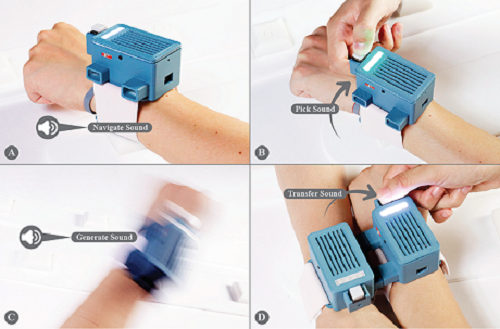
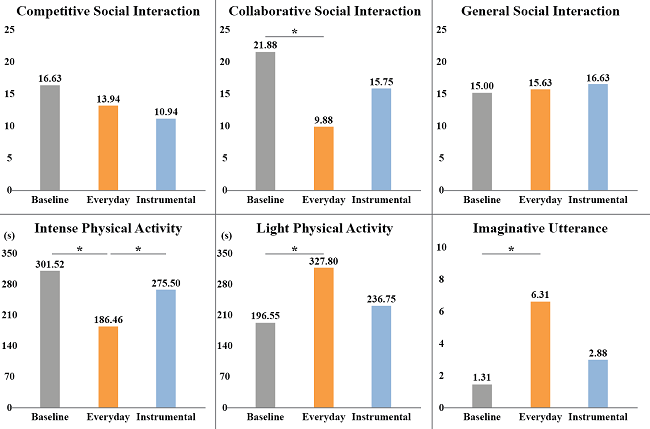
< Figure 2. Differences in social interaction, physical activity, and imaginative utterances under the condition of baseline, everyday sound, and instrumental sound >
Publication:
Hong, J., et al. (2020) ‘SoundWear: Effect of Non-speech Sound Augmentation on the Outdoor Play Experience of Children’. Proceedings of the 2020 ACM Designing Interactive Systems Conference (DIS'20), Pages 2201-2213. Available online at https://doi.org/10.1145/3357236.3395541
Profile:
Professor Woohun Lee
woohun.lee@kaist.ac.kr
http://wonderlab.kaist.ac.kr
Department of Industrial Design (ID)
KAIST
-
research KAIST Develops Gravity-Independent Wearable Eyedrop Patch for Use in Space
Applying eyedrops is difficult in space, where there is almost no gravity. A KAIST research team has developed a wearable patch that delivers eyedrops to the eye without relying on gravity, for use in space. KAIST (President Choongsik Bae) announced on October 21 that a research team led by Professor Ki-Hun Jeong from the Department of Bio and Brain Engineering, in collaboration with a research team led by Professor Se Joon Woo from Seoul National University Bundang Hospital, has developed
2026-10-21 -
research KAIST and KIOM Develop a Wearable Microneedle Electroceutical for Personalized Pain Management
A "wearable electroceutical" has been developed that could reduce the need to visit a hospital or rely on painkillers every time pain occurs. When attached to the skin, it modulates pain through electrical stimulation and can be remotely controlled via smartphone even across long distances, such as between Korea and the United States. KAIST (President Choongsik Bae) announced on September 13 that a joint research team led by Professor Jae-Woong Jeong from the School of Electrical Engineering
2026-09-14 -
research KAIST Develops Next-Generation Self-Powered Wearable Sensor Resilient to 668% Elongation
Wearable medical devices that monitor heart rate, respiration, and joint movements for long periods without battery concerns, electronic skins that sense external stimuli like human skin, and soft robots made of flexible materials that move freely have all come one step closer to reality. KAIST researchers have developed a self-powered sensor (a sensor that generates electricity on its own without a battery) that can stretch up to 668% while producing stable electrical signals. KAIST announce
2026-06-18 -
research KAIST Develops Wearable Ultrasound Sensor Enabling Noninvasive Treatment Without Surgery
<(From Left) Professor Hyunjoo Jenny Lee, Dr.Sang-Mok Lee, Ph.D candidate Xiaojia Liang> Conventional wearable ultrasound sensors have been limited by low power output and poor structural stability, making them unsuitable for high-resolution imaging or therapeutic applications. A KAIST research team has now overcome these challenges by developing a flexible ultrasound sensor with statically adjustable curvature. This breakthrough opens new possibilities for wearable medical devices that
2025-11-12 -
event KAIST’s Wearable Robot Design Wins ‘2025 Red Dot Award Best of the Best’
<Professor Hyunjoon Park, M.S candidate Eun-ju Kang, Prospective M.S candidate Jae-seong Kim, undergraduate student Min-su Kim> A team led by Professor Hyunjoon Park from the Department of Industrial Design won the ‘Best of the Best’ award at the 2025 Red Dot Design Awards, one of the world's top three design awards, for their 'Angel Robotics WSF1 VISION Concept.' The design for the next-generation wearable robot for people with paraplegia successfully implements functional
2025-08-09