research

< The research team. Bottom row, from left: Professor Jae-Gil Lee (co-author, KAIST); Dr. Hansoo Lee (first author, postdoctoral researcher, Imperial College London); and Professor Uichin Lee (corresponding author, KAIST). Top row, from left: Youngji Koh (co-author, postdoctoral researcher, the University of Tokyo) and Taehyeon Park (co-author, undergraduate researcher, KAIST). >
Clues to stress can be hidden in everyday habits such as chatting, searching, and making payments on a smartphone. KAIST researchers have developed a technology that analyzes several routine behaviors repeatedly performed within apps to identify a person’s daily stress state.
KAIST (President Choongsik Bae) announced on October 15 that a research team led by Professor Uichin Lee from the Department of AI Computing developed “SHIRBT-MMF,” a technology that automatically identifies repeated smartphone behaviors and uses factors such as the duration and frequency of each behavior and text-input patterns to determine daily stress status.
Previous smartphone-based stress research has mainly analyzed factors such as screen time, the number of app launches, time and frequency of use by app category, and typing behavior. However, when the apps being used or their interfaces change, the data being analyzed also change, which can reduce the stability of models designed to track stress over long periods.
The research team therefore focused on “what a person does” rather than “which app they use.” Even if a user switches from KakaoTalk to LINE or WhatsApp, the activity itself remains “messenger chatting.” In other words, the analysis is based on the purpose of the behavior rather than the name of the app.
The team defined these repeated behaviors as “Smartphone Human Interaction Routine Behavior Tasks (SHIRBTs).” Using its independently developed “Multi-Level Sequential Pattern Mining (ML-SPM)” technique, the team identified recurring screen-transition patterns across multiple days and then used a large language model (LLM) to assign easily understandable behavior labels such as “messenger chatting,” “web browsing,” “financial payment,” and “reading/writing email.” In evaluations of whether the same behavior could be consistently classified across different email, web browser, and messenger apps, the system achieved an accuracy of more than 95%.
To protect privacy, the system did not store the actual text or message content entered by users, recording only behavioral information such as whether text was entered, how often it was entered, and screen transitions. Information about message recipients or call partners was also processed using hashing, which converts the original information into values that do not directly reveal it.
The research team analyzed real-life data from 26 university students and office workers in their 20s and 30s. Among participants for whom both self-reported stress assessments and smartphone records were available, 16 short-term participants provided an average of 30.5 days of data, while 10 long-term participants provided an average of 105.1 days. Based on the participants’ daily self-assessments, the researchers built personalized models that distinguished between days with and without stress.
A total of 29 types of repeated behaviors were identified in participants’ smartphone use, with each person routinely repeating an average of about seven behaviors. The research team used personalized artificial intelligence models trained on these behavioral patterns to determine whether a person was experiencing stress on a given day. The best-performing model achieved an average accuracy of 75.9% for short-term participants and 73.8% for long-term participants, meaning it was correct roughly three out of four times. These results were 5.5 percentage points and 3.5 percentage points higher, respectively, than the conventional approach of analyzing app usage using the same AI technique.
Performance could also be maintained even when the number of behaviors used in the analysis was reduced. With the same personalized model, using only two behaviors, “messenger chatting” and “financial payment,” or even analyzing “messenger chatting” alone, produced higher average classification accuracy than the conventional method. In the long-term data, analytical indicators based on repeated behaviors also changed less over time and maintained a more stable structure than those used in the conventional approach.
In this experiment, the researchers collected a broad range of smartphone usage records in order to compare their method with conventional approaches. In the future, the team expects that once an individual’s repeated behaviors have been identified, focusing data collection and analysis on those relevant behaviors could reduce the burden of data collection. The study suggests the potential for developing digital mental health monitoring technology that makes it easier to understand which behaviors were used in classification and remains relatively stable even when the app environment changes.
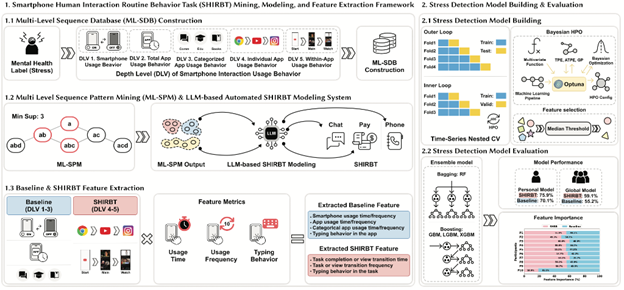
< Figure1. Overview of the SHIRBT-MMF framework and the stress detection model >
Professor Uichin Lee of the KAIST AI Computing Department said, “We viewed the smartphone not simply as a device for measuring usage time, but as a space in everyday life where an individual’s communication, information seeking, and financial activities are repeatedly carried out,” adding, “This study provides a foundation for converting complex smartphone records into human-understandable behavioral units and offering long-term mental health tracking more reliably.”
However, this study used associations between behavior and stress and did not demonstrate a causal relationship showing that a particular behavior causes or reduces stress. Based on findings from Android smartphone users in their 20s and 30s, the research team plans to expand the study to a broader range of age groups, occupations, and smartphone environments and verify its long-term stability.
In this study, Hansoo Lee participated in the study as the first author, Professor Uichin Lee as the corresponding author, and researchers Taehyeon Park and Youngji Koh, along with Professor Jae-Gil Lee of the School of Computing, as co-authors. The research was published in December 2025 in the international journal Proceedings of the ACM on Interactive, Mobile, Wearable and Ubiquitous Technologies. The study is scheduled to be presented at ACM UbiComp/ISWC 2026, which will be held in Shanghai, China, from October 13 to 15, 2026.
Paper title: Leveraging Smartphone Human Interaction Routine Behavior Task Mining and Modeling for Daily Stress Monitoring, DOI: https://doi.org/10.1145/3770644
Author information: First author (Hansoo Lee), co-authors (Taehyeon Park, Youngji Koh, Jae-Gil Lee), corresponding author (Uichin Lee)
This research was supported by the Institute of Information & Communications Technology Planning & Evaluation (IITP) ICT Convergence Digital Inclusion Technology Development project and the National Research Foundation of Korea (NRF) Sejong Fellowship project, funded by the Ministry of Science and ICT.
-
research Devilray Exposes Blind Spots in FBS Detection
DAEJEON, South Korea — Governments use them to track phones. Criminals drive them through city streets and send texts that look like they came from your bank. For 20 years, researchers have been building tools to catch these fake cell towers. They have tested those tools mostly against fake towers they built themselves. That loop has left gaps. Researchers at KAIST built a platform called Devilray that reproduces 2,592 distinct fake-base-station behaviors. They ran it against seven existi
2026-11-04 -
research KAIST Cuts AI Fine-Tuning from 10 Hours to 3… Faster Development of Medical and Coding AI
Can AI fine-tuning, that once took 10 hours, be completed in just 3 hours? KAIST researchers have developed a technology that selects the most useful training data and distributes it evenly across multiple GPUs. By reducing repetitive learning of similar data, the method shortened training time by up to 69.6% while maintaining nearly the same AI performance. The technology is expected to help develop AI tailored to specific tasks, such as corporate customer service or assisting medical profess
2026-11-02 -
event KAIST Hosts 4th Failure Society to Celebrate “Failed Projects” and Anticipate Failures in the AI Era
KAIST will host an event where participants can proudly share failed projects and imagine in advance the kinds of failures that may occur in the AI era. From setbacks already experienced to risks that have yet to emerge, participants will explore together what can be learned from failure. KAIST (President Choongsik Bae) announced on October 30 that it will hold the “4th KAIST Failure Society” from Wednesday, November 4 to Friday, November 13 under the theme “The Future and F
2026-10-30 -
research KAIST Develops AI That Reconstructs Cloud-Covered Ground in Satellite Images with Photo-Like Clarity
Satellite images of the Earth are not always easy to use. Clouds can block the view of the ground, and images captured with certain imaging methods look different from ordinary photographs, which makes them difficult to interpret. A KAIST research team has developed an artificial intelligence (AI) model that learns the appearance of diverse terrain and cities. The model can restore cloud-covered images and convert radar images into images that resemble ordinary photographs. It applies what it
2026-10-20 -
event KAIST Presents “Jazz AI Artists” That Respond Spontaneously to Human Performers at the Jarasum Jazz Festival
When a jazz pianist stopped playing, a “jazz AI artist” followed the flow of the performance and continued on the piano. Even when the musician’s tempo and rhythm changed, the AI continued its part smoothly. When a pianist began improvising, artificial intelligence (AI) also generated bass and drum accompaniment. KAIST researchers presented music AI technology that listens and responds to human performers and creates music together with them on an actual jazz stage. KAIST
2026-10-19