research

<(From left)Professor Heung-kyu Lee from the Department of Biological Sciences, Dr.Myeong Seung Kwon from the Graduate School of Medical Science>
It is already well-known that when a mother experiences inflammation during pregnancy, her child is more likely to develop allergic diseases. Recently, a KAIST research team became the first in the world to discover that inflammation within the placenta affects the fetus's immune system, leading to the child exhibiting excessive allergic reactions after birth. This study presents a new possibility for the early prediction and prevention of allergic diseases such as pediatric asthma.
KAIST (President Kwang Hyung Lee) announced on the 4th of August that a research team led by Professor Heung-kyu Lee from the Department of Biological Sciences found that inflammation occurring during pregnancy affects the fetus's stress response regulation system through the placenta. As a result, the survival and memory differentiation of T cells (key cells in the adaptive immune system) increase, which can lead to stronger allergic reactions in the child after birth.
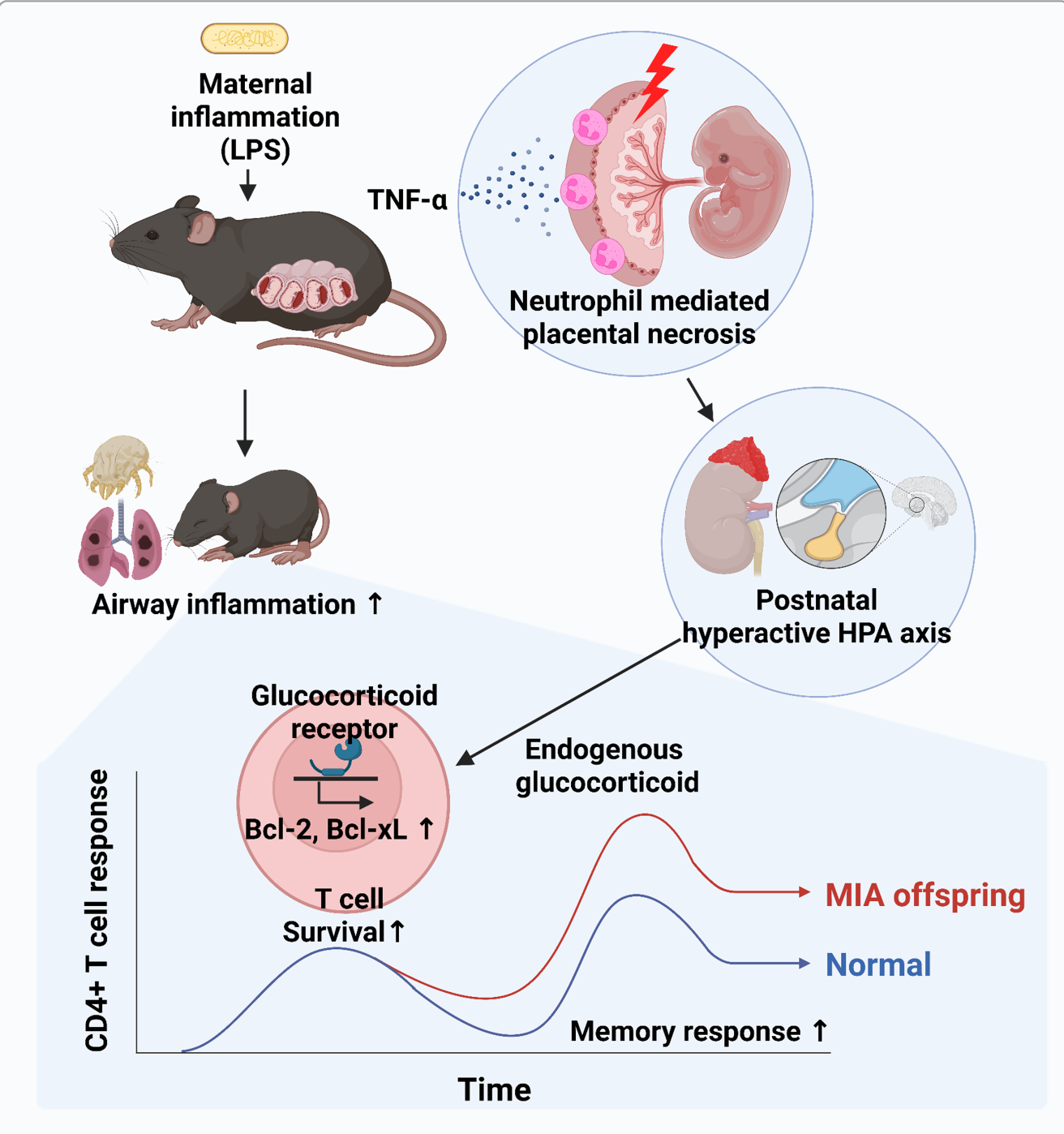
The research team proved this through experiments on mice that had excessive inflammation induced during pregnancy. First, they injected the toxin component 'LPS (lipopolysaccharide),' a substance known to be a representative material that induces an inflammatory response in the immune system, into the mice to cause an inflammatory response in their bodies, which also caused inflammation in the placenta.
It was confirmed that the placental tissue, due to the inflammatory response, increased a signaling substance called 'Tumor Necrosis Factor-alpha (TNF-α),' and this substance activated immune cells called 'neutrophils*', causing inflammatory damage to the placenta. *Neutrophils: The most abundant type of white blood cells in our bodies (40-75%), playing an important role in innate immunity and killing invading bacteria and fungi.
This damage modulated postnatal offspring stress response, leading to a large secretion of stress hormone (glucocorticoid). As a result, the offspring's T cells, which are responsible for immune memory, survived longer and had stronger memory functions.
In particular, the memory T cells created through this process caused excessive allergic reactions when repeatedly exposed to antigens after birth. Specifically, when house dust mite 'allergens' were exposed to the airways of mice, a strong eosinophilic inflammatory response and excessive immune activation were observed, with an increase in immune cells important for allergy and asthma reactions.
Professor Heung Kyu Lee stated, "This study is the first in the world to identify how a mother's inflammatory response during pregnancy affects the fetus's allergic immune system through the placenta." He added, "This will be an important scientific basis for developing biomarkers for early prediction and establishing prevention strategies for pediatric allergic diseases."
The first author of this study is Dr. Myeong Seung Kwon from the KAIST Graduate School of Medical Science (currently a clinical fellow of gynecological oncology at Konyang University Hospital's Department of Obstetrics and Gynecology), and the research results were published in the authoritative journal in the field of mucosal immunology, 'Mucosal Immunology,' on July 1st. ※ Paper Title: Placental inflammation-driven T cell memory formation promotes allergic responses in offspring via endogenous glucocorticoids ※ DOI: https://doi.org/10.1016/j.mucimm.2025.06.006
This research was conducted as part of the Basic Science Research Program and the Bio-Medical Technology Development Program supported by the Ministry of Science and ICT and the National Research Foundation of Korea.
-
research KAIST Boosts Ammonia Production 57-Fold by Shrinking Ruthenium Catalysts… Maximizing Efficiency for Next-Generation Hydrogen Fuel
Ammonia is drawing renewed attention as a “magic container” for safely storing and transporting hydrogen, a promising clean energy source of the future, as well as a carbon-free fuel that does not emit greenhouse gases when burned. However, for ammonia to be widely used as a key fuel, improving the efficiency of its production process is essential. A Korean research team has presented a new approach that enables ammonia to be produced rapidly and in large quantities while using far
2026-11-19 -
research KAIST Develops Li-S Structural Battery Electrode That Turns Curved Drone Legs into Energy Storage Spaces
What if a drone’s legs could do more than support its weight—and also store energy? Researchers at the Korea Advanced Institute of Science and Technology (KAIST) have developed a structural battery electrode that remains stable even when fitted into curved structures, such as drone legs. By making it possible to integrate energy storage into a device’s frame, the technology could help make drones and robots lighter and extend their operating times. On November 18, KAIST (Pre
2026-11-18 -
event Who Will Shape the Future of AI?
KAIST Hosts First Student-Led Model UN Summit to Address the AI Divide Through Dialogue Among Governments, Industry, and Civil Society Who should benefit from artificial intelligence, and who should bear responsibility for its risks? How can those with limited access to AI, along with future generations who will live with its consequences, have a say in decisions largely shaped by leading nations and technology companies? These questions were at the heart of KAIST's first Model United Nations
2026-11-18 -
event KAIST and Tsinghua University Agree to Launch Dual Master’s Degree Program in Mechanical Engineering
Master’s students at KAIST and Tsinghua University will be able to study at both universities and earn a master’s degree from each. The program will give engineering students specializing in future vehicles, robotics, and advanced manufacturing the opportunity to gain hands-on experience in both countries’ research environments. KAIST announced on November 17 that it had signed an agreement with Tsinghua University to establish a dual master’s degree program in mechani
2026-11-18 -
research KAIST Identifies Why Combining Battery Additives Can Shorten Battery Life and Proposes an Alternative
Electrolyte additives designed to improve battery performance can instead shorten battery life when they are incompatible with each other. Researchers at the Korea Advanced Institute of Science and Technology (KAIST) have identified why protective layers inside batteries fail to form properly when certain additives are used together and have proposed a new additive to address this problem. The findings are expected to contribute to the development of electric vehicle (EV) batteries that retain
2026-11-17