fund
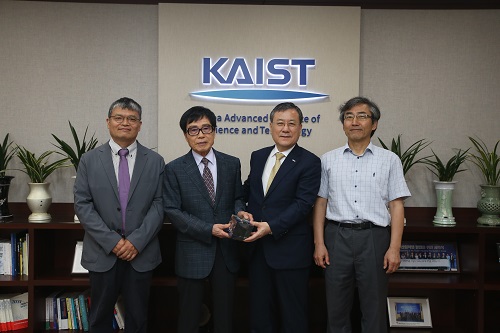
(From left: Dean of the Dept. Physics Eunseong Kim, Emeritus Professor JaeKwan Kim, KAIST President Sung-Chul Shin and Professor Soon Chil Lee)
Emeritus Professor JaeKwan Kim from the Department of Physics made a one hundred million won contribution to KAIST.
He joined KAIST in 1972 and for the next 25 years he dedicated himself to carrying out research and fostering students.
Professor Kim said, “It was a great pleasure and honor to dedicate myself to the development of KAIST as well as Korea. Although I only contributed a small amount of money, I hope that it will help to sustain the development of KAIST. I will continue to support the school behind the scenes.”
He also mentioned that it is meaningful to deliver this fund to KAIST President Sung-Chul Shin, who is the first alumnus president and also his former student.
President Shin said, “His warm heart towards his students will be a priceless gift for the development of KAIST. Not only the Department of Physics, but the entire school will need to work together to help us become a global value-creative leading university and contribute to the country and its people.”
-
research KAIST Controls Where 2D Semiconductor Crystals Begin to Grow, Addressing a Key Challenge in Stacking AI Chips
Two-dimensional (2D) semiconductors, only a few atomic layers thick, are a promising material for making AI chips faster and more energy efficient by stacking additional semiconductor layers on top of existing computing circuits. However, when crystals form at multiple random locations during growth, it is difficult to produce high-quality semiconductors at the desired positions. A KAIST joint research team has developed a technology that sets in advance where a crystal begins to grow and allo
2026-10-13 -
research KAIST Develops a Beetle-Inspired Soft Robot That Operates with Artificial Muscles and Sensory Feedback
Researchers have developed a technology that lets a user move a small robot by bending and straightening a finger. The user can also pick up and move objects while checking the images and contact information that the robot sends back. The system combines artificial muscles, a camera, and tactile sensors in a small soft robot modeled on a beetle. It is expected to be used in remote tasks, such as inspecting narrow spaces that are difficult for people to reach and retrieving small objects. KAIS
2026-10-13 -
event KAIST to Showcase Noise Reduction and Robotics Technologies at 2026 Tech Fair
Technologies that reduce noise using thin, lightweight structures, make wireless charging devices lighter, and enable robots to navigate and perform tasks autonomously will be on display at the 2026 KAIST Tech Fair. The event will give companies an opportunity to explore technologies developed in KAIST laboratories and discuss potential applications in their products and manufacturing processes directly with the researchers. KAIST announced on October 12 that it will hold the 2026 KAIST Tech
2026-10-12 -
event KAIST to Chart a Platform-FirstCourse for “Physical AI” Beyond Humanoids
KAIST (President Choongsik Bae) announced on October 11 that it will host “Physical AI KOREA 2026” at its Daejeon campus on October 13. At the event, KAIST plans to present physical AI platform technologies that can be applied not only to manufacturing but also to healthcare, defense, logistics, and everyday life, as well as strategies for research, education, and entrepreneurship that can be utilized by a wide range of companies. Humanoid robots are beginning to surpass human rec
2026-10-12 -
research KAIST Reveals How Information Is Written in Ferroelectric Memory at the Nanoscale
What happens at the nanoscale when information is written to memory? Researchers at KAIST have shown how tiny regions with a new polarization direction form while previously formed regions continue to expand in a promising ferroelectric material. By linking these nanoscale changes to electrical measurements, the team developed a model that captures both processes, offering a basis for designing faster and more stable memory. KAIST (President Choongsik Bae) announced on October 8 that a team l
2026-10-08