people
The Mobile Software Platform Research Center (MSPRC) at KAIST received an award from the Minister of Science, ICT and Future Planning of Korea on November 29, 2016, at Coex in Seoul. The award was presented at the Conference of Software R&D Annual Report 2016 hosted by the Ministry of Science, ICT and Future Planning (MISP) and the Institute for Information and Communications Technology Promotion (IITP).
The research center developed user experience (UX)-oriented mobile software platforms that support the invention of next-generation UX service technologies. The center has filed 37 patents and registered 15 technologies. Its researchers received ten Best Paper Awards and published a total of 133 papers in Korean and international journals.
Research teams at MSPRC expect that their software platforms will offer training programs for software engineers and new UX services. They also said that their extensive event processing platforms would reduce energy consumption on mobile devices.
Professor Seungryoul Maeng of the School of Computing, the Director of MSPRC, said, “This is a great honor for us. I am greatly thankful for the teamwork of participating departments--Computer Science, Industrial Design, and Industrial and Systems Engineering. We will continue to introduce our research outcomes and to work towards commercializing these results.”
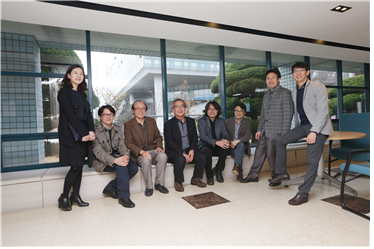
Members of the Mobile Software Platform Research Center, KAIST
-
research KAIST Develops Core Display Technology That Prevents Image Distortion Even When Stretched
Beyond bendable and foldable displays, the era of stretchable displays, whose screens can expand freely like rubber, is now emerging. KAIST researchers have developed a core technology that allows text, images, and other on-screen information to retain their original shape even when the screen is stretched by up to 15%. The achievement is expected to help solve the problem of image distortion and accelerate the commercialization of next-generation high-quality stretchable displays. KAIST (P
2026-07-08 -
research KAIST Develops Stretchable Displays Featuring 25% Expansion Without Image Distortion
Stretchable displays, praised for their spatial efficiency, design flexibility, and human-like flexibility, are seen as the next generation of display technology. A team of Korean researchers has developed a stretchable display that can expand by 25% while maintaining clear image quality without distortion. It can also stretch and contract up to 5,000 times at 15% expansion without any performance degradation, making it the first deformation-free stretchable display with a negative Poisson's rat
2024-09-20 -
people Globally renowned stained-glass artist Fr. En Joon Kim appointed as a distinguished invited professor in the KAIST Department of Industrial Design
World-renowned master of stained-glass Father En Joong Kim was appointed to a two-year distinguished invited professorship in the KAIST Department of Industrial Design starting August 1, 2022 - Fr. Kim will share his life, spirit, and artistic capabilities with the members of KAIST through special lectures for undergraduate and graduate students, and through a stained-glass piece he will work on and donate to the KAIST Academic and Cultural Complex - The 53-piece work of art will p
2022-09-08 -
research Object Identification and Interaction with a Smartphone Knock
(Professor Lee (far right) demonstrate 'Knocker' with his students.) A KAIST team has featured a new technology, “Knocker”, which identifies objects and executes actions just by knocking on it with the smartphone. Software powered by machine learning of sounds, vibrations, and other reactions will perform the users’ directions. What separates Knocker from existing technology is the sensor fusion of sound and motion. Previously, object identification used
2019-10-02 -
research 5 Biomarkers for Overcoming Colorectal Cancer Drug Resistance Identified
< Professor Kwang-Hyun Cho's Team > KAIST researchers have identified five biomarkers that will help them address resistance to cancer-targeting therapeutics. This new treatment strategy will bring us one step closer to precision medicine for patients who showed resistance. Colorectal cancer is one of the most common types of cancer worldwide. The number of patients has surpassed 1 million, and its five-year survival rate significantly drops to about 20 percent when metastasized. In
2019-05-27