fund
A KAIST undergraduate student who developed and sold a smart phone application donated USD 26,000 to his alma mater.
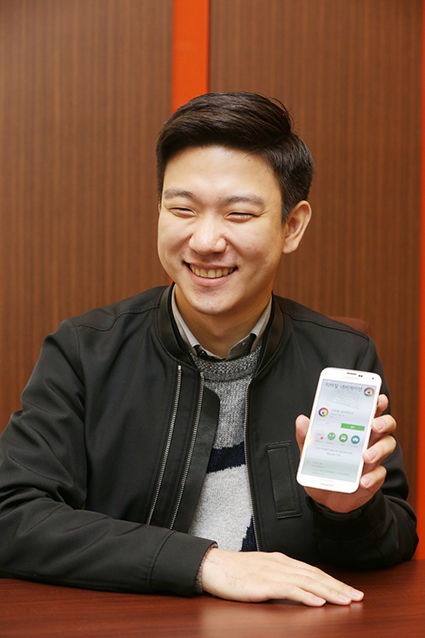
Seung-Kyu Oh of the School of Electrical Engineering gave his donation to President Steve Kang of KAIST on November 24, 2015. This is the largest amount donated by an enrolled undergraduate.
In 2010, at a time when android smart phones were just being released, Mr. Oh decided to develop a subway app because existing subway apps were not user-friendly.
Mr. Oh’s “Subway Navigation” app checks the current operation hours and gives users the shortest path when the user selects points of departure and arrival. The calculation for the shortest path involves factors such as which train comes first, where and to what train to transfer, the first and last trains of the day, transfer passageway usage time, etc.
To make the app useful to the largest number of people, Mr. Oh distributed it on the open market. Currently, the app is ranked the second most downloaded subway app, and has even made considerable advertising profits, having accumulated more than 5,000,000 users. This year, Mr. Oh received an offer from Kakao, an Internet company based in Seoul, Korea, to take over the app and sold it to them.
Mr. Oh said that making a donation KAIST was the first thing that came to his mind when he earned this profit.
Mr. Oh, who graduated from the Korea Science Academy, a science magnet high school, said that he felt a sense of responsibility for receiving support from Korea since high school, and that he decided to donate to KAIST as a way of returning the support that he had received so far.
He further said that “if an individual’s efforts and talents created some profit together with what he or she learned from school, then the school that supported the student in furthering his studies has also played a significant role,” and that “likewise, our stellar alumni can contribute more to our younger classmates’ growth and development.”
Mr. Oh, who is at his last semester, plans to join Kakao and will take on a job managing his subway app.
President Kang said he hopes that “all KAISTians will emulate Mr. Oh’s example to support the school” and that “the university will use the money to invest further in its future.”
-
research KAIST, “BTS” Heads to Space… Five NEONSAT Microsatellites to Launch on Nuri
To monitor areas affected by wildfires or floods using satellites, it is necessary to be able to image those locations again when needed. With a single satellite, it takes time to revisit the same area, but operating multiple satellites together can increase observation opportunities. Five NEONSAT microsatellites, part of a constellation development project led by KAIST, are heading into space aboard the Nuri launch vehicle. KAIST (President Choongsik Bae) announced on October 6 that NEONSAT
2026-10-06 -
research KAIST Develops Vector Database Technology for Reliable Retrieval of Up-to-Date Information
When new information is continually added and old information is removed, an AI system may fail to find the correct material even when that material exists. KAIST researchers have developed a vector database technology that preserves the search paths leading to the needed information as data changes. This allows AI to find up-to-date information more accurately and quickly. KAIST (President Choongsik Bae) announced on October 5 that a research team led by Professor Min-Soo Kim from the School
2026-10-06 -
research KAIST Identifies a “Hidden Amplification Switch” in Lymphangiogenic Signaling
Lymphatic vessels act as the body’s “drainage system,” collecting excess fluid from tissues. When lymphatic drainage is impaired because lymphatic vessels are underdeveloped, damaged, or dysfunctional, lymphedema can develop, causing swelling, particularly in the arms and legs. Conversely, excessive lymphatic vessel growth around tumors can facilitate cancer metastasis by providing routes for tumor cells to spread. Korean researchers have discovered that VEGF-C brings two VEG
2026-10-02 -
research KAIST Reveals How the Light-Responsive Molecular Switch Azobenzene Changes Shape
Azobenzene is one of the best-known molecules that can be switched between two forms by light. However, the question of how the molecule moves in the first few picoseconds (trillionths of a second) after it absorbs light has remained unresolved for nearly 50 years. A Korean research team has now shown that, during the initial stage of the reaction, the molecule changes shape through a coordinated motion of the two nitrogen atoms at its center, while its two benzene rings stay nearly in place.
2026-10-02 -
research KAIST Develops a Venus Flytrap-Inspired 'Robot Hand' Material That Detects What Comes Near and Grasps It Under UV Light
A Venus flytrap closes its leaves to trap prey when it senses a stimulus. Taking inspiration from this plant, KAIST researchers have combined the roles of a skin that senses approaching objects and a muscle that grasps them in a single soft material. When an electrically charged object comes near, ions inside the material move and produce an electrical signal. When ultraviolet (UV) light is applied, the material bends and grasps the object. Because it holds its deformed shape for more than 10
2026-09-30