fund
“We’ve made a real effort to save our money, but can’t spend it all just on ourselves. Please use it to foster talented students in the field of science, who will enrich our country,” said donors at the donation ceremony held today on campus.
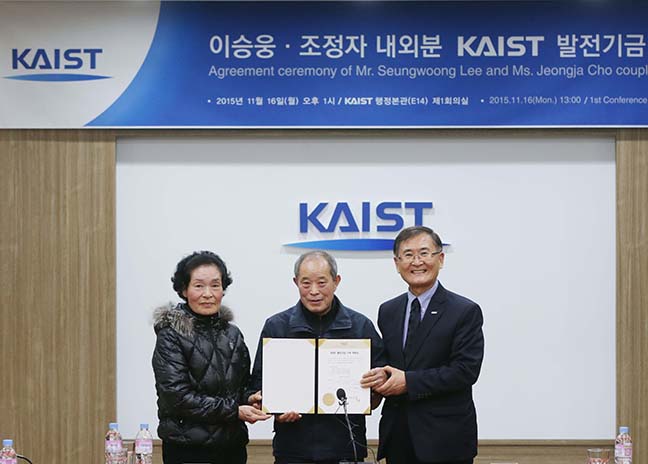
A married couple in their 70s donated their real estate, worth approximately USD 6.41 million, to KAIST on November 16, 2015. Seung-Woong Lee, the husband, and Jeong-Ja Cho, his wife, turned over three properties, including buildings in Seoul and Uijeongbu, to the university.
The couple made a promise to themselves to return their assets back to the Korean society since the beginning of their marriage life. They decided that KAIST was the institution with the most potential to contribute to Korea’s growth. This spring they took that step.
The Lee couple said, “We strove to be frugal to gather such a sum of money. We engaged in all sorts of jobs after we left for Seoul from the countryside when the nation was impoverished.”
Mr. Lee said, “On one snowy winter day, I was riding a bicycle on my way back home. Then I saw a restaurant and, at that moment, I yearned for a bowl of soup in such cold weather. But I just rode past because the whole family could eat with the money that I would spend for the soup.”
Ms. Cho said, “At the beginning, I was rather unhappy with my husband’s very frugal personality. But as time passed, I noticed I had become just like him.” She added, smiling, “I often wandered around the market to get even the smallest discounts, and the shops sometimes refused to sell me the goods.”
Their assets are the result of that work ethic and humility. The couple said, “Today is definitely the happiest day of our life because we would keep our promise. We hope that KAIST will foster outstanding talents in the field of science and technology, students who will advance our nation in the future.”
President Steve Kang of KAIST said, “I would like to express my most sincere gratitude toward to this generous couple who have donated their lifetime assets so willingly to KAIST. Their invaluable support will surely become our springboard to continuously pursue our excellence in science and technology.”
In the picture from left to right are Ms. Jeong-Ja Cho (wife), Mr. Seung-Woong Lee (husband), and President Steve Kang.
-
research KAIST, “BTS” Heads to Space… Five NEONSAT Microsatellites to Launch on Nuri
To monitor areas affected by wildfires or floods using satellites, it is necessary to be able to image those locations again when needed. With a single satellite, it takes time to revisit the same area, but operating multiple satellites together can increase observation opportunities. Five NEONSAT microsatellites, part of a constellation development project led by KAIST, are heading into space aboard the Nuri launch vehicle. KAIST (President Choongsik Bae) announced on October 6 that NEONSAT
2026-10-06 -
research KAIST Develops Vector Database Technology for Reliable Retrieval of Up-to-Date Information
When new information is continually added and old information is removed, an AI system may fail to find the correct material even when that material exists. KAIST researchers have developed a vector database technology that preserves the search paths leading to the needed information as data changes. This allows AI to find up-to-date information more accurately and quickly. KAIST (President Choongsik Bae) announced on October 5 that a research team led by Professor Min-Soo Kim from the School
2026-10-06 -
research KAIST Identifies a “Hidden Amplification Switch” in Lymphangiogenic Signaling
Lymphatic vessels act as the body’s “drainage system,” collecting excess fluid from tissues. When lymphatic drainage is impaired because lymphatic vessels are underdeveloped, damaged, or dysfunctional, lymphedema can develop, causing swelling, particularly in the arms and legs. Conversely, excessive lymphatic vessel growth around tumors can facilitate cancer metastasis by providing routes for tumor cells to spread. Korean researchers have discovered that VEGF-C brings two VEG
2026-10-02 -
research KAIST Reveals How the Light-Responsive Molecular Switch Azobenzene Changes Shape
Azobenzene is one of the best-known molecules that can be switched between two forms by light. However, the question of how the molecule moves in the first few picoseconds (trillionths of a second) after it absorbs light has remained unresolved for nearly 50 years. A Korean research team has now shown that, during the initial stage of the reaction, the molecule changes shape through a coordinated motion of the two nitrogen atoms at its center, while its two benzene rings stay nearly in place.
2026-10-02 -
research KAIST Develops a Venus Flytrap-Inspired 'Robot Hand' Material That Detects What Comes Near and Grasps It Under UV Light
A Venus flytrap closes its leaves to trap prey when it senses a stimulus. Taking inspiration from this plant, KAIST researchers have combined the roles of a skin that senses approaching objects and a muscle that grasps them in a single soft material. When an electrically charged object comes near, ions inside the material move and produce an electrical signal. When ultraviolet (UV) light is applied, the material bends and grasps the object. Because it holds its deformed shape for more than 10
2026-09-30