event
On May 23rd, KAIST (President Kwang-Hyung Lee) announced that its Digital Bio-Health AI Research Center (Director: Professor JongChul Ye of KAIST Kim Jaechul Graduate School of AI) has been selected for the Ministry of Science and ICT's 'AI Top-Tier Young Researcher Support Program (AI Star Fellowship Project).' With a total investment of ₩11.5 billion from May 2025 to December 2030, the center will embark on the full-scale development of AI technology and a platform capable of independently inferring and determining the kinds of diseases, and discovering new drugs.
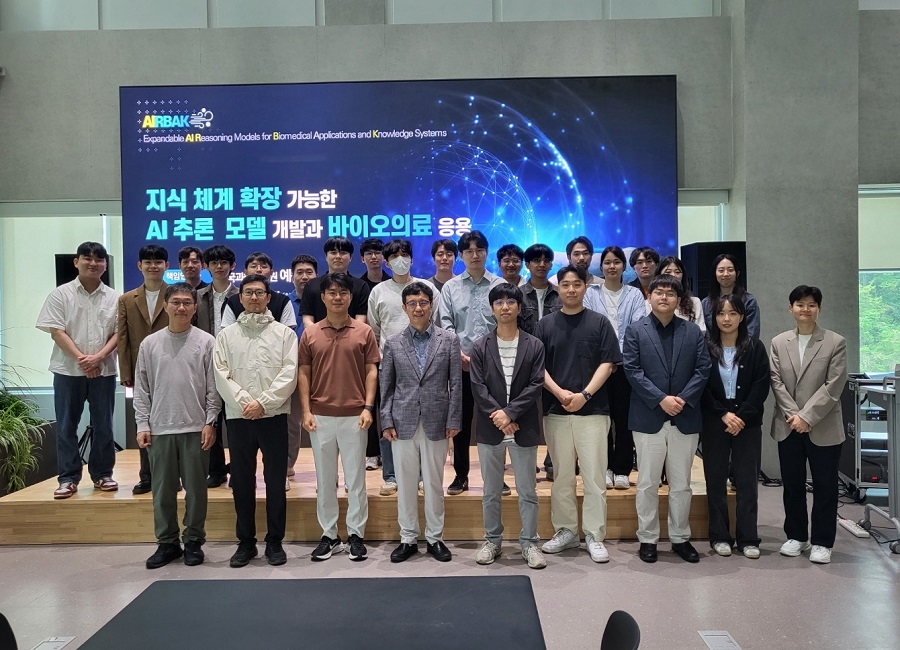
< Photo. On May 20th, a kick-off meeting for the AI Star Fellowship Project was held at KAIST Kim Jaechul Graduate School of AI’s Yangjae Research Center with the KAIST research team and participating organizations of Samsung Medical Center, NAVER Cloud, and HITS. [From left to right in the front row] Professor Jaegul Joo (KAIST), Professor Yoonjae Choi (KAIST), Professor Woo Youn Kim (KAIST/HITS), Professor JongChul Ye (KAIST), Professor Sungsoo Ahn (KAIST), Dr. Haanju Yoo (NAVER Cloud), Yoonho Lee (KAIST), HyeYoon Moon (Samsung Medical Center), Dr. Su Min Kim (Samsung Medical Center) >
This project aims to foster an innovative AI research ecosystem centered on young researchers and develop an inferential AI agent that can utilize and automatically expand specialized knowledge systems in the bio and medical fields.
Professor JongChul Ye of the Kim Jaechul Graduate School of AI will serve as the lead researcher, with young researchers from KAIST including Professors Yoonjae Choi, Kimin Lee, Sungsoo Ahn, and Chanyoung Park, along with mid-career researchers like Professors Jaegul Joo and Woo Youn Kim, jointly undertaking the project. They will collaborate with various laboratories within KAIST to conduct comprehensive research covering the entire cycle from the theoretical foundations of AI inference to its practical application.
Specifically, the main goals include:
- Building high-performance inference models that integrate diverse medical knowledge systems to enhance the precision and reliability of diagnosis and treatment.
- Developing a convergence inference platform that efficiently combines symbol-based inference with neural network models.
- Securing AI technology for new drug development and biomarker discovery based on 'cell ontology.'
Furthermore, through close collaboration with industry and medical institutions such as Samsung Medical Center, NAVER Cloud, and HITS Co., Ltd., the project aims to achieve:
- Clinical diagnostic AI utilizing medical knowledge systems.
- AI-based molecular target exploration for new drug development.
- Commercialization of an extendible AI inference platform.
Professor JongChul Ye, Director of KAIST's Digital Bio-Health AI Research Center, stated, "At a time when competition in AI inference model development is intensifying, it is a great honor for KAIST to lead the development of AI technology specialized in the bio and medical fields with world-class young researchers." He added, "We will do our best to ensure that the participating young researchers reach a world-leading level in terms of research achievements after the completion of this seven-year project starting in 2025."
The AI Star Fellowship is a newly established program where post-doctoral researchers and faculty members within seven years of appointment participate as project leaders (PLs) to independently lead research. Multiple laboratories within a university and demand-side companies form a consortium to operate the program.
Through this initiative, KAIST plans to nurture bio-medical convergence AI talent and simultaneously promote the commercialization of core technologies in collaboration with Samsung Medical Center, NAVER Cloud, and HITS.
-
research Devilray Exposes Blind Spots in FBS Detection
DAEJEON, South Korea — Governments use them to track phones. Criminals drive them through city streets and send texts that look like they came from your bank. For 20 years, researchers have been building tools to catch these fake cell towers. They have tested those tools mostly against fake towers they built themselves. That loop has left gaps. Researchers at KAIST built a platform called Devilray that reproduces 2,592 distinct fake-base-station behaviors. They ran it against seven existi
2026-11-04 -
research KAIST Cuts AI Fine-Tuning from 10 Hours to 3… Faster Development of Medical and Coding AI
Can AI fine-tuning, that once took 10 hours, be completed in just 3 hours? KAIST researchers have developed a technology that selects the most useful training data and distributes it evenly across multiple GPUs. By reducing repetitive learning of similar data, the method shortened training time by up to 69.6% while maintaining nearly the same AI performance. The technology is expected to help develop AI tailored to specific tasks, such as corporate customer service or assisting medical profess
2026-11-02 -
event KAIST Hosts 4th Failure Society to Celebrate “Failed Projects” and Anticipate Failures in the AI Era
KAIST will host an event where participants can proudly share failed projects and imagine in advance the kinds of failures that may occur in the AI era. From setbacks already experienced to risks that have yet to emerge, participants will explore together what can be learned from failure. KAIST (President Choongsik Bae) announced on October 30 that it will hold the “4th KAIST Failure Society” from Wednesday, November 4 to Friday, November 13 under the theme “The Future and F
2026-10-30 -
research KAIST Develops AI That Reconstructs Cloud-Covered Ground in Satellite Images with Photo-Like Clarity
Satellite images of the Earth are not always easy to use. Clouds can block the view of the ground, and images captured with certain imaging methods look different from ordinary photographs, which makes them difficult to interpret. A KAIST research team has developed an artificial intelligence (AI) model that learns the appearance of diverse terrain and cities. The model can restore cloud-covered images and convert radar images into images that resemble ordinary photographs. It applies what it
2026-10-20 -
event KAIST Presents “Jazz AI Artists” That Respond Spontaneously to Human Performers at the Jarasum Jazz Festival
When a jazz pianist stopped playing, a “jazz AI artist” followed the flow of the performance and continued on the piano. Even when the musician’s tempo and rhythm changed, the AI continued its part smoothly. When a pianist began improvising, artificial intelligence (AI) also generated bass and drum accompaniment. KAIST researchers presented music AI technology that listens and responds to human performers and creates music together with them on an actual jazz stage. KAIST
2026-10-19