policy
KAIST and Shinhan Macquarie Financial Advisory Co. have reached an agreement for cooperation in the development and commercialization of the KAIST-led two national green growth projects, On-line Electric Vehicle (OLEV) and Mobile Harbor (MH) programs, university authorities said.
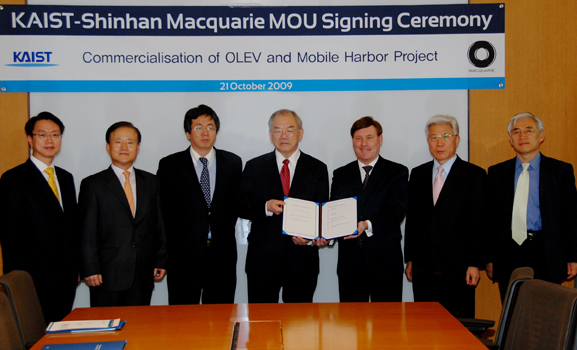
KAIST President Nam-Pyo Suh signed a memorandum of understanding with John Walker, Chairman of Macquarie Group of Companies in Korea, and Woo-Gon Hwang, Representative Director of Shinhan Macquarie Financial Advisory Co. on Wednesday, Oct. 21.
Under the agreement, KAIST and Macquarie will cooperate in developing an optimal business structure for a rapid commercialization of OLEV and MH. Specifically, Shinhan Macquarie Financial Advisory will provide financial advice, including basis financial analysis, potential investor inducement and feasibility analysis of the projects.
Shinhan Macquarie Financial Advisory Co. is a joint venture between Shinhan Financial Group of Korea and the Australia-based Macquarie Bank Group which provides global investment banking and diversified financial services.
KAIST"s OLEV is a project to develop a new growth engine for Korea and lead the future of global automotive industry. It is an entirely new concept: the electric vehicle picks up power from underground power supplier lines, while either running or standing, through the non-contact magnetic charging method.
The MH program is designed to develop a system that can load/unload containers from a containership in the open sea and deliver them to their destinations at the harbor.
The Korean government has included these KAIST projects, which both are great technical and engineering challenges, in the nation"s sustainable growth programs, providing substantial research grants. KAIST offers its advanced research capabilities for the nation"s efforts to achieve efficient, environment-friendly utilization of resources as new growth engines that spur the development of related industries and explore global markets.
-
event Center for Global Strategies and Planning Hosts Successful Virtual KAIST U.S. Alumni Connection Event
< Screen capture of the KAIST U.S. Alumni meeting held online on December 8 > On December 8th, the Center for Global Strategies and Planning at KAIST, led by Vice President Man-Sung Yim of the International Office, conducted a virtual event to bring together KAIST alumni in the United States. The purpose of this event was to showcase KAIST's current initiatives in the U.S., facilitate information exchanges among U.S. alumni, and foster networking opportunities. Over 130 KAIST alumni b
2023-12-08 -
event NYU-KAIST Global AI & Digital Governance Conference Held
< Photo 1. Opening of NYU-KAIST Global AI & Digital Governance Conference > In attendance of the Minister of Science and ICT Jong-ho Lee, NYU President Linda G. Mills, and KAIST President Kwang Hyung Lee, KAIST co-hosted the NYU-KAIST Global AI & Digital Governance Conference at the Paulson Center of New York University (NYU) in New York City, USA on September 21st, 9:30 pm. At the conference, KAIST and NYU discussed the direction and policies for ‘global AI and digit
2023-09-22 -
event KAIST holds its first ‘KAIST Tech Fair’ in New York, USA
< Photo 1. 2023 KAIST Tech Fair in New York > KAIST (President Kwang-Hyung Lee) announced on the 11th that it will hold the ‘2023 KAIST Tech Fair in New York’ at the Kimmel Center at New York University in Manhattan, USA, on the 22nd of this month. It is an event designed to be the starting point for KAIST to expand its startup ecosystem into the global stage, and it is to attract investments and secure global customers in New York by demonstrating the technological value
2023-09-11 -
event MVITRO Co., Ltd. Signs to Donate KRW 1 Billion as Development Fund toward KAIST-NYU Joint Campus
KAIST (President Kwang Hyung Lee) announced on the 29th that it has solicited a development fund of KRW 1 billion from MVITRO (CEO Young Woo Lee) for joint research at the KAIST-NYU Joint Campus, which is being pursued to be KAIST's first campus on the United States. KAIST plans to use this development fund for research and development of various solutions in the field of 'Healthcare at Home' among several joint researches being conducted with New York University (hereinafter referred to as N
2023-05-30 -
event KAIST Holds 2023 Commencement Ceremony
< Photo 1. On the 17th, KAIST held the 2023 Commencement Ceremony for a total of 2,870 students, including 691 doctors. > KAIST held its 2023 commencement ceremony at the Sports Complex of its main campus in Daejeon at 2 p.m. on February 27. It was the first commencement ceremony to invite all its graduates since the start of COVID-19 quarantine measures. KAIST awarded a total of 2,870 degrees including 691 PhD degrees, 1,464 master’s degrees, and 715 bachelor’s degrees
2023-02-20