people
- Professor Joseph J. Lim from the Kim Jaechul Graduate School of AI at KAIST and his team receive an award for the most outstanding paper in the implementation of robot systems.
- Professor Lim works on AI-based perception, reasoning, and sequential decision-making to develop systems capable of intelligent decision-making, including robot learning
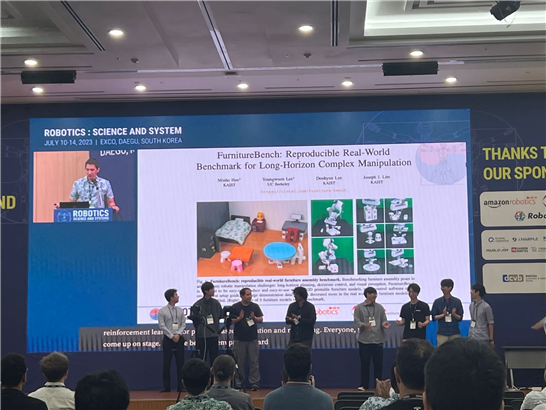
< Photo 1. RSS2023 Best System Paper Award Presentation >
The team of Professor Joseph J. Lim from the Kim Jaechul Graduate School of AI at KAIST has been honored with the 'Best System Paper Award' at "Robotics: Science and Systems (RSS) 2023".
The RSS conference is globally recognized as a leading event for showcasing the latest discoveries and advancements in the field of robotics. It is a venue where the greatest minds in robotics engineering and robot learning come together to share their research breakthroughs. The RSS Best System Paper Award is a prestigious honor granted to a paper that excels in presenting real-world robot system implementation and experimental results.
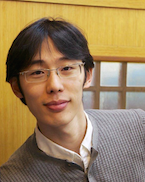
< Photo 2. Professor Joseph J. Lim of Kim Jaechul Graduate School of AI at KAIST >
The team led by Professor Lim, including two Master's students and an alumnus (soon to be appointed at Yonsei University), received the prestigious RSS Best System Paper Award, making it the first-ever achievement for a Korean and for a domestic institution.
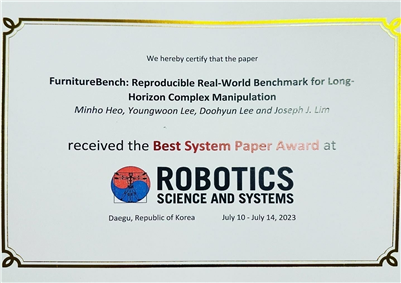
< Photo 3. Certificate of the Best System Paper Award presented at RSS 2023 >
This award is especially meaningful considering the broader challenges in the field. Although recent progress in artificial intelligence and deep learning algorithms has resulted in numerous breakthroughs in robotics, most of these achievements have been confined to relatively simple and short tasks, like walking or pick-and-place. Moreover, tasks are typically performed in simulated environments rather than dealing with more complex, long-horizon real-world tasks such as factory operations or household chores. These limitations primarily stem from the considerable challenge of acquiring data required to develop and validate learning-based AI techniques, particularly in real-world complex tasks.
In light of these challenges, this paper introduced a benchmark that employs 3D printing to simplify the reproduction of furniture assembly tasks in real-world environments. Furthermore, it proposed a standard benchmark for the development and comparison of algorithms for complex and long-horizon tasks, supported by teleoperation data. Ultimately, the paper suggests a new research direction of addressing complex and long-horizon tasks and encourages diverse advancements in research by facilitating reproducible experiments in real-world environments.
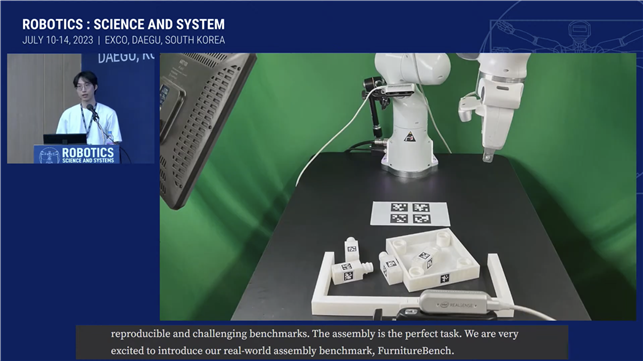
Professor Lim underscored the growing potential for integrating robots into daily life, driven by an aging population and an increase in single-person households. As robots become part of everyday life, testing their performance in real-world scenarios becomes increasingly crucial. He hoped this research would serve as a cornerstone for future studies in this field.
The Master's students, Minho Heo and Doohyun Lee, from the Kim Jaechul Graduate School of AI at KAIST, also shared their aspirations to become global researchers in the domain of robot learning. Meanwhile, the alumnus of Professor Lim's research lab, Dr. Youngwoon Lee, is set to be appointed to the Graduate School of AI at Yonsei University and will continue pursuing research in robot learning.
Paper title: Furniture Bench: Reproducible Real-World Benchmark for Long-Horizon Complex Manipulation. Robotics: Science and Systems.

< Image. Conceptual Summary of the 3D Printing Technology >
-
research KAIST Develops a Venus Flytrap-Inspired 'Robot Hand' Material That Detects What Comes Near and Grasps It Under UV Light
A Venus flytrap closes its leaves to trap prey when it senses a stimulus. Taking inspiration from this plant, KAIST researchers have combined the roles of a skin that senses approaching objects and a muscle that grasps them in a single soft material. When an electrically charged object comes near, ions inside the material move and produce an electrical signal. When ultraviolet (UV) light is applied, the material bends and grasps the object. Because it holds its deformed shape for more than 10
2026-09-30 -
research KAIST’s World-First Full-Course Robot Marathon Completion Published in Nature
A quadruped robot ran 42.195 km, a distance that is not easy even for humans to complete, without replacing its battery. KAIST researchers have developed this world-first achievement into design principles for long-distance operation, published the results in Nature, and are now moving toward commercializing robots that can be used in real industrial environments. KAIST (President Choongsik Bae) announced on the September 24 that the long-distance running technology of RAIBO2, a quadruped rob
2026-09-28 -
research KAIST Develops a Soft 3D-Printed Robotic Hand that Gently Grips Everything from Eggs to a 1 kg Water Bottle
3D printers that once could only produce rigid objects can now create products as soft and stretchable as rubber. A team of Korean researchers used AI to identify the optimal "recipe" for a material that can be printed into complex shapes while stretching to more than six times its original length. The material is expected to expand the range of applications for 3D printing, from robotic hands to form-fitting wearable devices and custom medical devices. KAIST (President Choong-Sik Bae) announ
2026-09-01 -
research KAIST Develops Robot That Judges Its Surroundings and Walks, Runs, and Jumps Like an Animal
An era in which robots decide "how to walk" on their own has arrived. A four-legged robot has been developed that, much like a person or an animal, autonomously chooses the appropriate gait strategy for its surroundings — changing its gait on stairs, leaping over gaps, and keeping its balance on forest trails. KAIST (President Choongsik Bae) announced on the 16th of July that a research team led by Professor Hae-Won Park from the Department of Mechanical Engineering has developed a core
2026-07-16 -
research KAIST Begins Developing the World’s First Brain-to-Robot Technology, Moving Robots by Thought and Sending Sensation Back to the Brain
KAIST researchers have begun developing a next-generation brain-robot interface platform that uses human brain signals to control an exoskeleton in real time and sends the tactile and force information sensed by the robot back to the brain. KAIST, led by President Kwang-Hyung Lee, announced on the 25th that research teams led by Professors Kyoungchul Kong and Jung Kim of its Department of Mechanical Engineering, together with Angel Robotics Co., Ltd., have launched the world’s first bid
2026-06-25