people
President Lee stressed that nurturing medical scientists, semiconductor R&D personnel, startup entrepreneurs, and global innovators are key missions he will continue to pursue during a news conference
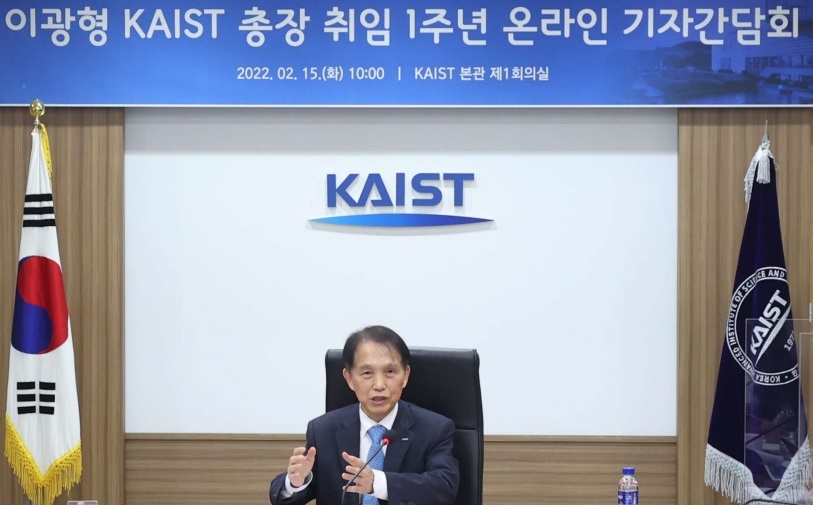
< President Lee holds a news conference marking the 1st anniversary of him becoming the president on February 15. >
KAIST President Kwang Hyung Lee said that nurturing medical scientists, semiconductor R&D personnel, startup entrepreneurs, and global innovators are key missions he will continue to pursue during an online news conference marking the 1st anniversary of him becoming the president on February 15.
He said that nurturing physician-scientists is the most critical mission for KAIST to help the nation create a new growth engine. He said KAIST will help the nation drive the bio-industry and provide medical science resources for the nation’s health sector. To this end, he said that KAIST will open its Medical Science and Technology School by 2026.
“We plan to expand the current Graduate School of Medical Science and Engineering into a new Medical Science and Technology School that will focus entirely on a condensed MD-PhD course converging the fields of AI, bio, and physics,” he said.
The school aims to foster medical scientists whose research results will eventually be commercialized. He said that the university is now discussing revisions to related laws and regulations with the government and other universities.
To supply human resources to the semiconductor industry, President Lee said the university will add a campus in Pyongtaek City that will serve as an advanced convergence research hub in the field of next generation semiconductors in collaboration with Samsung Electronics and the city of Pyongtaek. The three-stage opening plan projected the final opening of the campus by 2036. During the first stage, which will be completed by 2026, it will construct the campus infrastructure in Pyongtaek city where Samsung Semiconductors runs two massive semiconductor complexes. By 2031, it plans to launch the open research platform including a future cities research center and future vehicles research center. The campus will open the global industrial collaboration cluster hub by 2036.
In the global arena, President Lee said he is working to open the New York campus with stakeholders in the United States. He announced the plan last December that was endorsed by New York-based entrepreneur Hee-Nam Bae, the chairman of Big Continent Inc. President Lee and Chairman Lee signed an MOU for the funding to open the campus in New York.
“We are discussing how to facilitate the plan and best accommodate the interests and potential of our students. Many ideas and plans are on the table and we think it will take longer than expected to finalize the plan,” explained President Lee.
However, he added that the basic idea is to offer art tech and health technology programs as well as an AI-based finance MBA at the New York campus, in addition to it serving as the startup accelerator of KAIST.
President Lee stressed the importance of technology commercialization when successfully launching KAIST Holdings last month to help spinoffs of KAIST labs accelerate their end results. He said that KAIST Holdings will build a virtuous supporting system to commercialize the technology startups coming from KAIST.
“We plan to list at least 10 KAIST startups on the KOSDAQ and two on the NASDAQ by 2031. KAIST Holdings also aims to nurture companies valued at a total of one billion KRW and earn 100 billion KRW in technology fees by 2031.
-
research KAIST Develops AI Chip That Recognizes Changes in Motion over Time
For a wearable device to distinguish walking from a brief swing of the arm, it must recognize how a movement changes over time. Korean researchers have developed a technology that stacks semiconductor devices with different response speeds, allowing them to recognize both a change that has just occurred and the changes before it. The technology could be applied to small devices that are worn on or attached to the body to analyze movement and physiological signals. KAIST (President Choongsik B
2026-09-29 -
research KAIST Extends Lifespan of Graphite-Free Anode-Free Batteries That Could Make EV Batteries Smaller and Lighter
Korean researchers have developed a technology that could make electric-vehicle (EV) batteries smaller and lighter while helping EVs travel farther on a single charge. A KAIST research team has proposed a new solution to a persistent problem in anode-free batteries, which reduce weight and volume by eliminating anode materials such as graphite that normally store lithium during charging. In these batteries, lithium can grow into sharp, spike-like structures that shorten battery life. The key l
2026-09-22 -
research Single Material Enables Efficient Charge Injection into Two Types of Ultrathin Semiconductors, Paving the Way for Smaller, More Energy-Efficient AI Chips
A new approach could help make future AI chips smaller and more energy-efficient. A KAIST-led research team has used a single material to address one of the major obstacles facing atomically thin semiconductors, the difficulty of efficiently injecting charge. The technology could contribute to next-generation AI and low-power semiconductor devices in which multiple ultrathin layers are vertically integrated to increase device density and performance. KAIST (President Choongsik Bae) announced
2026-09-16 -
research KAIST Tames a Semiconductor Greenhouse Gas 6,000 Times More Potent Than CO₂ with the ‘Power of Disorder’
Among the gases used in semiconductor manufacturing, tetrafluoromethane (CF₄) is a greenhouse gas over 6,000 times more potent than carbon dioxide. A KAIST research team has developed a technology that removes this gas with high efficiency while extending the usable lifetime of the catalyst that helps break it down by harnessing the ‘power of disorder,’ in which mixing multiple metal atoms together actually stabilizes the catalyst’s structure. KAIST (President Choongsik Bae)
2026-09-03 -
research KAIST Solves 3D Memory Reliability Problem with "Oxygen Tunnel" Structure, Boosting AI Chip Performance and Reducing Power Consumption
As AI systems become more advanced, memory is required to transfer larger amounts of data at higher speeds. But conventional planar semiconductor scaling is running out of room. A KAIST research team has now addressed a key weakness in three-dimensional, vertically stacked memory devices, opening a new path to faster, more power-efficient AI semiconductors. KAIST (President Choongsik Bae) announced on August 25 that a research team led by Professor Jimin Kwon from the School of Electrical Eng
2026-08-20