event
The center is expected to enhance the manufacturing competitiveness of SMEs and root industry
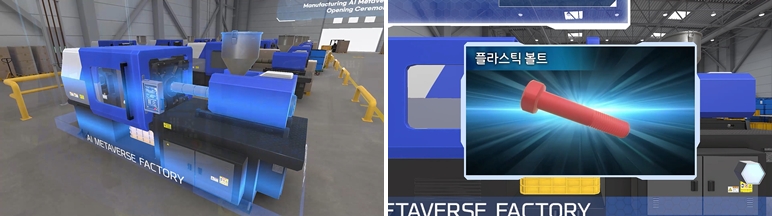
< A plastic bolt manufactured at the Metaverse Factory Center which opened on November 1 at KAIST in collaboration with Digiforet. >
KAIST opened the ‘Metaverse Factory Experience Center for Manufacturing AI’ on November 1 at the KAIST Bigdata Center for Manufacturing AI. The AI-powered manufacturing metaverse factory will provide real-life experiences for the analysis and application of manufacturing data. Funded by the Ministry of SMEs and Startups, the center is a collaboration with Digiforet, which donated the software system to KAIST.
The center allows users to experience the collection, analysis, and utilization process of manufacturing data equivalent to that of real manufacturing sites. Users can connect to the service from anywhere in the world using AR/VR/XR equipment and a metaverse solution, which allows small and middle-sized domestic manufacturing companies to overcome the challenges of entering and selling their production lines overseas in the post-COVID-19 era. The platform is an opportunity for such companies to introduce and export their excellent manufacturing techniques.
With the same manufacturing and AI processes of real production sites, the injection molding metaverse factory for plastic screw production runs simulations of the products they will make. Based on the data collection parameters (temperature, pressure, speed, location, time, etc.) built into the Korea AI Manufacturing Platform, an AI-powered SME manufacturing platform, the metaverse factory can detect causes of defects, provide analysis, and guide improvements in productivity and product quality.
Starting with the injection molding equipment metaverse factory, the platform aims to expand into plating, welding, molding, casting, forging, and annealing, and become a root industry to contribute greatly to enhancing the manufacturing competitiveness of Korea’s small and middle-sized root industries.
Il-Joong Kim, head of the KAIST Manufacturing AI Bigdata Center where the metaverse factory is located, said, “To successfully incorporate manufacturing AI into production sites, it is indispensable that various AI algorithms are tested to optimize decisions. The platform allows users to collect manufacturing data and to experience and test AI analysis simultaneously without interrupting the production process, making it highly effective.”
KAIST President Kwang Hyung Lee said, “We will support the close academic-industrial cooperation with Digiforet such as this collaborative for improving SMEs’ competitiveness.”
Digiforet CEO Sunghoon Park, who donated a whole HW/SW interface for the construction of the Metaverse Factory Experience Center for Manufacturing AI, said, “I will do my best to realize the best “Metaverse Factory for Manufacturing AI” in the world by combining the AI and bigdata accumulated at KAIST and Digiforet’s XR metaverse technology.”
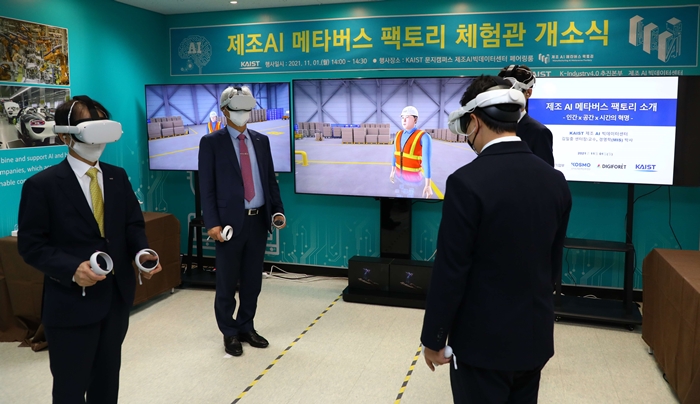
< President Kwang Hyung Lee (far left) and participants at the opening ceremony of the Metaverse Factory Experience Center give a demonstration wearing the AR kits. >
-
research KAIST Develops Healthcare Device Tracking Chronic Diabetic Wounds
A KAIST research team has developed an effective wireless system that monitors the wound healing process by tracking the spatiotemporal temperature changes and heat transfer characteristics of damaged areas such as diabetic wounds. On the 5th of March, KAIST (represented by President Kwang Hyung Lee) announced that the research team led by Professor Kyeongha Kwon from KAIST’s School of Electrical Engineering, in association with Chung-Ang University professor Hanjun Ryu, developed digit
2024-03-11 -
research KAIST Team Develops an Insect-Mimicking Semiconductor to Detect Motion
The recent development of an “intelligent sensor” semiconductor that mimics the optic nerve of insects while operating at ultra-high speeds and low power offers extensive expandability into various innovative technologies. This technology is expected to be applied to various fields including transportation, safety, and security systems, contributing to both industry and society. On February 19, a KAIST research team led by Professor Kyung Min Kim from the Department of Materials S
2024-02-29 -
event KAIST to begin Joint Research to Develop Next-Generation LiDAR System with Hyundai Motor Group
< (From left) Jong-Soo Lee, Executive Vice President at Hyundai Motor, Sang-Yup Lee, Senior Vice President for Research at KAIST > The ‘Hyundai Motor Group-KAIST On-Chip LiDAR Joint Research Lab’ was opened at KAIST’s main campus in Daejeon to develop LiDAR sensors for advanced autonomous vehicles. The joint research lab aims to develop high-performance and compact on-chip sensors and new signal detection technology, which are essential in the increasingly compe
2024-02-27 -
event World-renowned Soprano Sumi Jo and Broadcom CEO Hock Tan awarded honorary doctorate from KAIST
< (From left) Sumi Jo, Distinguished Visiting Professor at the Graduate School of Culture and Technology, and Broadcom President and CEO Hock Tan > KAIST (President Kwang-Hyung Lee) announced that it awarded honorary doctorates to world-renowned soprano Sumi Jo, a distinguished visiting professor at the Graduate School of Culture and Technology, and the President and Chief Executive Officer of Broadcom Inc., Hock Tan, at the graduation ceremony held on the 16th of February, 2024. P
2024-02-17 -
research Genome Sequencing Unveils Mutational Impacts of Radiation on Mammalian Cells
Recent release of the waste water from Japan's Fukushima nuclear disaster stirred apprehension regarding the health implications of radiation exposure. Classified as a Group 1 carcinogen, ionizing radiation has long been associated with various cancers and genetic disorders, as evidenced by survivors and descendants of atomic bombings and the Chernobyl disaster. Despite much smaller amount, we remain consistently exposed to low levels of radiation in everyday life and medical procedures. Radi
2024-02-15