policy
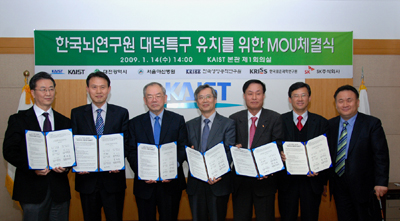
Six major organizations including KAIST have joined forces to help Daejeon City to win the government approval to build the envisioned Korean Brain Institute in Daedeok Research Complex.
The six organizations signed a memorandum of understanding on cooperating in establishing the government-funded institute built within the Daedeok Research Complex in the city of Daejeon, at KAIST on Jan. 14. The six organizations are KAIST, the Daejeon City Government, Korea Research Institute of Bioscience and Biotechnology, Korea Research Institute of Standard and Science, Asan Medical Center, and SK Corp., a pioneer in effective therapeutic invention for serious brain disorders.
The partnership of the six organizations is expected to bring a broad-based cooperation opportunities and create a massive synergy effect in the brain science researches and the development of new therapeutic treatment for brain disorders by combining their resources and infrastructures.
The six organizations have also built an international research network with such globally-renowned brain research institutions as RIKEN, a large natural sciences research institute in Japan, Max Plank Institute in Germany, Federal Institute of Technology, Lausanne, in Switzerland and Brain Research Institute of University of Queensland in Australia. The research network is under the support and guidance of Dennis Choi, a prominent neuroscientist who once served as the President of the Society for Neuroscience and is currently a professor in the Departments of Neurology and biology at Emory University.
The tentatively titled Korea Brain Institute is envisioned to help fight brain disorders and create Korea"s new growth engine, as well as lengthening life span, by conducting convergence researches in nero science, brain science and pharmacology. If the consortium of the six organizations wins the government approval to build the proposed institute within the Daedeok complex, the central government and the Daejeon city government are expected to pour a total of 329.7 billion won into the project by 2020.
-
people KAIST Names Former Samsung Electronics Chairman and CEO Oh Hyun Kwon as Chair of Its Board of Trustees
KAIST announced that its Board of Trustees elected Oh Hyun Kwon, former Chairman and CEO of Samsung Electronics and Chairman of the Orange Planet startup foundation, as its new chair at the board’s 298th extraordinary meeting in Seoul on September 21, 2026. Prior to the election, Kichul Cha, a KAIST trustee and CEO of InBody, had served as acting chair since the term of former Chair Myung Ja Kim ended in late June. Kwon earned a bachelor’s degree in electrical engineering from Seo
2026-09-22 -
research Next-Generation Biological Foundation Model, K-Fold
“Design a drug candidate that binds effectively to this protein.” In response to such a request, AI predicts the protein’s three-dimensional structure, analyzes which compounds are most likely to bind to it, and designs promising drug candidates. KAIST researchers have developed K-Fold, the world's fastest Bio-AI model for protein structure prediction, which also supports drug candidate design. KAIST (President Choongsik Bae) announced on August 28 that it had formed &ldquo
2026-08-28 -
research KAIST Develops Semiconductor Neuron That Tunes Noise to Selectively Process Signals
In electronic devices, irregular fluctuations in signals are generally referred to as “noise.” Because noise interferes with accurate information processing, conventional semiconductor technology has mainly treated it as something to be reduced or eliminated. However, neurons in the human brain do not respond in exactly the same way every time, even to the same stimulus. Tiny internal variations in neurons change when and how often neurons are fired, and this probabilistic operatio
2026-08-18 -
event KAIST Held Inauguration Ceremony for 18th President Choongsik Bae, Unveiling Vision of "Fundamentals First, Innovation Forward"
KAIST announced that it held an inauguration ceremony for its 18th president, Choongsik Bae, at the KAIST Auditorium on Monday, August 10. At the ceremony, the university unveiled "Fundamentals First, Innovation Forward" as its new vision. The ceremony officially presented President Bae's philosophy on university governance and his vision for KAIST's future to the KAIST community and the public. Departing from the conventional format of a formal inaugural address, President Bae personally exp
2026-08-10 -
event KAIST and Seoul National University Students Hold 100-Hour Robot Hackathon to Nurture Physical AI Talent
KAIST (President Choongsik Bae) announced on August 4 that RoboticUS, a joint student organization formed by students from KAIST and Seoul National University, is holding the inaugural Robot Hackathon at KAIST from August 3 to 8. "In the era of Physical AI, we need convergence talent who can go beyond building good AI to design and implement robots and systems that move the real world based on AI," said Choongsik Bae, President of KAIST. "This hackathon, planned and run entirely by students
2026-08-04