%4a%69%6d%69%6e%20%50%61%72%6b
-
 KAIST Turns DNA from Genetic Information Carrier into Energy Designer, Improving Catalyst Performance
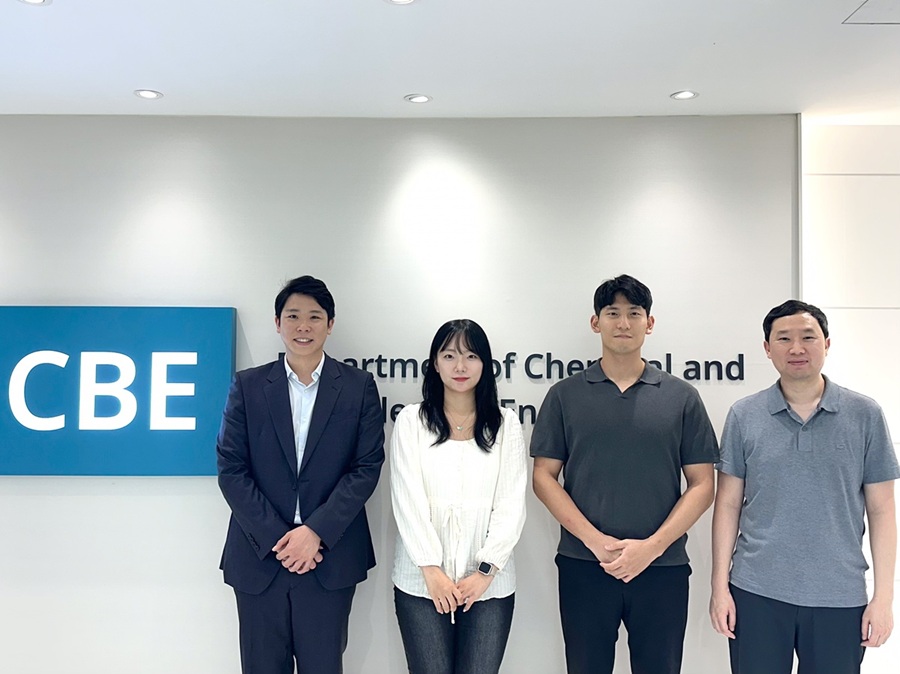
<Professor Jimin Park(Center), Ph.D candidate Tae Kyoung Lee, Ph. D candidate Sang Yeon Oh>
The fixed idea that DNA is only a molecule that stores genetic information is being challenged. KAIST researchers have developed a technology that controls the chemical environment around catalysts at the nanometer scale by designing DNA sequences, the arrangement of A, T, G, and C that make up genetic information. The team has presented a new catalyst platform that can improve hydrogen production efficiency and increase the yield of desired chemical products by designing DNA much like writing a computer program.
KAIST (President Kwang Hyung Lee) announced on the 21st of May that a research team led by Professor Jimin Park of the Department of Chemical and Biomolecular Engineering has developed a core technology that precisely controls the microscopic chemical environment around catalysts by coating the surface of gold nanoparticles, ultrafine gold particles measuring 1–100 nm, with “single-stranded DNA,”a flexible DNA molecule composed of a single strand that can be designed with a desired length and structure and serves as a nano-coating material for controlling the reaction environment.
In electrochemical reactions, which use electricity to drive chemical reactions and are used for hydrogen production or the manufacture of eco-friendly chemicals, performance is determined not only by the catalyst itself but also by the local reaction environment around the catalyst, such as acidity (pH) and ion distribution. However, conventional approaches have relied on special polymer coating materials, plastic-like materials made of long molecular chains, and have faced limitations in precisely designing internal structures at the nanometer scale.
To solve this problem, the research team focused on “single-stranded DNA,” DNA composed of a single strand. DNA carries a negative charge, meaning it can influence the movement of surrounding ions, atoms or molecules with electric charge, and it has the advantage that its length and base sequence can be freely designed. In particular, changing the base sequence allows the internal network structure of DNA to be precisely controlled, making it possible to create a customized nano-coating layer on the catalyst surface.
< Schematic illustration of catalytic interfacial microenvironment regulation using a single-stranded DNA layer >
The research team attached DNA with various base sequences to the surface of gold nanoparticles and analyzed the electrochemical reactions. As a result, they found that the key factor determining catalyst performance was not simply the thickness of the coating layer, but the internal network structure formed according to the DNA base sequence.
This means that even coating layers of the same thickness can create different pathways for the movement of ions needed for reactions, depending on how the internal DNA structure is organized. It is the same principle as traffic flow changing depending on how a road network is designed, even when the roads are the same width.
The team also used real-time surface-enhanced Raman spectroscopy, a technology that uses lasers to analyze the chemical state of molecules in real time, to observe the reaction process. Through this, they directly confirmed that the DNA layer functions as an interfacial layer, a layer that performs a special function at the boundary where two materials meet, by regulating the movement of hydroxide ions (OH⁻) and changing the local pH around the catalyst.
In simple terms, the DNA layer acts like a “traffic control center” around the catalyst, guiding the movement of ions. It helps some ions move more quickly while restricting the movement of others, thereby changing the reaction environment in the desired direction. By observing this process in real time, the researchers proved that DNA is not merely a protective film, but actively regulates the reaction environment.
The team applied this technology to the hydrogen evolution reaction and the glycerol oxidation reaction, which converts glycerol, a byproduct of biodiesel production, into high-value chemicals. As a result, hydrogen production efficiency varied significantly depending on the DNA base sequence, and the selectivity, the proportion of a specific product formed, for glycerate, a material used in cosmetics and pharmaceuticals, also improved. This means that desired reaction outcomes can be achieved simply by adjusting the DNA sequence, without newly creating complex catalyst structures.
< Research image (AI-generated image) >
Professor Jimin Park said, “This study shows that DNA can be used not as a genetic information storage medium, but as a precise nanomaterial that controls electrochemical reactions,” adding, “By designing DNA sequences to control acidity and ion movement on catalyst surfaces, we expect this technology to be broadly applied across carbon-neutral technologies, including hydrogen production and biomass conversion.”
This study was conducted with KAIST Department of Chemical and Biomolecular Engineering doctoral students Sang Yeon Oh and Tae Kyoung Lee as co-first authors, and Professor Jimin Park as the corresponding author. The research was published on May 5 in the internationally renowned Journal of the American Chemical Society.
※ Paper title: “Programmable Single-Stranded DNA Layers as Modulators of Nanoscale pH at Electrocatalytic Interfaces,” DOI: 10.1021/jacs.6c02995
※ Author information: Sang Yeon Oh and Tae Kyoung Lee (KAIST, co-first authors), Jaeyeon Jun, Jinse Woo, Changho Lee, Yongha Kim (KAIST, co-authors), and Jimin Park (KAIST, corresponding author)
This research was supported by the National Research Foundation of Korea’s Outstanding Young Scientist Program , Global Matching Program , and Young Researcher Infrastructure Support Program.
2026.06.08 View 2219
-
 Turning a Toxic Gas into a Therapeutic Tool Using Electricity: The Two Faces of Hydrogen Sulfide
<(From Left) Professor Jimin Park, Dr. Jaewoong Lee, M.S candidate Lian Lim, Ph.D candidate Changho Lee>
KAIST Research Team Develops a 'Bioelectronic Platform' for Precision Hydrogen Sulfide Delivery, Opening New Doors for Digital Healthcare and Precision Medicine
A toxic gas known for its "rotten egg smell" has been transformed into a therapeutic tool. A research team at KAIST has developed a technology to precisely control hydrogen sulfide (H2S) using electrical signals, bringing us one step closer to precision medicine that targets only the desired areas while minimizing side effects.
KAIST announced on March 23 that a research team led by Professor Jimin Park from the Department of Chemical and Biomolecular Engineering has developed a "bioelectronic H2S delivery platform." This platform can precisely regulate the generation and delivery of H2S at specific times and locations.
< Schematic Diagram of a Hydrogen Sulfide–Generating Bioelectronic Platform (AI-Generated Image) >
While H2S has long been recognized as a hazardous substance due to its odor and toxicity, it has recently gained attention as a "biological signaling molecule" that maintains cellular health and regulates protein functions.
In particular, H2S acts as a "chemical switch" that can modulate protein functions by subtly altering their conformations. However, its use in clinical therapy has been limited because it is difficult to control its concentration and deliver it precisely to specific sites. The research team solved these issues by implementing a technology that controls H2S delivery precisely like an electrical switch.
Inspired by the metabolic cycles of bacteria in nature, the team designed a system that generates H2S by applying electricity to thiosulfate ions (S2O32-), a precursor harmless to the human body. This method offers higher safety and precision compared to conventional chemical administration methods.
< Hydrogen Sulfide Regulation Capability Depending on Electrode Materials and Input Parameters >
Furthermore, through a comparative analysis of various metal electrodes, the team identified the "silver (Ag) electrode" as the most efficient material for H2S electrosynthesis. The Ag electrode selectively generates H2S with high electron transfer efficiency, allowing precise control over its production. Using this platform, both the amount and release kinetics of H2S can be finely tuned by adjusting the voltage and electrolysis time, enabling delivery at the optimal time based on the patient’s condition or the treatment site.
When applied to human-derived cells (HEK293T), the research team successfully regulated ion channels (TRPA1), which act as an internal cellular "switch" for sensing pain and irritation. Notably, when applied to cells under oxidative stress (such as those with increased reactive oxygen species), the delivered H2S restored cellular redox balance and demonstrated protective effects. Minimal cytotoxicity was observed, confirming its safety for potential human applications.
< Spatiotemporal Regulation of TRPA1 Activation by a Hydrogen Sulfide–Delivering Bioelectronic Platform >
< Spatiotemporal Recovery of Oxidative Stress Using a Hydrogen Sulfide–Delivering Bioelectronic Platform >
Professor Jimin Park explained, "This study is significant in that it transforms H2S, once regarded solely as a toxic substance, into a new tool for regulating biological systems through precise electrical control." He added, "This technology holds great potential for expansion into precision medical devices for treating neurological and cardiovascular diseases, as well as digital healthcare for real-time health management."
This research involved Lian Lim, Changho Lee, and Jaewoong Lee as co-first authors. The study also included contributions from Myeongeun Lee, Yongha Kim, Tae Kyoung Lee, Gwangbin Lee, Jinsoo Kim, and Sang Yeon Oh, with Professor Jihan Kim as a co-author and Professor Jimin Park as the corresponding author.
The findings were published on March 19 in the internationally renowned academic journal Science Advances.
Paper Title: Bioelectronic Synthesis of Hydrogen Sulfide Enables Spatiotemporal Regulation of Protein Modification and Cellular Redox
DOI: https://doi.org/10.1126/sciadv.aeb3401
This research was supported by the National Research Foundation of Korea (NRF) through the Young Researcher Program and the Global Matching Program.
< Research Illustration (AI-Generated Image) >
2026.03.25 View 1601
-
 KAIST Develops Bioelectrosynthesis Platform for Switch-Like Precision Control of Cell Signaling
<(From left)Professor Jimin Park, Ph.D candidate Myeongeun Lee, Ph.D cadidate Jaewoong Lee,Professor Jihan Kim>
Cells use various signaling molecules to regulate the nervous, immune, and vascular systems. Among these, nitric oxide (NO) and ammonia (NH₃) play important roles, but their chemical instability and gaseous nature make them difficult to generate or control externally. A KAIST research team has developed a platform that generates specific signaling molecules in situ from a single precursor under an applied electrical signal, enabling switch-like, precise spatiotemporal control of cellular responses. This approach could provide a foundation for future medical technologies such as electroceuticals, electrogenetics, and personalized cell therapies.
KAIST (President Kwang Hyung Lee) announced on August 11 that a research team led by Professor Jimin Park from the Department of Chemical and Biomolecular Engineering, in collaboration with Professor Jihan Kim's group, has developed a 'Bioelectrosynthesis Platform' capable of producing either nitric oxide or ammonia on demand using only an electrical signal. The platform allows control over the timing, spatial range, and duration of cell responses.
Inspired by enzymes involved in nitrite reduction, the researchers implemented an electrochemical strategy that selectively produces nitric oxide or ammonia from a single precursor, nitrite (NO₂⁻). By changing the catalyst, the team generated ammonia or nitric oxide from nitrite using a copper-molybdenum-sulfur catalyst (Cu2MoS4) and an iron-incorporated catalyst (FeCuMS4), respectively.
Through electrochemical measurements and computer simulations, the team revealed that Fe sites in the FeCuMoS4 catalyst bind nitric oxide intermediates more strongly, shifting product selectivity toward nitric oxide. Under the same electrical conditions, the Fe-containing catalyst preferentially produces nitric oxide, whereas the Cu2MoS4 catalyst favors ammonia production.
<Figure 1. Schematic diagram of a bio-electrosynthesis platform that synthesizes a desired signaling substance with an electrical signal (left) and the results of precise cell control using it (right)>
The research team demonstrated biological functionality by using the platform to activate ion channels in human cells. Specifically, electrochemically produced nitric oxide activated TRPV1 channels (responsive to heat and chemical stimuli), while electrochemically produced ammonia induced intracellular alkalinization and activated OTOP1 proton channels. By tuning the applied voltage and electrolysis duration, the team modulated the onset time, spatial extent, and termination of cellular responses, which effectively turned cellular signaling on and off like a switch.
<Figure 2. Experimental results showing the change in the production ratio of nitric oxide and ammonia signaling substances according to the type of catalyst (left) and computational simulation results showing the strong bond between iron and nitric oxide (right)>
Professor Jimin Park said, "This work is significant because it enables precise cellular control by selectively producing signaling molecules with electricity. We believe it has strong potential for applications in electroceutical technologies targeting the nervous system or metabolic disorders."
Myeongeun Lee and Jaewoong Lee, Ph.D. students in the Department of Chemical and Biomolecular Engineering at KAIST, served as the co-first authors. Professor Jihan Kim is a co-author. The paper was published online in 'Angewandte Chemie International Edition' on July 8, 2025 (DOI: 10.1002/ange.202508192).
Reference: https://doi.org/10.1002/ange.202508192
Authors: Myeongeun Lee†, Jaewoong Lee†, Yongha Kim, Changho Lee, Sang Yeon Oh, Prof. Jihan Kim, Prof. Jimin Park*
†These authors contributed equally. *Corresponding author.
2025.08.12 View 8313
-
 Professor Jimin Park and Dr. Inho Kim join the ranks of the 2024 "35 Innovators Under 35" by the MIT Technology Review
< (From left) Professor Jimin Park of the Department of Chemical and Biomolecular Engineering and Dr. Inho Kim, a graduate of the Department of Materials Science and Engineering >
KAIST (represented by President Kwang-Hyung Lee) announced on the 13th of September that Professor Jimin Park from KAIST’s Department of Chemical and Biomolecular Engineering and Dr. Inho Kim, a graduate from the Department of Materials Science and Engineering (currently a postdoctoral researcher at Caltech), were selected by the MIT Technology Review as the 2024 "35 Innovators Under 35”.
The MIT Technology Review, first published in 1899 by the Massachusetts Institute of Technology, is the world’s oldest and most influential magazine on science and technology, offering in-depth analysis across various technology fields, expanding knowledge and providing insights into cutting-edge technology trends.
Since 1999, the magazine has annually named 35 innovators under the age of 35, recognizing young talents making groundbreaking contributions in modern technology fields. The recognition is globally considered a prestigious honor and a dream for young researchers in the science and technology community.
< Image 1. Introduction for Professor Jimin Park at the Meet 35 Innovators Under 35 Summit 2024 >
Professor Jimin Park is developing next-generation bio-interfaces that link artificial materials with living organisms, and is engaged in advanced research in areas such as digital healthcare and carbon-neutral compound manufacturing technologies. In 2014, Professor Park was also recognized as one of the ‘Asia Pacific Innovators Under 35’ by the MIT Technology Review, which highlights young scientists in the Asia-Pacific region.
Professor Park responded, “It’s a great honor to be named as one of the young innovators by the MIT Technology Review, a symbol of innovation with a long history. I will continue to pursue challenging, interdisciplinary research to develop next-generation interfaces that seamlessly connect artificial materials and living organisms, from atomic to system levels.”
< Image 2. Introduction for Dr. Inho Kim as the 2024 Innovator of Materials Science for 35 Innovators Under 35 >
Dr. Inho Kim, who earned his PhD from KAIST in 2020 under the supervision of Professor Sang Ouk Kim from the Department of Materials Science and Engineering, recently succeeded in developing a new artificial muscle using composite fibers. This new material is considered the most human-like muscle ever reported in scientific literature, while also being 17 times stronger than natural human muscle.
Dr. Kim is researching the application of artificial muscle fibers in next-generation wearable assistive devices that move more naturally, like humans or animals, noting that the fibers are lightweight, flexible, and exhibit conductivity during contraction, enabling real-time feedback. Recognized for this potential, Dr. Inho Kim was named one of the '35 Innovators Under 35' this year, making him the first researcher to win the honor with the research conducted at KAIST and a PhD earned from Korea.
Dr. Kim stated, “I aim to develop robots using these new materials that can replace today’s expensive and heavy exoskeleton suits by eliminating motors and rigid frames. This will significantly reduce costs and allow for better customization, making cutting-edge technology more accessible to those who need it most, like children with cerebral palsy.”
2024.09.13 View 23181