Campus/People
-
 KPC4IR Publishes Global Standards Mapping Initiative 2.0
The report highlights South Korea as an early adopter of blockchain in policy and business
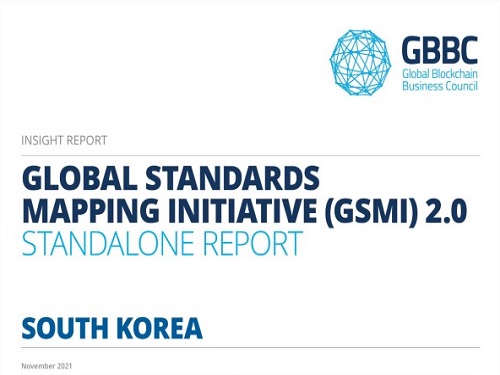
The KAIST Policy Center for the 4IR (KPC4IR), one of the nine working groups of the Global Blockchain Business Council (GBBC), published the Global Standards Mapping Initiative (GSMI) 2.0, highlighting Korea as an early adopter of blockchain. The report also offers an overview of how blockchain was adopted through an analysis of policy and business cases of South Korea.
In partnership with 131 institutions, GSMI 2.0 maps, catalogues, and analyzes data from 187 jurisdictions, 479 industry consortia, 38 technical standards, and 389 university courses and degree programs to provide a holistic view of the industry’s global activity.
Among the nine working groups, KAIST is the sole investigator for researching South Korea’s adoption of blockchain for policy and business. It says that in terms of policy and regulations for blockchain as a virtual asset, South Korea amended the Act on Reporting and Using Specific Financial Transaction Information to comply with the Financial Action Task Force’s recommendations.
The report also reviewed South Korea’s blockchain R&D. Seventeen ministries have funded 417 projects to cultivate blockchain inventions since 2015. Significantly, the Ministry of Science and ICT’s Blockchain Convergence Technology Development Program supported 50 projects between 2018 and 2021. Their R&D focused on virtual assets during the initial stage in 2015 and soon shifted its application to various domains, including identification and logistics.
The report noted that the Korea Customs Service was one of the first agencies in the world to introduce blockchain into customs clearance. Through collaborations with the private sector, the Korean government has also created the world’s first blockchain-based vaccination certification services and extended it to a globally integrated decentralized identity system.
Finally, the report states that these South Korean cases highlight three ambiguities in blockchain policies. First, blockchain involves both financial and industrial features. Thus, it needs a new regulatory framework that embraces the two features together.
Second, integrating services on a blockchain platform will bring forth seamless automation of industries across the manufacturing, financial, and public sectors. South Korea, which already has well-proven manufacturing capabilities, is in need of a comprehensive strategy to encompass multiple services on one platform.
Third, the two cases of the government’s adoption of blockchain suggest that innovations in blockchain can be facilitated through effective cooperation among government ministries and agencies regarding particular businesses in the private sector. Consequently, the government’s policy is not simply to invest in virtual assets but also to develop a virtual-physical world woven by blockchain. The new environment demands that South Korea transform its policy stances on blockchain, from specialization to comprehensiveness and cooperation.
Professor So Young Kim who heads the center said, “This report shows the main lessons from South Korea for other countries adopting blockchain. We will continue to work closely with our partners including the World Economic Forum to investigate many other global issues.”
2021.12.21 View 3353
KPC4IR Publishes Global Standards Mapping Initiative 2.0
The report highlights South Korea as an early adopter of blockchain in policy and business
The KAIST Policy Center for the 4IR (KPC4IR), one of the nine working groups of the Global Blockchain Business Council (GBBC), published the Global Standards Mapping Initiative (GSMI) 2.0, highlighting Korea as an early adopter of blockchain. The report also offers an overview of how blockchain was adopted through an analysis of policy and business cases of South Korea.
In partnership with 131 institutions, GSMI 2.0 maps, catalogues, and analyzes data from 187 jurisdictions, 479 industry consortia, 38 technical standards, and 389 university courses and degree programs to provide a holistic view of the industry’s global activity.
Among the nine working groups, KAIST is the sole investigator for researching South Korea’s adoption of blockchain for policy and business. It says that in terms of policy and regulations for blockchain as a virtual asset, South Korea amended the Act on Reporting and Using Specific Financial Transaction Information to comply with the Financial Action Task Force’s recommendations.
The report also reviewed South Korea’s blockchain R&D. Seventeen ministries have funded 417 projects to cultivate blockchain inventions since 2015. Significantly, the Ministry of Science and ICT’s Blockchain Convergence Technology Development Program supported 50 projects between 2018 and 2021. Their R&D focused on virtual assets during the initial stage in 2015 and soon shifted its application to various domains, including identification and logistics.
The report noted that the Korea Customs Service was one of the first agencies in the world to introduce blockchain into customs clearance. Through collaborations with the private sector, the Korean government has also created the world’s first blockchain-based vaccination certification services and extended it to a globally integrated decentralized identity system.
Finally, the report states that these South Korean cases highlight three ambiguities in blockchain policies. First, blockchain involves both financial and industrial features. Thus, it needs a new regulatory framework that embraces the two features together.
Second, integrating services on a blockchain platform will bring forth seamless automation of industries across the manufacturing, financial, and public sectors. South Korea, which already has well-proven manufacturing capabilities, is in need of a comprehensive strategy to encompass multiple services on one platform.
Third, the two cases of the government’s adoption of blockchain suggest that innovations in blockchain can be facilitated through effective cooperation among government ministries and agencies regarding particular businesses in the private sector. Consequently, the government’s policy is not simply to invest in virtual assets but also to develop a virtual-physical world woven by blockchain. The new environment demands that South Korea transform its policy stances on blockchain, from specialization to comprehensiveness and cooperation.
Professor So Young Kim who heads the center said, “This report shows the main lessons from South Korea for other countries adopting blockchain. We will continue to work closely with our partners including the World Economic Forum to investigate many other global issues.”
2021.12.21 View 3353 -
 KAIST ISPI Releases Report on the Global AI Innovation Landscape
Providing key insights for building a successful AI ecosystem
The KAIST Innovation Strategy and Policy Institute (ISPI) has launched a report on the global innovation landscape of artificial intelligence in collaboration with Clarivate Plc. The report shows that AI has become a key technology and that cross-industry learning is an important AI innovation. It also stresses that the quality of innovation, not volume, is a critical success factor in technological competitiveness.
Key findings of the report include:
• Neural networks and machine learning have been unrivaled in terms of scale and growth (more than 46%), and most other AI technologies show a growth rate of more than 20%.
• Although Mainland China has shown the highest growth rate in terms of AI inventions, the influence of Chinese AI is relatively low. In contrast, the United States holds a leading position in AI-related inventions in terms of both quantity and influence.
• The U.S. and Canada have built an industry-oriented AI technology development ecosystem through organic cooperation with both academia and the Government. Mainland China and South Korea, by contrast, have a government-driven AI technology development ecosystem with relatively low qualitative outputs from the sector.
• The U.S., the U.K., and Canada have a relatively high proportion of inventions in robotics and autonomous control, whereas in Mainland China and South Korea, machine learning and neural networks are making progress. Each country/region produces high-quality inventions in their predominant AI fields, while the U.S. has produced high-impact inventions in almost all AI fields.
“The driving forces in building a sustainable AI innovation ecosystem are important national strategies. A country’s future AI capabilities will be determined by how quickly and robustly it develops its own AI ecosystem and how well it transforms the existing industry with AI technologies. Countries that build a successful AI ecosystem have the potential to accelerate growth while absorbing the AI capabilities of other countries. AI talents are already moving to countries with excellent AI ecosystems,” said Director of the ISPI Wonjoon Kim.
“AI, together with other high-tech IT technologies including big data and the Internet of Things are accelerating the digital transformation by leading an intelligent hyper-connected society and enabling the convergence of technology and business. With the rapid growth of AI innovation, AI applications are also expanding in various ways across industries and in our lives,” added Justin Kim, Special Advisor at the ISPI and a co-author of the report.
2021.12.21 View 4221
KAIST ISPI Releases Report on the Global AI Innovation Landscape
Providing key insights for building a successful AI ecosystem
The KAIST Innovation Strategy and Policy Institute (ISPI) has launched a report on the global innovation landscape of artificial intelligence in collaboration with Clarivate Plc. The report shows that AI has become a key technology and that cross-industry learning is an important AI innovation. It also stresses that the quality of innovation, not volume, is a critical success factor in technological competitiveness.
Key findings of the report include:
• Neural networks and machine learning have been unrivaled in terms of scale and growth (more than 46%), and most other AI technologies show a growth rate of more than 20%.
• Although Mainland China has shown the highest growth rate in terms of AI inventions, the influence of Chinese AI is relatively low. In contrast, the United States holds a leading position in AI-related inventions in terms of both quantity and influence.
• The U.S. and Canada have built an industry-oriented AI technology development ecosystem through organic cooperation with both academia and the Government. Mainland China and South Korea, by contrast, have a government-driven AI technology development ecosystem with relatively low qualitative outputs from the sector.
• The U.S., the U.K., and Canada have a relatively high proportion of inventions in robotics and autonomous control, whereas in Mainland China and South Korea, machine learning and neural networks are making progress. Each country/region produces high-quality inventions in their predominant AI fields, while the U.S. has produced high-impact inventions in almost all AI fields.
“The driving forces in building a sustainable AI innovation ecosystem are important national strategies. A country’s future AI capabilities will be determined by how quickly and robustly it develops its own AI ecosystem and how well it transforms the existing industry with AI technologies. Countries that build a successful AI ecosystem have the potential to accelerate growth while absorbing the AI capabilities of other countries. AI talents are already moving to countries with excellent AI ecosystems,” said Director of the ISPI Wonjoon Kim.
“AI, together with other high-tech IT technologies including big data and the Internet of Things are accelerating the digital transformation by leading an intelligent hyper-connected society and enabling the convergence of technology and business. With the rapid growth of AI innovation, AI applications are also expanding in various ways across industries and in our lives,” added Justin Kim, Special Advisor at the ISPI and a co-author of the report.
2021.12.21 View 4221 -
 Team KAIST to Race at CES 2022 Autonomous Challenge
Five top university autonomous racing teams will compete in a head-to-head passing competition in Las Vegas
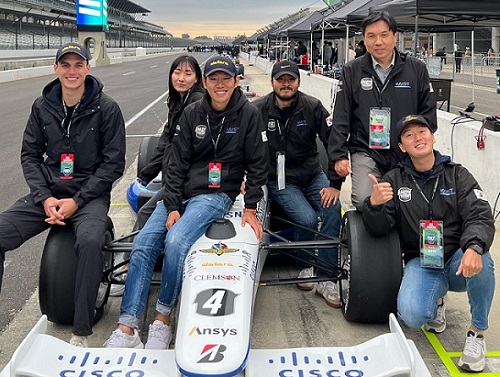
A self-driving racing team from the KAIST Unmanned System Research Group (USRG) advised by Professor Hyunchul Shim will compete at the Autonomous Challenge at the Consumer Electronic Show (CES) on January 7, 2022. The head-to-head, high speed autonomous racecar passing competition at the Las Vegas Motor Speedway will feature the finalists and semifinalists from the Indy Autonomous Challenge in October of this year. Team KAIST qualified as a semifinalist at the Indy Autonomous Challenge and will join four other university teams including the winner of the competition, Technische Universität München.
Team KAIST’s AV-21 vehicle is capable of driving on its own at more than 200km/h will be expected to show a speed of more than 300 km/h at the race.The participating teams are:1. KAIST2. EuroRacing : University of Modena and Reggio Emilia (Italy), University of Pisa (Italy), ETH Zürich (Switzerland), Polish Academy of Sciences (Poland) 3. MIT-PITT-RW, Massachusetts Institute of Technology, University of Pittsburgh, Rochester Institute of Technology, University of Waterloo (Canada)4.PoliMOVE – Politecnico di Milano (Italy), University of Alabama 5.TUM Autonomous Motorsport – Technische Universität München (Germany)
Professor Shim’s team is dedicated to the development and validation of cutting edge technologies for highly autonomous vehicles. In recognition of his pioneering research in unmanned system technologies, Professor Shim was honored with the Grand Prize of the Minister of Science and ICT on December 9.
“We began autonomous vehicle research in 2009 when we signed up for Hyundai Motor Company’s Autonomous Driving Challenge. For this, we developed a complete set of in-house technologies such as low-level vehicle control, perception, localization, and decision making.” In 2019, the team came in third place in the Challenge and they finally won this year.
For years, his team has participated in many unmanned systems challenges at home and abroad, gaining recognition around the world. The team won the inaugural 2016 IROS autonomous drone racing and placed second in the 2018 IROS Autonomous Drone Racing Competition. They also competed in 2017 MBZIRC, ranking fourth in Missions 2 and 3, and fifth in the Grand Challenge.
Most recently, the team won the first round of Lockheed Martin’s Alpha Pilot AI Drone Innovation Challenge. The team is now participating in the DARPA Subterranean Challenge as a member of Team CoSTAR with NASA JPL, MIT, and Caltech.
“We have accumulated plenty of first-hand experience developing autonomous vehicles with the support of domestic companies such as Hyundai Motor Company, Samsung, LG, and NAVER. In 2017, the autonomous vehicle platform “EureCar” that we developed in-house was authorized by the Korean government to lawfully conduct autonomous driving experiment on public roads,” said Professor Shim.
The team has developed various key technologies and algorithms related to unmanned systems that can be categorized into three major components: perception, planning, and control. Considering the characteristics of the algorithms that make up each module, their technology operates using a distributed computing system.
Since 2015, the team has been actively using deep learning algorithms in the form of perception subsystems. Contextual information extracted from multi-modal sensory data gathered via cameras, lidar, radar, GPS, IMU, etc. is forwarded to the planning subsystem. The planning module is responsible for the decision making and planning required for autonomous driving such as lane change determination and trajectory planning, emergency stops, and velocity command generation. The results from the planner are fed into the controller to follow the planned high-level command. The team has also developed and verified the possibility of an end-to-end deep learning based autonomous driving approach that replaces a complex system with one single AI network.
2021.12.17 View 5500
Team KAIST to Race at CES 2022 Autonomous Challenge
Five top university autonomous racing teams will compete in a head-to-head passing competition in Las Vegas
A self-driving racing team from the KAIST Unmanned System Research Group (USRG) advised by Professor Hyunchul Shim will compete at the Autonomous Challenge at the Consumer Electronic Show (CES) on January 7, 2022. The head-to-head, high speed autonomous racecar passing competition at the Las Vegas Motor Speedway will feature the finalists and semifinalists from the Indy Autonomous Challenge in October of this year. Team KAIST qualified as a semifinalist at the Indy Autonomous Challenge and will join four other university teams including the winner of the competition, Technische Universität München.
Team KAIST’s AV-21 vehicle is capable of driving on its own at more than 200km/h will be expected to show a speed of more than 300 km/h at the race.The participating teams are:1. KAIST2. EuroRacing : University of Modena and Reggio Emilia (Italy), University of Pisa (Italy), ETH Zürich (Switzerland), Polish Academy of Sciences (Poland) 3. MIT-PITT-RW, Massachusetts Institute of Technology, University of Pittsburgh, Rochester Institute of Technology, University of Waterloo (Canada)4.PoliMOVE – Politecnico di Milano (Italy), University of Alabama 5.TUM Autonomous Motorsport – Technische Universität München (Germany)
Professor Shim’s team is dedicated to the development and validation of cutting edge technologies for highly autonomous vehicles. In recognition of his pioneering research in unmanned system technologies, Professor Shim was honored with the Grand Prize of the Minister of Science and ICT on December 9.
“We began autonomous vehicle research in 2009 when we signed up for Hyundai Motor Company’s Autonomous Driving Challenge. For this, we developed a complete set of in-house technologies such as low-level vehicle control, perception, localization, and decision making.” In 2019, the team came in third place in the Challenge and they finally won this year.
For years, his team has participated in many unmanned systems challenges at home and abroad, gaining recognition around the world. The team won the inaugural 2016 IROS autonomous drone racing and placed second in the 2018 IROS Autonomous Drone Racing Competition. They also competed in 2017 MBZIRC, ranking fourth in Missions 2 and 3, and fifth in the Grand Challenge.
Most recently, the team won the first round of Lockheed Martin’s Alpha Pilot AI Drone Innovation Challenge. The team is now participating in the DARPA Subterranean Challenge as a member of Team CoSTAR with NASA JPL, MIT, and Caltech.
“We have accumulated plenty of first-hand experience developing autonomous vehicles with the support of domestic companies such as Hyundai Motor Company, Samsung, LG, and NAVER. In 2017, the autonomous vehicle platform “EureCar” that we developed in-house was authorized by the Korean government to lawfully conduct autonomous driving experiment on public roads,” said Professor Shim.
The team has developed various key technologies and algorithms related to unmanned systems that can be categorized into three major components: perception, planning, and control. Considering the characteristics of the algorithms that make up each module, their technology operates using a distributed computing system.
Since 2015, the team has been actively using deep learning algorithms in the form of perception subsystems. Contextual information extracted from multi-modal sensory data gathered via cameras, lidar, radar, GPS, IMU, etc. is forwarded to the planning subsystem. The planning module is responsible for the decision making and planning required for autonomous driving such as lane change determination and trajectory planning, emergency stops, and velocity command generation. The results from the planner are fed into the controller to follow the planned high-level command. The team has also developed and verified the possibility of an end-to-end deep learning based autonomous driving approach that replaces a complex system with one single AI network.
2021.12.17 View 5500 -
 KAIST Plans to Open a New York Campus
President Lee signs an MOU with New York-based Big Continent Inc. Chairman Hee-Nam Bae on funding the New York campus
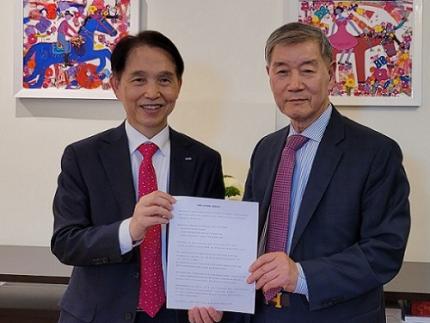
President Kwang Hyung Lee announced a plan to open a KAIST campus in New York with funding from New York-based entrepreneur Hee-Nam Bae. President Lee and Big Continent Inc. Chairman Hee-Nam Bae signed the MOU last week for the funding to open the campus in New York.
President Lee said it will take years to open up a campus in New York in order to conform with both Korean and US legal procedures. However, during a news conference in New York following the signing of the MOU with Chairman Bae, President Lee said this is the first step toward realizing KAIST’s new vision of a ‘Global Twin Strategy’ by making New York KAIST’s newest stronghold to target both domestic and global markets.
“New York is the center of the world’s commerce, culture, and new technologies. If we want to grow big, we should go to one of the biggest cities in the world and New York is the place. I highly encourage our students and faculty go into the world and never be satisfied enjoying the top position in Korea. The next place to investigate will be Silicon Valley,” said President Lee.
“We still have many issues to resolve domestically. We need to discuss more details first with the Board of Trustees and the Korean government,” he added.
The New York campus will aim to become an enterprise-type university to help KAIST create global value. "Our goal is to make sure that Korean businesses gain competitiveness in the global market and can become listed on the NASDAQ. We plan to open majors related to AI, financial engineering, and cultural technologies. We will recruit students from both the US and KAIST to study at our New York campus.” President Lee said.
Chairman Bae, a self-made entrepreneur who immigrated to the US in 1981, also leads the Global Leadership Foundation in the US. “President Lee and I have already toured several candidate sites for the campus in the New York region and we will make a final decision on the best site to purchase,” said Chairman Bae.
Chairman Bae added that he has always dreamed of fostering young global talents who will take on global challenges with pioneering minds. He believes KAIST shares this global vision.
The New York campus will be the first KAIST campus for global students funded by someone from the private sector. This is also a major step forward for KAIST, which was founded by a six million dollar USAID loan in 1971. KAIST announced its plans to establish Kenya KAIST in 2018 with funding from the Korea Eximbank’s 95 million USD development cooperation fund loan to the Kenyan government. KAIST will provide turn-key-based education consultancy featuring curriculum design and the construction of facilities for Kenya’s first advanced science and technology institute. The campus will be located in the Konza Techno City near Nairobi and plans to open in 2023.
2021.12.13 View 5228
KAIST Plans to Open a New York Campus
President Lee signs an MOU with New York-based Big Continent Inc. Chairman Hee-Nam Bae on funding the New York campus
President Kwang Hyung Lee announced a plan to open a KAIST campus in New York with funding from New York-based entrepreneur Hee-Nam Bae. President Lee and Big Continent Inc. Chairman Hee-Nam Bae signed the MOU last week for the funding to open the campus in New York.
President Lee said it will take years to open up a campus in New York in order to conform with both Korean and US legal procedures. However, during a news conference in New York following the signing of the MOU with Chairman Bae, President Lee said this is the first step toward realizing KAIST’s new vision of a ‘Global Twin Strategy’ by making New York KAIST’s newest stronghold to target both domestic and global markets.
“New York is the center of the world’s commerce, culture, and new technologies. If we want to grow big, we should go to one of the biggest cities in the world and New York is the place. I highly encourage our students and faculty go into the world and never be satisfied enjoying the top position in Korea. The next place to investigate will be Silicon Valley,” said President Lee.
“We still have many issues to resolve domestically. We need to discuss more details first with the Board of Trustees and the Korean government,” he added.
The New York campus will aim to become an enterprise-type university to help KAIST create global value. "Our goal is to make sure that Korean businesses gain competitiveness in the global market and can become listed on the NASDAQ. We plan to open majors related to AI, financial engineering, and cultural technologies. We will recruit students from both the US and KAIST to study at our New York campus.” President Lee said.
Chairman Bae, a self-made entrepreneur who immigrated to the US in 1981, also leads the Global Leadership Foundation in the US. “President Lee and I have already toured several candidate sites for the campus in the New York region and we will make a final decision on the best site to purchase,” said Chairman Bae.
Chairman Bae added that he has always dreamed of fostering young global talents who will take on global challenges with pioneering minds. He believes KAIST shares this global vision.
The New York campus will be the first KAIST campus for global students funded by someone from the private sector. This is also a major step forward for KAIST, which was founded by a six million dollar USAID loan in 1971. KAIST announced its plans to establish Kenya KAIST in 2018 with funding from the Korea Eximbank’s 95 million USD development cooperation fund loan to the Kenyan government. KAIST will provide turn-key-based education consultancy featuring curriculum design and the construction of facilities for Kenya’s first advanced science and technology institute. The campus will be located in the Konza Techno City near Nairobi and plans to open in 2023.
2021.12.13 View 5228 -
 Startup Elice Donates 300 Million KRW to School of Computing
Elice hopes to create a virtuous circle that bridges the educational gap
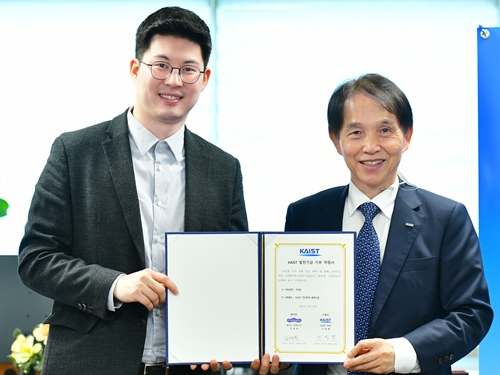
Elice, a student startup from the School of Computing has committed to donate 300 million KRW to KAIST. Jae-Won Kim, CEO of the coding education company, established the startup with his colleagues in 2015. Since then, more than 100 companies, including 17 of Korea’s top 20 companies such as SK and LG have used Elice' digital coding platform to educate employees. More than 200,000 employees have completed the online training with completion rates over 80%.
Kim said during the donation ceremony that he hopes to fund the renovation of the School of Computing building and that he will continue to work on expanding platforms that will help make communication between educators and students more interactive. He explained, “We are making this contribution to create a virtuous circle that bridges the educational gap and improves the quality of education."
President Kwang Hyung Lee was pleased to welcome the student startup’s donation, saying, "Software talent is one of the most precious resources we should foster for the nation’s future. I am thrilled to see that a startup that was founded here on the KAIST campus has grown into a great company that provides excellent coding education for our society.”
Professor Alice Oh, who was the advisor for Kim and his colleagues when they launched the startup, joined the ceremony along with the founding members from KAIST including CPO Su-In Kim, CTO Chong-Kuk Park, and team leader Chang-Hyun Lee.
2021.12.13 View 2603
Startup Elice Donates 300 Million KRW to School of Computing
Elice hopes to create a virtuous circle that bridges the educational gap
Elice, a student startup from the School of Computing has committed to donate 300 million KRW to KAIST. Jae-Won Kim, CEO of the coding education company, established the startup with his colleagues in 2015. Since then, more than 100 companies, including 17 of Korea’s top 20 companies such as SK and LG have used Elice' digital coding platform to educate employees. More than 200,000 employees have completed the online training with completion rates over 80%.
Kim said during the donation ceremony that he hopes to fund the renovation of the School of Computing building and that he will continue to work on expanding platforms that will help make communication between educators and students more interactive. He explained, “We are making this contribution to create a virtuous circle that bridges the educational gap and improves the quality of education."
President Kwang Hyung Lee was pleased to welcome the student startup’s donation, saying, "Software talent is one of the most precious resources we should foster for the nation’s future. I am thrilled to see that a startup that was founded here on the KAIST campus has grown into a great company that provides excellent coding education for our society.”
Professor Alice Oh, who was the advisor for Kim and his colleagues when they launched the startup, joined the ceremony along with the founding members from KAIST including CPO Su-In Kim, CTO Chong-Kuk Park, and team leader Chang-Hyun Lee.
2021.12.13 View 2603 -
 A Judicial Scrivener in His 90s Donates to AI Research
Dong-Myoung Kim donated 2 billion KRW to fund the Kim Jae-Chul AI Graduate School
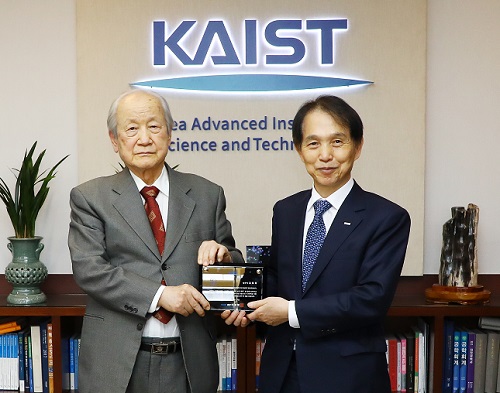
Dong-Myong Kim, a 90-year-old resident living in Seongnam City in Kyonggido made a gift of 300 million KRW in cash and property valued at 1.7 billion KRW to fund the Kim Jae-Chul AI Graduate School. KAIST President Kwang Hyung Lee and a senior leadership team warmly received Kim during the donation ceremony on December 6 and delivered a plaque of appreciation.
Kim, a certified judicial scrivener, sent a letter regarding his intention to donate to the KAIST Development Foundation Office in October. Development foundation officers contacted him for a meeting and presented the major achievements of KAIST and new vision for the future during the meeting. After meeting with KAIST officials, Kim completed all the legal procedures for donating such as handing over the title of his property.
A Development Foundation official said that Kim was well aware of what KAIST has achieved and is doing now. “He had already searched KAIST’s website and scrutinized what we are doing now. He was clear about his intentions,” said the official.
Kim said that media news reports on the recent series of huge donations to KAIST inspired him. “I thought there was something special behind the donors’ intention to make such a decision.”
Kim said the studies on futurism he started in the 1980s led him to become interested in new technologies. “I firmly believe that KAIST will make huge contributions to the nation and our society through advances in science and technology. It is said that the joy of giving is much larger than that of receiving. I am now experiencing such immense joy. I will be even happier if KAIST can lead the nation through its AI research.”
President Kwang Hyung Lee said Kim’s letter of intention touched him deeply. He thanked Kim, saying that the entire KAIST community will make every effort to respond to Kim’s donation wishes.
2021.12.08 View 2692
A Judicial Scrivener in His 90s Donates to AI Research
Dong-Myoung Kim donated 2 billion KRW to fund the Kim Jae-Chul AI Graduate School
Dong-Myong Kim, a 90-year-old resident living in Seongnam City in Kyonggido made a gift of 300 million KRW in cash and property valued at 1.7 billion KRW to fund the Kim Jae-Chul AI Graduate School. KAIST President Kwang Hyung Lee and a senior leadership team warmly received Kim during the donation ceremony on December 6 and delivered a plaque of appreciation.
Kim, a certified judicial scrivener, sent a letter regarding his intention to donate to the KAIST Development Foundation Office in October. Development foundation officers contacted him for a meeting and presented the major achievements of KAIST and new vision for the future during the meeting. After meeting with KAIST officials, Kim completed all the legal procedures for donating such as handing over the title of his property.
A Development Foundation official said that Kim was well aware of what KAIST has achieved and is doing now. “He had already searched KAIST’s website and scrutinized what we are doing now. He was clear about his intentions,” said the official.
Kim said that media news reports on the recent series of huge donations to KAIST inspired him. “I thought there was something special behind the donors’ intention to make such a decision.”
Kim said the studies on futurism he started in the 1980s led him to become interested in new technologies. “I firmly believe that KAIST will make huge contributions to the nation and our society through advances in science and technology. It is said that the joy of giving is much larger than that of receiving. I am now experiencing such immense joy. I will be even happier if KAIST can lead the nation through its AI research.”
President Kwang Hyung Lee said Kim’s letter of intention touched him deeply. He thanked Kim, saying that the entire KAIST community will make every effort to respond to Kim’s donation wishes.
2021.12.08 View 2692 -
 KI-Robotics Wins the 2021 Hyundai Motor Autonomous Driving Challenge
Professor Hyunchul Shim’s autonomous driving team topped the challenge
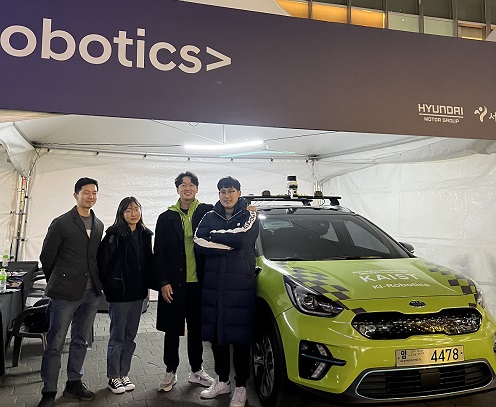
KI-Robotics, a KAIST autonomous driving research team led by Professor Hyunchul Shim from the School of Electric Engineering won the 2021 Hyundai Motor Autonomous Driving Challenge held in Seoul on November 29. The KI-Robotics team received 100 million won in prize money and a field trip to the US.
Out of total 23 teams, the six teams competed in the finals by simultaneously driving through a 4km section within the test operation region, where other traffic was constrained. The challenge included avoiding and overtaking vehicles, crossing intersections, and keeping to traffic laws including traffic lights, lanes, speed limit, and school zones. The contestants were ranked by their order of course completion, but points were deducted every time they violated a traffic rule. A driver and an invigilator rode in each car in case of an emergency, and the race was broadcasted live on a large screen on stage and via YouTube.
In the first round, KI-Robotics came in first with a score of 11 minutes and 27 seconds after a tight race with Incheon University. Although the team’s result in the second round exceeded 16 minutes due to traffic conditions like traffic lights, the 11 minutes and 27 seconds ultimately ranked first out of the six universities. It is worth noting that KI-Robotics focused on its vehicle’s perception and judgement rather than speed when building its algorithm. Out of the six universities that made it to the final round, KI-Robotics was the only team that excluded GPS from the vehicle to minimize its risk.
The team considered the fact that GPS signals are not accurate in urban settings, meaning location errors can cause problems while driving. As an alternative, the team added three radar sensors and cameras in the front and the back of the vehicle. They also used the urban-specific SLAM technology they developed to construct a precise map and were more successful in location determination.
As opposed to other teams that focused on speed, the KAIST team also developed overtaking route construction technology, taking into consideration the locations of surrounding cars, which gave them an advantage in responding to obstacles while keeping to real urban traffic rules. Through this, the KAIST team could score highest in rounds one and two combined.
Professor Shim said, “I am very glad that the autonomous driving technology our research team has been developing over the last ten years has borne fruit. I would like to thank the leader, Daegyu Lee, and all the students that participated in the development, as they did more than their best under difficult conditions.”
Dae-Gyu Lee, the leader of KI-Robotics and a Ph.D. candidate in the School of Electrical Engineering, explained, “Since we came in fourth in the preliminary round, we were further behind than we expected. But we were able to overtake the cars ahead of us and shorten our record.”
2021.12.07 View 3468
KI-Robotics Wins the 2021 Hyundai Motor Autonomous Driving Challenge
Professor Hyunchul Shim’s autonomous driving team topped the challenge
KI-Robotics, a KAIST autonomous driving research team led by Professor Hyunchul Shim from the School of Electric Engineering won the 2021 Hyundai Motor Autonomous Driving Challenge held in Seoul on November 29. The KI-Robotics team received 100 million won in prize money and a field trip to the US.
Out of total 23 teams, the six teams competed in the finals by simultaneously driving through a 4km section within the test operation region, where other traffic was constrained. The challenge included avoiding and overtaking vehicles, crossing intersections, and keeping to traffic laws including traffic lights, lanes, speed limit, and school zones. The contestants were ranked by their order of course completion, but points were deducted every time they violated a traffic rule. A driver and an invigilator rode in each car in case of an emergency, and the race was broadcasted live on a large screen on stage and via YouTube.
In the first round, KI-Robotics came in first with a score of 11 minutes and 27 seconds after a tight race with Incheon University. Although the team’s result in the second round exceeded 16 minutes due to traffic conditions like traffic lights, the 11 minutes and 27 seconds ultimately ranked first out of the six universities. It is worth noting that KI-Robotics focused on its vehicle’s perception and judgement rather than speed when building its algorithm. Out of the six universities that made it to the final round, KI-Robotics was the only team that excluded GPS from the vehicle to minimize its risk.
The team considered the fact that GPS signals are not accurate in urban settings, meaning location errors can cause problems while driving. As an alternative, the team added three radar sensors and cameras in the front and the back of the vehicle. They also used the urban-specific SLAM technology they developed to construct a precise map and were more successful in location determination.
As opposed to other teams that focused on speed, the KAIST team also developed overtaking route construction technology, taking into consideration the locations of surrounding cars, which gave them an advantage in responding to obstacles while keeping to real urban traffic rules. Through this, the KAIST team could score highest in rounds one and two combined.
Professor Shim said, “I am very glad that the autonomous driving technology our research team has been developing over the last ten years has borne fruit. I would like to thank the leader, Daegyu Lee, and all the students that participated in the development, as they did more than their best under difficult conditions.”
Dae-Gyu Lee, the leader of KI-Robotics and a Ph.D. candidate in the School of Electrical Engineering, explained, “Since we came in fourth in the preliminary round, we were further behind than we expected. But we were able to overtake the cars ahead of us and shorten our record.”
2021.12.07 View 3468 -
 A Team of Three PhD Candidates Wins the Korea Semiconductor Design Contest
“We felt a sense of responsibility to help the nation advance its semiconductor design technology”
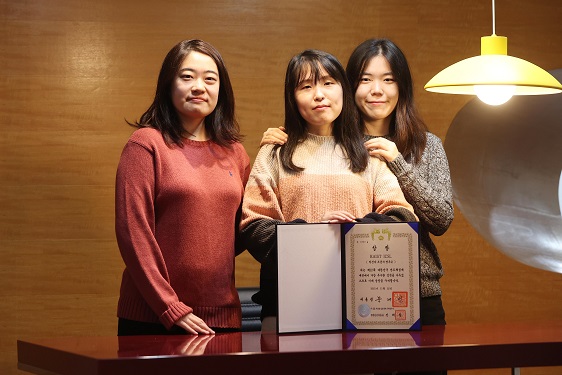
A CMOS (complementary metal-oxide semiconductor)-based “ultra-low noise signal chip” for 6G communications designed by three PhD candidates at the KAIST School of Electrical Engineering won the Presidential Award at the 22nd Korea Semiconductor Design Contest.
The winners are PhD candidates Sun-Eui Park, Yoon-Seo Cho, and Ju-Eun Bang from the Integrated Circuits and System Lab run by Professor Jaehyouk Choi. The contest, which is hosted by the Ministry of Trade, Industry and Energy and the Korea Semiconductors Industry Association, is one of the top national semiconductor design contests for college students.
Park said the team felt a sense of responsibility to help advance semiconductor design technology in Korea when deciding to participate the contest. The team expressed deep gratitude to Professor Choi for guiding their research on 6G communications.
“Our colleagues from other labs and seniors who already graduated helped us a great deal, so we owe them a lot,” explained Park. Cho added that their hard work finally got recognized and that acknowledgement pushes her to move forward with her research. Meanwhile, Bang said she is delighted to see that many people seem to be interested in her research topic.
Research for 6G is attempting to reach 1 tera bps (Tbps), 50 times faster than 5G communications with transmission speeds of up to 20 gigabytes. In general, the wider the communication frequency band, the higher the data transmission speed. Thus, the use of frequency bands above 100 gigahertz is essential for delivering high data transmission speeds for 6G communications.
However, it remains a big challenge to make a precise benchmark signal that can be used as a carrier wave in a high frequency band. Despite the advantages of CMOS’s ultra-small and low-power design, it still has limitations at high frequency bands and its operating frequency. Thus, it was difficult to achieve a frequency band above 100 gigahertz.
To overcome these challenges, the three students introduced ultra-low noise signal generation technology that can support high-order modulation technologies. This technology is expected to contribute to increasing the price competitiveness and density of 6G communication chips that will be used in the future.
5G just got started in 2020 and still has long way to go for full commercialization. Nevertheless, many researchers have started preparing for 6G technology, targeting 2030 since a new cellular communication appears in every other decade.
Professor Choi said, “Generating ultra-high frequency signals in bands above 100 GHz with highly accurate timing is one of the key technologies for implementing 6G communication hardware. Our research is significant for the development of the world’s first semiconductor chip that will use the CMOS process to achieve noise performance of less than 80fs in a frequency band above 100 GHz.”
The team members plan to work as circuit designers in Korean semiconductor companies after graduation. “We will continue to research the development of signal generators on the topic of award-winning 6G. We would like to continue our research on high-speed circuit designs such as ultra-fast analog-to-digital converters,” Park added.
2021.11.30 View 4541
A Team of Three PhD Candidates Wins the Korea Semiconductor Design Contest
“We felt a sense of responsibility to help the nation advance its semiconductor design technology”
A CMOS (complementary metal-oxide semiconductor)-based “ultra-low noise signal chip” for 6G communications designed by three PhD candidates at the KAIST School of Electrical Engineering won the Presidential Award at the 22nd Korea Semiconductor Design Contest.
The winners are PhD candidates Sun-Eui Park, Yoon-Seo Cho, and Ju-Eun Bang from the Integrated Circuits and System Lab run by Professor Jaehyouk Choi. The contest, which is hosted by the Ministry of Trade, Industry and Energy and the Korea Semiconductors Industry Association, is one of the top national semiconductor design contests for college students.
Park said the team felt a sense of responsibility to help advance semiconductor design technology in Korea when deciding to participate the contest. The team expressed deep gratitude to Professor Choi for guiding their research on 6G communications.
“Our colleagues from other labs and seniors who already graduated helped us a great deal, so we owe them a lot,” explained Park. Cho added that their hard work finally got recognized and that acknowledgement pushes her to move forward with her research. Meanwhile, Bang said she is delighted to see that many people seem to be interested in her research topic.
Research for 6G is attempting to reach 1 tera bps (Tbps), 50 times faster than 5G communications with transmission speeds of up to 20 gigabytes. In general, the wider the communication frequency band, the higher the data transmission speed. Thus, the use of frequency bands above 100 gigahertz is essential for delivering high data transmission speeds for 6G communications.
However, it remains a big challenge to make a precise benchmark signal that can be used as a carrier wave in a high frequency band. Despite the advantages of CMOS’s ultra-small and low-power design, it still has limitations at high frequency bands and its operating frequency. Thus, it was difficult to achieve a frequency band above 100 gigahertz.
To overcome these challenges, the three students introduced ultra-low noise signal generation technology that can support high-order modulation technologies. This technology is expected to contribute to increasing the price competitiveness and density of 6G communication chips that will be used in the future.
5G just got started in 2020 and still has long way to go for full commercialization. Nevertheless, many researchers have started preparing for 6G technology, targeting 2030 since a new cellular communication appears in every other decade.
Professor Choi said, “Generating ultra-high frequency signals in bands above 100 GHz with highly accurate timing is one of the key technologies for implementing 6G communication hardware. Our research is significant for the development of the world’s first semiconductor chip that will use the CMOS process to achieve noise performance of less than 80fs in a frequency band above 100 GHz.”
The team members plan to work as circuit designers in Korean semiconductor companies after graduation. “We will continue to research the development of signal generators on the topic of award-winning 6G. We would like to continue our research on high-speed circuit designs such as ultra-fast analog-to-digital converters,” Park added.
2021.11.30 View 4541 -
 Renault 5 EV and Canoo’s Pickup Truck Win the 2021 FMOTY Awards
KAIST Future Mobility of the Year Awards recognize the most innovative concept cars of the year
The Renault 5 EV from France and a pickup truck from the US startup Canoo won the 2021 Future Mobility of the Year Awards (FMOTY) hosted by the Cho Chun Shik Graduate School of Green Transportation at KAIST. The awards ceremony was held at Renault Samsung Motors in Seoul on November 25.
KAIST began the FMOTY in 2019 to advance future car technology and stimulate growth in the industry. The award recognizes the most innovative ideas for making the most futuristic concept car and improving the technological and social value of the industry.
The awards ceremony was attended by KAIST President Kwang Hyung Lee, the dean of the Cho Chun Shik Graduate School of Green Transportation In Gwun Jang, CEO of Renault Samsung Motors Dominique Signora, and CEO of Canoo Tony Aquila. President Lee said, “The new world order will be impacted by new technology developers who envision the future. Their innovation and creative ideas will open a new world of sustainable future transportation.”
Out of the 46 concept cars revealed at global motor exhibitions between last year and the first quarter of this year, models demonstrating transport technology useful for future society and innovative service were selected in the categories of passenger cars and commercial vehicles.
Sixteen automotive journalists from 11 countries, including the chief editor of Car Magazine in Germany Georg Kacher and editorial director of BBC Top Gear Charlie Turner, participated as judges.
This year’s award for the best concept car for a passenger vehicle went to an electric vehicle, the Renault 5 EV. The compact electric car was highly regarded for its practicality and environmental friendliness. A pickup truck by Canoo, an American EV manufacturing start-up, won the award in the commercial vehicle category. The pickup features an innovative design allowing for a variety of functions topped with a competitive price and it received overwhelming support from the judges.
While Hyundai Motors swept both prizes at the awards last year and demonstrated the potential of Korean concept cars, Canoo’s win in the commercial vehicle section as a young American venture company brought attention to the changing dynamics in the automotive market. This shows that young EV start-ups can compete with existing car companies as the automotive paradigm is shifting from those with internal combustion engines to EVs.
The awards organizers said that the Cho Chun Shik Graduate School of Green Transportation will continue to hold the FMOTY to lead the fast-changing global mobility market. For more information, please visit www.fmoty.org.
2021.11.26 View 3819
Renault 5 EV and Canoo’s Pickup Truck Win the 2021 FMOTY Awards
KAIST Future Mobility of the Year Awards recognize the most innovative concept cars of the year
The Renault 5 EV from France and a pickup truck from the US startup Canoo won the 2021 Future Mobility of the Year Awards (FMOTY) hosted by the Cho Chun Shik Graduate School of Green Transportation at KAIST. The awards ceremony was held at Renault Samsung Motors in Seoul on November 25.
KAIST began the FMOTY in 2019 to advance future car technology and stimulate growth in the industry. The award recognizes the most innovative ideas for making the most futuristic concept car and improving the technological and social value of the industry.
The awards ceremony was attended by KAIST President Kwang Hyung Lee, the dean of the Cho Chun Shik Graduate School of Green Transportation In Gwun Jang, CEO of Renault Samsung Motors Dominique Signora, and CEO of Canoo Tony Aquila. President Lee said, “The new world order will be impacted by new technology developers who envision the future. Their innovation and creative ideas will open a new world of sustainable future transportation.”
Out of the 46 concept cars revealed at global motor exhibitions between last year and the first quarter of this year, models demonstrating transport technology useful for future society and innovative service were selected in the categories of passenger cars and commercial vehicles.
Sixteen automotive journalists from 11 countries, including the chief editor of Car Magazine in Germany Georg Kacher and editorial director of BBC Top Gear Charlie Turner, participated as judges.
This year’s award for the best concept car for a passenger vehicle went to an electric vehicle, the Renault 5 EV. The compact electric car was highly regarded for its practicality and environmental friendliness. A pickup truck by Canoo, an American EV manufacturing start-up, won the award in the commercial vehicle category. The pickup features an innovative design allowing for a variety of functions topped with a competitive price and it received overwhelming support from the judges.
While Hyundai Motors swept both prizes at the awards last year and demonstrated the potential of Korean concept cars, Canoo’s win in the commercial vehicle section as a young American venture company brought attention to the changing dynamics in the automotive market. This shows that young EV start-ups can compete with existing car companies as the automotive paradigm is shifting from those with internal combustion engines to EVs.
The awards organizers said that the Cho Chun Shik Graduate School of Green Transportation will continue to hold the FMOTY to lead the fast-changing global mobility market. For more information, please visit www.fmoty.org.
2021.11.26 View 3819 -
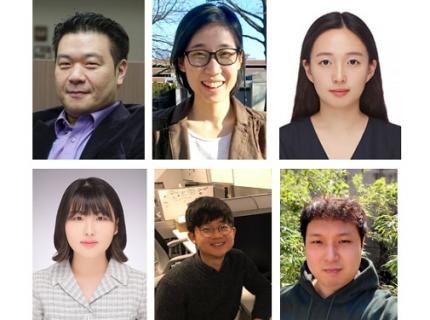 Professor Sung-Ju Lee’s Team Wins the Best Paper and the Methods Recognition Awards at the ACM CSCW
A research team led by Professor Sung-Ju Lee at the School of Electrical Engineering won the Best Paper Award and the Methods Recognition Award from ACM CSCW (International Conference on Computer-Supported Cooperative Work and Social Computing) 2021 for their paper “Reflect, not Regret: Understanding Regretful Smartphone Use with App Feature-Level Analysis”.
Founded in 1986, CSCW has been a premier conference on HCI (Human Computer Interaction) and Social Computing. This year, 340 full papers were presented and the best paper awards are given to the top 1% papers of the submitted. Methods Recognition, which is a new award, is given “for strong examples of work that includes well developed, explained, or implemented methods, and methodological innovation.”
Hyunsung Cho (KAIST alumus and currently a PhD candidate at Carnegie Mellon University), Daeun Choi (KAIST undergraduate researcher), Donghwi Kim (KAIST PhD Candidate), Wan Ju Kang (KAIST PhD Candidate), and Professor Eun Kyoung Choe (University of Maryland and KAIST alumna) collaborated on this research.
The authors developed a tool that tracks and analyzes which features of a mobile app (e.g., Instagram’s following post, following story, recommended post, post upload, direct messaging, etc.) are in use based on a smartphone’s User Interface (UI) layout. Utilizing this novel method, the authors revealed which feature usage patterns result in regretful smartphone use.
Professor Lee said, “Although many people enjoy the benefits of smartphones, issues have emerged from the overuse of smartphones. With this feature level analysis, users can reflect on their smartphone usage based on finer grained analysis and this could contribute to digital wellbeing.”
2021.11.22 View 3549
Professor Sung-Ju Lee’s Team Wins the Best Paper and the Methods Recognition Awards at the ACM CSCW
A research team led by Professor Sung-Ju Lee at the School of Electrical Engineering won the Best Paper Award and the Methods Recognition Award from ACM CSCW (International Conference on Computer-Supported Cooperative Work and Social Computing) 2021 for their paper “Reflect, not Regret: Understanding Regretful Smartphone Use with App Feature-Level Analysis”.
Founded in 1986, CSCW has been a premier conference on HCI (Human Computer Interaction) and Social Computing. This year, 340 full papers were presented and the best paper awards are given to the top 1% papers of the submitted. Methods Recognition, which is a new award, is given “for strong examples of work that includes well developed, explained, or implemented methods, and methodological innovation.”
Hyunsung Cho (KAIST alumus and currently a PhD candidate at Carnegie Mellon University), Daeun Choi (KAIST undergraduate researcher), Donghwi Kim (KAIST PhD Candidate), Wan Ju Kang (KAIST PhD Candidate), and Professor Eun Kyoung Choe (University of Maryland and KAIST alumna) collaborated on this research.
The authors developed a tool that tracks and analyzes which features of a mobile app (e.g., Instagram’s following post, following story, recommended post, post upload, direct messaging, etc.) are in use based on a smartphone’s User Interface (UI) layout. Utilizing this novel method, the authors revealed which feature usage patterns result in regretful smartphone use.
Professor Lee said, “Although many people enjoy the benefits of smartphones, issues have emerged from the overuse of smartphones. With this feature level analysis, users can reflect on their smartphone usage based on finer grained analysis and this could contribute to digital wellbeing.”
2021.11.22 View 3549 -
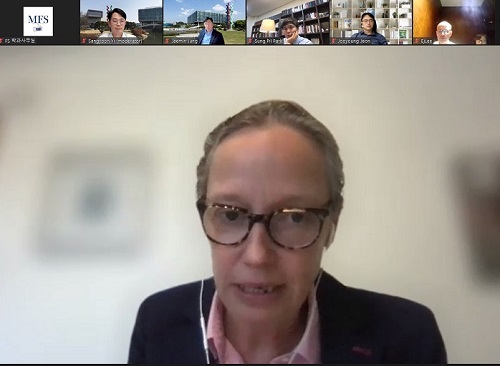 Marien Buissonniere Awarded the 9th Grand Award for Future Strategy
Global healthcare and humanitarian activist honored by the Grand Award for Future Strategy
The Moon Soul Graduate School of Future Strategy awarded the 9th Grand Award for Future Strategy to Marine Buissonniere, an independent advisor and practitioner in the fields of global health and humanitarian action. She currently works as a senior advisor to the Prevent Epidemics team at Resolve to Save Lives. She also co-chairs Doctors Without Borders’ Transformational Investment Capacity.
Buissonniere was recognized for designing and implementing global response strategies in global strife and disaster stricken areas over the 25 years while serving as secretary general of Doctors Without Borders. She has been working with various government agencies around the world including Resolve to Save Lives to respond to the Covid-19 pandemic and preparing global future strategies for the post-pandemic era.
The Grand Award for Future Strategy recognizes individual and organization who have contributed to the nation and humanity through future research and strategies in the fields of science and technology, economy and industry, society and culture, politics and governance, and resources and environment.
The selection committee place particular emphasis on her humanitarian efforts toward North Korea. She was in charge of the task force for resuming the health project in North Korea and facilitated the North Korean program in 2002. She also played a significant role in raising awareness of North Korea’s humanitarian issues in the international community by lecturing at Columbia and Princeton.
Buissonniere said during the awards ceremony held online on November 5, “I am very grateful to receive this award from KAIST, a world’s top-flight university as well as from South Korea related to the Korean Peninsula and North Korea, where I have spent most of my life. What makes this award even more special is it is about the international medical relief activities and system innovations that I’ve devoted my life to over the last 25 years. I am going to continue this journey to help many people in difficult situations. Eventually, I would like to make it possible for those people in need to make their own future by themselves.”
2021.11.11 View 3403
Marien Buissonniere Awarded the 9th Grand Award for Future Strategy
Global healthcare and humanitarian activist honored by the Grand Award for Future Strategy
The Moon Soul Graduate School of Future Strategy awarded the 9th Grand Award for Future Strategy to Marine Buissonniere, an independent advisor and practitioner in the fields of global health and humanitarian action. She currently works as a senior advisor to the Prevent Epidemics team at Resolve to Save Lives. She also co-chairs Doctors Without Borders’ Transformational Investment Capacity.
Buissonniere was recognized for designing and implementing global response strategies in global strife and disaster stricken areas over the 25 years while serving as secretary general of Doctors Without Borders. She has been working with various government agencies around the world including Resolve to Save Lives to respond to the Covid-19 pandemic and preparing global future strategies for the post-pandemic era.
The Grand Award for Future Strategy recognizes individual and organization who have contributed to the nation and humanity through future research and strategies in the fields of science and technology, economy and industry, society and culture, politics and governance, and resources and environment.
The selection committee place particular emphasis on her humanitarian efforts toward North Korea. She was in charge of the task force for resuming the health project in North Korea and facilitated the North Korean program in 2002. She also played a significant role in raising awareness of North Korea’s humanitarian issues in the international community by lecturing at Columbia and Princeton.
Buissonniere said during the awards ceremony held online on November 5, “I am very grateful to receive this award from KAIST, a world’s top-flight university as well as from South Korea related to the Korean Peninsula and North Korea, where I have spent most of my life. What makes this award even more special is it is about the international medical relief activities and system innovations that I’ve devoted my life to over the last 25 years. I am going to continue this journey to help many people in difficult situations. Eventually, I would like to make it possible for those people in need to make their own future by themselves.”
2021.11.11 View 3403 -
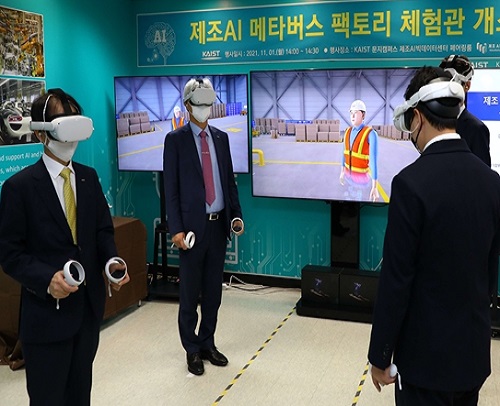 Metaverse Factory Center to Improve SME’s Competitiveness
The center is expected to enhance the manufacturing competitiveness of SMEs and root industry
KAIST opened the ‘Metaverse Factory Experience Center for Manufacturing AI’ on November 1 at the KAIST Bigdata Center for Manufacturing AI. The AI-powered manufacturing metaverse factory will provide real-life experiences for the analysis and application of manufacturing data. Funded by the Ministry of SMEs and Startups, the center is a collaboration with Digiforet, which donated the software system to KAIST.
The center allows users to experience the collection, analysis, and utilization process of manufacturing data equivalent to that of real manufacturing sites. Users can connect to the service from anywhere in the world using AR/VR/XR equipment and a metaverse solution, which allows small and middle-sized domestic manufacturing companies to overcome the challenges of entering and selling their production lines overseas in the post-COVID-19 era. The platform is an opportunity for such companies to introduce and export their excellent manufacturing techniques.
With the same manufacturing and AI processes of real production sites, the injection molding metaverse factory for plastic screw production runs simulations of the products they will make. Based on the data collection parameters (temperature, pressure, speed, location, time, etc.) built into the Korea AI Manufacturing Platform, an AI-powered SME manufacturing platform, the metaverse factory can detect causes of defects, provide analysis, and guide improvements in productivity and product quality.
Starting with the injection molding equipment metaverse factory, the platform aims to expand into plating, welding, molding, casting, forging, and annealing, and become a root industry to contribute greatly to enhancing the manufacturing competitiveness of Korea’s small and middle-sized root industries.
Il-Joong Kim, head of the KAIST Manufacturing AI Bigdata Center where the metaverse factory is located, said, “To successfully incorporate manufacturing AI into production sites, it is indispensable that various AI algorithms are tested to optimize decisions. The platform allows users to collect manufacturing data and to experience and test AI analysis simultaneously without interrupting the production process, making it highly effective.”
KAIST President Kwang Hyung Lee said, “We will support the close academic-industrial cooperation with Digiforet such as this collaborative for improving SMEs’ competitiveness.”
Digiforet CEO Sunghoon Park, who donated a whole HW/SW interface for the construction of the Metaverse Factory Experience Center for Manufacturing AI, said, “I will do my best to realize the best “Metaverse Factory for Manufacturing AI” in the world by combining the AI and bigdata accumulated at KAIST and Digiforet’s XR metaverse technology.”
2021.11.03 View 4087
Metaverse Factory Center to Improve SME’s Competitiveness
The center is expected to enhance the manufacturing competitiveness of SMEs and root industry
KAIST opened the ‘Metaverse Factory Experience Center for Manufacturing AI’ on November 1 at the KAIST Bigdata Center for Manufacturing AI. The AI-powered manufacturing metaverse factory will provide real-life experiences for the analysis and application of manufacturing data. Funded by the Ministry of SMEs and Startups, the center is a collaboration with Digiforet, which donated the software system to KAIST.
The center allows users to experience the collection, analysis, and utilization process of manufacturing data equivalent to that of real manufacturing sites. Users can connect to the service from anywhere in the world using AR/VR/XR equipment and a metaverse solution, which allows small and middle-sized domestic manufacturing companies to overcome the challenges of entering and selling their production lines overseas in the post-COVID-19 era. The platform is an opportunity for such companies to introduce and export their excellent manufacturing techniques.
With the same manufacturing and AI processes of real production sites, the injection molding metaverse factory for plastic screw production runs simulations of the products they will make. Based on the data collection parameters (temperature, pressure, speed, location, time, etc.) built into the Korea AI Manufacturing Platform, an AI-powered SME manufacturing platform, the metaverse factory can detect causes of defects, provide analysis, and guide improvements in productivity and product quality.
Starting with the injection molding equipment metaverse factory, the platform aims to expand into plating, welding, molding, casting, forging, and annealing, and become a root industry to contribute greatly to enhancing the manufacturing competitiveness of Korea’s small and middle-sized root industries.
Il-Joong Kim, head of the KAIST Manufacturing AI Bigdata Center where the metaverse factory is located, said, “To successfully incorporate manufacturing AI into production sites, it is indispensable that various AI algorithms are tested to optimize decisions. The platform allows users to collect manufacturing data and to experience and test AI analysis simultaneously without interrupting the production process, making it highly effective.”
KAIST President Kwang Hyung Lee said, “We will support the close academic-industrial cooperation with Digiforet such as this collaborative for improving SMEs’ competitiveness.”
Digiforet CEO Sunghoon Park, who donated a whole HW/SW interface for the construction of the Metaverse Factory Experience Center for Manufacturing AI, said, “I will do my best to realize the best “Metaverse Factory for Manufacturing AI” in the world by combining the AI and bigdata accumulated at KAIST and Digiforet’s XR metaverse technology.”
2021.11.03 View 4087